
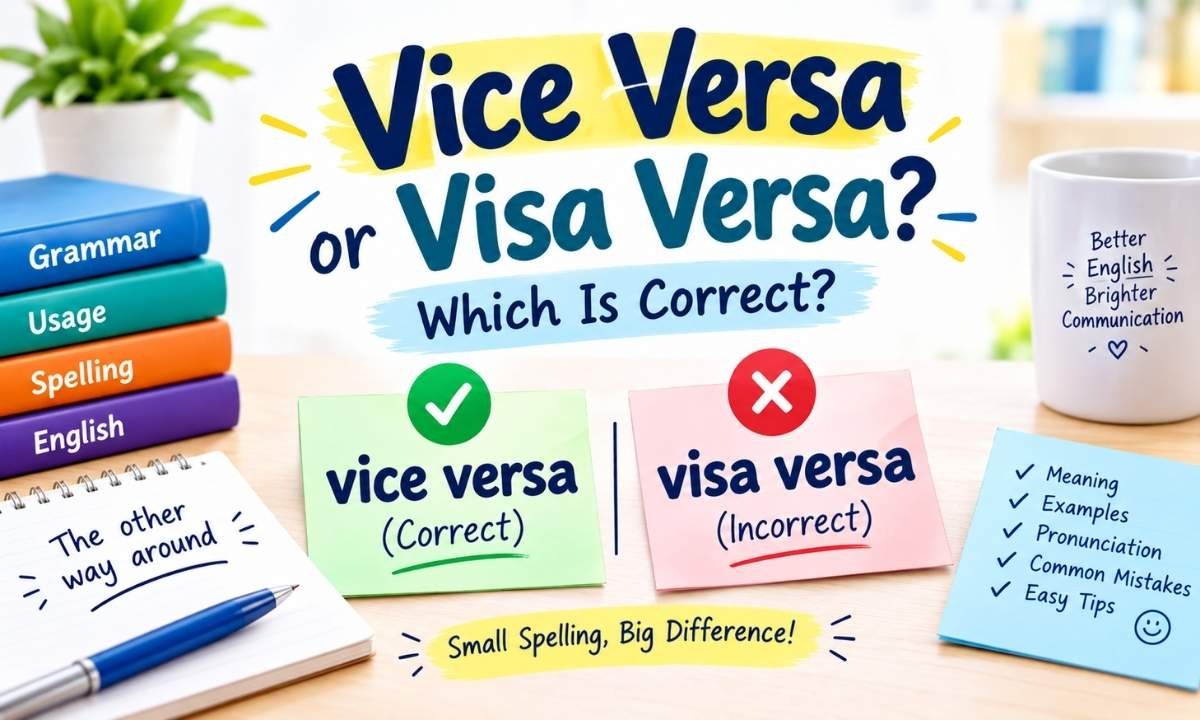
If you’ve typed “visa versa” and paused wondering if that’s right, here’s the quick answer: it isn’t. The correct spelling is vice versa, and Vice Versa or Visa Versa is one of the most common mix-ups in everyday writing, mostly because of how the phrase sounds when spoken quickly.
Vice versa means “the other way around,” describing a situation where a statement also works in reverse. This guide walks through the correct spelling, clear meaning, real examples, pronunciation, grammar rules, and simple tricks to remember it for good.
The Correct Spelling Is Vice Versa
Every major English dictionary, including Cambridge, Merriam-Webster, and Collins, lists vice versa as the standard spelling. There is no dictionary entry for visa versa, which confirms it’s a spelling error rather than an accepted variant.
Is Visa Versa Correct?
No. Visa versa is not a recognized spelling in any standard reference. It shows up frequently in casual writing and social media, but that popularity doesn’t make it grammatically correct.
Why Do People Write Visa Versa?
The mix-up almost always comes down to sound. When spoken at normal conversational speed, “vice” can blend into something that resembles “visa,” especially for people more familiar with the travel document than the Latin-based phrase.
What Does Vice Versa Mean?
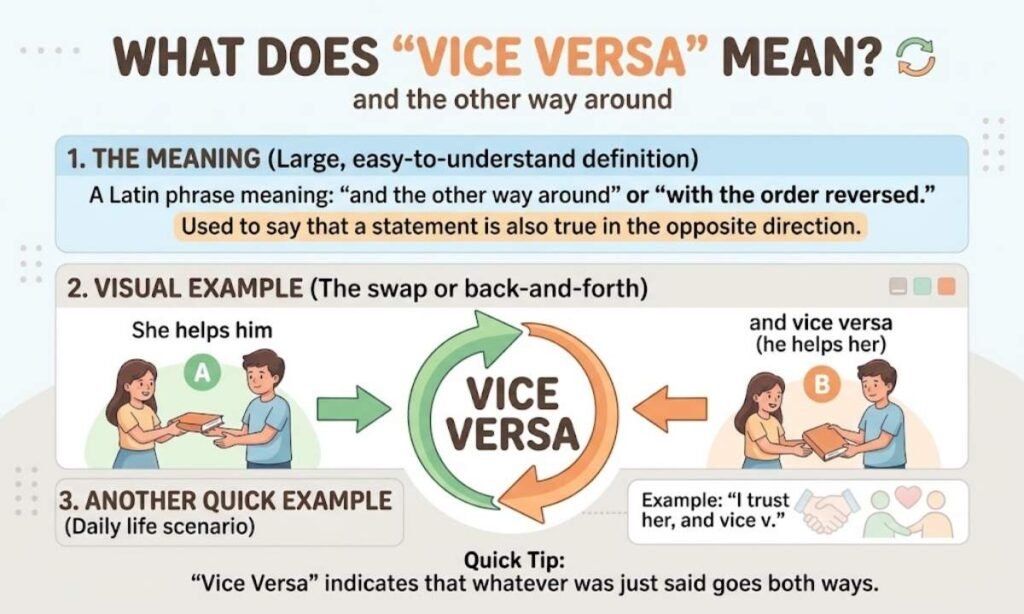
At its core, vice versa signals that a statement holds true in both directions, so the listener doesn’t need the full sentence repeated in reverse.
Vice Versa Means the Other Way Around
If someone says, “I trust her, and vice versa,” they’re saying the trust goes both ways without spelling out the second half of the sentence separately.
When Do You Use Vice Versa?
Use it whenever a relationship, action, or comparison applies equally in reverse. It works well in relationships, workplace dynamics, comparisons, and any situation involving mutual or reversible connections.
Vice Versa vs Visa Versa at a Glance
| Phrase | Correct | Meaning |
| vice versa | Yes | The other way around |
| visa versa | No | Common misspelling |
| vise versa | No | Common spelling error |
| vice-versa | Generally not standard | Unnecessary hyphen |
Why Vice Versa Is the Standard Form?
Dictionaries consistently list vice versa as two separate words with no hyphen, making it the only form considered correct in formal and everyday writing alike.
Common Misspellings of Vice Versa
- Visa versa
- Vise versa
- Vice-versa (hyphenated)
- Viceversa (one word)
How to Use Vice Versa in a Sentence?
The phrase typically appears at the end of a sentence, often introduced by “and” or “or,” signaling that the previous idea also applies in reverse.
A simple pattern to remember: A affects B, and vice versa.
Vice Versa After And
“She helps him with math, and vice versa.” This means he also helps her, without repeating the full idea.
Vice Versa After Or
“You can call me first, or vice versa.” Either direction works, and the listener understands both options without restating them.
Vice Versa in a Comparison
“The manager reports issues to the team, and vice versa.” Communication flows both directions between the two parties.
15 Examples of Vice Versa in Sentences
Seeing the phrase across different contexts makes the pattern easier to apply naturally.
Everyday examples:
- My sister borrows my clothes, and vice versa.
- He cooks on weekdays, and vice versa on weekends.
- The kids help clean up, and vice versa when parents cook.
Professional examples:
- Marketing shares data with sales, and vice versa.
- The client updates the vendor, and vice versa.
- Remote staff communicate with office staff, and vice versa.
Conversational examples:
- I like your playlist, and vice versa.
- We trust each other completely, and vice versa.
- She texts me updates, and vice versa.
Examples with “and vice versa”:
- Prices affect demand, and vice versa.
- The dog follows the cat around, and vice versa.
Examples with “or vice versa”:
- Pick the venue first, or vice versa with the date.
- Either you drive there, or vice versa on the way back.
Why Is It Vice Versa and Not Visa Versa?
Understanding the actual words behind the phrase clears up the confusion permanently.
The Difference Between Vice and Visa
“Vice” in this context comes from Latin, referring to a change or reversal in order, while “visa” refers to official travel documentation. The two words are unrelated in origin and meaning despite sounding alike.
Is Visa Related to the Phrase?
No. A visa, the travel authorization document, shares no linguistic connection with vice versa. The similarity is purely coincidental and rooted in pronunciation, not etymology.
How Do You Pronounce Vice Versa?
Pronunciation plays a direct role in why the misspelling spreads so widely.
American and British Pronunciation
In American English, it’s typically pronounced “vy-see VER-suh” or “vys VER-suh.” British English follows a similar pattern, with slight variation in how clearly the second syllable of “vice” is emphasized.
Why It Can Sound Like Visa Versa
When the “vice” syllable is spoken quickly or softened, the sound can blur toward “vy-suh,” which closely resembles “visa.” This auditory overlap is the main driver behind the spelling mistake.
Is Vice Versa One Word or Two Words?
Vice versa is always written as two separate words in standard English.
Is Viceversa Correct?
No, combining it into a single word isn’t recognized in dictionaries or formal writing guides.
Is Vice-Versa Correct?
Adding a hyphen isn’t standard practice either. Style guides generally treat it as two unhyphenated words in both American and British English.
Is Vice Versa Formal or Informal?
Vice versa works comfortably across writing styles, which is part of why it appears so often.
- Formal writing: Common in academic papers, business reports, and legal documents.
- Emails: Useful for summarizing mutual arrangements concisely.
- Academic writing: Frequently used to describe reversible relationships or comparisons.
- Everyday conversation: Just as natural in casual speech as in professional contexts.
Can You Use Vice Versa at the Beginning of a Sentence?
Technically it’s possible, but it often reads awkwardly compared to placing it at the end.
Better Ways to Structure the Sentence
Instead of starting with “Vice versa, she also enjoys it,” most writers find it flows better as “She also enjoys it, and vice versa applies here too,” or simply restructuring the sentence to place vice versa naturally at the close.
Vice Versa vs Other Similar Expressions
| Expression | Closest Meaning | Typical Use |
| Vice versa | The other way around | Reversible relationships |
| Conversely | From the opposite view | Contrasting ideas |
| The other way around | Same core meaning, less formal | Casual speech |
| In reverse | Opposite direction or order | Sequences or processes |
| Mutually | Shared equally between parties | Agreements or benefits |
While these phrases overlap in meaning, vice versa specifically signals that a stated relationship also holds true when flipped, rather than simply describing an opposite or shared quality.
The Origin and History of Vice Versa
Vice versa is a Latin phrase, literally translating to something close to “the position being turned around.” It entered English usage centuries ago and has remained essentially unchanged in both spelling and meaning ever since, which is part of why dictionaries still list it as a fixed Latin borrowing rather than a modern coinage.
Common Mistakes When Using Vice Versa
- Writing “visa versa” instead of the correct spelling
- Writing “vise versa,” confusing it with the tool
- Adding an unnecessary hyphen between the words
- Using it when the relationship described isn’t actually reversible
- Repeating the full reversed statement right after using the phrase, which makes it redundant
Easy Trick to Remember the Correct Spelling
A simple way to lock in the spelling: think “vice,” like a vice grip that reverses direction, not “visa,” the travel document. Connecting vice versa mentally with the idea of reversing or flipping something helps the correct spelling stick.
Memory sentence: “Vice versa reverses the version of events.”
Vice Versa in American English vs British English
The spelling stays identical in both varieties of English. Dictionary sources note minor pronunciation differences between American and British speech patterns, but neither variety treats visa versa as an acceptable alternative spelling.
When Should You Use Vice Versa?
- When both directions of a statement are genuinely true
- When two people or things switch roles in a described relationship
- When repeating the full reversed sentence would sound clunky
- When “the other way around” fits but a shorter phrase is preferred
When Should You Avoid Vice Versa?
- When the relationship described isn’t actually reversible
- When using it could create ambiguity about what’s being reversed
- When a simpler, more direct phrase would communicate the idea more clearly
Frequently Asked Questions
Is it vice versa or visa versa?
Vice versa is correct. Visa versa is a common misspelling based on how the phrase sounds when spoken.
What does vice versa mean?
It means “the other way around,” showing that a stated relationship also applies in reverse.
Is visa versa a word?
No, it isn’t recognized in any standard English dictionary.
Is vise versa correct?
No, that spelling confuses the phrase with the tool called a vise.
Is vice versa one word?
No, it’s always written as two separate words.
Should vice versa be hyphenated?
No, standard usage doesn’t include a hyphen between the two words.
How do you pronounce vice versa?
It’s typically said as “vy-see VER-suh,” with slight variation between American and British speech.
Is vice versa formal English?
Yes, it fits naturally in both formal and informal writing.
Can you start a sentence with vice versa?
It’s possible but often sounds smoother placed at the end of a sentence instead.
What is another word for vice versa?
Conversely and “the other way around” are close alternatives, though not identical in tone.
Is vice versa Latin?
Yes, it originates from Latin and has kept its spelling largely unchanged in English.
Conclusion
Remember this simple rule: vice versa is correct, visa versa is incorrect.
One-line example: “I help her, and vice versa,” meaning she helps me too. Keep that pattern in mind, and the correct spelling becomes automatic every time you reach for the phrase.