
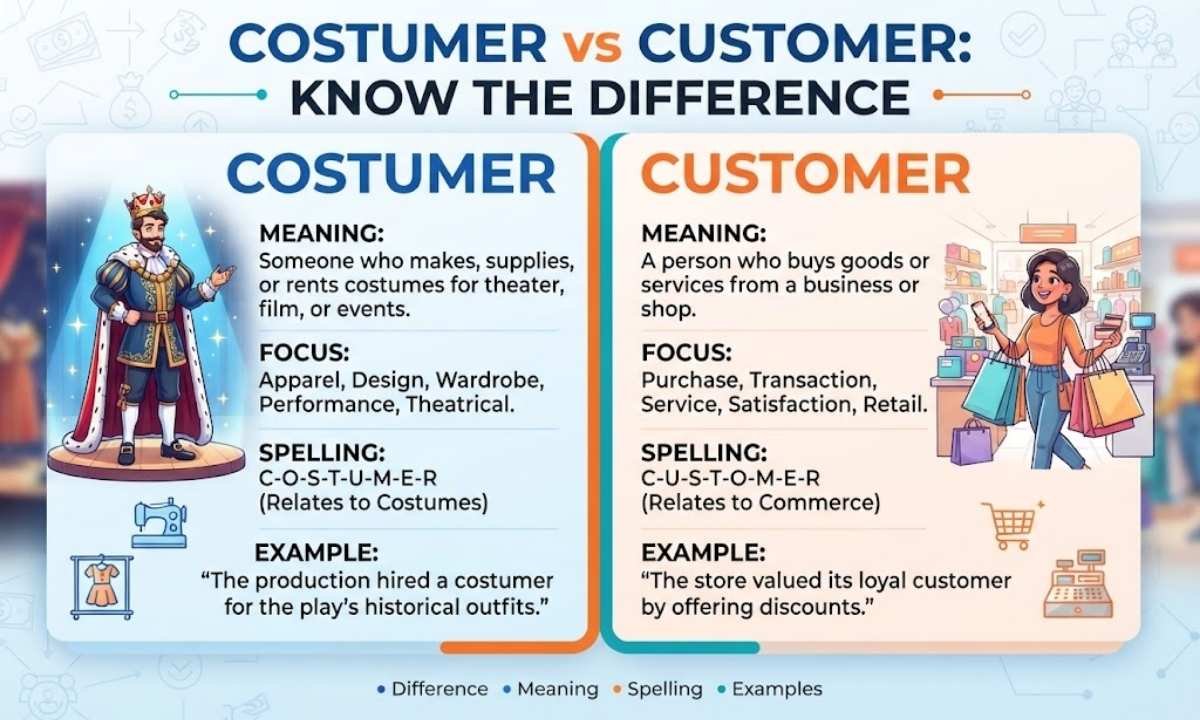
Costumer and customer look almost identical, and one swapped letter can change your whole sentence. Writers mix them up in emails, product pages, and school essays every day. Both are real English words, which is why spellcheck rarely catches the error.
In this guide, you will learn what each word means, how to spell and pronounce them, and which one fits your sentence. You will also get examples, a quick test, and short answers to common questions. Read on and settle it for good.
Costumer vs Customer: Quick Answer
A customer is a person who buys goods or uses a service. A costumer is a person who makes, supplies, rents, or manages costumes.
Use this simple test:
• Is someone buying or paying for something? Write customer.
• Is someone working with costumes? Write costumer.
In nearly all everyday writing, such as shopping, banking, or support, the word you need is customer.
Meaning of Customer
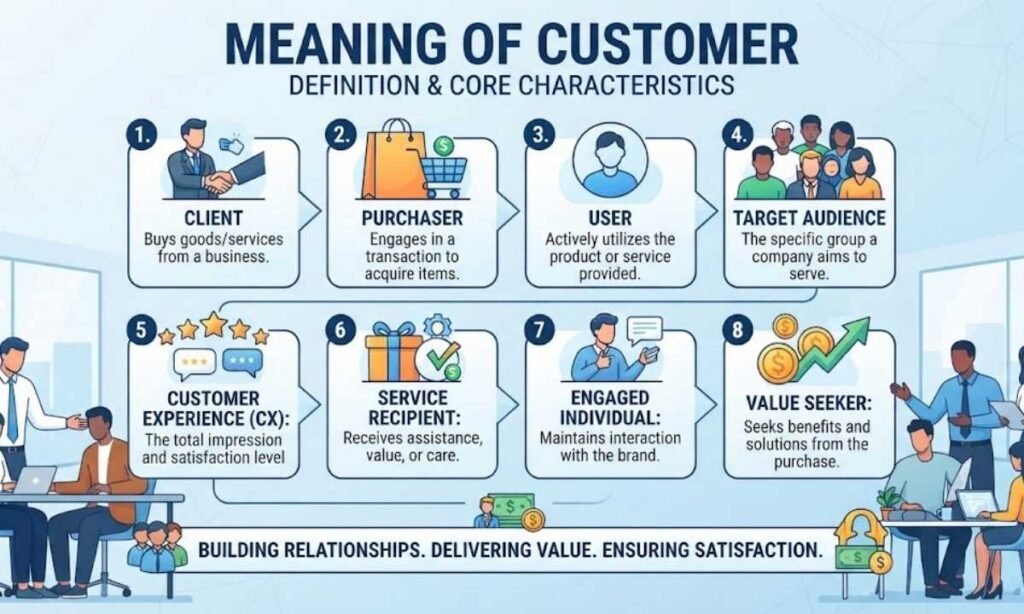
A customer is anyone who purchases a product or receives a paid service from a business. The word covers shoppers in a store, diners in a restaurant, and clients of an online platform.
Where Customer Is the Right Word
• Retail shopping and online orders
• Restaurants, cafes, and hotels
• Banking and insurance
• Subscriptions and software plans
• Repairs, consulting, and other professional services
Customer Examples
• The customer asked for a refund.
• Every customer receives a confirmation email.
• Our support team replies to each customer within a day.
Meaning of Costumer

A costumer is a professional who designs, sews, fits, rents, or looks after costumes. You will find the word in theater, film, television, and live events. It also describes a business that supplies costumes to productions or the public.
What a Costumer Does
• Fitting actors before a performance
• Repairing and cleaning outfits between shows
• Sourcing fabric, accessories, and period pieces
• Managing costume rentals for schools and events
Costumer Examples
• The costumer stitched the final dress an hour before curtain.
• The film hired an experienced costumer for its historical scenes.
Side by Side Comparison
| Feature | Customer | Costumer |
| Core meaning | Buyer or service user | Person who works with costumes |
| Common field | Retail, business, service | Theater, film, events |
| Root word | Custom | Costume |
| Everyday frequency | Very high | Low and specialized |
| Sample sentence | The customer paid online. | The costumer fitted the cast. |
Word Origins and History
Both words grew from the same ancient root. Custom and costume come from the Latin word for habit or usual practice. Over time, custom gave us customer, meaning someone who habitually shops at a particular place. Costume traveled through French and Italian and came to mean a style of dress, and eventually theatrical clothing.
That shared ancestry explains why the spellings sit so close together. It also shows that the two words describe different roles that simply grew from one family tree.
Customer vs Costumer Examples in Sentences
Seeing both words in context makes the difference easier to remember.
Correct Uses of Customer
1. The customer compared prices before checking out.
2. Our bank offers free advice to every new customer.
3. The restaurant thanked each customer for visiting.
Correct Uses of Costumer
1. The costumer packed the garments for the tour.
2. A local costumer rented us pirate outfits for the school play.
3. The theater promoted its head costumer to department lead.
Both Words in One Sentence
The customer rented a costume from the costumer.
Here, the person paying is the customer, and the person supplying the outfit is the costumer. One individual can even play both roles: a costumer becomes a customer when buying fabric from a supplier.
How to Spell Each Word Correctly?
Spelling is where most mistakes begin. Focus on the middle of each word.
• Customer contains the word custom. Think of a business building habits with its buyers.
• Costumer contains the word costume. Think of the outfit.
A handy memory line: custom leads to customer, costume leads to costumer.
Another trick is to look at the letter order. Customer has the letters s, t, o, m in the order “stom,” just like custom. Costumer flips to “ostum,” just like costume.
How to Pronounce Customer and Costumer
The two words sound close, which adds to the confusion.
| Word | Typical Pronunciation | Stress |
| Customer | KUS tuh mer | First syllable |
| Costumer | KAHS too mer or KAHS tyoo mer | First syllable |
The vowel in the first syllable is the clearest clue. Customer starts with a short “uh” sound, while costumer starts with an “ah” sound, like the word “cost.” Speaking slowly in meetings or recorded videos helps listeners tell them apart.
Customer Service or Costumer Service?
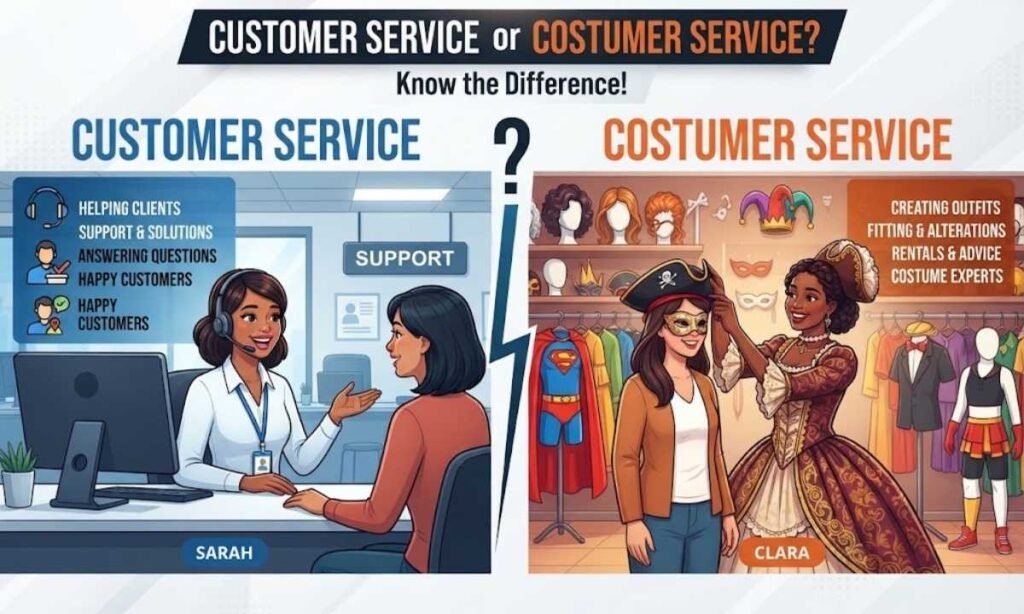
The correct business phrase is customer service. It refers to the help a company gives to the people who buy from it.
Common Phrases With the Right Word
• Customer service team
• Customer service representative
• Customer service department
• Customer support request
• Customer satisfaction survey
Writing “costumer service” would suggest a department that helps with costumes, which is almost never what the writer means. Always check signs, job titles, and email signatures for this slip, since it appears often in public.
Why Spellcheck Misses This Mistake
Costumer is a valid word in every standard dictionary. Because spellcheck only flags words it does not recognize, it treats “costumer” as perfectly fine, even when you meant customer. Autocorrect can also swap the words when you type quickly or on a phone keyboard.
This is a word choice error, not a spelling error. Software cannot read your intent, so a human check is the only reliable safeguard.
Common Mistakes to Avoid
Mistake 1: Using Costumer for a Buyer
• Wrong: Our store welcomes every costumer.
• Right: Our store welcomes every customer.
Mistake 2: Using Customer for a Costume Professional
• Wrong: The customer designed the costumes for the movie.
• Right: The costumer designed the costumes for the movie.
Why These Errors Happen
• The spellings differ by only a couple of letters.
• The pronunciations are similar.
• Fast typing and autocorrect hide the slip.
• Both words are legitimate, so nothing looks wrong.
Costumer in American and British English
This is not an American versus British spelling difference. Both countries use customer for a buyer and costumer for someone connected to costumes. In British English, you will often see the related word costumier for a person who makes or hires out costumes, though costumer is understood as well.
So if you see costumer in a British text, it is not a regional variant of customer. It is a different word with a different meaning.
Proofreading Tips for Writers and Marketers
Small errors can weaken trust, especially on a product page or business email. Try these habits:
1. Search your document for “costumer” before publishing.
2. Read the sentence aloud and ask who is buying and who is dressing the cast.
3. Check headings, buttons, and image captions, since these are often skipped.
4. Review automated templates and chat replies for the same slip.
5. Ask a colleague to scan the final copy with fresh eyes.
Related Words Worth Knowing
Learning nearby terms sharpens your word choice.
• Client: often used for professional or ongoing service relationships.
• Shopper: someone browsing or buying in a store.
• Consumer: the end user of a product.
• Costume designer: the creative lead who plans the look of a production.
• Wardrobe supervisor: a role that manages clothing for a cast.
Quick Decision Table
| If You Mean | Use |
| A person buying a product | Customer |
| A person paying for a service | Customer |
| Someone placing an order online | Customer |
| Someone contacting support | Customer |
| Someone who makes costumes | Costumer |
| Someone who rents out costumes | Costumer |
| Someone fitting actors for a play | Costumer |
| Someone handling film wardrobe | Costumer |
Conclusion
The difference is easy once you know the rule. A customer buys something. A costumer works with costumes. If your sentence is about shopping, support, or business, customer is almost always the answer.
Remember the two anchors: custom belongs to customer, and costume belongs to costumer. Read your final draft aloud, double check headings and buttons, and you will avoid this mix up every time.
Frequently Asked Questions
Is costumer or customer correct?
Both are correct words with different meanings. Use customer for buyers and costumer for costume work.
Is costumer a real word?
Yes, costumer is listed in standard dictionaries. It describes someone who makes, supplies, or manages costumes.
What does customer mean?
A customer is a person who buys goods or uses a paid service. It is the common word in retail and business.
Can costumer mean customer?
No, costumer does not mean customer. Using it that way is a mistake, even though it is a real word.
Is it customer service or costumer service?
The correct phrase is customer service. Costumer service would imply help related to costumes.
How do you remember the difference?
Link custom to customer and costume to costumer. The shared letters give you a quick visual cue.
Is costumer the British spelling of customer?
No, it is a separate word in both American and British English. British writers may also use costumier for costume suppliers.