
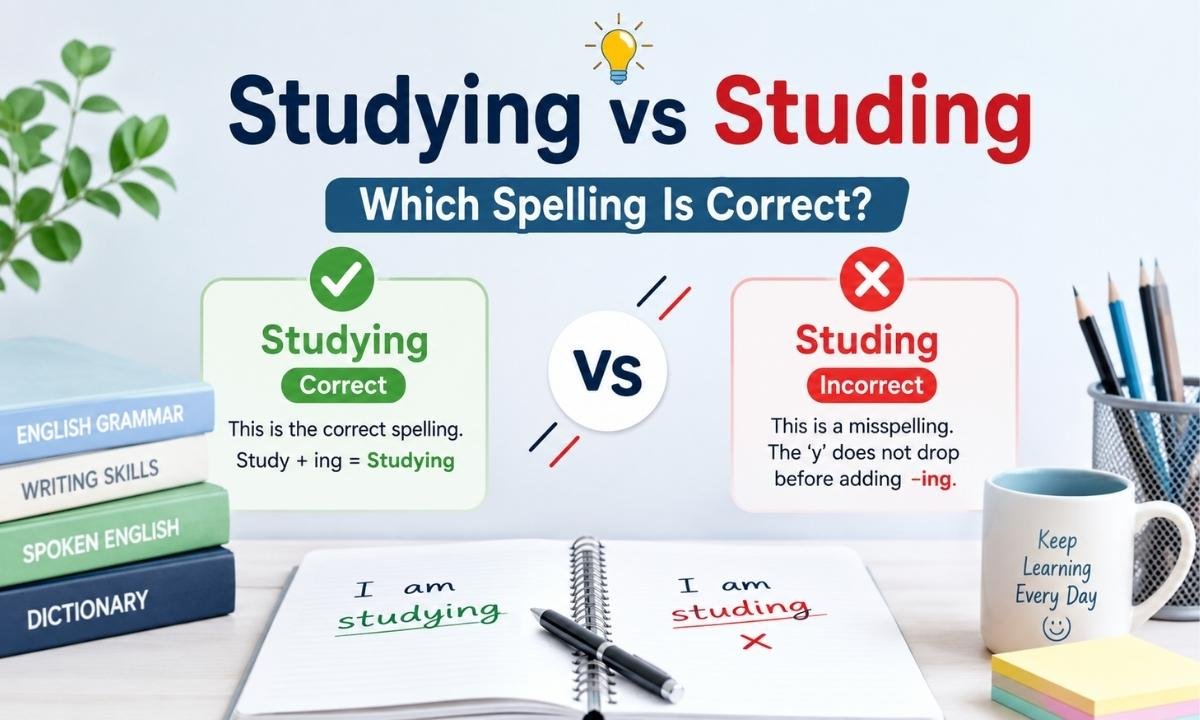
Many English learners and even native speakers pause when typing this word because Studying vs Studing can be confusing. The sound does not always match the letters on the page, and the confusion usually starts with the final “y” in study, which seems to disappear or change depending on the ending added to it.
This guide breaks down the correct spelling, the reason behind the rule, and how to use the word properly in daily writing, schoolwork, and professional communication. By the end, the mix-up between these two spellings will no longer be a problem.
The Correct Spelling At A Glance
Studying is the only accepted spelling in standard English. Studing is a spelling error that appears when the final “y” in study is dropped by mistake before adding the ending. Dictionaries, grammar guides, and style manuals consistently list studying as the present participle and gerund form of the verb study, and none of them recognize studing as a valid word.
The rule is short and easy to remember:
- study + ing = studying
- The letter “y” is kept, not removed, because the ending begins with the vowel i.
Why The Letter Y Stays Before ING?
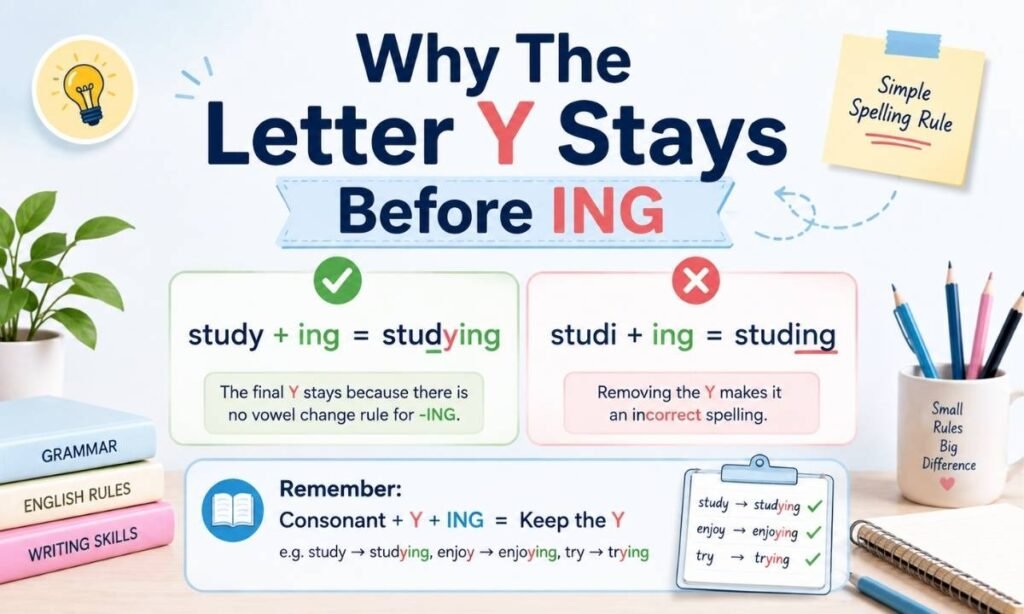
English spelling rules treat the suffix -ing differently from suffixes like -ed or -es. When a verb ends in a consonant followed by “y”, that “y” usually changes to “i” before endings such as -ed or -es. However, this change does not apply before -ing, because two vowels sitting together (i and i) would create an awkward and incorrect spelling pattern.
That is why:
- study becomes studied (y changes to i before -ed)
- study becomes studies (y changes to i before -es)
- study becomes studying (y stays the same before -ing)
This pattern is not unique to study. Verbs such as apply, try, and carry follow the same logic, which makes the rule easier to apply across many similar words once it is understood.
Breaking Down The Word Formation Step By Step
Understanding word formation helps prevent the mistake from happening again. Here is how the transformation works from base verb to present participle:
- Start with the root verb: study
- Identify the ending being added: -ing
- Check the last letter of the root word: y, preceded by a consonant
- Apply the rule: keep the y because the suffix starts with a vowel
- Combine the letters: s-t-u-d-y-i-n-g
- Final spelling: studying
Following these steps consistently removes any guesswork, especially for learners who are memorizing English spelling conventions for the first time.
Studying vs Studing Side By Side
| Feature | Studying | Studing |
|---|---|---|
| Spelling status | Correct and standard | Incorrect, not a recognized word |
| Part of speech | Verb (present participle), Gerund | None, spelling error only |
| Dictionary listing | Listed in all major English dictionaries | Not listed anywhere |
| Common cause | N/A | Dropping the final y from study |
| Example sentence | She is studying for her final exam | She is studing for her final exam (wrong) |
| Used in academic writing | Yes, widely accepted | Never acceptable |
Also Read This: Reinforce vs Reenforce: Which Spelling Is Correct? Full Guide (2026)
All Verb Forms Of Study In One Table
Seeing every form of the verb together makes the pattern much clearer and helps avoid mixing up tenses.
| Verb Form | Type | Example Sentence |
| Study | Base form | I study every night after dinner. |
| Studies | Third-person singular present | He studies mathematics at university. |
| Studied | Past tense and past participle | They studied for three hours yesterday. |
| Studying | Present participle and gerund | We are studying together this weekend. |
When To Use Study Instead Of Studying?
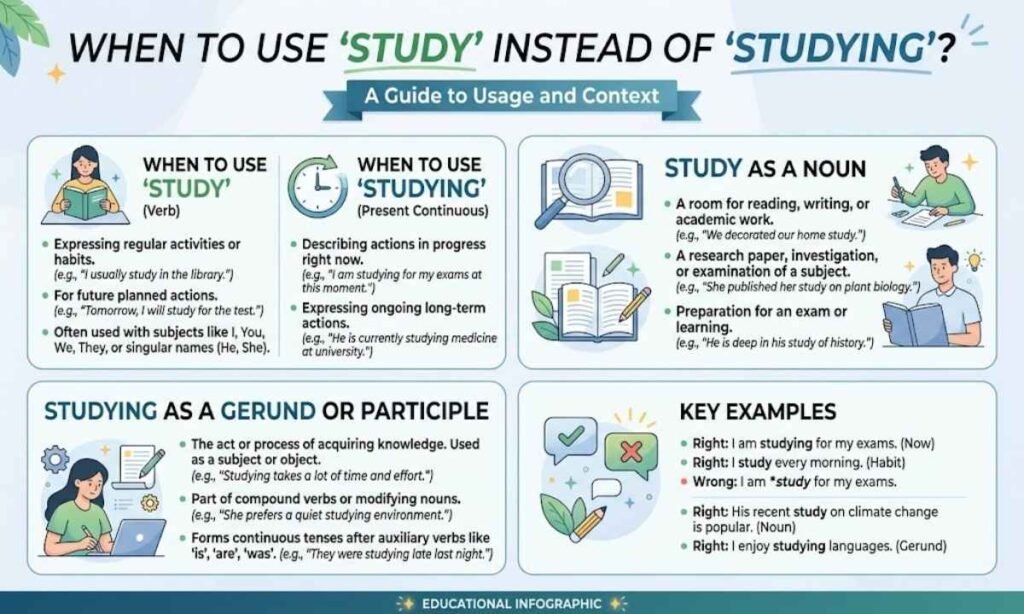
Choosing between study and studying depends on the tense and structure of the sentence, not personal preference.
- Use study for simple present statements describing habits or routines, such as “I study English every morning.”
- Use studying with a helping verb such as am, is, are, was, or were to describe an action happening now or continuing over a period, such as “I am studying English right now.”
- Use studying as a gerund when the word functions as a noun, such as “Studying late at night helps me remember details better.”
This distinction matters for grammar accuracy, especially in academic writing, resumes, and formal emails where tense consistency is closely checked.
Real Sentence Examples For Practice
Correct usage examples:
- I am studying for my final exam this week.
- She has been studying biology since morning.
- They spent the whole weekend studying together.
- He was studying quietly in the library.
Incorrect usage examples to avoid:
- I am studing for my exam. (wrong)
- She was studing English literature. (wrong)
- They are studing hard for finals. (wrong)
Replacing “studing” with “studying” in each example above instantly fixes the sentence without changing anything else.
Common Reasons Writers Misspell This Word
Understanding why the mistake happens makes it easier to catch and correct before hitting send or submit.
- Forgetting that the final y is retained before -ing
- Confusing the -ing pattern with the -ed or -es pattern, where the y does change
- Spelling the word the way it sounds when spoken quickly
- Typing fast on a keyboard or phone and skipping a letter
- Relying on autocorrect, which does not always catch every typo in casual typing apps
Also Read This: Aswell or As Well: Which Spelling Is Correct?
Simple Tricks To Remember The Correct Spelling

- Break the word into two parts mentally: study and ing, then join them without removing any letters.
- Say the word slowly while spelling it out loud: s-t-u-d-y-i-n-g.
- Compare it with a familiar word like playing, which also keeps the y before -ing, since the same rule applies whenever a verb ends in a vowel plus y.
- Proofread written work specifically for this word before submitting assignments, emails, or reports.
Is This Spelling The Same In British And American English?
Yes. Unlike some words that change between American and British spelling, such as color versus colour, studying is spelled identically in both varieties of English. There is no regional version of this word, so the same spelling applies whether writing for a US, UK, Canadian, or Australian audience.
Frequently Asked Questions
Is it studying or studing?
Studying is correct. Studing is a common spelling mistake with no valid meaning.
Why is studying spelled with a y?
The y stays because -ing begins with a vowel, unlike -ed or -es, which trigger a y to i change.
How do you spell studying correctly?
It is spelled s-t-u-d-y-i-n-g, formed by simply adding -ing to study.
Is studing a real word in English?
No, studing does not appear in any English dictionary and is always a spelling error.
What is the present participle of study?
The present participle of study is studying, used in continuous tenses like am, is, or are studying.
Is I am studying grammatically correct?
Yes, it is a correct present continuous sentence describing an action happening right now.
What is the difference between study and studying?
Study is the base form for habits and routines, while studying describes an ongoing or continuous action.
Conclusion
Studying is the only correct spelling of this word, and studing should always be avoided in any type of writing. The rule behind it is simple: keep the final y of study before adding -ing, since the suffix starts with a vowel.
Once this pattern is understood, it applies naturally to similar verbs as well, making future spelling decisions much easier. Reviewing the tables and examples above before submitting written work is a quick way to catch this mistake before anyone else notices it.