

Kinesiology is the correct and standard term. Kinesthesiology is not a standard dictionary word, and most people who type it actually mean kinesiology, the study of human movement, or kinesthesia, the sense of body movement and position. The confusion is common because the words look and sound alike and both relate to movement.
This guide explains kinesthesiology vs kinesiology in plain English. You will learn what each term means, how kinesiology, kinesthesia, and kinesthetic differ, how kinesiology is used in the United States, and which word to choose in your own writing, with real sentence examples and a clear comparison table.
Kinesthesiology vs Kinesiology: The Quick Answer
Kinesiology Is the Standard Academic Term
Kinesiology is the accepted name for the academic study of human movement. Universities, professional groups, and dictionaries all use it.
Kinesthesiology Is a Rare, Less-Standardized Term
Kinesthesiology appears occasionally in informal writing, but it has no settled definition in major dictionaries or degree programs. Treat it as nonstandard.
The Word You May Actually Mean Is Kinesthesia
If you are talking about the sense that tells you where your limbs are without looking, the word is kinesthesia. That extra “thes” in your spelling likely comes from this word.
What Does Kinesiology Mean?
Kinesiology Definition in Simple English
Kinesiology is the scientific study of how the human body moves. The word comes from the Greek kinesis, meaning movement, and logia, meaning study.
What Does Kinesiology Study?
It looks at how muscles, bones, joints, and the nervous system work together during movement. It also covers exercise, performance, injury prevention, and how people learn and control motion.
Where Is Kinesiology Used?
• Fitness training and strength and conditioning
• Sports performance and coaching
• Rehabilitation and physical therapy preparation
• Public health and wellness programs
• Ergonomics and workplace safety
What Does Kinesthesiology Mean?
Is Kinesthesiology a Real Word?
Not in the standard sense. You may see it online, but major references list kinesiology and kinesthesia, not kinesthesiology.
Why Kinesthesiology Is Much Less Common
It blends two real words, kinesiology and kinesthesia. Because neither field needs a third name, the blend never became an accepted term.
When You May Encounter the Term Kinesthesiology
You may see it as a typing slip, a student paper, or an informal phrase meaning the study of kinesthesia. In formal writing, use “kinesiology” or write out “the study of kinesthesia.”
Kinesthesiology vs Kinesiology: Key Differences
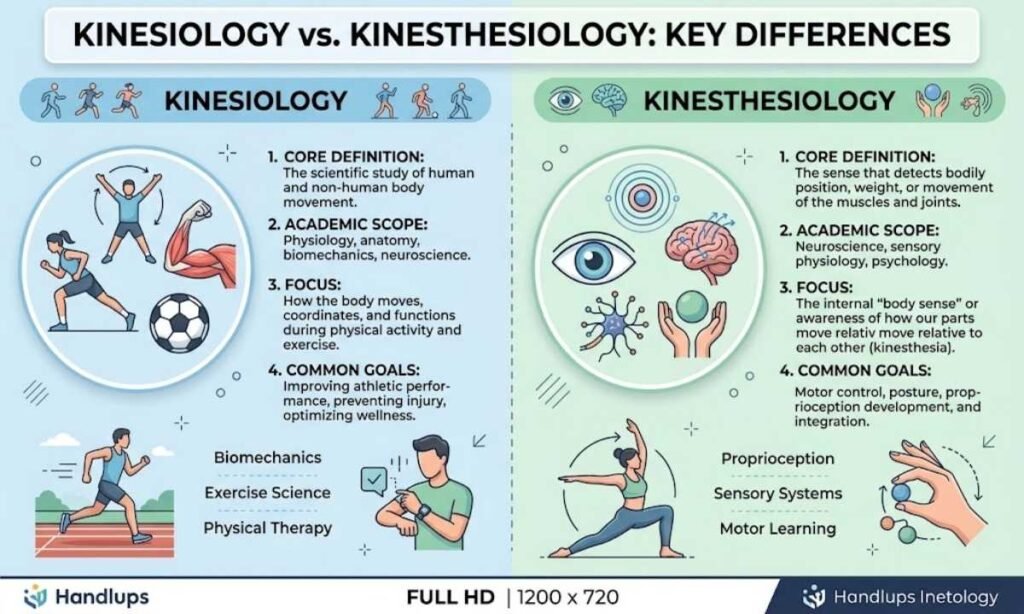
| Feature | Kinesiology | Kinesthesiology |
| Status | Standard, widely accepted | Nonstandard, rarely used |
| Meaning | Study of human movement | No settled meaning; sometimes used for study of kinesthesia |
| Found in degrees | Yes, common college major | No established degree programs |
| Safe for formal writing | Yes | No |
Meaning and Focus
Kinesiology has a clear focus on movement science. Kinesthesiology has no firm focus, which is why it causes confusion.
Standard Usage and Recognition
Editors, teachers, and employers recognize kinesiology immediately. Kinesthesiology may be flagged as a spelling error.
Academic and Professional Use
Departments, journals, and job titles use kinesiology. You will not find kinesthesiology on a typical degree or license.
How the Two Terms Differ in Context
Use kinesiology for the field of study. Use kinesthesia for the sense of movement. Kinesthesiology fits neither need cleanly.
Kinesiology vs Kinesthesia vs Kinesthetic
| Term | Part of Speech | Meaning |
| Kinesiology | Noun | The study of human movement |
| Kinesthesia | Noun | The sense of body position and movement |
| Kinesthetic | Adjective | Relating to movement or the sense of movement |
Kinesiology: The Study of Human Movement
It names a field of science and education.
Kinesthesia: The Sense of Movement and Position
It names a bodily sense, also called proprioception in everyday use. It lets you touch your nose with your eyes closed.
Kinesthetic: An Adjective Related to Movement
It describes things tied to movement, such as kinesthetic learning, where people learn best by doing.
A Simple Way to Remember All Three Terms
Kinesiology ends in “ology,” so it is a study. Kinesthesia ends in “thesia,” like anesthesia, so it is a sensation. Kinesthetic ends in “ic,” so it describes something.
Why Are Kinesthesiology and Kinesiology So Easy to Confuse?
Their Similar Spelling and Pronunciation
Both words begin with “kines” and share the same Greek root for movement, so they look alike on the page.
The Shared Connection With Human Movement
Both topics deal with the body in motion. People naturally assume one term must cover both.
How Kinesthesia Creates the Extra “Thes” Confusion
Kinesthesia carries the “thes” sound. When writers add “ology” to it, they create kinesthesiology by accident.
How Is Kinesiology Used in the United States?
Kinesiology as a College Major
Many American colleges offer kinesiology as a bachelor’s degree. Some universities renamed older physical education departments to kinesiology as the field grew more science focused.
Common Subjects in a Kinesiology Program
• Anatomy and physiology
• Biomechanics
• Exercise physiology
• Motor control and motor learning
• Nutrition and sport psychology
Kinesiology and Health-Related Careers
A kinesiology degree can lead to roles in fitness, coaching, cardiac rehab, and wellness. It is also a common path toward physical therapy, occupational therapy, or athletic training, which need extra education and licensing.
Kinesiology, Exercise Science, and Physical Therapy: Are They the Same?
Kinesiology vs Exercise Science
Exercise science is a branch within kinesiology. Kinesiology is broader and also covers motor behavior, biomechanics, and public health.
Kinesiology vs Physical Therapy
Kinesiology is an academic field. Physical therapy is a licensed healthcare profession that treats injury and movement problems, and it usually requires a doctoral degree.
Kinesiology vs Applied Kinesiology
Applied kinesiology is a separate alternative practice that uses muscle testing to claim to diagnose health conditions. Scientific reviews have not supported these diagnostic claims, so do not confuse it with academic kinesiology.
How to Use Kinesiology and Kinesthesiology Correctly
Correct Examples With “Kinesiology”
• She is majoring in kinesiology.
• The kinesiology department runs a biomechanics lab.
When “Kinesthesiology” May Be Appropriate
Only when quoting a source that uses it, or when clearly defining it yourself. Otherwise choose a standard term.
Common Word-Choice Mistakes to Avoid
• Writing kinesthesiology when you mean kinesiology
• Using kinesiology when you mean the sense of movement
• Treating applied kinesiology as the same as the academic field
Kinesthesiology vs Kinesiology Examples in Real Sentences
Academic and College Examples
• “He earned a bachelor’s degree in kinesiology.”
• “Her thesis focused on motor learning in kinesiology.”
Healthcare and Movement-Science Examples
• “The clinic hired a kinesiologist to design exercise programs.”
• “After the injury, her kinesthesia was tested to check balance and joint position.”
Everyday Examples of Kinesthesia
• Walking up stairs in the dark without looking at your feet
• Typing without watching your fingers
• Catching a ball while keeping your eyes on the game
Frequently Asked Questions
Is kinesthesiology a real word?
Not as a standard term. It is rarely used and is not listed as a main word in major dictionaries.
Is kinesthesiology the same as kinesiology?
No. Kinesiology is the established study of human movement, while kinesthesiology has no settled meaning.
Which is correct, kinesiology or kinesthesiology?
Kinesiology is correct for the field of study. Use kinesthesia for the sense of movement.
What does kinesiology mean?
It is the scientific study of human body movement, including muscles, joints, and motor control.
What is the difference between kinesiology and kinesthesia?
Kinesiology is a field of study. Kinesthesia is the sense of body position and movement.
Is kinesiology a science or a college major?
Both. It is a science of movement and a common college major in the United States.
What does a kinesiologist study or do?
A kinesiologist studies how people move and helps with exercise, performance, and movement health. Their work depends on their training and role.
Conclusion
Kinesiology is the correct term for the study of human movement. Kinesthesiology is a rare, nonstandard blend that most readers will treat as a spelling mistake.
If you mean the field, write kinesiology. If you mean the sense of movement and position, write kinesthesia. Keep kinesthetic for descriptions, and stay clear of applied kinesiology unless you mean that specific practice.