
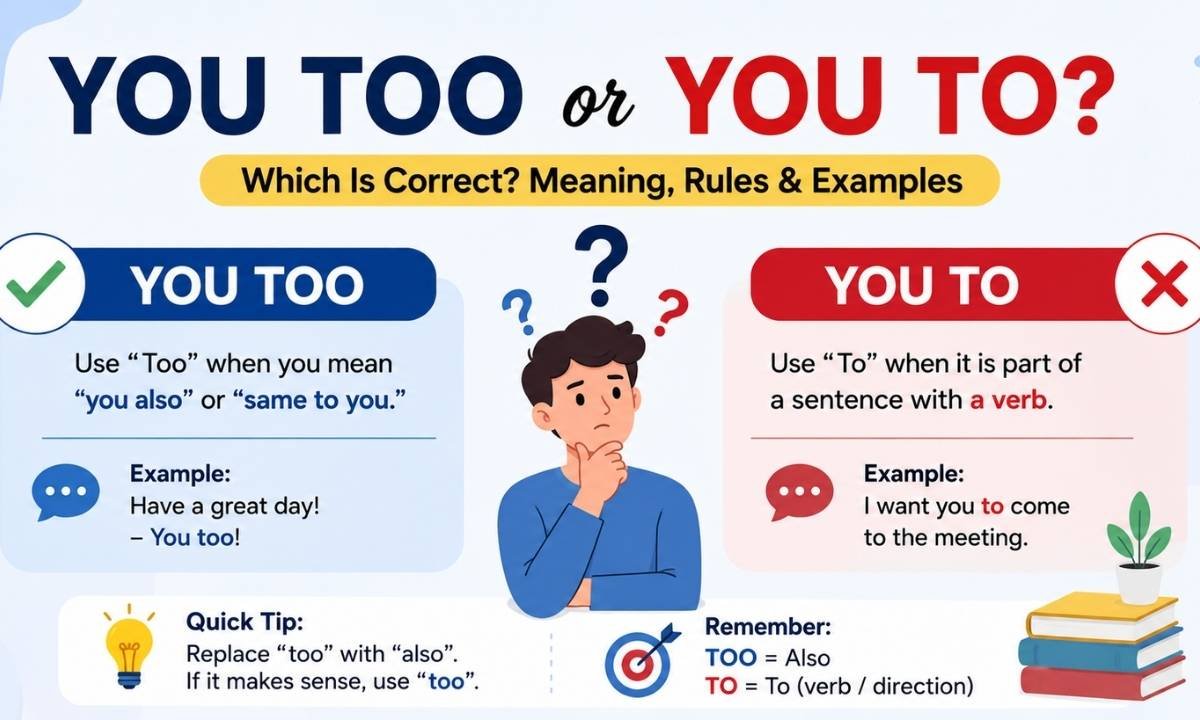
Many English speakers pause at this exact spot in a sentence and wonder which spelling belongs there. “You too” is correct when the meaning is “you also” or “same to you,” such as replying to a wish or a compliment. “You to” is correct only when “to” is doing grammatical work inside a larger sentence, usually before a verb or as part of a phrase.
This confusion happens because “too” and “to” sound identical when spoken, even though they serve completely different jobs in a sentence. Once you understand the pattern behind each word, the choice becomes automatic, and you will never second guess yourself in a text message, an email, or a formal document again.
You Too or You To: Which One Is Correct?
Both forms can be correct, but they answer different grammatical needs. “You too” works as a short reply that mirrors something already said. “You to” only works when “to” connects to an infinitive verb or acts as a preposition inside a full sentence.
You Too Is Correct When You Mean You Also
If someone says “enjoy the trip” and you reply “you too,” you are shortening “I hope you enjoy the trip as well.” The word “too” adds the meaning of also.
You To Can Be Correct in a Complete Sentence
“I want you to call me later” uses “to” as an infinitive marker before the verb call. Removing “to” would break the sentence entirely.
The Quick Rule for Choosing Too or To
Try swapping the word with “also.” If the sentence still makes sense, use too. If a verb follows and the sentence needs an action word, use to.
What Does You Too Mean?
“You too” is an informal reply used to return a wish, greeting, or compliment back to the original speaker without repeating the whole sentence.
You Too Means You Also or You As Well
It compresses a longer thought into two words while keeping the same friendly intent.
Why People Say You Too as a Short Reply?
Spoken English favors efficiency, and native speakers naturally shorten responses in casual conversation.
Examples of You Too in Everyday Conversation
Have a great day, you too. Good luck, you too. Enjoy your weekend, you too. Take care, you too.
When Should You Use You Too?
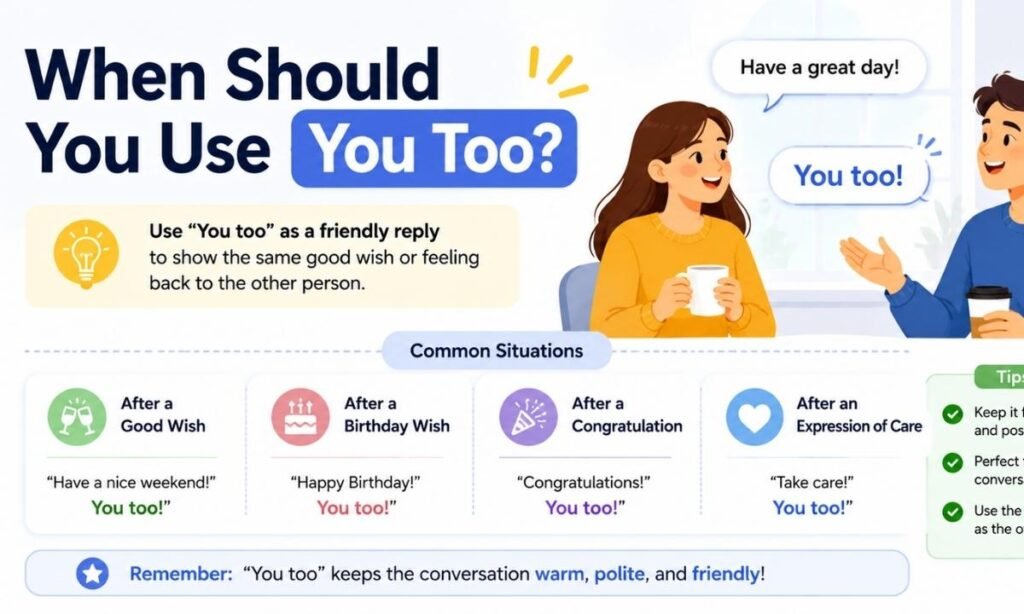
“You too” fits naturally after greetings, compliments, and casual exchanges where the reply simply reflects the same sentiment back.
You Too After a Greeting or Good Wish
Someone wishing you well expects a mirrored response, and “you too” delivers exactly that.
You Too After a Compliment or Positive Statement
If a coworker says your presentation was excellent, replying “you too” acknowledges their contribution as well.
You Too in Text Messages and Social Media
Casual digital conversation relies heavily on shortened replies, and “you too” is one of the most common.
You Too in Emails and Professional Conversations
Even formal writing allows “you too” when closing a message warmly, such as replying to a client wishing you a good week.
When Is You To Correct?
“To” earns its place in a sentence when it introduces an infinitive verb or functions as a preposition showing direction or relationship.
You To Before an Infinitive Verb
I want you to come. I need you to help. She asked you to wait. We expect you to arrive early.
You To as Part of a Prepositional Phrase
I gave the message to you to show direction, meaning the message was handed over to that person.
Why You To Is Not Always Wrong
Many casual writers assume “you to” is a mistake in every case, but grammar depends entirely on sentence structure, not on the words alone.
You Too vs You To: What Is the Difference?
| Aspect | You Too | You To |
| Meaning | You also, same to you | Part of a longer sentence |
| Word Type | Too is an adverb | To is a preposition or infinitive marker |
| Common Use | Short replies, wishes | Requests, instructions, directions |
| Example | Have fun, you too | I want you to leave |
Meaning Difference
You too express agreement or shared feelings, while you simply connect a subject to an action or object.
Grammar Difference
Too modifies meaning by adding emphasis, while linking words together structurally.
Pronunciation Difference
Both words sound alike in fast speech, which is exactly why spelling mistakes happen so often, even among fluent speakers.
Easy Comparison Table
| Phrase | Meaning | Example |
| You too | You also | Have fun, you too |
| You to | Grammatical connector | I want you to come |
I Love You Too or I Love You To?
“I love you too” is the correct romantic and platonic reply, confirming shared affection. “I love you to” is not a standalone valid sentence unless followed by a verb, such as “I love you to bits.”
Why I Love You Too Is Correct
It reflects mutual feeling, matching the emotion the other person already expressed.
Is I Love You Too Also Correct With a Comma
Yes, “I love you, too” is grammatically acceptable, especially in formal or literary writing.
Why I Love You To Change the Meaning?
Without the following verb, “I love you to” feels incomplete and confusing to readers.
More Examples With Love You Too
She said she missed him, and he replied that he missed her too.
Have a Good Day, Is It You Too or You To?
The correct reply is always “you too,” since it mirrors the same wish back to the speaker in a natural, friendly way.
Correct Have a Good Day You Too
This phrase works in casual chats, workplace exchanges, and customer service replies alike.
Why You To Is Wrong as a Reply
“You to” has no grammatical function here since no verb follows it.
Other Common Replies to Have a Good Day
You too. Thanks, you too. Thank you, same to you. Thanks, have a great day too.
You Too or You To in Text Messages
Texting culture leans heavily on shortcuts, but the spelling rule remains unchanged regardless of platform.
Is You Too Correct in Texting
Yes, it remains grammatically correct even in the most casual messaging apps.
Why People Type You To by Mistake?
Autocorrect, speed typing, and phonetic spelling all contribute to this common slip.
You Too in Casual Chats
Friends rarely worry about formality, yet the correct spelling still matters for clarity.
Should You Use You Too in Professional Texts
Yes, professional texting still favors correct grammar, especially with clients or supervisors.
Common You Too vs You To Mistakes
Recognizing wrong patterns helps readers avoid repeating the same errors in future writing.
| Incorrect | Correct |
| Have a nice weekend, you to | Have a nice weekend, you too |
| I want you too help me | I want you to help me |
| I need you too come early | I need you to come early |
| I love you to | I love you too |
Have a Nice Weekend You To
This is incorrect since no verb follows “to,” so “too” is required instead.
I Want You Too Help Me
This sentence needs an infinitive marker, making “to” the correct choice, not “too.”
Easy Trick to Remember Too vs To
A single mental test solves nearly every confusion between these two words instantly.
Replace Too With Also
If also fits naturally in the sentence, too is the correct spelling.
Look for a Verb After To
If a verb immediately follows, to is functioning as an infinitive marker.
Remember Too Has an Extra O
Too equals also, while to relates to direction or verbs, a simple visual anchor for memory.
You Too or Me Too: What Is the Difference?
“Me too” agrees with a statement about yourself, while “you too” reflects a wish back toward someone else.
When to Say Me Too
I love pizza, me too, shows shared personal preference between speaker and listener.
When to Say You Too
Have a great day, you too, redirects the sentiment toward the original speaker instead.
Nice to Meet You, Me Too or You Too
“You too” is grammatically smoother here, since “me too” technically implies meeting yourself.
The Safest Natural Reply
When unsure, repeating the full phrase, such as “nice to meet you as well,” avoids ambiguity entirely.
More Examples of You Too and You To
Seeing multiple examples side by side reinforces the pattern faster than rules alone.
You Too Examples
Good luck, you too. Stay safe, you too. Have fun tonight, you too. Congratulations, you too. Sleep well, you too.
You To Examples
I told you to wait. They allowed you to leave early. We invited you to join us. He encouraged you to apply.
Correct vs Incorrect Examples
| Incorrect | Correct |
| Have fun, you to | Have fun, you too |
| I need you too help | I need you to help |
| I love you to | I love you too |
You Too in American English
American English treats these forms identically to other English varieties, with no regional spelling exception for either word.
Is You Too Standard American English
Yes, it appears constantly in daily conversation, media, and workplace communication across the United States.
How Americans Use You Too in Conversation
It functions as a default polite reply across nearly every social setting, from casual to semiformal.
Is There a US vs UK Difference
There is no spelling difference between American and British English for these two forms, since grammar rules remain shared.
You Too Grammar: Does It Need a Comma?
A comma before too is optional and depends largely on writing style rather than strict grammar rules.
You Too vs You Comma Too
Both versions are acceptable, though the comma version feels slightly more formal or emphatic.
When a Comma Before Too Is Appropriate
Formal writing, literary text, and emphasis based sentences often favor adding the comma.
Examples in Formal Writing
She wished him well, and he thanked her, too, before leaving the room.
Quick You Too or You To Cheat Sheet
Use You Too When
You mean you also. You are returning a wish. You are returning a greeting. You are agreeing with a feeling.
Use You To When
To introduces an infinitive verb. To functions as a preposition. The phrase belongs to a longer sentence.
Why This Distinction Confuses Even Native Speakers
Homophones like too and to create automatic spelling errors during fast typing, since the brain processes sound before visual spelling. This is the same reason words like their, there, and they are commonly swapped in casual writing.
How Grammar Checkers Handle You Too and You To?
Most grammar tools flag “you to” only when no verb follows it, since context determines correctness rather than a fixed spelling rule.
The Role of Context in Choosing Too or To
Context always overrides memorization, since the same two letters can serve completely different grammatical purposes depending on sentence structure.
Why This Mistake Appears Often in Voice Typing?
Voice to text software converts spoken words phonetically, meaning it cannot distinguish too from to without analyzing sentence intent.
Practical Writing Tips to Avoid This Mistake
Reading a sentence aloud slowly, checking for a following verb, and testing the also substitution together eliminate nearly every spelling slip.
Frequently Asked Questions
Is You Too Grammatically Correct?
Yes, it is correct when used to mean also or as a reply to a wish or compliment.
Is You To Ever Correct?
Yes, it is correct before an infinitive verb or as part of a prepositional phrase.
What Does You Too Mean in Text?
It usually means the same wish or feeling applies back to the original speaker.
Is I Love You Too Correct?
Yes, it correctly expresses mutual affection between two people.
Is Have a Good Day You Too Correct?
Yes, it is the standard and grammatically correct reply to that phrase.
Should I Say Me Too or You Too?
Use me too for shared personal statements and you too when returning a wish to someone else.
How Do I Remember the Difference Between To and Too?
Try replacing the word with also, and if it still fits, too is correct.
Conclusion
Choosing between you too and you to becomes simple once you focus on function rather than sound. You too always signals agreement or a shared wish, while you to depends on the verb or preposition that follows it in the sentence.
Keeping this small test in mind during writing, texting, or professional communication will remove this common mistake permanently and help your writing read cleanly and confidently every time.