
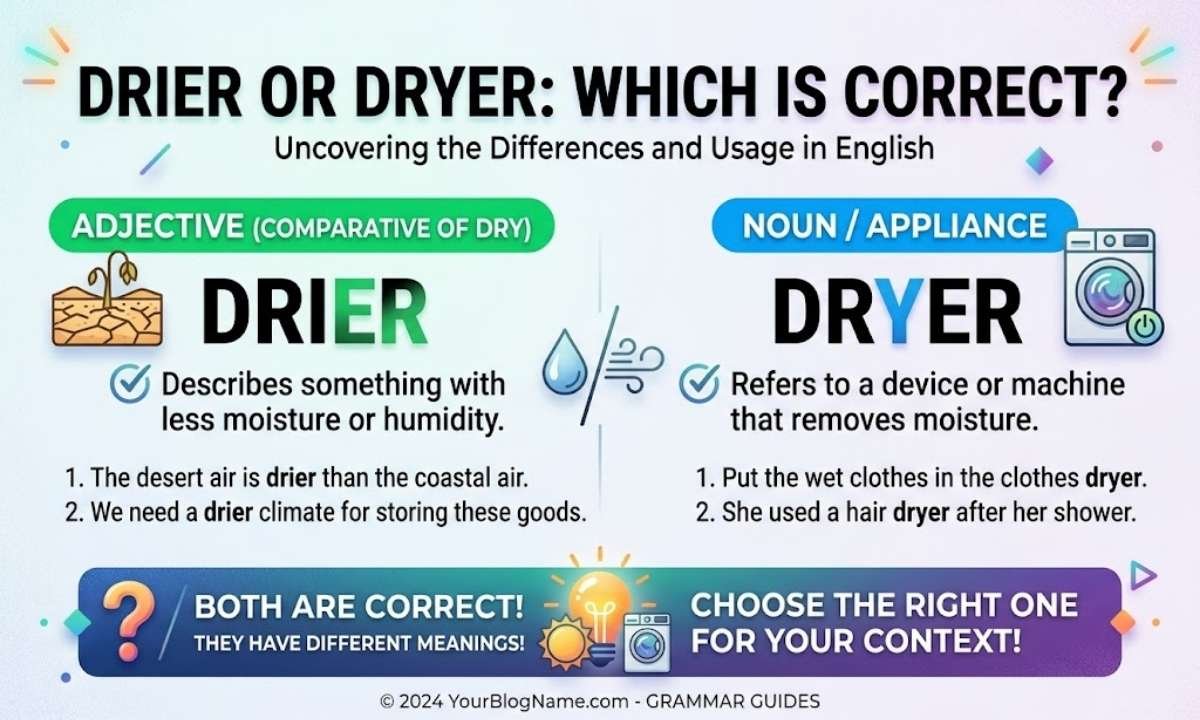
Drier or dryer looks like a tiny spelling choice, yet it trips up students, bloggers, and even seasoned editors. Both words come from dry, both sound almost identical, and both appear in everyday sentences about weather, laundry, and hair care.
Here is the short answer. Drier compares how dry something is, while dryer usually names a machine or device that dries things. This guide covers the meaning, grammar rule, real examples, regional usage, and easy memory tricks, so you can choose the right word with confidence every time you write.
Drier or Dryer: Which One Is Correct?
Both are correct, but they do different jobs.
Quick answer: Drier is the comparative form of dry, meaning “more dry” or “less wet.” Dryer usually refers to a machine or device that dries something, such as a clothes dryer or a hair dryer.
Key points to remember:
- Drier compares two things or two conditions.
- Dryer names an object that removes moisture.
- The easiest rule: drier compares, dryer dries.
What Does Drier Mean?
Drier is a comparative adjective. It tells the reader that one thing has less moisture than another thing, or than it had before.
You will see it in many everyday situations:
- Weather and climate: “The forecast says tomorrow will be drier.”
- Air and humidity: “Winter air feels drier indoors.”
- Skin and hair: “My skin gets drier after long showers.”
- Food and cooking: “This bread is drier than yesterday’s loaf.”
- Humor and tone: “She has a drier sense of humor than her brother.”
The last example shows a figurative use. Here, drier describes a plain, understated style, not a lack of water.
What Does Dryer Mean?
Dryer is a noun in most cases. It names a device, appliance, or person that dries something.
Common examples include:
- Clothes dryer: the laundry appliance that tumbles wet clothes in warm air.
- Hair dryer: a handheld device that blows warm air to dry hair.
- Hand dryer: the wall mounted machine found in public restrooms.
- Food dryer: a dehydrator used to preserve fruit, herbs, or jerky.
- Tumble dryer: the British term for a clothes dryer.
If you can place “a” or “the” before the word and it points to an object, dryer is almost always the right choice.
Drier vs Dryer Quick Comparison Table
| Word | Meaning | Grammar Role | Example |
| Drier | More dry, less wet | Comparative adjective | The air is drier today. |
| Dryer | A machine or device that dries | Usually a noun | The clothes are in the dryer. |
One sentence that shows both: The towel is drier after it comes out of the dryer.
The Grammar Rule Made Simple
English adds “er” to many short adjectives to make comparisons. Tall becomes taller, and cold becomes colder. Dry follows the same pattern, but it ends in a consonant plus y.
When that happens, the y changes to i before the ending. That is why happy becomes happier, busy becomes busier, and dry becomes drier.
The noun works differently. Dryer comes from the verb dry plus the agent ending “er,” which means “one that does the action.” Think of how a teacher teaches or a runner runs. A dryer is the thing that dries. The y stays in place because the word is built from the verb, not from the adjective.
Related Word Forms: Dry, Drier, Driest, and Dried
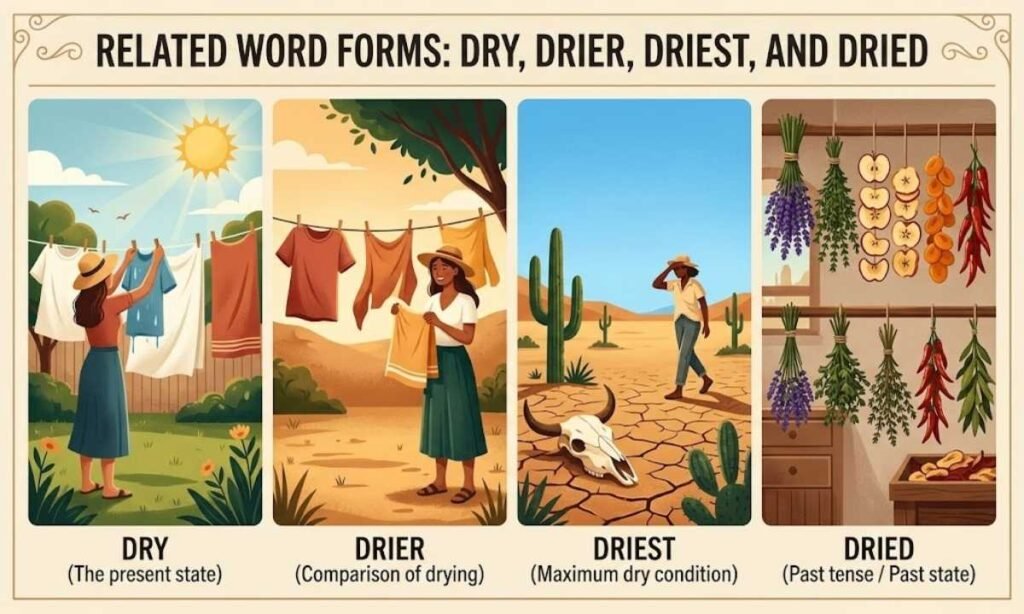
Knowing the whole word family helps you avoid mix ups.
| Form | Word | Example |
| Base adjective | Dry | The soil is dry. |
| Comparative | Drier | The soil is drier than last week. |
| Superlative | Driest | This is the driest month of the year. |
| Verb | Dry, dries, dried, drying | She dried the dishes. |
| Noun (device) | Dryer | Please clean the lint from the dryer. |
Notice that driest and dried also swap the y for an i. Drying keeps the y because the ending starts with an i already.
Is It Drier Than or Dryer Than?
Use “drier than” for comparisons. The word “than” signals that you are comparing two things, and that calls for the comparative adjective.
Correct examples:
- This desert is drier than the coast.
- My throat feels drier than it did this morning.
- The cake turned out drier than I expected.
Writing “dryer than” in a comparison is a common slip, and most editors will mark it as an error.
Special Cases: Drier as a Noun and Dryer as an Adjective
English rarely follows a rule without a few exceptions, and this pair has two.
First, drier can be a noun. In painting and manufacturing, a drier is a substance added to paint, ink, or varnish to speed up drying. Some dictionaries also list drier as an accepted variant spelling of the appliance, although dryer is far more common in modern American writing.
Second, some dictionaries record dryer as a rare variant of the comparative. It appears in older texts and occasional casual writing. For formal work, school essays, and professional content, stick with drier for comparisons. It is the safer, standard choice.
Drier or Dryer in American and British English
Many spelling differences split American and British English, such as color and colour. This pair is not one of them. Both varieties use drier for the comparative and dryer for the appliance.
The main difference is vocabulary. Americans say clothes dryer, while people in the United Kingdom often say tumble dryer. Hair dryer and hand dryer are used on both sides of the Atlantic.
So if your audience is in the United States, the same rules apply. You do not need a separate spelling guide for each region.
Common Mistakes With Drier and Dryer
Watch for these frequent errors:
- “The weather is dryer today.” Correct form: drier, because it compares conditions.
- “Put the clothes in the drier.” Preferred form: dryer, because it names the appliance.
- “This towel is dryer than that one.” Correct form: drier.
- Choosing by sound alone. The words sound nearly the same, so always check the meaning.
- Mixing up comparison and machine. Ask yourself whether the word compares or names an object.
How to Remember the Difference?
A few simple tricks make the choice automatic:
- Drier equals more dry. Both end in the same sound as “higher” or “wire.”
- Dryer does the drying. The “er” ending points to someone or something doing the action.
- The comparison test. If “than” fits after the word, choose drier.
- The object test. If “a” or “the” fits before the word and it points to a device, choose dryer.
Keep this memory sentence handy: The towel is drier after it comes out of the dryer.
Practice Sentences to Test Yourself
Fill in each blank with drier or dryer, then check the answers below.
- The weather is ___ than yesterday.
- Put the wet towels in the ___.
- My hair feels ___ today.
- I need a new hair ___.
- This climate is much ___.
Answers: 1. drier, 2. dryer, 3. drier, 4. dryer, 5. drier.
Items 1, 3, and 5 describe a condition or comparison, so they take drier. Items 2 and 4 name a device, so they take dryer.
Editing Checklist for Students and Content Writers
Before you publish or submit, run through this short list:
- Search your draft for both words.
- Ask whether each one compares or names a machine.
- Confirm that “than” always follows drier in comparisons.
- Check that appliance references use dryer.
- Read the sentence aloud to catch meaning errors that spell check will miss.
Spell checkers often accept both words, because both are real. That is why a human review matters here.
Why Correct Spelling Builds Reader Trust?
Small errors add up. A single wrong word will not ruin an article, but repeated slips make readers question your accuracy. On product pages, care guides, and school assignments, clean writing signals that you pay attention to detail.
Search engines also reward clear, well edited content, because it satisfies what readers came to find. Getting simple word choices right supports both your credibility and your rankings.
Frequently Asked Questions
Is it drier or dryer?
Both are correct in different roles. Use drier to compare dryness and dryer for a drying machine.
What is the difference between drier and dryer?
Drier means more dry, and it is a comparative adjective. Dryer usually means a device that dries something.
Is it drier than or dryer than?
Use drier than in almost every case. It is the standard comparative form.
Is it hair dryer or hair drier?
Hair dryer is the common and preferred form. Hair drier appears occasionally but looks dated.
Should I say clothes dryer or clothes drier?
Clothes dryer is the standard choice in American English. It names the appliance.
Is dryer a real word?
Yes, it is a real and common noun. It names appliances like clothes, hair, and hand dryers.
Is drier correct in American English?
Yes, drier is the standard comparative in American English. It is also standard in British English.
Conclusion
Drier and dryer share a root, but they serve different purposes. Drier compares how dry something is, while dryer names the machine that does the drying. Remember the simple test: if you are comparing, write drier, and if you mean an appliance, write dryer.
Use the memory sentence, run the editing checklist, and practice with the examples above. Within a few tries, choosing the right word will feel natural.