
Many English learners and even native speakers pause for a second when they type this word, because the keyboard sometimes drops a letter without anyone noticing. The confusion usually comes from typing speed, autocorrect habits, or simply forgetting a basic spelling rule taught in early grammar classes.
The good news is that the answer is straightforward once you understand the small grammar rule behind it. This guide breaks down the correct spelling, the reason behind it, and the rare cases where the other spelling actually exists and means something completely different.
Quick Answer (Stopping or Stoping)
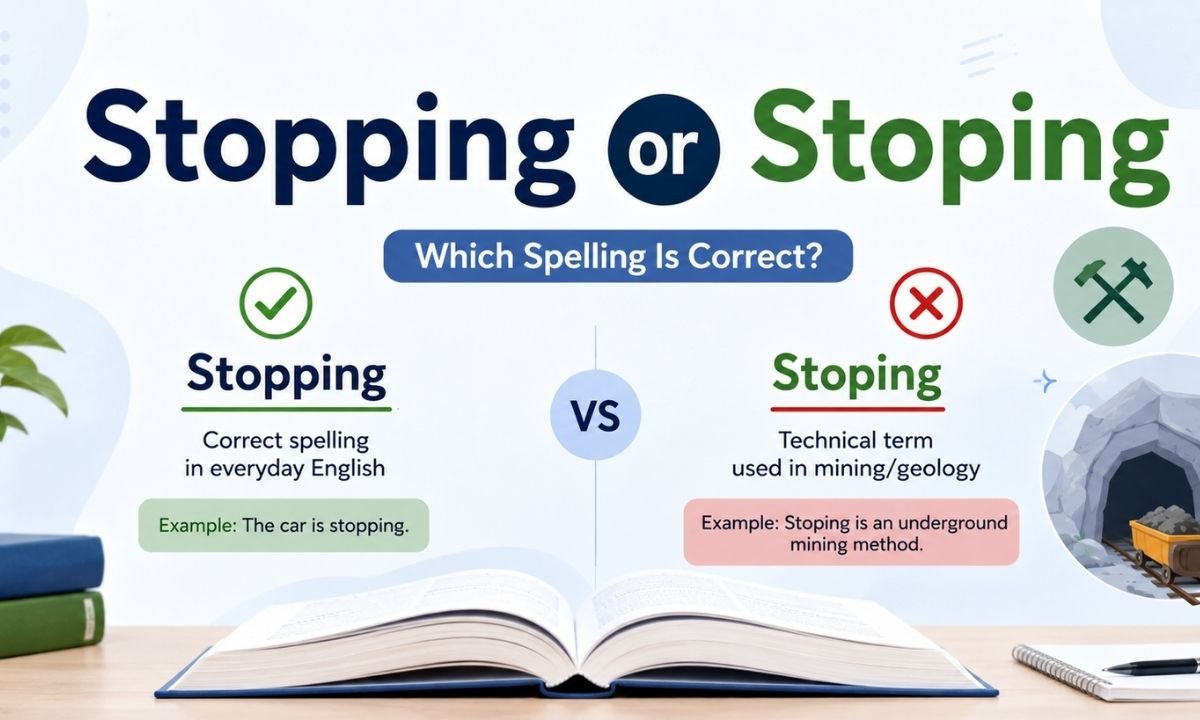
In everyday English, stopping is the only correct form when you mean coming to a halt, pausing, or ending an action. Stoping, on the other hand, is not a misspelling in every context — it is a genuine technical term used in mining and geology to describe a method of underground ore extraction.
So the short rule is simple: use stopping for daily writing, speech, texting, and professional communication. Reserve stoping only for mining, engineering, or geological writing where it has a specific, narrow meaning.
| Word | Correct Usage | Field |
|---|---|---|
| Stopping | Halting, pausing, or ending an action | General English |
| Stoping | Extracting ore underground | Mining and Geology |
The Grammar Rule Behind the Double P
English spelling often follows a pattern called the CVC rule, which stands for consonant-vowel-consonant. The base word “stop” ends in a consonant (p), which is preceded by a single vowel (o), which is preceded by another consonant (t). When a one-syllable word follows this CVC pattern and you add a suffix that starts with a vowel, like “ing” or “ed,” the final consonant usually doubles.
That is exactly why “stop” becomes “stopping” and not “stoping.” Dropping the second p changes the pronunciation and, in technical writing, changes the meaning entirely, since “stoping” already belongs to a completely different vocabulary set.
This same doubling pattern appears across dozens of common English verbs, which makes it easier to remember once you see the family of words together.
Words That Follow the Same Doubling Pattern
- Hop becomes hopping
- Run becomes running
- Sit becomes sitting
- Drop becomes dropping
- Swim becomes swimming
- Plan becomes planning
- Shop becomes shopping
What Stopping Actually Means?
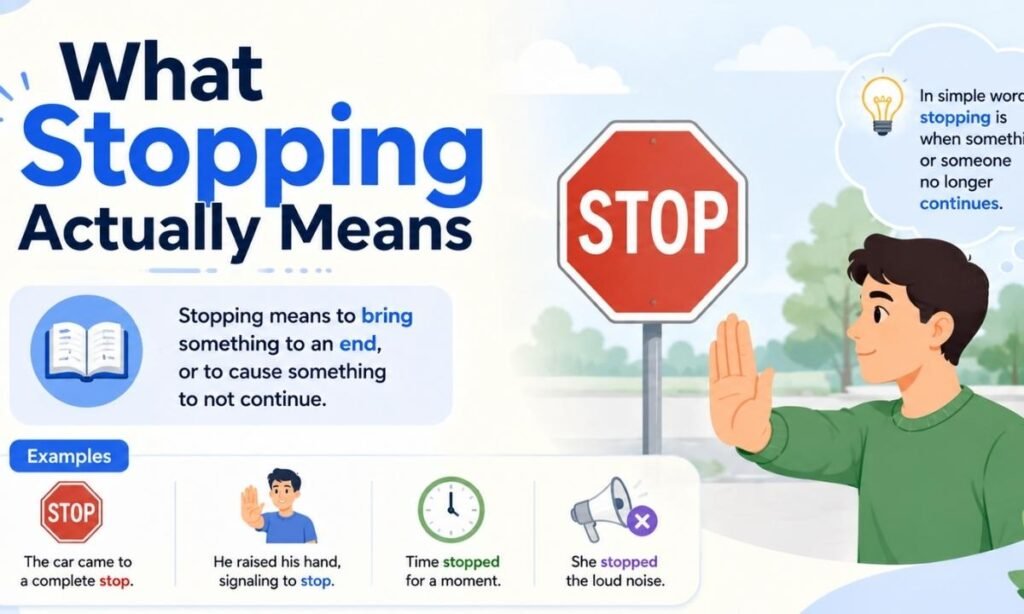
Stopping is the present participle and gerund form of the verb “stop.” It describes an action currently in progress, whether that action is physical movement, an ongoing task, or something happening figuratively, like a habit or a process.
Common everyday meanings of stopping include:
- Bringing motion or travel to a halt
- Pausing an activity temporarily
- Preventing something from continuing
- Ending a process, habit, or event completely
Because it functions as both a gerund and a continuous verb form, stopping shows up constantly in casual conversation, business writing, and academic work.
Real Examples of Stopping in Sentences
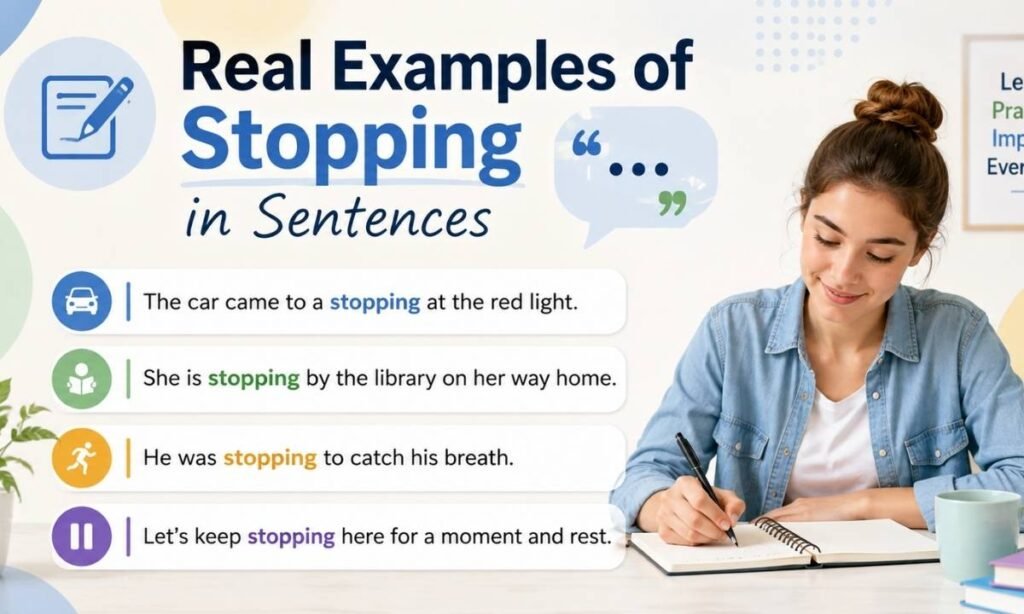
- The bus is stopping at every corner during rush hour.
- She kept stopping to check her phone during the walk.
- Stopping the leak early saved the company thousands of dollars.
- He was stopping by the office before heading home.
- Stopping smoking was the hardest decision she ever made.
These examples show the flexibility of the word across different tenses and sentence structures, from present continuous to descriptive noun-like usage.
Understanding Stoping in Mining and Geology
Stoping is not a random typo that happened to survive in dictionaries. It is an established technical term describing the process of removing ore or valuable rock from underground deposits by creating horizontal or vertical excavations called stopes. Mining engineers rely on this term constantly, and it appears in technical reports, safety documentation, and geological surveys.
In geology specifically, stoping can also describe a process where magma works its way upward through surrounding rock by breaking off and absorbing fragments of that rock as it rises. Both usages share the same root idea of material being removed or displaced during an extraction-like process, which is very different from the everyday meaning of pausing or halting.
When Stoping Is the Right Word to Use?
- Writing a mining engineering report
- Describing underground excavation methods
- Explaining magma movement in geological studies
- Academic or technical research in earth sciences
Outside these narrow fields, stoping should not appear in your writing at all.
Stopping vs Stopped: Knowing the Difference
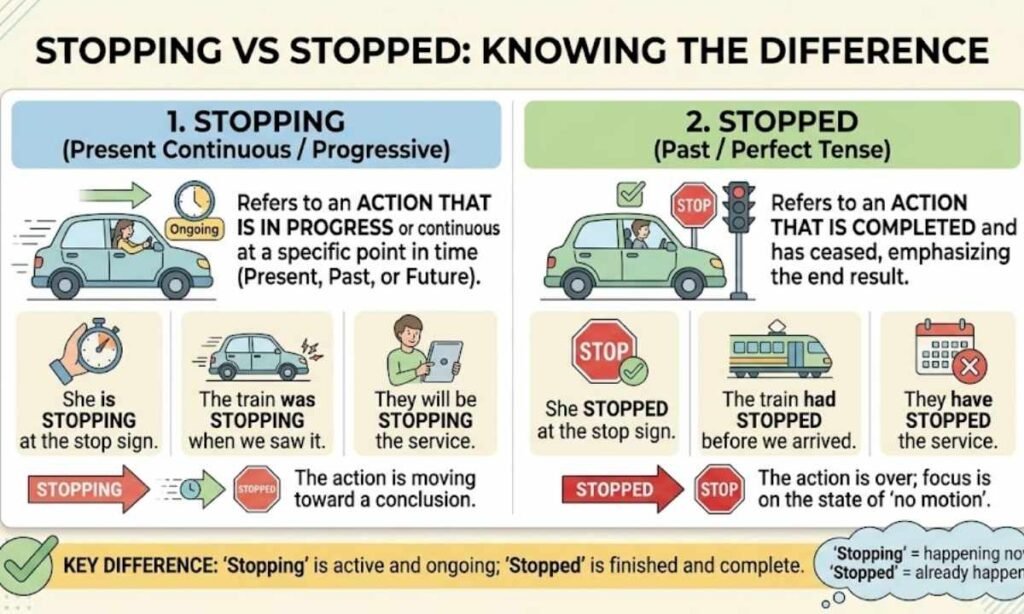
Stopping and stopped both come from the same base verb, but they serve different grammatical roles. Stopping is the present participle, used for ongoing or continuous action, while stopped is the past tense and past participle, used for completed action.
| Form | Grammar Role | Example |
| Stop | Base verb | I stop at the light. |
| Stops | Third person singular | He stops every morning. |
| Stopping | Present participle/gerund | She is stopping the car. |
| Stopped | Past tense/past participle | They stopped yesterday. |
Neither of these forms should ever be spelled with a single p, so “stoped” as a past tense is incorrect outside of extremely specific technical mining contexts where it is rarely used anyway.
Frequent Misspellings People Search Online
Search engines see a wide range of typing errors related to this word every day. Understanding these mistakes helps explain why confusion around stopping and stoping persists.
- Stoping used instead of stopping
- Stoped used instead of stopped
- Stoppping with an extra letter
- Stopsing as an incorrect blend
- Stopinng with a misplaced letter
Most of these errors come from rushed typing, voice-to-text mistakes, or simply not knowing the doubling rule discussed earlier.
American English and British English: No Real Difference
Unlike some words that shift spelling across regions, such as color versus colour, stopping remains identical in both American and British English. There is no regional variant that changes the spelling to stoping in ordinary use, so writers on either side of the Atlantic can apply the same doubling rule without exception.
Common Synonyms for Stopping
Depending on context, several words can substitute for stopping without changing the core meaning too much.
- Pausing
- Halting
- Ending
- Ceasing
- Discontinuing
- Interrupting
Each synonym carries a slightly different tone. Pausing suggests something temporary, while ceasing or discontinuing often implies a more permanent conclusion.
Choosing the Right Word Depending on Context
Selecting between stopping and stopping ultimately comes down to the subject you are writing about. If your content involves everyday actions, business communication, or general storytelling, stopping is always the correct choice. If you are writing specifically about underground mining operations or geological rock formation, stopping becomes the accurate technical term.
Writing for General Audiences
- Emails and workplace messages
- School assignments and essays
- Social media posts and captions
- Everyday conversation and texting
Writing for Technical or Scientific Audiences
- Mining engineering reports
- Geological research papers
- Industry-specific training materials
- Academic textbooks on earth sciences
Why This Small Spelling Mistake Matters?
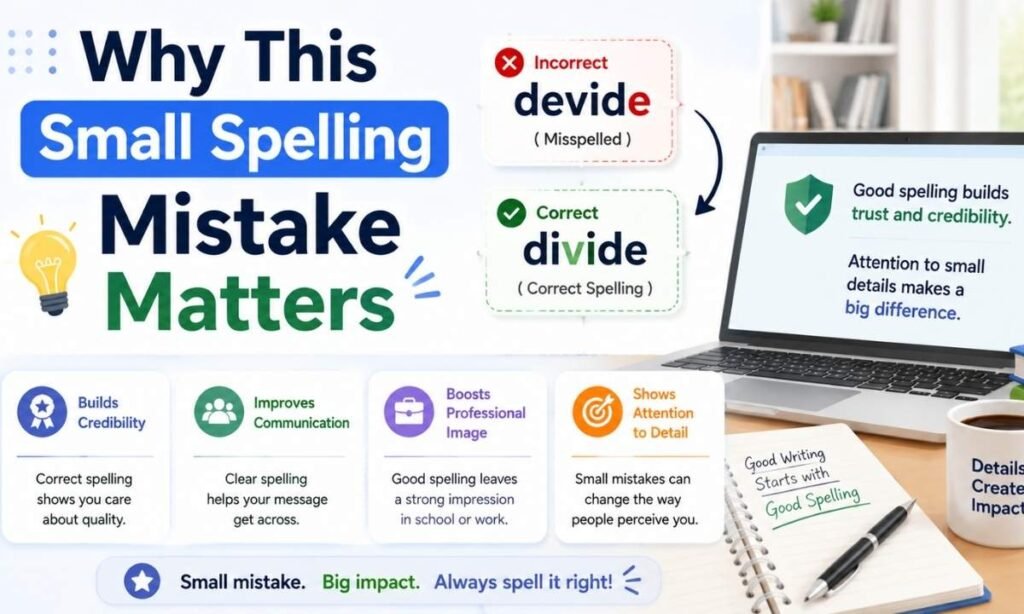
A single missing letter might seem minor, but in professional or academic writing, it can signal carelessness or reduce credibility, especially in technical fields where stoping already has an established, unrelated meaning. Using the wrong word in a formal report could confuse readers who assume you meant the mining term instead of a simple pause or halt.
Getting this right builds trust with readers and shows attention to detail, something that matters whether you are writing a school paper, a business email, or a published article.
Conclusion
Stopping is the word you need for nearly every everyday sentence involving pausing, halting, or ending an action, and it always carries the double p because of the CVC spelling rule.
Stoping exists too, but only within mining and geology, where it describes underground ore extraction or magma movement through rock. Keep these two separate, remember the simple doubling pattern, and you will never second-guess this spelling again.
Frequently Asked Questions
Is stopping the correct spelling?
Yes, stopping is always correct for everyday English when describing a pause or halt.
Is stoping a real word?
Yes, but only as a technical mining and geology term, not as a substitute for stopping.
Why does stopping have two Ps?
Because the CVC spelling rule doubles the final consonant before adding ing or ed.
What is the past tense of stop?
The correct past tense is stopped, always spelled with two Ps.
Can I use stoping in everyday writing?
No, stoping should only appear in mining or geological contexts, never in casual writing.
Is there a spelling difference between American and British English?
No, stopping is spelled the same way in both American and British English.
What are common synonyms for stopping?
Pausing, halting, ending, ceasing, discontinuing, and interrupting are all common synonyms.