
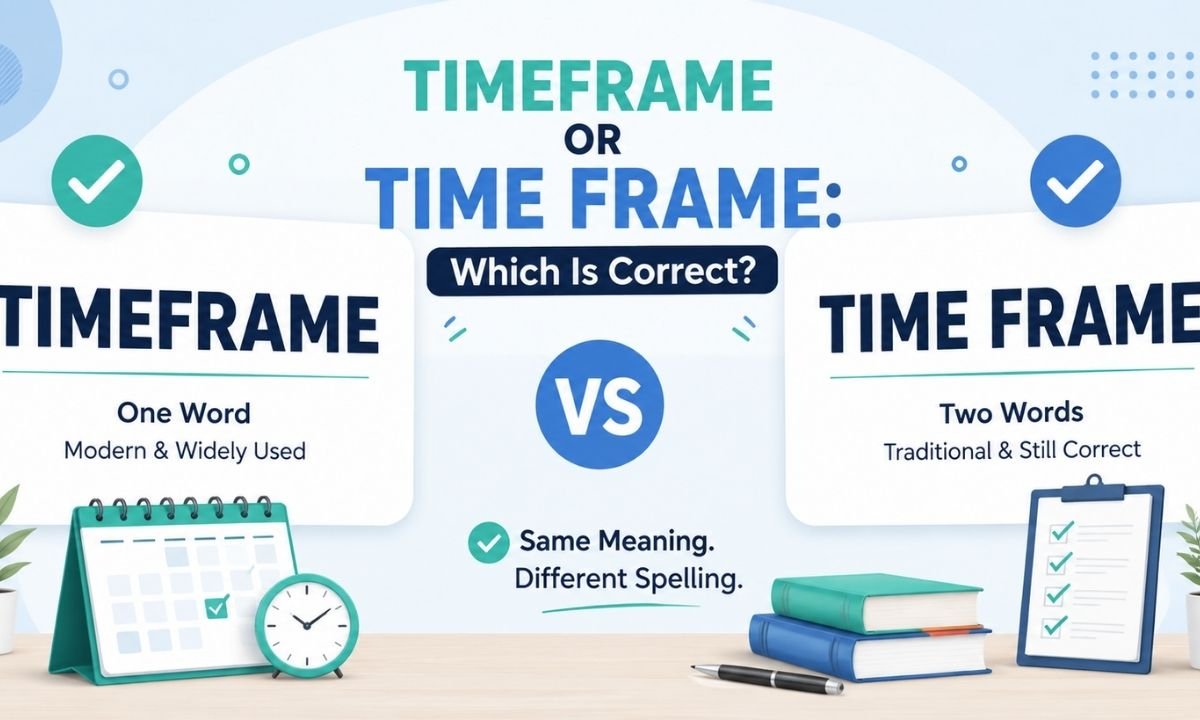
Anyone who writes reports, emails, or web content has paused at some point wondering whether to type Timeframe or Time Frame. Both spellings appear frequently in business writing, news articles, and casual conversation, which only adds to the confusion.
The good news is that neither version is wrong. Dictionaries recognize both forms, though usage can vary depending on formality, region, and personal or brand style. This guide breaks down the meaning, correct usage, and subtle differences so you never second-guess your spelling again.
Is Timeframe One Word or Two Words?
Timeframe as a single word is widely accepted, especially in modern digital writing, marketing copy, and everyday communication. It reads quickly and feels natural in casual sentences such as project updates or emails.
Why the Single Word Form Became Popular?
English naturally merges frequently paired words over time, the same way “website” replaced “web site.” The timeframe followed that same pattern as digital communication grew faster and more compressed.
Is It Acceptable in Professional Settings?
Yes, timeframe is now common in professional and technical writing, particularly in tech, marketing, and project management industries where concise language is valued.
Is Time Frame Still Correct as Two Words?
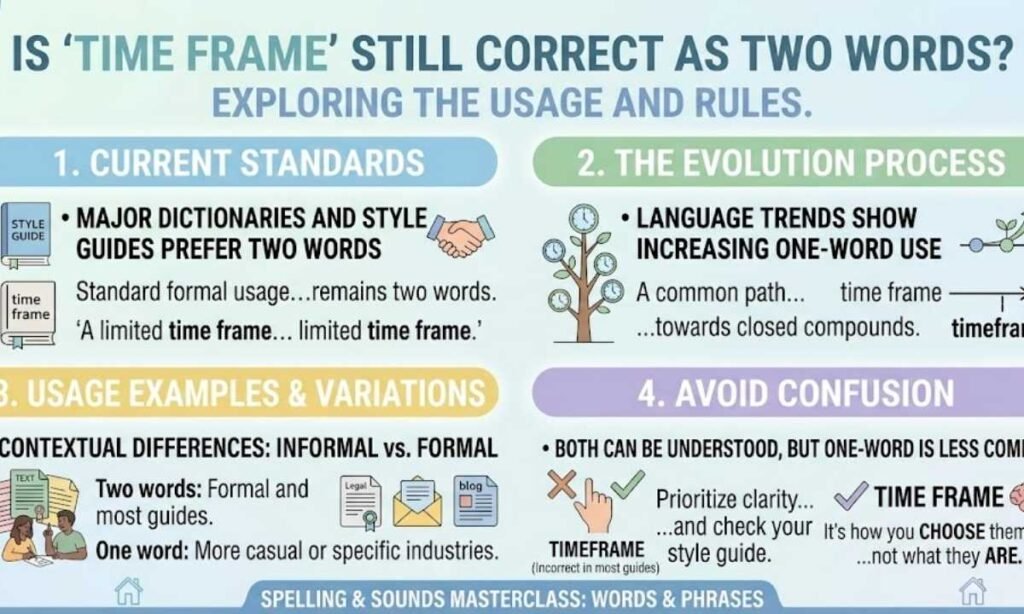
Time frame written as two separate words remains the more traditional and widely documented form in major dictionaries. Formal writing, academic papers, and legal documents often favor this version.
Why Some Style Guides Prefer Two Words?
Older publishing standards and print journalism traditionally kept compound nouns separated until usage became overwhelmingly common in single word form, and time frame has not fully crossed that threshold everywhere.
Does It Look More Formal?
Many editors consider the two word spelling slightly more formal, which makes it a safer choice for resumes, official reports, and academic submissions.
What About the Hyphenated Time Frame Spelling?
Time frame with a hyphen is generally considered incorrect or outdated in current English usage. Most modern style guides do not support hyphenating this term at all.
When Hyphens Are Actually Needed??
Hyphens typically appear only when the phrase functions as a compound modifier before a noun, such as a short term project plan, but even then, time frame itself stays unhyphenated.
What Does Time Frame Mean?
A time frame refers to a specific period during which something happens, is planned, or must be completed. It describes duration, boundaries, or a scheduled window of time.
Simple Definition
In plain terms, a time frame answers the question of when something starts and ends, or how long a task, event, or process is expected to take.
Everyday Use of the Term
People use it constantly in daily conversation, such as asking about the time frame for a delivery, a response, or a project milestone.
Workplace Use of the Term
In professional settings, a time frame often refers to deadlines, sprint durations, contract periods, or scheduling windows tied to deliverables and milestones.
Timeframe vs Time Frame Is There a Real Difference
There is no difference in meaning between timeframe and time frame. Both describe the same concept of a defined period, and dictionaries confirm they are interchangeable in nearly every context.
Same Meaning Different Spelling
The word functions identically as a noun in both forms, referring to duration or scheduled periods without any shift in definition.
Formal Versus Modern Usage
Time frame leans formal and traditional, while timeframe feels modern, casual, and increasingly common in digital and business communication.
When Spelling Actually Matters?
Spelling matters mainly for consistency. Once you choose a version, stick with it throughout a document, website, or brand style guide to avoid confusing readers.
Timeframe in American English
Timeframe as one word is increasingly common across American blogs, business communication, and online publications, especially in fast paced industries like marketing and technology.
Is Timeframe Common in the USA?
Yes, American writers frequently use timeframe casually, though many major American dictionaries still list time frame as the primary or preferred entry.
Formal American Writing Still Prefers Two Words
Academic journals, legal documents, and government publications in the United States typically default to the two word spelling for consistency and tradition.
Which Version Should Americans Choose?
For everyday writing, either spelling works. For formal or academic writing, time frame remains the safer and more widely accepted option.
Timeframe or Time Frame in British English
British publications also accept both spellings, though time frame as two words appears slightly more often in newspapers, official documents, and traditional publishing.
Regional Consistency Tips
If your audience is primarily British, checking a style guide like Oxford or a major newspaper reference can help maintain regional consistency.
How Style Guides and Editors Handle Time Frame?
Most professional style guides recommend picking one spelling and applying it consistently, rather than strictly banning either version outright.
| Style Guide or Source | Preferred Spelling | Notes |
| Merriam Webster | Time frame | Lists timeframe as a less common variant |
| Cambridge Dictionary | Time frame (US) | Notes timeframe as an accepted alternative |
| AP Style | Time frame | Common in journalism and news writing |
| Business and Marketing Writing | Timeframe | Frequently used for brevity and modern tone |
Why Editors Recommend Consistency
Switching between spellings within the same document looks inconsistent and unpolished, so editors typically flag it during proofreading and revision.
Time Frame vs Timeframe in Formal Writing
Academic Writing
Academic papers generally favor a time frame as two words to align with traditional dictionary entries and formal publishing standards.
Business Writing
Business communication often mixes both spellings, though the timeframe is gaining ground due to its shorter, cleaner appearance in reports and presentations.
Emails and Professional Communication
Either spelling works fine in emails, though staying consistent with your company’s existing communication style is generally recommended.
Reports and Workplace Documents
Long form documents such as reports or proposals benefit from picking one spelling early and applying it uniformly throughout.
How to Use Time Frame in a Sentence?
Below are natural examples showing both spellings in real context.
- Please confirm the time frame for the project delivery.
- We need a realistic timeframe before signing the contract.
- The short time frame made planning difficult for the team.
- Our timeframe for launch has shifted by two weeks.
- Within this time frame, all approvals must be finalized.
- The long timeframe allowed for thorough testing and review.
- Can you provide an updated time frame for the shipment.
- The team worked within a tight timeframe all quarter.
Time Frame vs Timeline Duration and Deadline
These related words often get confused, though each carries a slightly different meaning.
| Term | Meaning | Example Use |
| Time frame | A defined period during which something occurs | The time frame for review is two weeks |
| Timeline | A visual or sequential order of events over time | The project timeline shows each milestone |
| Duration | The total length of time something lasts | The meeting duration was one hour |
| Deadline | A specific end point by which something must finish | The deadline is next Friday |
Time Frame vs Timeline
A time frame describes a period, while a timeline shows the sequence of events happening within that period.
Time Frame vs Duration
Duration focuses purely on length, while time frame often includes both a starting and ending point.
Time Frame vs Deadline
A deadline is a fixed cutoff point, while a time frame can be flexible and cover a broader window.
Time Frame in Project Management and Planning
Project managers rely heavily on time frames to structure sprints, milestones, and delivery schedules across teams and departments.
Setting Realistic Time Frames
Effective planning depends on setting achievable time frames based on resources, team capacity, and task complexity.
Communicating Time Frames to Stakeholders
Clear time frame communication helps stakeholders understand expectations and reduces confusion around delivery dates.
Common Time Frame Spelling Mistakes
Writing Time Frame With a Hyphen
Adding a hyphen between time and frame is generally incorrect and not supported by major dictionaries.
Switching Spellings Within One Document
Alternating between timeframe and time frame in the same piece of writing looks careless and inconsistent.
Assuming One Spelling Is Always Wrong
Neither spelling is technically incorrect, so avoid correcting others too strictly without checking your specific style guide.
Using the Wrong Word for Context
Confusing time frame with deadline or timeline can create miscommunication, especially in professional settings.
SEO and Content Writing Considerations for Time Frame
Choosing a Spelling for Web Content
For blogs and websites, timeframe often performs well due to shorter search queries, though including both spellings naturally can widen keyword coverage.
Matching Search Intent
Understanding whether readers are searching for spelling clarification or general meaning helps shape more useful, targeted content.
Tools to Check Your Time Frame Spelling Consistency
Using Editing Software
Grammar checking tools can flag inconsistent spelling automatically, helping maintain uniformity across long documents.
Creating a Personal Style Guide
Keeping a simple internal style sheet for your preferred spelling saves time and prevents repeated inconsistency across future content.
Timeframe or Time Frame Which Should You Use
Best Choice for Formal Writing
Time frame as two words remains the safer, more traditional choice for academic and formal documents.
Best Choice for Business Writing
Either spelling works, though timeframe fits well in modern, concise business communication.
Best Choice for Everyday Writing
Timeframe feels natural and quick for casual writing, emails, and conversational content.
Best Choice for SEO Content
Using both spellings naturally throughout content improves topical coverage without keyword stuffing.
Quick Comparison Timeframe vs Time Frame
| Feature | Time Frame | Timeframe |
| Spelling | Two words | One word |
| Meaning | Same | Same |
| Formality | Traditional and formal | Modern and casual |
| Common Region | Widely used in US and UK | Increasingly common globally |
| Hyphen Needed | No | No |
Frequently Asked Questions
Is timeframe one word or two?
Both forms exist, but timeframe as one word is increasingly common in modern casual and business writing.
Is time frame grammatically correct?
Yes, time frame is grammatically correct and remains the more traditional dictionary preferred spelling.
Is timeframe a real word?
Yes, timeframe is recognized as a valid alternative spelling in most modern dictionaries and style references.
Which is correct, timeframe or time frame?
Both are correct. Choose one spelling and stay consistent throughout your writing.
Is time frame hyphenated?
No, hyphenating time frame is not standard or recommended in current English usage.
Which spelling is more common in American English?
Time frame remains slightly more common in formal American writing, while timeframe is popular in everyday use.
Should I use timeframe in formal writing?
For strictly formal or academic writing, time frame as two words is generally the safer option.
Conclusion
Both timeframe and time frame are correct, and the choice mostly comes down to formality, audience, and personal or brand consistency. Formal writing leans toward the traditional two word spelling, while modern business and digital content increasingly favor the single word form. Whichever version you choose, consistency throughout your writing matters more than the spelling itself.