
Anyone who writes business emails, contracts, or online listings has probably paused at some point wondering about Vender or Vendor. The two words look and sound almost identical, and spell checkers do not always catch the difference, which adds to the confusion.
The short answer is that vendor is the standard, widely accepted spelling in modern English, while vender is a recognized but far less common variant. This guide breaks down the meaning, usage, and simple rules so you never second-guess this word again.
The Correct Spelling in American English
In American English, vendor is the spelling used in newspapers, contracts, academic writing, and everyday conversation. Dictionaries list it as the primary entry, and businesses across every industry use it in official documents such as vendor agreements and vendor invoices.
Is Vender Also a Real Word?
Yes, vender is a real word, but it is treated as a minor or secondary spelling. Major dictionaries such as Merriam Webster and Cambridge acknowledge it, yet they still point readers toward vendor as the preferred form for formal and everyday writing.
What Does Vendor Mean?
A vendor is a person, business, or organization that sells goods or services to others. The term applies broadly, covering everything from a small street cart to a multinational software supplier.
Vendor Meaning in Simple English
In plain terms, a vendor is simply a seller. If someone offers a product or service in exchange for payment, that person or company can be called a vendor.
Vendor Meaning in Business and Commerce
In a corporate setting, a vendor usually refers to a third party company that supplies products, raw materials, or services to another business under a formal agreement or purchase order.
Vendor Meaning in Online Shopping
On marketplaces and e commerce platforms, a vendor is the individual seller or store that lists products for customers to purchase, separate from the platform itself.
What Does Vender Mean?
Vender carries the same core meaning as vendor, referring to someone who sells goods. The difference lies purely in spelling frequency rather than definition, since both words describe a seller.
Is Vender a Correct Word to Use?
Vender is grammatically valid and appears in dictionaries, but using it in professional writing may look unusual to readers who are more accustomed to seeing vendor.
Why Is Vender Less Common Today?
Vender has faded from regular use as vendor became the standardized business term, especially with the rise of formal contracts, procurement systems, and vendor management software that consistently use the or spelling.
Vendor vs Vender: Key Differences at a Glance
| Aspect | Vendor | Vender |
| Status | Standard, widely used | Variant, rarely used |
| Meaning | Seller of goods or services | Same meaning as vendor |
| Common in | Business, contracts, retail, daily use | Older or informal writing |
| Dictionary listing | Primary entry | Secondary or variant entry |
| Recommended use | Yes, for all writing types | Not recommended for formal use |
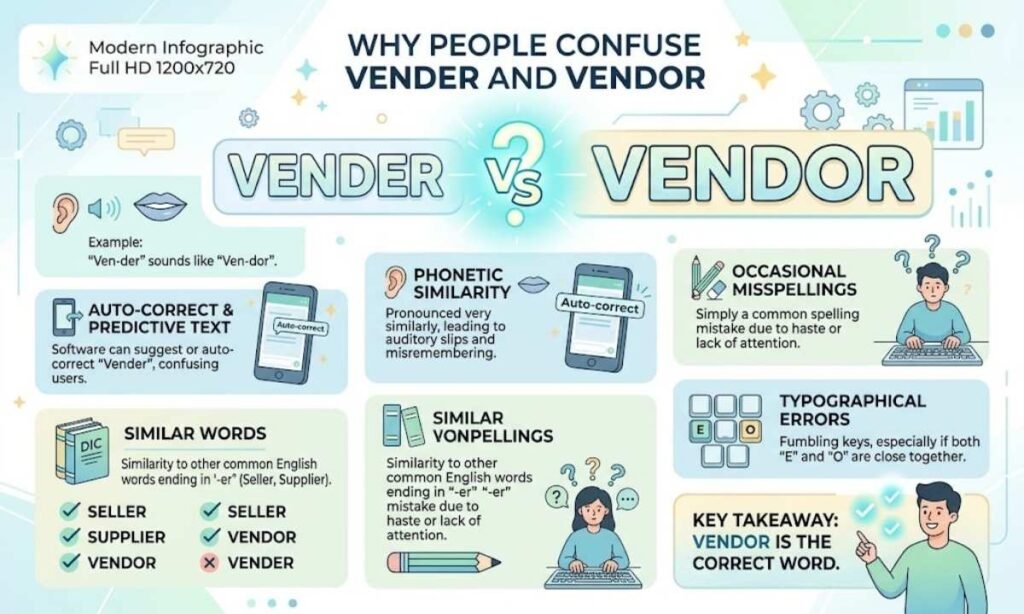
Why People Confuse Vender and Vendor?
They Sound Nearly Identical
Since both words are pronounced almost the same way, many writers rely on memory rather than checking the spelling, which naturally leads to mix ups.
The Or Versus Er Ending Confusion
English has many word pairs where the or and er endings compete, such as advisor and adviser, which makes writers unsure which ending applies to vendor as well.
Autocorrect and Typing Habits
Because vender is technically recognized, some spell checkers do not flag it as an error, allowing the less common spelling to slip through unnoticed in emails and documents.
Vendor Examples in Everyday Sentences
- The company signed a new vendor for its office supplies.
- The street vendor sold fresh fruit near the market entrance.
- Our procurement team is reviewing three software vendors this quarter.
- The vendor agreement outlines payment terms and delivery schedules.
- She works closely with vendors to negotiate better pricing.
Vendor in American English vs British English
Vendor is used consistently across both American and British English, appearing in legal, commercial, and everyday contexts on both sides of the Atlantic. Vender shows up occasionally in American dictionaries as a variant but is rarely seen in British publications, making vendor the safer universal choice.
Vendor vs Supplier vs Seller: Are They the Same?
These three words overlap but are not always interchangeable. A vendor typically sells directly to a buyer or business, a supplier usually provides raw materials or components used to make other products, and a seller is the broadest term covering anyone offering something for sale. Understanding this distinction helps writers choose the most precise term for contracts and business communication.
Common Vendor Phrases You Should Know
| Phrase | Meaning |
| Software vendor | A company that sells software products or licenses |
| Food vendor | A person or business selling food, often at markets or events |
| Street vendor | Someone selling goods informally in public spaces |
| Online vendor | A seller operating through an e commerce platform |
| Vendor agreement | A contract outlining terms between buyer and seller |
| Vendor management | The process of overseeing supplier relationships |
Common Mistakes to Avoid When Using Vendor
One frequent mistake is switching between vendor and vender within the same document, which looks inconsistent and unprofessional. Another common error is confusing vendor with vendee, a legal term referring to the buyer rather than the seller. Writers should also avoid assuming vender is a plural form, since the correct plural is simply vendors.
Vendor Spelling in Legal and Business Documents
Legal contracts, purchase orders, and procurement policies almost always use vendor rather than vender. Because these documents are reviewed by multiple parties and sometimes referenced in disputes, consistency matters. Sticking with vendor throughout a contract avoids ambiguity and matches standard legal drafting conventions used by most companies and law firms.
How to Remember Vendor vs Vender?
The Simple Vendor Equals Standard Rule
Whenever there is doubt, defaulting to vendor is the safest option since it applies correctly in nearly every context, from casual writing to formal contracts.
A Quick Spelling Memory Trick
Associate vendor with words like actor, doctor, and supervisor, all of which end in or, to help the correct spelling stick in memory.
Quick Vendor Spelling Checklist
- Use vendor for business writing, contracts, and reports.
- Avoid vender unless quoting an older or historical source.
- Do not mix both spellings within the same document.
- Remember that vendor and vendee are different words with different meanings.
- Check the plural form, which is vendors, not venders in modern usage.
Final Verdict: Vendor or Vender?
Vendor wins as the correct and expected spelling across nearly all contexts, including business, legal, academic, and casual writing. Vender remains technically valid but is best left for historical references or specific quoted material rather than everyday communication.
Frequently Asked Questions
Is Vender a Correct Spelling?
Yes, but it is a rare variant. Vendor remains the standard and recommended spelling.
Is Vendor the Correct Spelling?
Yes, vendor is the primary and most widely accepted spelling in modern English.
Are Vender and Vendor the Same Word?
They share the same core meaning of a seller, differing only in spelling frequency.
Is Vender Used in American English?
It appears occasionally as a variant, but vendor is far more common in American writing.
Which Spelling Is Better for Business Writing?
Vendor is always the safer and more professional choice for business documents.
How Do You Spell Vendor Correctly?
The correct spelling is v e n d o r, ending in or rather than er.
What Is the Plural of Vendor?
The plural form is vendors, formed simply by adding an s.
Conclusion
Choosing between vender and vendor does not need to be complicated. Vendor is the spelling recognized across dictionaries, business documents, and everyday communication, while vender exists only as a minor variant with limited modern use. Whenever you are unsure which spelling fits your writing, defaulting to vendor will keep your content accurate, professional, and easy to trust.