
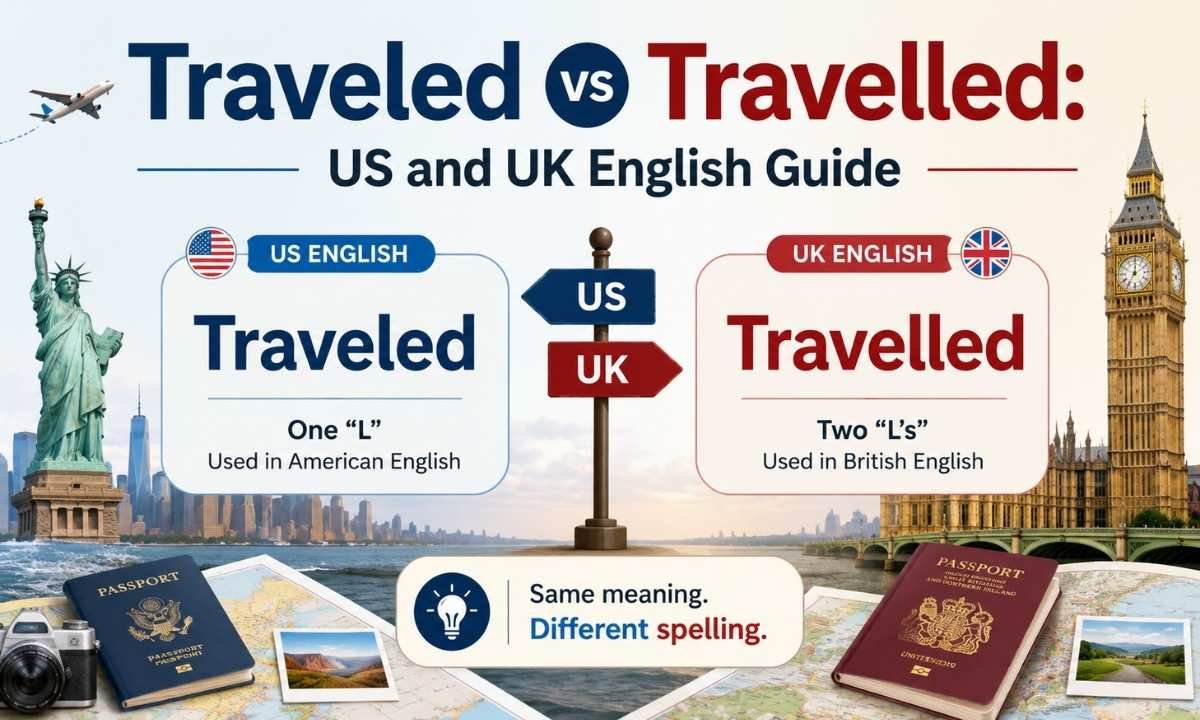
If you have ever paused mid-sentence wondering whether to write traveled or travelled, you are not alone. This single-letter difference confuses students, bloggers, and even professional writers because both versions appear correct depending on where you look.
The short answer is that both spellings are correct, but they belong to different English varieties. Traveled is the standard American spelling, while travelled is the standard British spelling. This guide breaks down the difference with real examples, verb forms, and simple rules so you never second-guess yourself again.
Traveled vs Travelled: The Quick Answer
Is Traveled Correct?
Yes, traveled is correct and is the preferred spelling in American English, used across US newspapers, textbooks, and websites.
Is Travelled Correct?
Yes, travelled is correct and is the standard spelling in British, Australian, and Canadian English.
Do They Mean the Same Thing?
Both words are past tense forms of the verb travel and carry the exact same meaning; only the regional spelling changes.
What Causes the Spelling Difference?
The One-L and Two-L Rule
American English generally does not double the final consonant of a verb when adding -ed unless the last syllable is stressed, so travel becomes traveled.
The British Doubling Convention
British English doubles the final L in verbs like travel regardless of stress, which is why travelled, travelling, and traveller carry two Ls.
It Is a Spelling Rule, Not a Grammar Rule
This difference has nothing to do with tense, meaning, or correctness; it is purely a regional spelling convention inherited from separate style traditions.
The Origin of the Word Travel
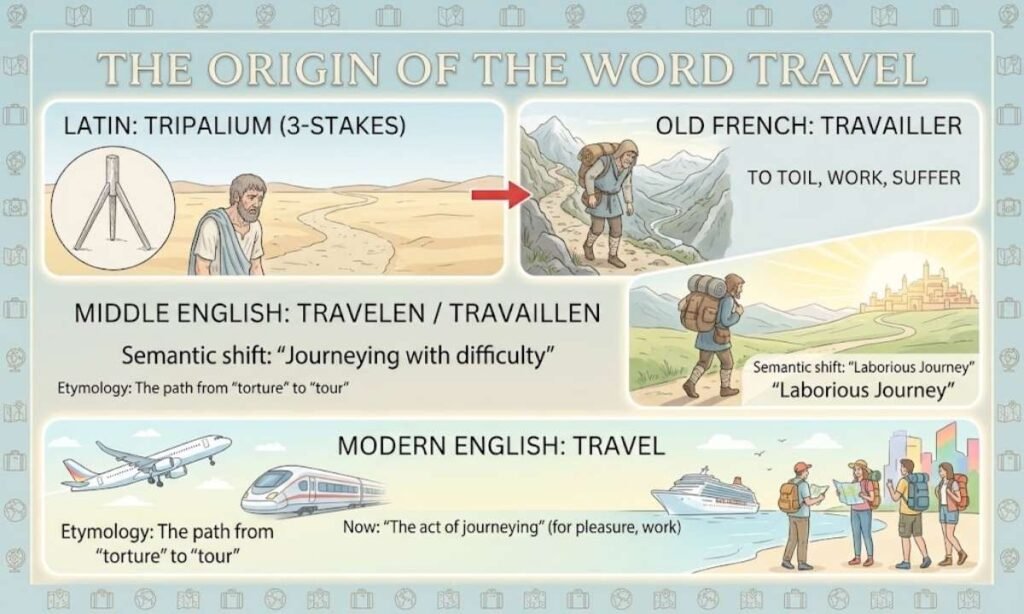
Where Travel Comes From?
The word travel traces back to the Old French travail, originally meaning hard or painful labor, reflecting how difficult long-distance journeys once were.
How the Meaning Evolved?
Over centuries the sense shifted from suffering to the modern meaning of journeying or moving from one place to another, and the spelling split later followed as American and British English diverged.
Why This History Matters for Writers?
Knowing the word’s roots helps explain why English spelling rules can feel inconsistent; they developed independently on each side of the Atlantic.
Traveled in American English
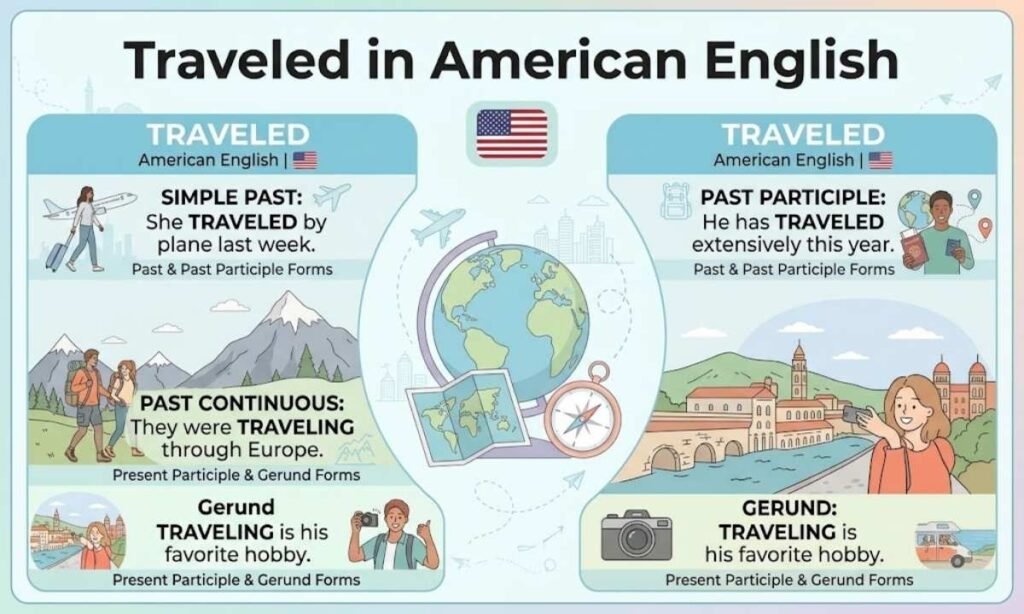
How It Is Used?
Traveled follows the standard American pattern of single consonants before -ed, matching similar words like canceled and labeled.
Example Sentences
- She traveled across Europe last summer.
- He has traveled to more than twenty countries.
- We traveled by train instead of flying.
- They traveled light for the weekend trip.
- I have never traveled outside the country before.
Travelled in British English
How It Is Used?
Travelled follows the British doubling pattern, matching similar words like cancelled and modelled.
Example Sentences
- She travelled across Europe last summer.
- He has travelled to more than twenty countries.
- We travelled by train instead of flying.
- They travelled light for the weekend trip.
- I have never travelled outside the country before.
Traveled vs Travelled Across Verb Forms
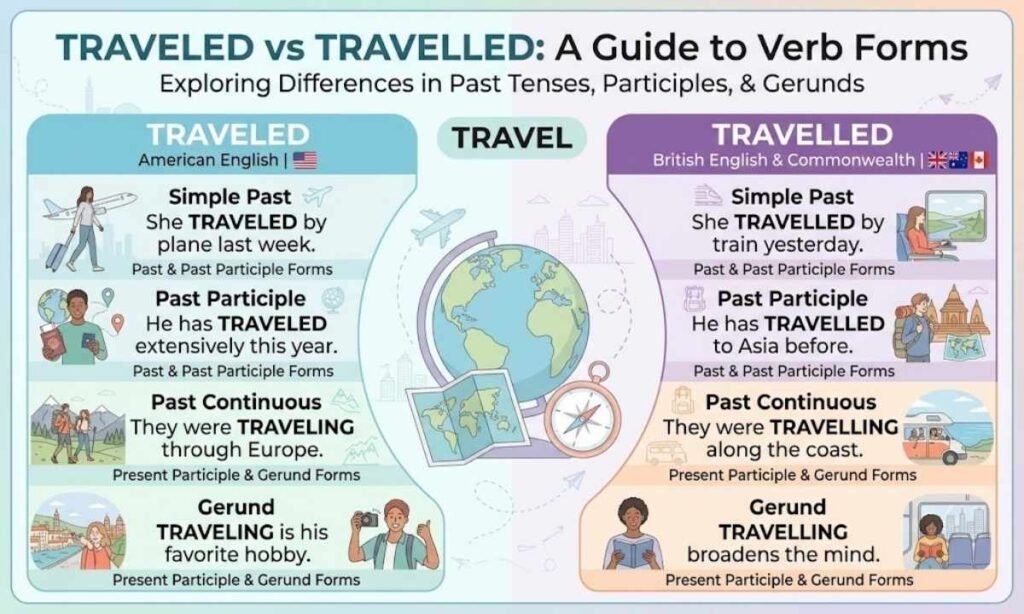
The spelling difference is not limited to the past tense; it carries through every related form of the verb.
| Verb Form | American English | British English |
| Base form | Travel | Travel |
| Past tense | Traveled | Travelled |
| Past participle | Traveled | Travelled |
| Present participle | Traveling | Travelling |
| Noun (person) | Traveler | Traveller |
| Adjective | Well-traveled | Well-travelled |
Traveling vs Travelling: The -ing Form
Traveling in American English
American writers use traveling with one L, consistent with the single-consonant pattern used throughout US spelling conventions.
Travelling in British English
British writers use travelling with two Ls, matching the doubled-consonant style found across the UK, Australia, and much of the Commonwealth.
Traveler vs Traveller: The Noun Form
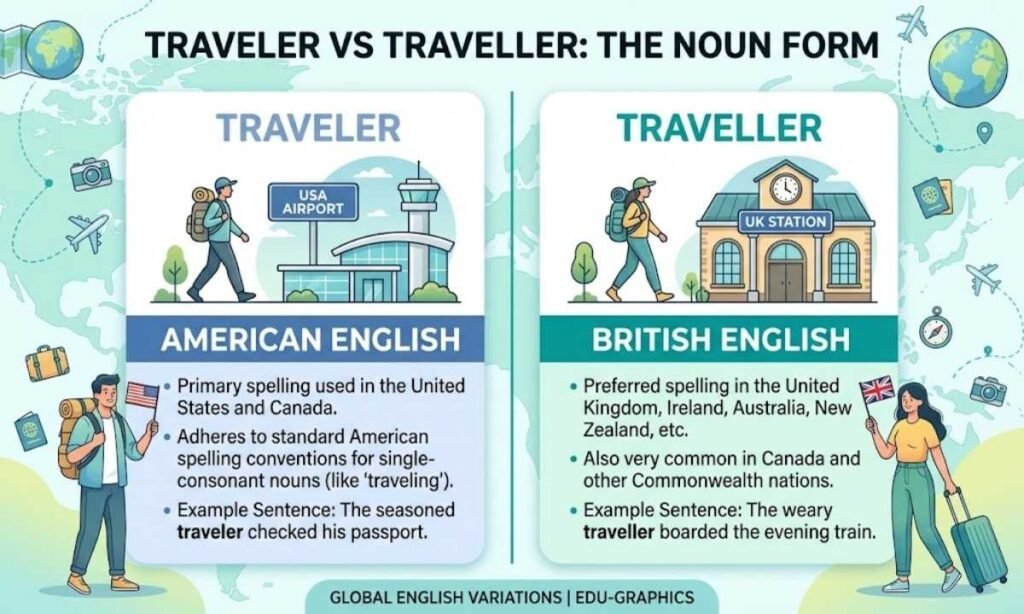
Traveler in American English
The American spelling traveler drops the second L, and this version appears throughout US travel publications and government documents.
Traveller in British English
The British spelling traveller keeps the double L and is standard in UK newspapers, airlines, and official writing.
How Dictionaries Define Traveled and Travelled
Merriam-Webster’s Position
American dictionaries such as Merriam-Webster list traveled as the primary US entry, confirming it as the accepted American standard.
Oxford’s Position
British dictionaries such as the Oxford English Dictionary list travelled as the primary British entry, confirming the UK standard.
What This Means for You
Neither dictionary treats the other spelling as incorrect; both simply document regional preference rather than grammatical error.
Other Words That Follow the Same Pattern
The traveled versus travelled split is not an isolated case. Several common verbs follow the same US versus UK doubling pattern.
- Canceled and cancelled
- Labeled and labelled
- Modeled and modelled
- Fueled and fuelled
- Signaled and signalled
- Traveled and travelled
Keeping this short list in mind makes it easier to stay consistent across an entire piece of writing.
When Should You Use Traveled or Travelled?
Writing for a US Audience
Choose traveled, traveling, and traveler if your readers, publication, or company are based in the United States.
Writing for a UK or Commonwealth Audience
Choose travelled, travelling, and traveller if your audience is in the United Kingdom, Australia, or most Commonwealth countries.
Following a Style Guide
Many companies, universities, and publications have an internal style guide; when one exists, it should always override personal preference.
Traveled vs Travelled in Business and Professional Writing
Emails and Reports
Professional documents should match the spelling convention of the intended audience, since inconsistent spelling can look unpolished in client-facing material.
Resumes and Cover Letters
Job seekers should match the spelling style of the country or company they are applying to, particularly on resumes describing international travel experience.
Corporate Style Guides
Global companies often set a single house style, usually American English, to keep marketing and internal communication consistent across regions.
Traveled vs Travelled on Websites and Global Content
Why This Matters for Online Publishing
Websites targeting a US audience typically rank better with US spelling because it matches what most American users type into search engines.
Adjusting Content for Multiple Regions
International brands sometimes localize spelling per region, using traveled for US pages and travelled for UK or Australian pages.
Search Engine Behavior
Search engines generally recognize both spellings as related, but matching your audience’s regional spelling still improves readability and trust.
Common Mistakes With Traveled and Travelled
Assuming One Spelling Is Wrong
Many writers mistakenly flag one version as an error, when both are fully correct within their respective English varieties.
Mixing Spellings in One Document
Switching between traveled and travelled within the same article looks inconsistent and can distract careful readers.
Ignoring Autocorrect Settings
Word processors set to US or UK English will auto-flag the opposite spelling, so writers should confirm their language settings before finalizing content.
Forgetting Related Word Forms
Writers often fix traveled correctly but leave traveling or traveler in the wrong regional spelling, creating inconsistency within the same piece.
Quick Reference Cheat Sheet
- American English: one L — traveled, traveling, traveler.
- British English: two Ls — travelled, travelling, traveller.
- Meaning: identical in both varieties.
- Rule to remember: US English rarely doubles the final consonant; UK English almost always does for this verb group.
Traveled vs Travelled Comparison Table
| Feature | Traveled | Travelled |
| Region | American English | British English |
| Number of Ls | One | Two |
| Related noun | Traveler | Traveller |
| Related -ing form | Traveling | Travelling |
| Meaning | Same | Same |
| Common in | US, sometimes Canada | UK, Australia, most Commonwealth |
| Dictionary standard | Merriam-Webster | Oxford English Dictionary |
Frequently Asked Questions
Is traveled or travelled correct?
Both are correct; traveled is American English and travelled is British English.
Is traveled correct in American English?
Yes, traveled is the standard and preferred spelling across the United States.
Is travelled correct in British English?
Yes, travelled is the standard spelling used throughout the United Kingdom.
Do traveled and travelled have the same meaning?
Yes, both words mean exactly the same thing and only differ in regional spelling.
Is traveling or travelling correct?
Traveling is American English, while travelling is British English; both are correct.
Is traveler or traveller correct?
Traveler is the American spelling, and traveller is the British spelling.
Which spelling should I use for a US website?
Use traveled, traveling, and traveler to match American audience expectations and search behavior.
Conclusion
There is no wrong answer between traveled and travelled; the only real rule is consistency. If you are writing for a US audience, stick with traveled, traveling, and traveler throughout your content. If you are writing for a UK or Commonwealth audience, use travelled, travelling, and traveller instead.
Pick one style, apply it across your entire piece, and your writing will read as polished and professional no matter which side of the Atlantic your readers are on.