
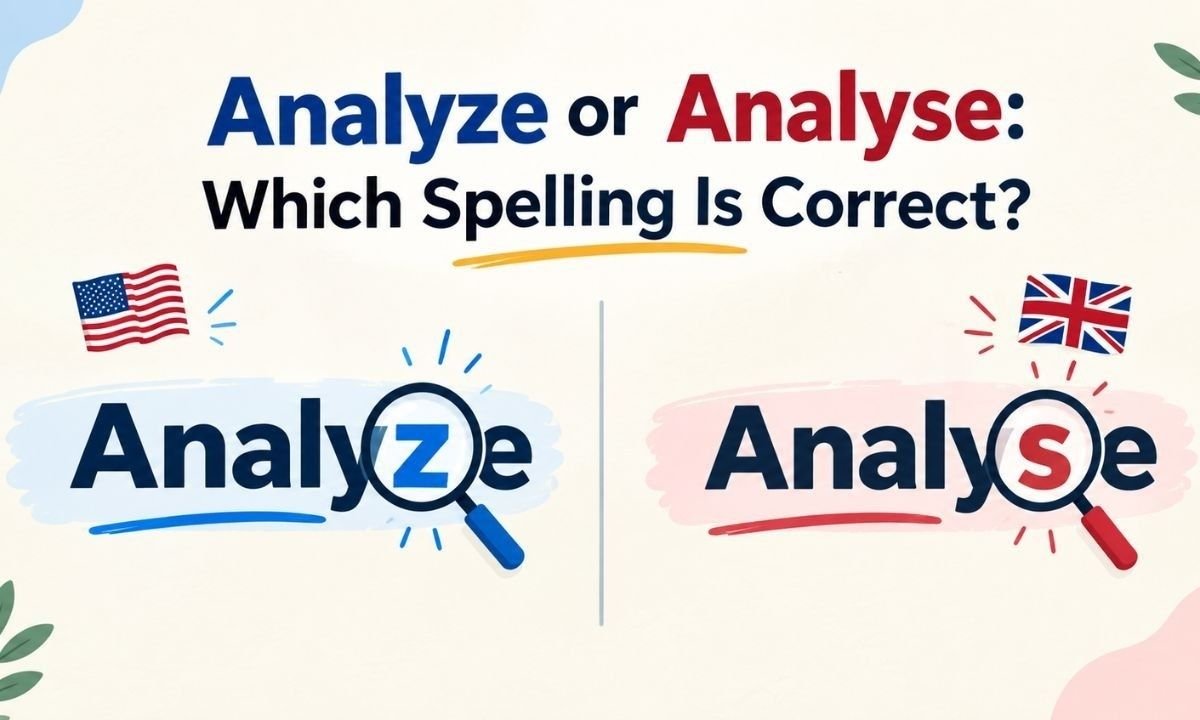
Analyze and analyse are the same word with two spellings. Analyze is standard in American English, while analyse is standard in British English. Both mean to examine something carefully by breaking it into parts, and both are pronounced identically. Neither spelling is a mistake in standard writing.
The choice still matters because mixed spelling looks careless in essays, reports, and research papers. Picking the form that suits your audience keeps your writing consistent and professional. This guide explains each spelling, shows how both work in sentences, and covers the related noun, synonyms, and common mistakes. Use the quick rules below to choose with confidence every time.
Comparison Overview
The table below shows the key facts at a glance.
| Feature | Analyze | Analyse |
| Main region | United States, and generally Canada | United Kingdom, Ireland, Australia, New Zealand, India, Pakistan |
| Meaning | To examine something in detail | To examine something in detail |
| Pronunciation | Same as analyse | Same as analyze |
| Verb forms | analyzes, analyzed, analyzing | analyses, analysed, analysing |
| Related noun | analysis | analysis |
The only real difference is the letter before the final “e”. Meaning, grammar, and pronunciation do not change.
Definition of Analyze
Analyze is a transitive verb. It means to study something closely by separating it into parts so you can understand how it works or what it means. Major dictionaries such as Merriam-Webster list it as the standard American spelling.
- The finance team will analyze the budget before approving it.
- She analyzed the survey results and found a clear pattern.
Definition of Analyse
Analyse carries exactly the same meaning. It is the standard spelling in British English and in most countries that follow British conventions. Dictionaries such as Oxford and Cambridge record both forms and mark analyse as the British choice.
- The engineers will analyse the fault before repairing the machine.
- He analysed the poem line by line.
Main Differences Between Analyze and Analyse
The differences are limited to spelling and regional preference.
- Spelling: Analyze ends in “-yze”. Analyse ends in “-yse”.
- Region: Analyze is American. Analyse is British and Commonwealth.
- Meaning: There is none. Both words mean the same thing.
- Word class: Both are verbs. Neither is a noun.
A common belief is that one spelling is more formal or more correct than the other. That is not true. Correctness depends on your audience and style guide.
Grammar Guide
Analyze and analyse are regular verbs. They follow the same grammar rules as any other verb, and only the spelling of each form changes.
How each term is used in sentences
Both words take a direct object. You analyze or analyse something, such as data, a poem, a market, or a problem.
| Form | American | British |
| Base form | analyze | analyse |
| Third person singular | analyzes | analyses |
| Past tense and past participle | analyzed | analysed |
| Present participle | analyzing | analysing |
- Every Monday, she analyzes the sales figures. (American)
- Every Monday, she analyses the sales figures. (British)
- They have already analysed the sample. (British)
Common mistakes learners make
- Mixing spellings in one document. Incorrect: “We analyzed the data and analysed the results.” Corrected: “We analyzed the data and analyzed the results.” (or use “analysed” both times). Consistency is the rule.
- Using the noun form as a verb. Incorrect: “Please analysis the report.” Corrected: “Please analyse the report.”
- Writing “analyze” in a British publication. If your target audience is British, use “analyse”.
- Adding the wrong ending. Incorrect: “analysating”. Corrected: “analysing” or “analyzing”.
Simple rules to remember
- Z goes with American English.
- S goes with British English.
- Choose one spelling and keep it throughout the document.
- Match every form: analyzes with analyzed, analyses with analysed.
Quick tips for writing and speaking
- Set your word processor to the correct language variant, such as English (US) or English (UK). Spellcheck will then flag the wrong form.
- When speaking, you do not need to choose. Both spellings sound the same.
- If you are unsure who will read your work, check whether the publication or institution has a style guide.
When to Use Each One
Use analyze when:
- Your readers are mainly American.
- You follow a US style guide or American academic conventions.
- You write for a US company, school, or journal.
Use analyse when:
- Your readers are mainly British, Irish, Australian, New Zealand, Indian, or Pakistani.
- Your school, employer, or publisher follows British spelling.
- You are writing for a UK-based journal or website.
Canadian usage generally follows American practice for this word, though some Canadian writers prefer British forms. Follow your institution’s style guide if one exists.
When NOT to Use Each One
Avoid analyze when:
- A British style guide or UK publisher requires “analyse”.
- You have already used “analyse” elsewhere in the same document.
Avoid analyse when:
- Your audience or style guide is American.
- You are quoting an American source directly. Keep quotations and proper titles exactly as written. The 1999 film title Analyze This, for example, keeps its original spelling even in British text.
Which One to Use (Decision Guide)
Follow these steps in order.
- Check whether your school, employer, or publisher gives a spelling rule. If it does, follow it.
- If there is no rule, think about your main readers. Use analyze for Americans and analyse for British and most Commonwealth readers.
- If your audience is mixed, choose the spelling used by your own region.
- Apply that choice to every form of the word, then proofread for consistency.
Analyze or Analyse Noun: What Is the Correct Form?
Neither word is a noun. The noun is analysis, and it is spelled the same in American and British English.
- The analysis showed a steady rise in costs.
- Her analysis of the poem won first prize.
The plural is analyses, pronounced differently from the singular. The spelling “analyses” can also be the British third person verb, so context shows the meaning.
- The two analyses disagreed. (noun, plural)
- She analyses reports for a living. (verb, British)
Related words include analyst (a person who analyses) and analytical (describing something based on analysis).
Analyze or Analyse Synonyms
Several words can replace analyze or analyse, but each has a slightly different focus.
- Examine: look at something closely.
- Study: investigate over time, often in an academic setting.
- Assess: judge quality or value.
- Evaluate: decide how good or effective something is.
- Investigate: search for facts, often about a cause or problem.
- Break down: separate something into parts in plain language.
- Scrutinize (US) or scrutinise (UK): examine with great care.
Choose a synonym that fits your meaning. “Evaluate” is not always interchangeable with “analyze”, because evaluating involves judging, while analyzing may only involve understanding.
Analyse or Analyze UK: What British English Prefers
British English uses analyse. This applies even to publishers that use the “-ize” ending in words such as organize and recognize. Oxford style, for example, keeps “-ize” in many verbs but still spells this word with “-yse”, because analyse does not come from the Greek “-izein” ending. Other common British “-yse” verbs include paralyse and catalyse.
In everyday UK writing, “analyze” will usually be treated as an American spelling. Use “analyse”, “analysed”, “analyses”, and “analysing” for British readers.
Analyze or Analyse in Research
Academic and research writing depends on the style of the journal, university, or publisher.
- American journals and APA-style papers use analyze.
- UK, Australian, and many other Commonwealth journals use analyse.
- Many journals state their preferred spelling in the author guidelines. Always check before submitting.
Whichever form you use, apply it everywhere, including the abstract, headings, figure captions, and reference notes. Direct quotations and titles of cited works keep their original spelling.
- Researchers will analyze the interview transcripts using thematic coding. (American)
- Researchers will analyse the interview transcripts using thematic coding. (British)
Real-World Practical Examples
These examples show both spellings in everyday contexts.
Analyze Examples
- The coach analyzes game footage after every match.
- We need to analyze customer feedback before launching the update.
- The lab technician analyzed the water sample for bacteria.
- Students must analyze the author’s argument in their essays.
- The app analyzes your spending and suggests ways to save.
Analyse Examples
- The coach analyses match footage after every game.
- We need to analyse customer feedback before launching the update.
- The technician analysed the water sample for bacteria.
- Students must analyse the writer’s argument in their essays.
- The app analyses your spending and suggests ways to save.
Self-Assessment (Fill in the Blanks)
Fill in each blank with the correct word. Use American spelling for questions 1 to 4 and British spelling for questions 5 to 8.
- The manager will ______ the quarterly report. (analyze or analyse)
- She ______ the data last week. (analyzed or analysed)
- They are ______ market trends. (analyzing or analysing)
- He ______ every contract before signing. (analyzes or analyses)
- The students ______ the poem in class. (analyze or analyse)
- Scientists ______ the sample yesterday. (analyzed or analysed)
- We are ______ the survey results. (analyzing or analysing)
- She ______ customer behaviour for a living. (analyzes or analyses)
Answers
- analyze
- analyzed
- analyzing
- analyzes
- analyse
- analysed
- analysing
- analyses
Final Verdict
Both spellings are correct. Use analyze for American audiences and analyse for British and most Commonwealth audiences, then stay consistent. If you are unsure, follow the spelling in your style guide or in the region where your readers live.
Frequently Asked Questions
Is it analyze or analyse?
Both are correct. Analyze is the American spelling, and analyse is the British spelling.
Is analyse a real word in American English?
Analyse is recognized as a British variant in American dictionaries, but American writing normally uses analyze.
Do analyze and analyse have different meanings?
No. They have the same meaning and the same pronunciation.
Which spelling does Canada use?
Canadian usage generally follows American practice and uses analyze. Some Canadian writers and institutions use British forms, so check your style guide.
Is the noun spelled analysis or analyze?
The noun is analysis. Analyze and analyse are verbs.
What is the past tense of analyse?
The past tense is analysed in British English and analyzed in American English.
Can I use both spellings in the same document?
No. Mixing spellings looks inconsistent. Choose one form and apply it throughout.
Conclusion
Analyze and analyse mean the same thing and sound the same. The only difference is the spelling: Z for American English, S for British English.
Pick the form that matches your audience or style guide, apply it to every form of the verb, and remember that the noun is always analysis.