
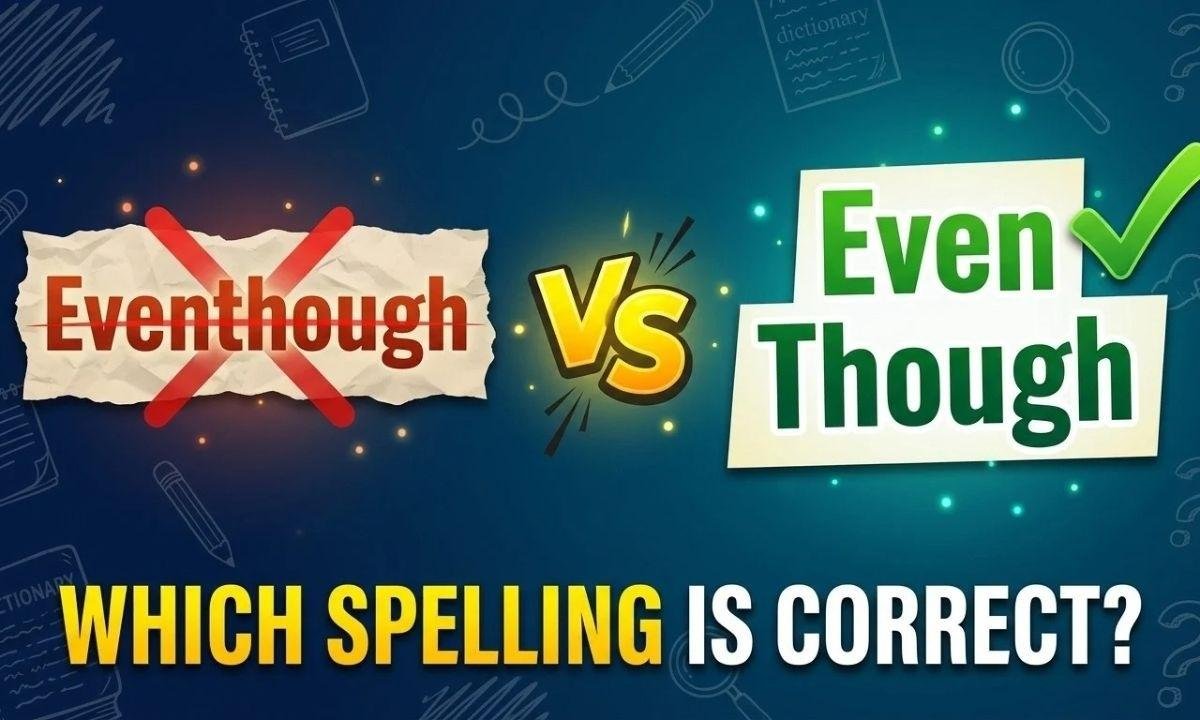
The correct spelling is even though, written as two words. “Eventhough” is a common misspelling and is not accepted in standard English. Even though is a subordinating conjunction that means “despite the fact that,” and it introduces a fact that contrasts with the main clause.
The confusion is understandable, because the two words are spoken together without a pause. This guide explains the rule, shows how to use the phrase in real sentences, and covers common mistakes, alternatives, and memory tricks. Fast typing and the way we speak make the slip easy to repeat. Knowing the difference helps your writing look careful and credible.
Eventhough vs Even Though
Only one of these forms is correct.
- Correct: Even though it was late, we kept working.
- Incorrect: Eventhough it was late, we kept working.
Standard dictionaries treat “even though” as a two-word phrase. They do not list “eventhough” as an accepted variant, so you should use two words in every kind of writing, from emails to essays.
Even Though Meaning
“Even though” means “despite the fact that” or “although, and this is true.” It links a true, often surprising fact to the main statement. Merriam-Webster defines “although” as “in spite of the fact that” and gives “even though” as an equivalent.
The word “even” adds emphasis, so “even though” usually sounds a little stronger than “though” or “although.”
- She smiled even though she was nervous.
- Even though the room was crowded, the speaker stayed calm.
The Grammar Rule Explained Simply
“Even though” is a subordinating conjunction. It begins a subordinate clause, which needs a subject and a verb, and it cannot stand alone as a sentence.
- Write it as two words.
- Follow it with a subject and a verb.
- Place the clause at the start of the sentence or after the main clause.
Comma use: When the “even though” clause comes first, add a comma after it. When it comes second, you usually do not need one.
- Even though the bus was late, I arrived on time.
- I arrived on time even though the bus was late.
Unlike “though,” the phrase “even though” does not go at the end of a sentence. “It was cold, though” is natural. “It was cold, even though” is not.
Table of Comparison: Eventhough vs Even Though
| Form | Status | Function | Example |
| Even though | Correct, standard | Subordinating conjunction meaning “despite the fact that” | Even though he was tired, he finished the report. |
| Eventhough | Incorrect, nonstandard | None in standard English | Eventhough he was tired, he finished the report. (wrong) |
Why This Tiny Spelling Error Matters More Than You Think
A single misspelling looks small, but readers notice it. In a cover letter, a class essay, or a business email, it can suggest that the text was rushed or not proofread.
The error also appears in a conjunction, a word that appears in many sentences. A writer who joins it incorrectly once is likely to repeat the mistake, so the problem tends to show up several times in a long document.
The Root of the Confusion: Why “Eventhough” Feels Right but Isn’t
Several habits push writers toward the one-word form. In speech, “even though” sounds like a single unit with one stress pattern. We also see many joined words in English, such as “nevertheless” and “although,” so a fused spelling can seem plausible.
Fast typing adds to the problem. When your fingers skip the space, the error looks natural on screen. The feeling that “eventhough” looks right is only familiarity, not a rule.
Why the Ear Tricks the Eye: Pronunciation vs. Spelling
Spoken English does not leave gaps between most words. “Even though” flows as one rhythm, much like “a lot” or “all right,” which also cause spelling errors.
Spelling follows convention, not sound. The two-word form is the convention for this phrase. A helpful habit is to say each word separately in your head as you write: “even” plus “though.”
A Quick Look Back: Origin & Historical Usage of “Even Though”
The phrase combines two older words. According to Merriam-Webster, “though” comes from Middle English and is of Scandinavian origin, related to Old Norse thō, and it was in use before the 12th century. The same dictionary traces “although” to Middle English “al” plus “though,” with a first known use in the 14th century.
“Even” works as an intensifier in front of “though.” The result is a phrase made of two words that each keep their own job, which helps explain why it has stayed written as two words.
Why “Eventhough” Will Never Be Correct: Linguistically or Grammatically
It is fair to ask why “although” fused into one word but “even though” did not. Words become standard compounds through long, widespread use in edited writing and in dictionaries, not through sound alone. “Eventhough” has not reached that point.
There is also a grammatical reason to keep the words apart. “Even” is a separate adverb that can modify other words too. Because it keeps that independent role, the two-word spelling matches how the phrase actually behaves. Language does change, but no reputable reference currently accepts the fused form, so you should treat it as an error.
Linguistic Insight: Why Word Separation Matters
A quick test shows that “even” stands apart. It combines with other conjunctions in the same way:
- Even though she knew the answer, she stayed quiet.
- Even if she knew the answer, she would stay quiet.
- Even when she knew the answer, she stayed quiet.
Each phrase shifts the meaning while “even” stays constant. If you wrote “eventhough,” you would hide this pattern, and you would also have to write “evenif” and “evenwhen,” which no one does. The spaces show the structure.
Common Myths & Misconceptions About “Eventhough”
- Myth: “Eventhough” is a British spelling. It is not accepted in British or American English.
- Myth: It is fine in casual writing. Casual writing has its own shortcuts, such as “tho,” but a run-together “eventhough” is simply a typo.
- Myth: Both forms mean different things. They do not. Only one is a real word.
- Myth: Many people write it, so it must be correct. Frequency of an error does not make it standard.
- Myth: Spellcheck would have flagged it. Many tools do flag it, but not always, and a flag only helps if you read it.
How to Use “Even Though” Naturally in Sentences
Use it when a fact seems to work against the main action, and you want to stress the contrast.
- The team won even though two players were injured.
- Even though I studied for weeks, the exam was difficult.
- He still calls his grandmother every Sunday, even though he lives abroad.
Do not use it for something uncertain. For a hypothetical, use “even if” instead.
- Fact: Even though it rained, we walked home.
- Possibility: Even if it rains, we will walk home.
Fix Your Writing Instantly: Real-Life Examples
Here are everyday situations where the error appears, with fixes.
- Email: ~~Eventhough~~ Even though the deadline has passed, we can still review your file.
- Social post: I went to the gym ~~eventhough~~ even though I felt sleepy.
- Essay: ~~Eventhough~~ Even though the study was small, its results were clear.
- Résumé: I completed the project on time ~~eventhough~~ even though the team was short-staffed.
Common Mistakes and How to Fix Them
Writing It as One Word
- Incorrect: I stayed home eventhough I felt fine.
- Correct: I stayed home even though I felt fine.
Using “Even Though” for an Uncertain Situation
- Incorrect: Even though it rains tomorrow, we will go.
- Correct: Even if it rains tomorrow, we will go.
Ending a Sentence With “Even Though”
- Incorrect: The food was great, even though.
- Correct: The food was great, though.
Forgetting the Comma After an Opening Clause
- Incorrect: Even though he tried he failed.
- Correct: Even though he tried, he failed.
Adding “But” After the Clause
- Incorrect: Even though she was tired, but she kept going.
- Correct: Even though she was tired, she kept going.
Quick Grammar Check: Smart Alternatives to “Even Though”
Several words can replace “even though,” but they differ in strength and structure.
| Alternative | Notes | Example |
| Although | Very close in meaning, slightly less emphatic | Although it was cold, we walked. |
| Though | Common in speech, can also end a sentence | Though it was cold, we walked. |
| Despite the fact that | Formal, longer | Despite the fact that it was cold, we walked. |
| Whereas / while | Contrast between two facts, not surprise | She likes tea, whereas he likes coffee. |
| Even so | Adverb phrase, begins a new sentence | It was cold. Even so, we walked. |
Note that “despite” and “in spite of” are prepositions, so they take a noun or gerund: “Despite the cold, we walked.”
Even Though Slang
In texting and social media, people shorten the phrase to “even tho” or just “tho.” This is informal and acceptable among friends, but it does not belong in school work, business writing, or published articles.
Do not confuse these shortcuts with “eventhough.” The first is an intentional informal abbreviation. The second is an accidental spelling error.
The Digital Factor: Autocorrect, Spellcheck & Internet Trends
Autocorrect and spellcheck tools help, but they are not reliable proof. Many tools underline “eventhough,” yet others may leave it alone, and autocorrect can sometimes change a word you meant to type.
The internet also spreads the error. Quick posts, comments, and captions rarely get proofread, so a wrong form can look common simply because it appears often. Treat online frequency as a reason for caution, not as evidence of correctness. Reading your text once before you publish catches most slips.
The Global View: Do Other Languages Merge Similar Phrases?
Languages handle this idea in different ways. Spanish uses the single word aunque, and German uses obwohl. French uses two-word phrases such as bien que and même si.
Learners whose first language has a one-word equivalent may be tempted to join the English words. This is only a possible influence, not a rule. In English, the two-word form is the standard, whatever your first language is.
Expert Opinion: What Grammar Authorities Agree On
Dictionaries and learning resources describe “even though” as a conjunction that introduces a contrast, and they present it as two words. Learner guides add that it is a little more emphatic than “although.” Writing tools and grammar blogs also label “eventhough” as a misspelling.
Sources vary slightly on the comma, with some advising no comma when the clause follows the main clause. That is a style preference, not a rule that changes the spelling.
Real Costs of Using the Wrong Form
The error rarely causes confusion, but it carries costs:
- It can lower a reader’s trust in your attention to detail.
- It may lose marks in exams, assignments, and professional writing tests.
- It can weaken a job application, where small errors stand out.
- It creates extra editing work for teams and publishers.
Why Getting It Right Boosts Credibility and Confidence?
Writers who know the rules write faster and second-guess less. Correct spelling signals care, which makes readers more willing to trust your message.
Mastering a small rule like this one also builds habits that carry over to other commonly confused forms, such as “a lot,” “all right,” and “maybe” versus “may be.”
Tricks to Remember the Correct Form (Mnemonic Magic)
- Swap test: Replace the phrase with “even if” or “even when.” If the swap works, “even” stands alone, so keep the space.
- Two ideas, two words: “Even” adds emphasis and “though” adds contrast. Two jobs, two words.
- Say it slowly: Pronounce “even” and “though” separately before typing.
- Look for the gap: Picture a small bridge between the words, which is the space.
Self Assessment
Choose the correct option in each sentence.
- She joined the call (eventhough / even though) she felt unwell.
- (Even though / Even if) it snows tomorrow, the match will go ahead.
- We lost the game, (even though / though).
- (Even though it was late / Even though it was late,) we stayed.
- Which is a formal alternative: “even tho” or “despite the fact that”?
Answers: 1. even though. 2. Even if, because the snow is only possible. 3. though, because “even though” cannot end a sentence. 4. Even though it was late, with a comma. 5. Despite the fact that.
Frequently Asked Questions
Is it “eventhough” or “even though”?
It is “even though,” written as two words. “Eventhough” is a misspelling.
What does “even though” mean?
It means “despite the fact that.” It introduces a true fact that contrasts with the main clause, often with extra emphasis.
Is “even though” the same as “although”?
They are very close in meaning and can often be swapped. “Even though” is usually a little stronger and more emphatic.
Do you put a comma before “even though”?
Usually not, when the clause follows the main clause. When “even though” begins the sentence, put a comma after the whole clause.
What is the difference between “even though” and “even if”?
“Even though” refers to something that is true. “Even if” refers to something that may or may not happen.
Can “even though” go at the end of a sentence?
No. Only “though” can end a sentence, as in “It was expensive, though.”
Is “even tho” acceptable?
Only in informal texting or social posts. In formal writing, use “even though.”
Conclusion
Always write “even though” as two words. It is a subordinating conjunction meaning “despite the fact that,” and “eventhough” is a misspelling in every context. Use “even though” for real facts, “even if” for possibilities, and “though” if you want a word that can end a sentence. A quick swap test with “even if” will help you remember the space.