
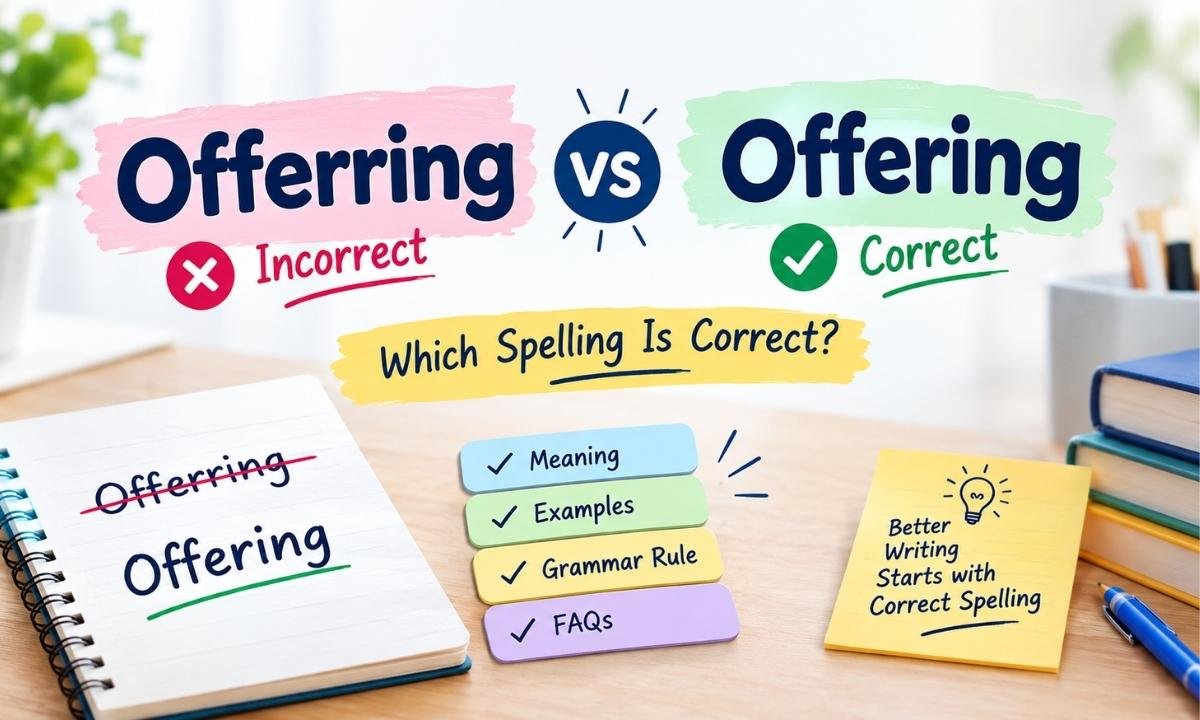
Many careful writers pause the moment they type the -ing form of “offer.” Is it “offering” or “offerring”? This small spelling slip shows up often in emails, resumes, business proposals, and web content, and it sends thousands of people to search engines every single month.
The confusion usually starts with words like “preferring” or “referring,” which really do double their final consonant. If you’re comparing Offerring vs Offering, this guide breaks down the correct spelling, the grammar rule behind it, and how to use “offering” naturally and confidently in your own writing.
Quick Answer: Offering Is Correct
Offering is the correct spelling. Offerring is a misspelling and does not appear in any standard dictionary. The word comes from the base verb offer, and adding the suffix -ing keeps a single r, because the stress in offer falls on the first syllable rather than the second.
What Does “Offering” Mean?
As a verb form, offering describes the ongoing action of giving, presenting, or making something available, as in “the store is offering a discount this week.” As a noun, an offering refers to the thing itself that is presented or provided, such as a gift, a donation, a proposal, or a product. Both senses share the same core idea: something is being put forward for someone else to accept, consider, or use.
Why Is “Offerring” Incorrect?
People add the extra r mostly by analogy with similar-looking verbs such as prefer, refer, and occur. Those words double their final consonant before -ing because their stress lands on the last syllable: pre-FER becomes preferring, re-FER becomes referring, oc-CUR becomes occurring. Offer, however, is stressed on the first syllable, OFF-er, so English spelling convention does not double the final consonant. The base word offer and its -ing form offering follow one consistent pattern, and there is no version of the word that correctly uses two r’s.
The Spelling Rule Behind “Offering”
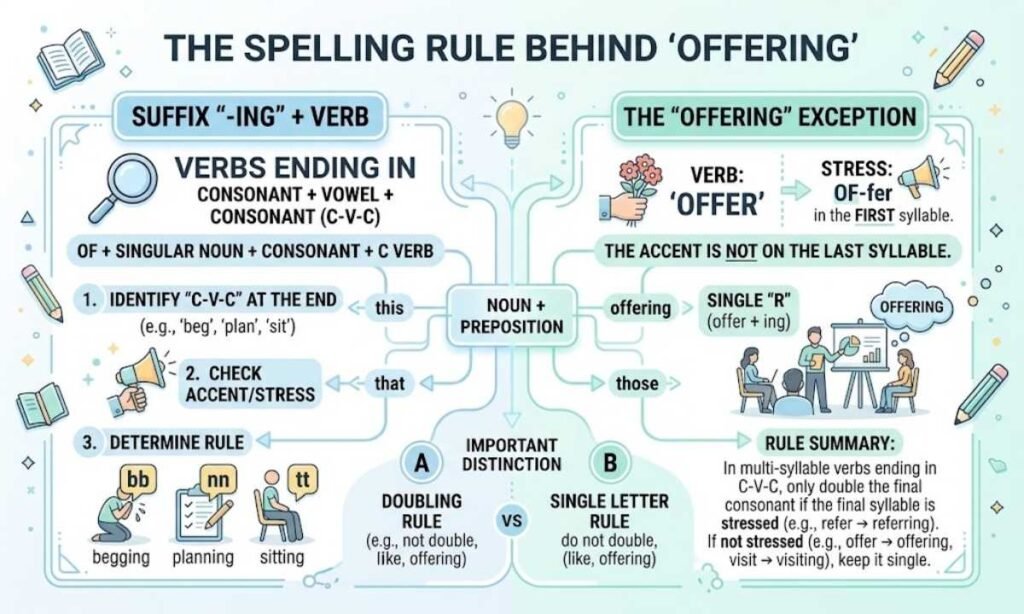
English follows a fairly reliable pattern for adding vowel suffixes like -ing or -ed to words that end in a single consonant after a single vowel. For a multi-syllable word, the final consonant is doubled only when the stress falls on the last syllable. Compare offer (stress on the first syllable) with prefer (stress on the last syllable). Offer keeps one r in offering and offered, while prefer becomes preferring and preferred. The same pattern explains listen becoming listened and open becoming opening, rather than listenned or openning.
Offerring vs Offering: Quick Comparison
| Feature | Offerring | Offering |
| Spelling status | Incorrect | Correct |
| Base word | Offer | Offer |
| -ing form | Offerring (wrong) | Offering (right) |
| Found in dictionaries | No | Yes |
| Standard English usage | Never | Always |
| Meaning | None | Giving, presenting, or providing something |
Offer, Offered, Offering, Offerings: The Full Word Family
Understanding the whole word family makes the spelling easier to remember, since every form keeps a single r.
| Word | Part of Speech | Example Sentence |
| Offer | Base verb / noun | They made a generous offer for the house. |
| Offered | Past tense verb | She offered her seat to the elderly passenger. |
| Offering | -ing verb form / noun | The company is offering free shipping this month. |
| Offerings | Plural noun | The bakery has new offerings on its autumn menu. |
The Origin and Grammar of “Offering”
The verb offer traces back through Old English and Latin roots tied to the idea of bringing something forward. Grammatically, offering can work as a present participle (“she is offering advice”), a gerund acting as a noun (“offering feedback is part of the job”), or a standalone noun (“a job offering”).
This flexibility is one reason the word appears so often in business writing, marketing copy, and everyday conversation, and it is also why getting the spelling right matters across so many contexts.
How “Offering” Is Used in Different Contexts?
In business and marketing, an offering usually means a product or service a company provides, as in “our software offering now includes analytics.” In finance, a public offering refers to shares a company sells to investors.
In religious or ceremonial settings, an offering is something given as a gift or act of devotion. In everyday conversation, offering simply describes providing help, advice, or an item to someone else. The spelling never changes between these uses, only the meaning shifts with context.
Synonyms and Related Words for “Offering”
Depending on context, offering can be replaced with words such as proposal, presentation, contribution, donation, provision, gift, or submission. Related verb forms include providing, presenting, and supplying. Recognizing these synonyms can help writers vary their sentences while keeping the same intended meaning, and it also reinforces that offering always relates to something being given or made available.
Is “Offerring” Ever Correct in Formal Writing?
No. Offerring is not accepted in formal writing, academic work, resumes, or professional emails. Style guides and dictionaries consistently list offering as the only correct form, and using the misspelled version in a resume or business proposal can come across as a careless error to a hiring manager or client.
American vs British English: Is “Offering” Spelled the Same?
Yes. Unlike words such as travelling and traveling, which differ between British and American English, offering keeps the same single-r spelling in both varieties. Because the stress in offer sits on the first syllable in every dialect of English, there is no regional version of the word that doubles the r.
Common Mistakes With “Offering” and Related Words
The extra-r mistake is not limited to offering. Writers sometimes also write offerred instead of offered, or confuse offering with offerings when only one item is meant. A useful check is to say the base word aloud: if the stress falls on the first syllable, as in OFF-er, the consonant stays single through every form of the word.
Why This Spelling Mistake Is So Common Online
Search data shows that offerring is one of the most frequently mistyped -ing forms in English. Fast typing, autocorrect tools that sometimes miss the error, and visual pattern-matching with words like preferring all contribute to the mix-up. Many non-native speakers also learn the doubling rule first and apply it too broadly, assuming every two-syllable verb doubles its final consonant before -ing.
Quick Tips for Writers to Avoid the Offerring Mistake
A simple memory trick removes the guesswork: OFFER + ING equals OFFERING, never OFFER + RING. Say the word aloud and notice the stress lands on the first syllable, which signals a single consonant. Running a spell-checker before publishing content, reading a sentence back slowly, and keeping a short list of frequently confused word pairs are all practical habits that prevent this error from slipping into finished writing.
Frequently Asked Questions
Is “offerring” or “offering” correct?
Offering is correct. Offerring is a misspelling and is not recognized in standard English dictionaries.
How do you spell the -ing form of offer?
It is spelled offering, with a single r, because the stress falls on the first syllable of offer.
Why do people spell it offerring by mistake?
Writers often confuse it with words like preferring and referring, which do double their final consonant.
Does offer ever become offerring in any context?
No. There is no correct context, formal or informal, where offerring is the right spelling.
Is offering a verb or a noun?
It can be both: a verb form of offer, and a noun meaning something presented or provided.
What is the past tense of offer?
The past tense is offered, again with a single r, following the same stress-based spelling rule.
Is the spelling of offering different in British and American English?
No, offering is spelled the same way in both British and American English.
Is offerred a correct spelling of offered?
No, offerred is incorrect. The correct past tense form is offered, with one r.
What is the plural of offering?
The plural form is offerings, used for multiple items, gifts, or contributions.
Conclusion
Offering is the only correct spelling of the -ing form of offer, and offerring should always be avoided in writing of any kind.
The rule comes down to one simple fact: offer is stressed on its first syllable, so its final consonant is never doubled. Keep the mnemonic OFFER + ING in mind, and this common spelling slip becomes easy to avoid for good.