
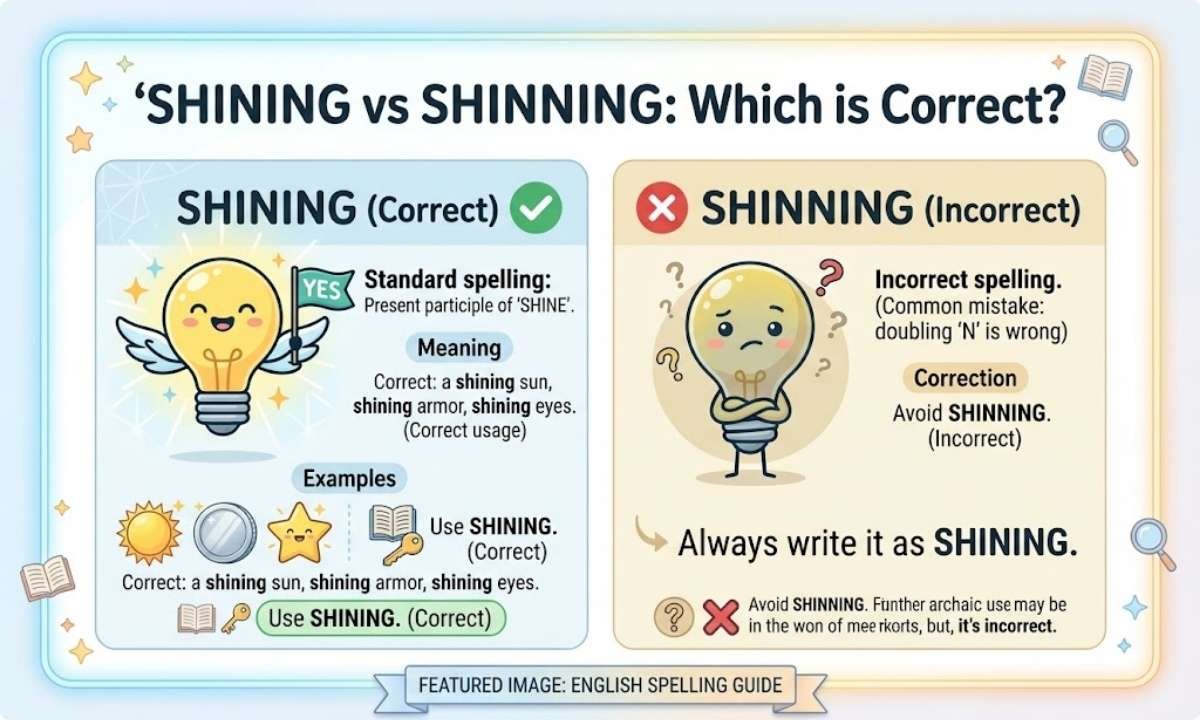
Many English learners and even native speakers stumble on shinning vs shining because the two words look almost identical but come from completely different verbs. One describes light, brightness, or excellence, while the other describes climbing something with your hands and legs.
This guide breaks down the real difference, explains the grammar rule behind the spelling, and shows you exactly when to use each word so you never second guess yourself again.
Quick answer: Shining is the correct spelling when you mean giving off light, looking bright, or excelling at something. Shinning is a separate, valid word that comes from the verb shin, meaning to climb by gripping with your hands and legs.
Shinning vs Shining: The Quick Answer
Shining is the present participle of the verb shine. It is used constantly in everyday English to describe sunlight, stars, polished surfaces, and outstanding performance.
Shinning is the present participle of the much rarer verb shin, which means to climb a pole, tree, or rope using only your arms and legs. It is grammatically correct but appears far less often in daily writing.
The two words are not variant spellings of the same idea. They are the ing forms of two entirely different base verbs, and that single fact solves almost every confusion around them.
Understanding the Root Words: Shine and Shin
To use either word correctly, it helps to look at where each one comes from.
● Shine is a verb meaning to emit light, reflect brightness, or perform exceptionally well.
● Shin is a verb meaning to climb quickly by using the hands and legs, often in reference to poles, trees, ropes, or fences.
Because shine ends in a silent e, you simply drop the e and add ing, giving you shining. Because shin ends in a single consonant after a short vowel, the final letter doubles before adding ing, giving you shinning.
What Does Shining Mean
Shining covers several related meanings in modern English, all connected to light or excellence.
● Giving off or reflecting light, such as the sun or a polished shoe
● Being bright, radiant, or glowing
● Excelling, standing out, or performing impressively in a role or task
● Describing someone admired as an outstanding example, as in a shining example
Examples in Sentences
● The sun is shining through the kitchen window this morning.
● The stars were shining clearly over the quiet valley.
● Her newly polished shoes were shining under the office lights.
● He is shining in his first year as team leader.
● She has always been a shining example of patience and hard work.
What Does Shinning Mean?
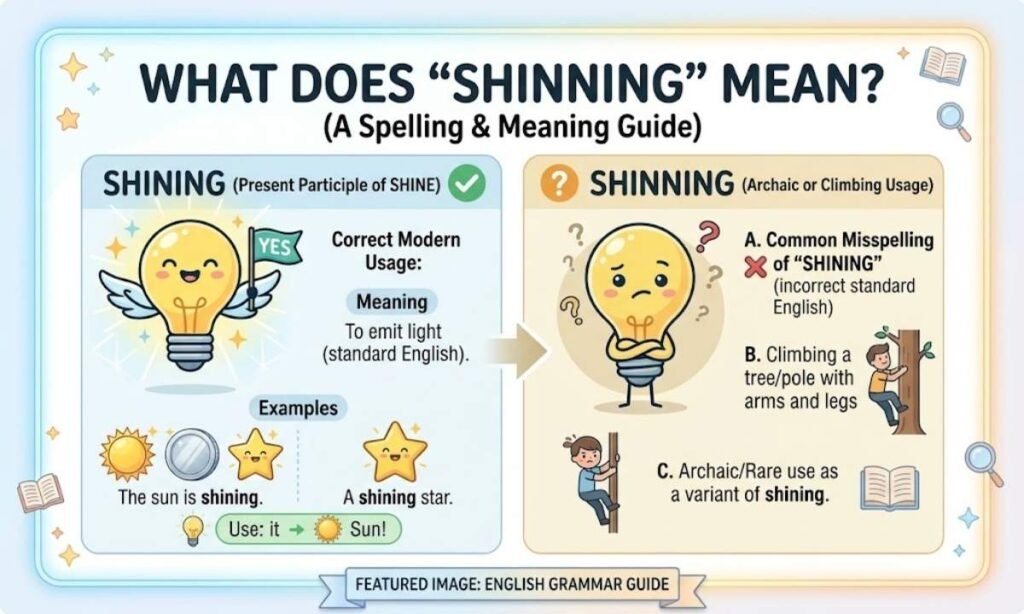
Shinning is far less common but still a legitimate English word. It describes the physical act of climbing by gripping a surface with the arms and legs rather than using tools, ladders, or ropes with proper equipment.
Examples in Sentences
● The boy was shinning up the old oak tree in the backyard.
● The firefighter was shinning up the pole during the training drill.
● The climber began shinning up the rope toward the top of the gym.
You will most often encounter shinning in descriptive writing, adventure stories, sports commentary, or instructional content about climbing techniques.
Shining vs Shinning: Side by Side Comparison
| Feature | Shining | Shinning |
| Base verb | Shine | Shin |
| Core meaning | Giving off light or excelling | Climbing with hands and legs |
| Frequency of use | Very common | Rare |
| Correct for brightness | Yes | No |
| Correct for excellence | Yes | No |
| Correct for climbing | No | Yes |
| Spelling rule applied | Drop silent e, add ing | Double final consonant, add ing |
Grammar Rule: Why Shine Does Not Double Its Final Letter
English spelling rules explain exactly why these two words end up looking so different despite being built the same way.
When a verb ends in a silent e, that e is dropped before adding ing. This is why shine becomes shining, the same pattern seen in write becoming writing or drive becoming driving.
When a short verb ends in a single consonant preceded by a single short vowel, the final consonant is doubled before adding ing. This is why shin becomes shinning, the same pattern seen in run becoming running or sit becoming sitting.
Once you recognize which rule applies to which base word, the correct spelling becomes automatic rather than something you need to memorize by rote.
Shining and Shinning in Real Sentences
Seeing both words used correctly side by side makes the contrast easy to internalize.
Incorrect: The sun is shinning brightly over the beach.
Correct: The sun is shining brightly over the beach.
Incorrect: The stars are shining up the flagpole for a bet.
Correct: The stars are shining above us tonight, and the boy is shinning up the flagpole for a bet.
Incorrect: Her shoes were shinning after she polished them.
Correct: Her shoes were shining after she polished them.
Common Mistakes to Avoid
● Writing shinning when describing light, sunshine, or brightness
● Assuming every short verb automatically doubles its final consonant
● Forgetting that shine keeps a single n because of the silent e rule
● Mixing up shin the body part with shin the verb meaning to climb
● Treating shinning as a spelling mistake instead of a valid, separate word
Synonyms for Shining and Shinning
Expanding your vocabulary around both words helps reinforce the distinction.
Synonyms for shining: gleaming, glowing, radiant, sparkling, glistening, beaming, outstanding, exceptional.
Synonyms for shinning: scaling, scrambling up, climbing, clambering, swarming up.
Shining and Shinning in Idioms and Phrases
Shining appears in several well known English expressions, including shining example, shining star, shining moment, and knight in shining armor. These phrases almost always describe excellence, admiration, or brightness.
Shinning does not appear in common idioms, which is another reason it feels unfamiliar to most readers. It stays close to its literal, physical meaning of climbing.
Pronunciation Differences Between Shining and Shinning
The two words are pronounced differently, which can help you choose the right spelling when speaking or transcribing audio.
Shining is pronounced with a long i sound, similar to the word shine itself.
Shinning is pronounced with a short i sound, similar to the word shin, the body part.
Listening for that vowel sound is a quick, practical way to confirm which word you actually mean before you write it down.
How Dictionaries Define Shining and Shinning?
Standard English dictionaries list shining as the present participle and adjective form of shine, defined around light, brightness, and excellence. Shinning is listed separately as the present participle of shin, defined specifically around climbing using the limbs.
Because both entries exist independently, neither word is considered a misspelling of the other. They simply serve different purposes in the language.
Quick Practice Exercise
Fill in the blank with either shining or shinning.
| Sentence | Correct Word |
| The moon is ___ brightly tonight. | Shining |
| The boy was ___ up the tree to get his kite. | Shinning |
| Her trophy was ___ on the shelf. | Shining |
| The climber kept ___ up the rope during practice. | Shinning |
| She is ___ as the new manager of the store. | Shining |
How to Remember the Difference Forever?
The simplest memory trick ties each word back to its base verb.
Shine means light, so shining means giving off light.
Shin means climb, so shinning means climbing with hands and legs.
If you are ever unsure, ask yourself whether the sentence is about brightness or about climbing. That single question resolves the confusion almost every time.
Frequently Asked Questions
Is shinning a correct word?
Yes, it is a real and correctly spelled word, though it is used far less often than shining.
Is shinning the correct spelling of shining?
No, they are different words with different meanings, not alternate spellings of each other.
Why is shining spelled with one n?
Because shine ends in a silent e, that e is dropped before adding ing, keeping a single n.
What does shinning mean?
It means climbing a pole, tree, or rope using the hands and legs rather than equipment.
What is the difference between shine and shin?
Shine relates to light and excellence, while shin relates to climbing and the lower leg.
Is shinning used in American English?
Yes, though rarely, mainly in descriptive or narrative writing about climbing.
Is shinning a British spelling of shining?
No, this is not a regional spelling difference, since both words exist in American and British English with their own meanings.