
Many English learners and even native speakers pause when typing this word quickly, wondering whether it ends in “each” or “ach.” This small mix up happens because the pronunciation does not always match the way a word is written in English.
In this guide you will find the correct spelling, the meaning of the word, common mistakes people make, useful examples, and answers to frequently searched questions. By the end, you will never second guess this word again.
Speach or Speech: The Correct Spelling Explained
The correct spelling is “speech.” The version “speach” is a spelling error that appears often because of how the word sounds when spoken aloud.
Speech refers to the act of speaking, a formal talk delivered to an audience, or a person’s particular manner of talking. It is used constantly in daily conversation, academic writing, journalism, and public communication.
The word “speach” carries no accepted meaning in any dictionary. Autocorrect tools and spell checkers will flag it instantly, and using it in professional or academic writing can hurt your credibility.
What Does Speech Actually Mean?
The term carries a few related meanings depending on context.
- Spoken communication: the general act of talking or expressing thoughts verbally.
- A formal talk or address: a prepared message delivered to a group, such as a graduation speech or a political address.
- A manner of speaking: the distinct way an individual pronounces words, including accent, tone, or rhythm.
All three meanings share the same root idea: verbal expression, whether casual or structured.
Why Do People Write Speach Instead of Speech?
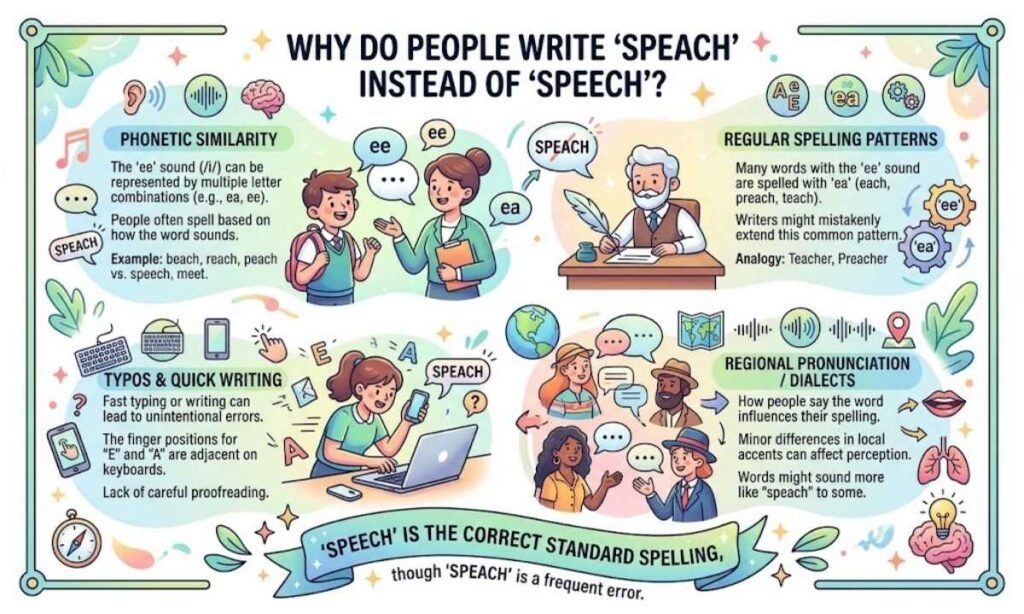
This mistake is not random. It follows a pattern found across several English words with similar sounds.
- English contains many words where “ea” and “ee” produce nearly identical sounds, such as “teach,” “reach,” and “beach.”
- Because those words are spelled with “ea,” learners assume “speech” follows the same rule.
- Pronunciation alone is an unreliable guide for spelling in English, since the language borrows patterns from many source languages.
- Fast typing and voice-to-text tools can also introduce this error without the writer noticing.
Recognizing this pattern helps prevent the mistake from repeating in future writing.
Speech vs Speach at a Glance
| Spelling | Correct or Incorrect | Explanation |
| Speech | Correct | Standard spelling used in all English dictionaries and formal writing |
| Speach | Incorrect | A frequent misspelling with no dictionary listing |
Whenever you are unsure, remember that the double “e” version is the one accepted in every English speaking country.
Simple Tricks to Remember the Spelling
A quick memory trick makes this word easy to recall permanently.
- Think of the phrase “a speaker gives a speech,” linking the related word “speaker” to reinforce the double “e.”
- Picture the word “screech,” which shares the same “ee” sound and spelling pattern.
- Before submitting any document, run a quick scan for “speach” using the find function in your word processor.
Small habits like these prevent recurring spelling slips in reports, emails, and essays.
Speech Used in Everyday Sentences
Seeing the word in context makes correct usage easier to internalize.
- School setting: The student practiced her speech before presenting it to the entire class.
- Workplace setting: The manager delivered a short speech to welcome new employees.
- Formal setting: The ambassador’s speech addressed several international policy concerns.
- Casual conversation: His speech was full of humor, keeping everyone entertained.
Notice how the word functions the same way in every sentence, always as a noun describing spoken expression.
Common Phrases Built Around Speech
The word appears in many well known expressions across formal and informal English.
- Public speech
- Freedom of speech
- Graduation speech
- Wedding speech
- Political speech
- Motivational speech
Each phrase keeps the identical spelling regardless of the setting or formality level.
Where the Word Speech Comes From
Understanding the origin of a word often makes its spelling feel less arbitrary.
The word traces back to Old English “sprǣc” or “spæc,” related to the verb “sprecan,” meaning to speak. Over centuries, the pronunciation and spelling evolved through Middle English before settling into the modern form used today. This historical shift explains why the spelling does not perfectly mirror its sound, a common trait among words with Germanic roots.
Idioms and Expressions That Use Speech
Beyond formal definitions, the word also appears inside idiomatic expressions.
- “Give a speech” means to deliver a prepared talk.
- “Part of speech” refers to grammatical categories such as nouns, verbs, and adjectives.
- “Speech is silver, silence is golden” is a proverb valuing thoughtful silence over unnecessary talking.
These expressions show how deeply embedded the word is in everyday English culture.
Words Often Confused With Speech
Several related words cause additional confusion alongside the speech versus speach issue.
- Speak: the verb form, as in “please speak clearly.”
- Speaker: the person delivering the talk.
- Speeches: the plural form, never written as “speaches.”
- Speechless: an adjective describing someone unable to talk due to shock or emotion.
Learning this word family together strengthens both spelling accuracy and vocabulary range.
Speech in Academic and Professional Writing
In essays, resumes, presentations, and business communication, spelling accuracy directly affects how a reader perceives competence. A misspelled word like “speach” inside a formal document can distract from otherwise strong content and reduce trust in the writer’s attention to detail.
Editing tools, style guides, and proofreading passes are especially useful before submitting academic papers or workplace reports that reference public speaking or communication skills.
Handy Tools to Catch This Mistake Instantly
Several simple resources help writers avoid this error permanently.
- Built in spell checkers in word processors such as Google Docs and Microsoft Word.
- Browser extensions designed for grammar and spelling review.
- Dictionary apps that confirm correct spelling before publishing content.
- Reading text aloud slowly, which often reveals awkward or incorrect wording.
Combining these tools with the memory tricks above creates a reliable long term solution.
Speech vs Speak: Understanding the Difference
Although related, these two words serve different grammatical roles.
- Speech is a noun, referring to the act or product of speaking.
- Speak is a verb, describing the action of talking.
Example: “She will speak at the event, and her speech is expected to last ten minutes.” This sentence shows both words working together correctly within the same context.
Is Speach a Word in English
No standard English dictionary lists “speach” as a valid word. It does not appear in Merriam Webster, Oxford, or Cambridge dictionaries. In formal writing, always default to “speech,” and treat any instance of the alternate spelling as a typing error rather than a stylistic choice.
Does Spelling Change Between American and British English
Unlike many words with regional spelling differences, such as “color” versus “colour,” this word remains identical across English varieties.
- American English uses “speech.”
- British English uses “speech.”
- Canadian and Australian English also use “speech,” with no accepted regional variant of “speach.”
This consistency makes the word easier to remember once the correct form is learned.
What Is the Plural of Speech?
| Singular | Plural | Correct Usage Example |
| Speech | Speeches | The teacher reviewed several speeches before the competition |
| Speach | Not applicable | This form does not exist in standard English |
The plural always changes “ch” to “ches,” similar to words like “church” becoming “churches.”
Frequently Asked Questions
Is it speach or speech?
The correct spelling is speech. Speach is a common misspelling with no dictionary listing.
Is speach ever correct in any context?
No, speach is never considered correct in formal or informal English writing.
How do you spell speech correctly?
Speech is spelled with a double “e,” following the pattern s p e e c h.
What does speech mean?
Speech means spoken communication, a formal talk, or a person’s manner of speaking.
Is speech a noun or a verb?
Speech is a noun, while speak is the related verb form.
What is the plural of speech?
The plural of speech is speeches, not speaches.
Is speech spelled the same in American and British English?
Yes, speech keeps the identical spelling across American, British, Canadian, and Australian English.
Conclusion
The correct spelling is always “speech,” never “speach.” The confusion stems from pronunciation patterns shared with similar sounding words, but dictionaries, style guides, and professional writing consistently confirm the double “e” spelling.
Using the memory tricks, sentence examples, and word family knowledge shared above will help you avoid this mistake permanently in both casual and formal writing.