
Learning to spell well is one of the most useful skills a Year 6 student can build before heading into high school. Australian classrooms expect students to handle everyday words, tricky homophones, and longer academic vocabulary with confidence, and parents often search for a simple, organised word list to support home practice.
This guide brings together over 100 Australian Year 6 spelling words, grouped from easy to hard, along with spelling patterns, homophones, a spelling bee list, and a practical five day study plan. Whether you are a teacher preparing a weekly list or a parent helping with homework, this article gives you a ready to use resource.
Australian Year 6 Spelling Words at a Glance
Year 6 spelling in Australia builds on earlier phonics knowledge and pushes students toward more complex vocabulary, longer words, and subject specific terms used in science, history, and everyday writing.
What Spelling Skills Should Year 6 Students Learn?
Year 6 students should master multisyllable words, common prefixes and suffixes, silent letters, and homophones. They should also recognise word origins and apply spelling rules across different subjects confidently.
How Many Spelling Words Should a Year 6 Student Know?
Most Australian curriculum guides suggest 15 to 20 new words per week, meaning a Year 6 student should encounter roughly 500 to 700 words across the school year through structured lists.
What Makes a Word Difficult to Spell?
Words become difficult when they contain silent letters, unusual vowel patterns, borrowed spellings from other languages, or when they sound similar to other words with different meanings.
100+ Australian Year 6 Spelling Words
Below is a categorised bank of Year 6 spelling words ranging from foundational vocabulary to genuinely challenging terms.
Essential Year 6 Spelling Words
- Necessary, definitely, separate, environment, government
- Business, February, restaurant, vehicle, occasion
- Beautiful, favourite, neighbour, colour, opinion
Challenging Year 6 Spelling Words
- Conscience, embarrass, exaggerate, questionnaire, rhythm
- Sincerely, vacuum, privilege, immediately, mischievous
Difficult Multisyllable Words
- Extraordinary, unnecessary, disappearance, communication, temperature
- Responsibility, congratulations, characteristic, satisfactory
Commonly Misspelled Words
- Definitely, separate, receive, believe, achieve
- Accommodate, occurrence, argument, disappoint, tomorrow
Easy Year 6 Spelling Words to Practise First
Starting with familiar, high-frequency words builds confidence before tackling harder vocabulary.
Everyday School Spelling Words
Words like library, timetable, uniform, assembly, and holiday appear constantly in school communication, making them practical first choices.
High-Frequency Tricky Words
Words such as because, always, straight, through, and although trip students up due to irregular letter patterns despite frequent use.
Easy Words With Common Mistakes
Simple words like until, receive, and until often get misspelled because students rely on how the word sounds rather than how it is written.
Hard Year 6 Spelling Words for Advanced Students
Advanced spellers benefit from a stretch list that introduces academic and less common vocabulary.
Advanced Academic Words
Words including hypothesis, phenomenon, analysis, and vocabulary push students toward subject specific literacy needed in high school.
Long and Multisyllable Words
Words like Mediterranean, extraordinary, and unconstitutional require students to break syllables apart to spell accurately.
Silent Letter Words
Words such as knowledge, autumn, and Wednesday contain letters that are not pronounced, making memorisation essential.
Unusual Letter Patterns
Words like rhythm, colonel, and queue follow patterns borrowed from other languages, which do not match typical English phonics rules.
Year 6 Spelling Words by Spelling Pattern
Grouping words by spelling pattern helps students spot rules rather than memorising words one by one.
| Spelling Pattern | Example Words | Quick Tip |
| Silent Letters | knowledge, gnome, Wednesday | Say the word slowly and notice the silent letter |
| -tion and -sion | education, decision, celebration | -tion follows most consonants, -sion follows vowels |
| -ance and -ence | performance, difference, confidence | Check the related root word for a clue |
| -gue and -que | catalogue, antique, unique | Common in French-origin words |
| Hard and Soft C | circle, cactus, decide | Soft c usually appears before e, i, or y |
| Hard and Soft G | giant, garden, gymnastics | Soft g often appears before e, i, or y |
| ph and gh Words | phone, laugh, alphabet | ph and gh can both make an f sound |
| Complex Vowels | beautiful, neighbour, receive | Learn the rule i before e except after c |
| Double Consonants | occurrence, embarrass, necessary | Break the word into syllables to check doubling |
Silent Letters
Silent letter words are best learned through visual memory since sounding them out rarely helps spelling accuracy.
-tion and -sion
These endings sound almost identical, so students should link the spelling to the base word, such as decide to decision.
-ance and -ence
Students can check the correct ending by testing whether a related word ends in -ant or -ent.
-gue and -que
These French-origin endings appear in words like catalogue and antique, and simply need repeated exposure to stick.
Hard and Soft C
The letter c changes sound depending on the vowel that follows it, which is a useful early pattern to teach.
Hard and Soft G
Like soft c, the letter g softens before e, i, and y, as seen in giant and gym.
ph and gh Words
Both letter combinations can represent the f sound, which often confuses students during dictation tasks.
Complex Vowel Patterns
Words with ei and ie combinations are notorious for errors, making the classic spelling rhyme genuinely useful here.
Double Consonants
Doubling rules often depend on stress patterns within the word, so syllable awareness helps prevent errors.
Year 6 Spelling Words With Prefixes and Suffixes
Understanding word parts allows students to decode unfamiliar words instead of memorising each one separately.
Common Prefixes
Prefixes such as un-, dis-, re-, and mis- change meaning without altering the spelling of the root word, as in unnecessary and misunderstand.
Common Suffixes
Suffixes like -able, -ible, -ful, and -less attach to root words and often follow predictable spelling adjustments, such as dropping a final e.
How Word Parts Help With Spelling
Recognising roots, prefixes, and suffixes turns long words into manageable chunks, which is especially useful for words like disappointment.
Tricky Year 6 Homophones and Confusing Words
Homophones remain one of the biggest challenges in Year 6 writing because spellcheck tools cannot catch meaning-based errors.
| Homophone Pair | Meaning | Example Sentence |
| Their / There / They’re | Possession, location, contraction | Their bags are there, and they’re ready. |
| Your / You’re | Possession, contraction | Is that your book, or are you’re mistaken? |
| To / Too / Two | Direction, also, number | I want to go too, since we have two tickets. |
| Affect / Effect | Verb, noun | The weather can affect mood, and the effect lasts all day. |
| Principal / Principle | Person, rule | The principal explained the school’s main principle. |
| Accept / Except | Agree, exclude | I accept all answers except the last one. |
Their, There and They’re
These three words share a sound but serve completely different grammatical roles in a sentence.
Your and You’re
Your shows possession, while you’re is simply a contraction of you are.
To, Too and Two
To indicates direction, too means also or excessive, and two is the number.
Affect and Effect
Affect is usually a verb describing influence, while effect is usually the resulting noun.
Principal and Principle
A principal is a person or the main item, while a principle refers to a rule or belief.
Accept and Except
Accept means to receive or agree, while except means to exclude something.
Australian vs American Spelling Differences
Australian students often encounter both spelling systems online, so understanding the difference prevents confusion.
Common Australian and US Differences
Australian English favours colour, favourite, and realise, while American English uses color, favorite, and realize.
Which Spelling Should Students Use?
Australian curriculum guidelines expect students to use Australian spelling consistently in school work and NAPLAN style assessments.
Year 6 Spelling Bee Words
Spelling bees push students toward vocabulary slightly above their comfort zone in a fun, competitive setting.
Medium Words
Words like fortunate, hesitate, and continuous suit early rounds of a Year 6 spelling bee.
Hard Words
Words such as bureaucracy, silhouette, and reminiscent challenge stronger spellers in later rounds.
Challenge Words
Words like onomatopoeia, entrepreneur, and idiosyncrasy work well as final round tiebreakers.
Spelling Bee Preparation Tips
Practising aloud, breaking words into syllables, and reviewing word origins all improve spelling bee performance significantly.
20 Commonly Misspelled Words for Year 6 Students
Certain words appear on nearly every Year 6 error list across Australian schools.
Common Mistakes
Definitely, separate, receive, believe, achieve, accommodate, occurrence, argument, disappoint, tomorrow, necessary, embarrass, government, February, environment, business, vehicle, restaurant, neighbour, and privilege are frequent culprits.
Memory Tricks
Breaking words into smaller sounds, such as sep-a-rate, or using memory phrases helps these stubborn spellings stick.
How to Learn Year 6 Spelling Words Faster?
A structured routine speeds up spelling improvement more than random memorisation.
Look, Say, Cover, Write and Check
This classic method reinforces visual memory and immediate self correction after each attempt.
Break Words Into Parts
Splitting words into syllables or morphemes makes long words feel far less intimidating.
Learn Word Roots
Understanding Latin and Greek roots helps students guess spelling patterns in unfamiliar academic vocabulary.
Use Words in Sentences
Writing a word in an original sentence strengthens both spelling and vocabulary retention together.
Weekly Review
Revisiting the previous week’s list prevents forgetting and builds long term spelling memory.
A 5-Day Year 6 Spelling Practice Plan
A short daily routine keeps spelling practice manageable rather than overwhelming.
Day 1
Introduce the new word list and read each word aloud while noting tricky letters.
Day 2
Practise writing each word three times while saying the letters out loud.
Day 3
Use each word in a full sentence to reinforce meaning and spelling together.
Day 4
Complete a quick self-test, marking any misspelled words for extra review.
Day 5
Finish with a short spelling quiz and revisit only the words that were missed.
Printable Australian Year 6 Spelling Word List
A printable list makes it easy to practise offline without screen distractions.
Weekly Practice Lists
Splitting the full 100+ word bank into weekly sets of 15 to 20 words keeps practice realistic and sustainable across a term.
Year 6 Spelling Words by Difficulty Level
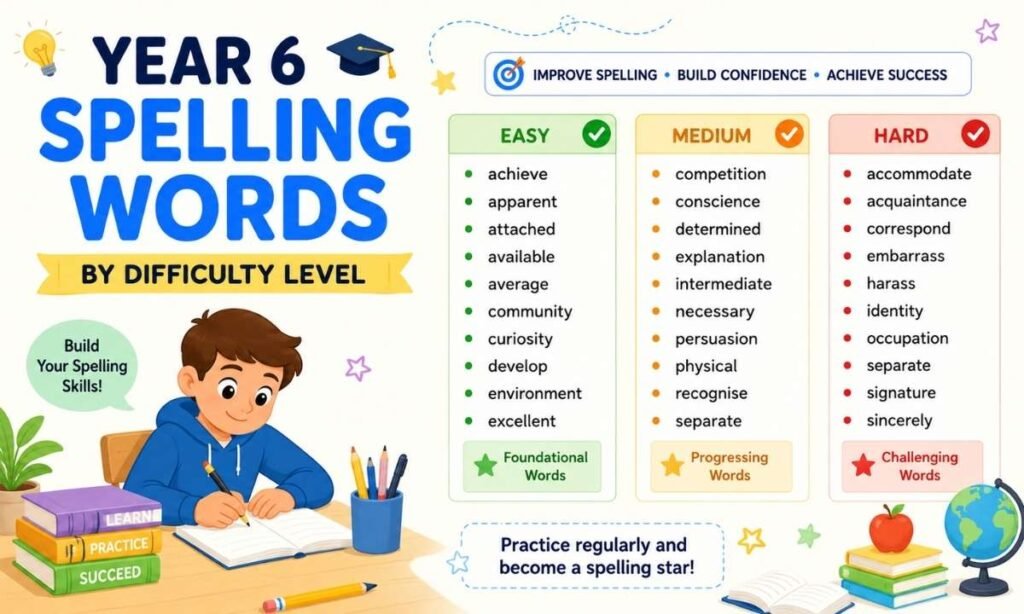
Sorting words by difficulty allows teachers to differentiate instruction easily.
Easy
Library, holiday, uniform, timetable, assembly
Medium
Necessary, separate, definitely, government, business
Hard
Rhythm, mischievous, questionnaire, embarrass, privilege
Expert
Onomatopoeia, entrepreneur, idiosyncrasy, bureaucracy, silhouette
Quick Year 6 Spelling Quiz
A short quiz helps confirm whether students have retained the words practised.
Choose the Correct Spelling
Ask students to pick the correct version between two similar looking spellings, such as recieve or receive.
Fill in the Missing Letters
Provide partial words such as sep_r_te and ask students to complete them correctly.
Answers
Receive is correct, and separate is the correctly completed word.
Frequently Asked Questions
What are the hardest Year 6 spelling words in Australia?
Words like rhythm, questionnaire, and mischievous are consistently ranked among the hardest by Australian teachers.
How can I help my child improve Year 6 spelling at home?
Use short daily practice sessions, the look say cover write check method, and regular word games.
Does the Australian curriculum have an official Year 6 spelling list?
There is no single official national list, but schools follow curriculum guidelines to select age-appropriate words.
What is the difference between Australian and American spelling?
Australian English uses forms like colour and realise, while American English uses color and realize.
How many spelling words should Year 6 students learn each week?
Most Australian classrooms use 15 to 20 new spelling words per week as a manageable target.
Are spelling bees useful for Year 6 students?
Yes, spelling bees build vocabulary, confidence, and word recognition in an engaging, competitive format.
What are common Year 6 homophone mistakes?
Their, there and they’re, along with your and you’re, are the most frequently confused homophones.
Final Thoughts
Mastering Australian Year 6 spelling words takes consistent practice rather than last minute cramming. By working through easy words first, then progressing to spelling patterns, homophones, and challenging vocabulary, students build a strong foundation for high school writing.
Use the word lists, tables, and five day practice plan in this guide to create a simple, repeatable routine that steadily improves spelling confidence over the school year.