
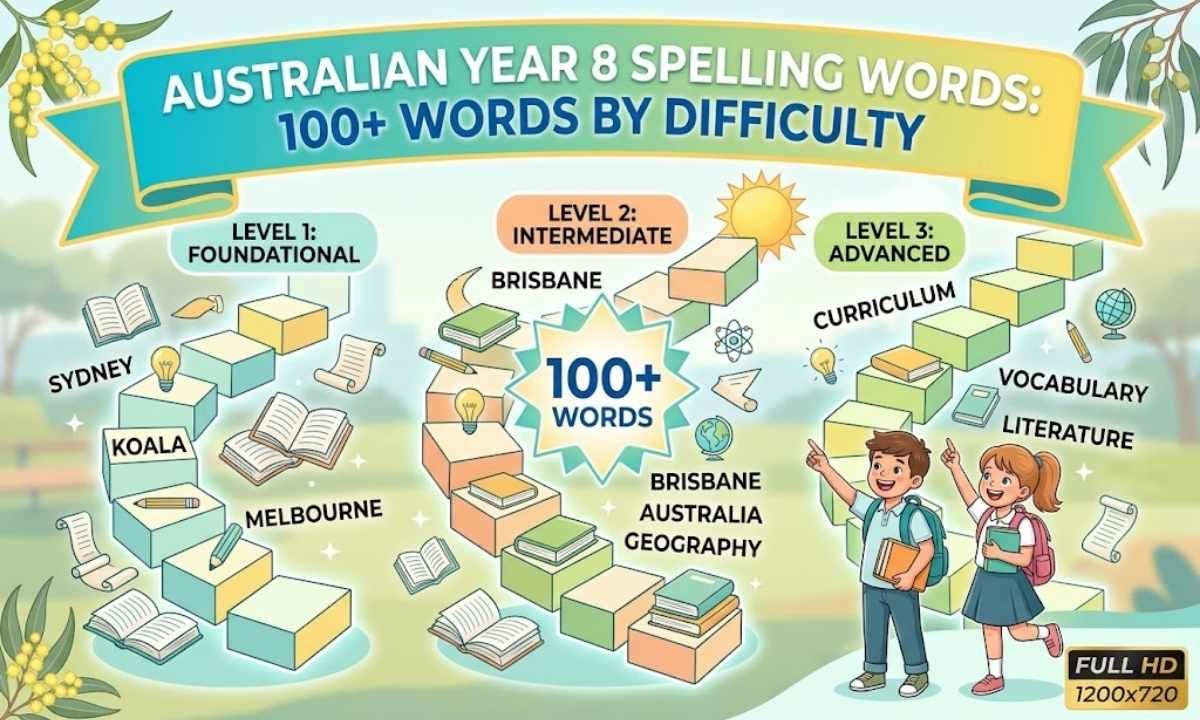
Spelling in Year 8 moves well beyond memorising a weekly list. Students are now expected to understand word origins, recognise tricky letter patterns, and apply that knowledge to brand new words they have never seen before.
This guide brings together 100 plus Australian Year 8 spelling words organised by difficulty, along with the patterns, prefixes, suffixes, and study strategies that help these words truly stick. Whether you are a student, parent, or teacher, you will find a practical reference you can return to all year.
Australian Year 8 Spelling Words List
Here is a quick snapshot of words across four difficulty bands, giving you an instant reference before diving into the detail below.
Easy words: achieve, believe, cautious, familiar, leisure, noticeable, process, receipt, similar, future
Medium words: accommodation, consequence, extraordinary, independent, necessary, opportunity, pronunciation, recommendation, responsibility, vocabulary
Hard words: bureaucracy, conscientious, fluorescent, miscellaneous, perseverance, questionnaire, sophisticated, surveillance, Mediterranean, exaggerate
Advanced words: circumference, chromosome, photosynthesis, perpendicular, sovereignty, entrepreneur, connoisseur, manoeuvre, renaissance, philanthropy
Why Year 8 Spelling Matters for Academic Success?
Strong spelling supports reading comprehension, confident writing, and performance across every subject, not just English. Students who spell accurately spend less mental energy second guessing words and more energy on ideas, structure, and argument. This becomes especially important as assessments in science, humanities, and mathematics start relying on precise technical vocabulary.
Australian Curriculum Word Knowledge Requirements for Year 8
The Australian Curriculum expects Year 8 students to apply learned spelling knowledge consistently, including how to spell nominalisations and complex academic terms. Students are also expected to draw on Greek and Latin roots, base words, prefixes, suffixes, and spelling generalisations to work out unfamiliar words rather than relying purely on memory. This shift toward applied word knowledge is exactly why pattern based learning matters more than flat word lists.
Year 8 Spelling Words by Spelling Pattern
Recognising patterns helps students spell new, unfamiliar words with confidence.
- Silent letters: knowledge, foreign, condemn, subtle
- Double letters: accommodation, embarrassed, recommend, occasion
- Tricky vowel combinations: questionnaire, connoisseur, manoeuvre, silhouette
- Unusual letter combinations: rhythm, yacht, synthesis, ratio
- Words ending in tion or sion: pronunciation, extension, decision, description
Year 8 Words With Prefixes and Suffixes
Prefixes and suffixes change meaning while following predictable spelling rules, which makes them one of the most useful patterns for this year level.
| Prefix or suffix | Example words | Meaning added |
| pre | predict, prevent, prepare | before |
| re | rebuild, react, reconsider | again |
| sub | submarine, subterranean, subheading | under |
| mis | misspell, mistake, mislead | wrongly |
| un, dis, non | unnecessary, disappearance, nonsense | not or opposite |
| ful, less | doubtful, careless, harmless | full of or without |
| able, ible | reliable, responsible, comfortable | capable of |
Year 8 Spelling Words From Greek and Latin Roots
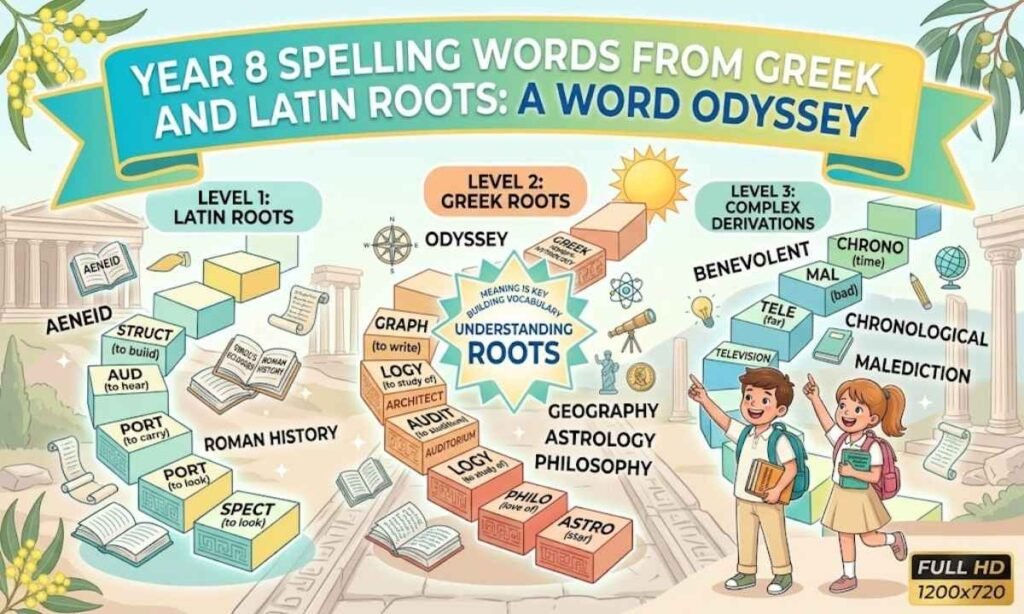
Many academic and scientific words become far easier once students understand the root behind them.
- Greek roots: photosynthesis (light), chromosome (colour), democracy (people), biology (life)
- Latin roots: circumference (around), perpendicular (through), audible (to hear), dictate (to speak)
Understanding a single root, such as photo meaning light, unlocks the spelling and meaning of dozens of related words including photograph and photocopy.
Words Borrowed From Other Languages
Not every tricky spelling follows English rules, because many words were borrowed directly from other languages. Umbrella comes from the Italian word ombrello, ballet keeps its French spelling because it entered English from French, and pharmacy uses ph because of its Greek origin. Recognising a borrowed word explains why it does not follow typical English spelling logic.
Australian vs American Spelling for Year 8 Students
Australian students should follow Australian English conventions in schoolwork, since these differ from the American spellings often seen online.
| Australian spelling | American spelling |
| colour | color |
| organise | organize |
| centre | center |
| favourite | favorite |
| analyse | analyze |
Year 8 Spelling Words by School Subject
Subject specific vocabulary is one of the biggest spelling challenges at this level.
| Subject | Example words |
| Science | chromosome, photosynthesis, hypothesis, catalyst, ecosystem |
| Mathematics | coefficient, circumference, perpendicular, algorithm, quadrilateral |
| English | metaphor, protagonist, narrative, perspective, characterisation |
| Humanities | democracy, parliament, sovereignty, legislation, electorate |
Difficult Year 8 Words Students Often Misspell
- Conscientious is often written without the second i
- Perseverance is frequently confused with perseverence
- Miscellaneous often loses an e or gains an extra letter
- Questionnaire is often spelled with only one n
How to Study Year 8 Spelling Words?
- Say the word slowly before attempting to write it
- Break long words into smaller syllables or word parts
- Identify the root or origin behind the word
- Write each new word inside a full sentence
- Revisit tricky words using spaced repetition across several days
- Test recall without looking at the original list
NAPLAN and Year 8 Spelling Skills
NAPLAN style assessments increasingly test a student’s ability to identify and correct spelling errors within a passage, rather than simply spelling isolated words aloud. Practising error correction, alongside standard spelling, builds the exact skill these assessments measure and mirrors real academic writing tasks.
Tips for Parents Supporting Year 8 Spelling at Home
Parents can help most by focusing on patterns rather than pure repetition. Ask your child to explain why a word is spelled a certain way, encourage them to group new words with similar ones they already know, and turn revision into short, low pressure quizzes rather than long copying sessions.
Frequently Asked Questions
What spelling words should a Year 8 student know?
Year 8 students should know academic, subject specific, and Greek or Latin rooted words alongside common everyday vocabulary.
What are the hardest Year 8 spelling words?
Words like conscientious, bureaucracy, questionnaire, and miscellaneous are consistently among the hardest for this year level.
How many spelling words should Year 8 students learn?
Most programs recommend around 100 to 150 words across the year, grouped by difficulty and pattern.
What are good spelling words for Year 8?
Good words combine everyday vocabulary with academic terms such as consequence, opportunity, and vocabulary itself.
What are common Year 8 spelling mistakes?
Common mistakes include dropped letters, extra letters, and confusing similar sounding word endings.
What Australian spelling words differ from American English?
Words like colour, organise, and centre differ from their American equivalents color, organize, and center.
How can I improve my Year 8 spelling?
Focus on word patterns, roots, and regular sentence practice rather than only memorising letter order.
Conclusion
Easy words build confidence, medium words build vocabulary, hard words build precision, and advanced words build genuine academic strength. Save this list, group ten words at a time, and practise a small batch each day rather than trying to master everything at once. Consistent, pattern based practice is what turns this word list into lasting spelling skill.