
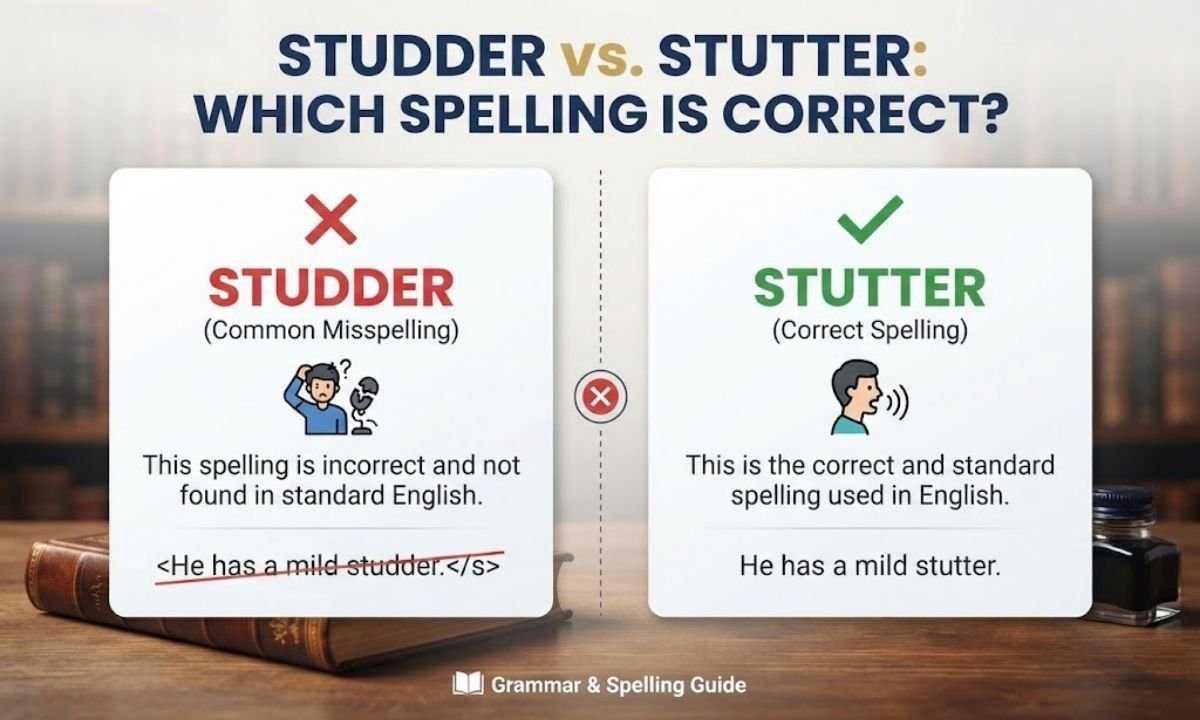
Studder vs stutter is a spelling question that trips up many writers, and the answer is clear. Stutter is the correct spelling for the word that describes halting, repeated speech. Studder is not standard English and is treated as a misspelling of stutter.
This guide covers the meaning of stutter, why studder looks right to some readers, how Americans pronounce the word, and which forms to use in a sentence. You will also find comparison tables, everyday examples, and a short proofreading checklist so you can write the word with confidence.
Studder vs Stutter: Which One Is Correct?
Stutter Is the Correct Spelling
Stutter, with a double t, is the form listed in major dictionaries. It works as both a verb and a noun.
Studder Is Usually a Misspelling of Stutter
Studder appears in some word lists, but only as a tagged misspelling. Avoid it in school, work, and published writing.
Quick Answer: Studder or Stutter?
Use stutter. If you mean to describe speech that repeats or pauses on sounds, stutter is the only spelling that dictionaries, teachers, and editors accept.
What Does Stutter Mean?
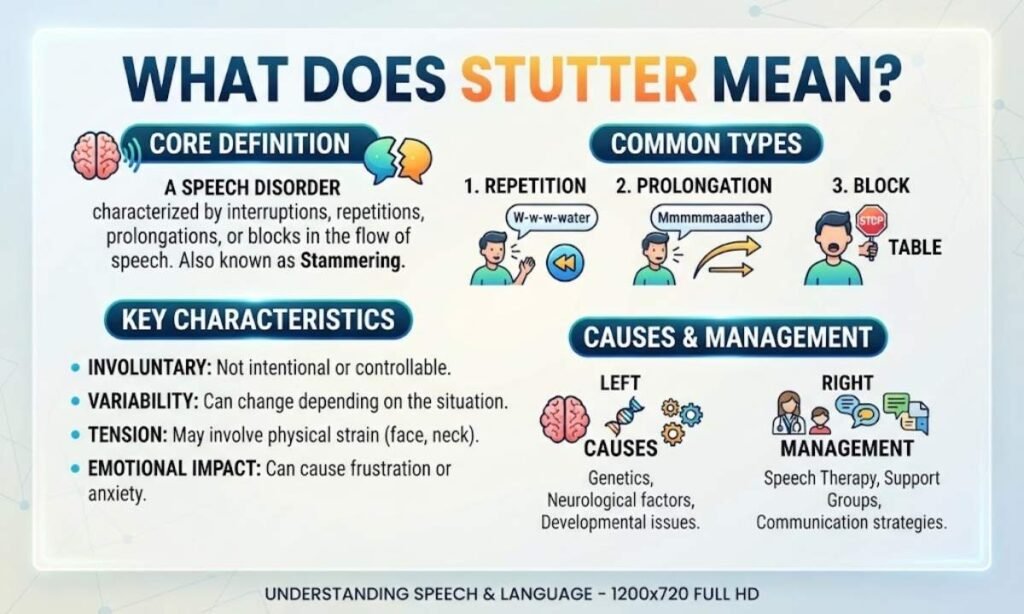
As a verb, stutter means to speak with difficulty by repeating or holding sounds, often the first sound of a word. As a noun, it names that speech pattern.
What Does Stuttering Mean in Speech?
In speech, stuttering means interruptions in the smooth flow of words, such as repeated sounds, long pauses, or stretched syllables. The word can describe a single moment or a lasting pattern.
• Verb: She tends to stutter when she feels rushed.
• Noun: He has a slight stutter.
• Related noun: Stuttering describes the act or pattern of halting speech.
What Does Studder Mean?
Is Studder a Real Word?
Studder has no meaning of its own. Reference sites label it a misspelling of stutter, so it points to the same idea of halting speech. Spell checkers usually flag it right away.
Studder vs Stutter Difference Explained
Spelling and Usage Difference
The difference is about correctness, not meaning. Stutter is the standard form in dictionaries and style guides, while studder is only a common error. The table gives a quick view.
| Feature | Stutter | Studder |
| Standard spelling | Yes | No |
| Meaning | Halting or repeated speech | Misspelling of stutter |
| Word forms | Stutters, stuttered, stuttering | Studders, studdered (incorrect) |
| Safe to use in writing | Yes, in every setting | No, avoid it |
Why Is Studder Commonly Confused With Stutter?
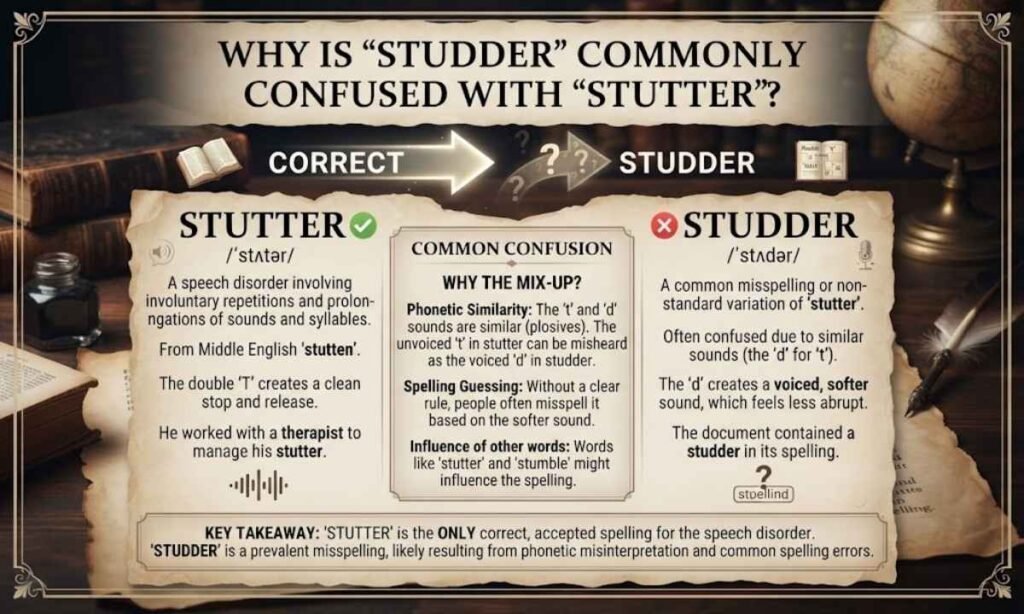
People often spell a word the way it sounds. In American English, a t between two vowels can turn into a quick tap that sounds close to d. Say the word fast and you may hear stuh der.
This pattern explains why the error feels natural. Your ear hears a d, but the correct spelling keeps the double t from the root word.
• Sound: the soft tap makes tt feel like dd.
• Habit: many writers spell by ear.
• Speed: quick typing hides small errors.
How Do You Spell Stutter Correctly?
Spell it s, t, u, t, t, e, r. The double t sits in the middle, and there is no d anywhere. Here is a simple trick: the word itself repeats a t sound, much like the speech it describes, so picture two t letters knocking together.
Another tip: split the word as stut and ter. Each part carries a t, so the double t in the middle comes naturally.
Stutter Pronunciation in American English
How to Say Stutter
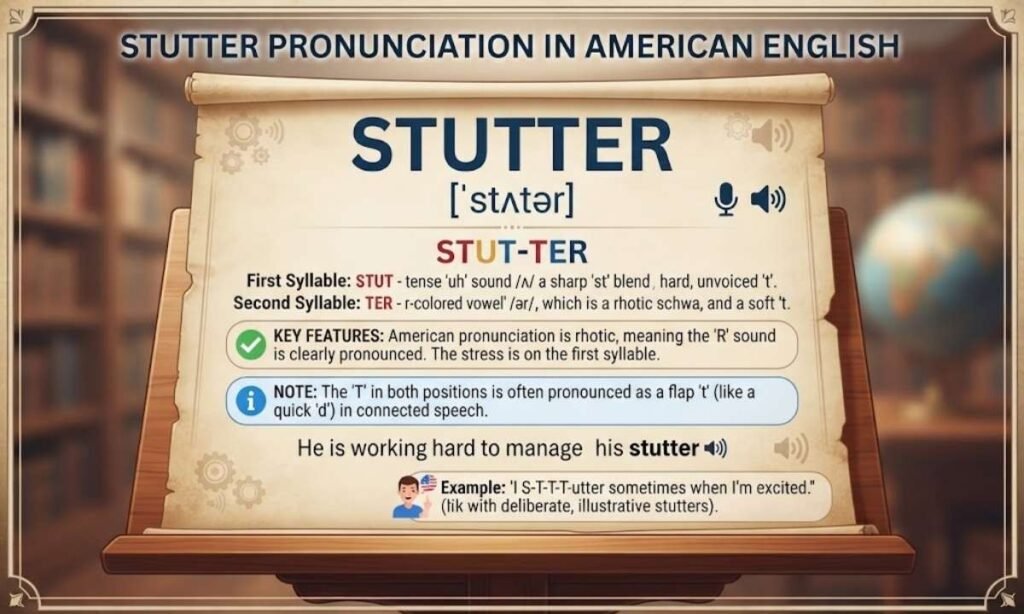
Most Americans say STUH der. Dictionaries show it with a t or with a soft d like tap, and British speakers usually keep a clear t. The sound can shift, but the spelling stays fixed. If you ever doubt the word, say it slowly and listen for both t sounds.
Why Stutter Can Sound Like Studder
The soft tap in fast American speech blurs the middle consonant, so listeners may think they hear a d. Checking a dictionary spelling clears up the doubt.
Stutter Examples in Sentences
These sentences show how the word fits real situations, from casual chats to formal reports.
• Everyday talk: I stutter a little when I rush my words.
• Formal writing: The report explains how a stutter can change with stress.
• Noun use: She has worked on her stutter for years.
• Verb use: The speaker stuttered through the first line.
Common Studder vs Stutter Mistakes
These errors show up in blogs, school work, and social posts. Each one comes from the same root problem, which is spelling by sound.
• He has a studder instead of He has a stutter.
• She studders when nervous instead of She stutters when nervous.
• Studdering instead of stuttering.
• Studdered instead of stuttered.
Stutter Word Forms You Should Know
Knowing each form helps you match the verb to the subject and the time of the action. Here is a simple reference.
| Form | Use | Example |
| Stutter | Base form and noun | They stutter at times. |
| Stutters | Third person singular | She stutters when tired. |
| Stuttered | Past tense and past participle | He stuttered a reply. |
| Stuttering | The ing form | The stuttering faded. |
Studder vs Stutter: Quick Grammar Check
In School
Teachers mark studder as an error, so always write stutter in essays and reports.
At Work
Correct spelling shows care in proposals, training material, and client messages.
In Emails and Messages
Casual texts are forgiving, but a quick check keeps your message clear and professional.
Is Stutter the Same as Stammer?
How the Two Words Are Related
Both words describe the same speech pattern, and dictionaries list them as synonyms. Stutter is common in American English, while stammer is often preferred in British English.
Can Stutter Be Used for Things Other Than Speech?
Stutter also works as a figure of speech when something moves or runs unevenly.
• Engines: The old truck stuttered up the hill.
• Video and audio: The live stream began to stutter.
• Movement: The lights stutter before they turn on.
Word Origin of Stutter
Stutter entered English in the late 1500s as a verb. It has Germanic roots tied to the idea of striking or knocking, and it is related to a dialect word stut. The repeated t sounds even echo the meaning.
Synonyms for Stutter
Pick a synonym based on tone and context. Falter and hesitate fit general writing, while stammer is a close match for speech.
• Stammer
• Falter
• Hesitate
• Stumble over words
• Bumble
Variety also helps readability, since repeating one verb can feel flat in a long article.
Respectful Language When Writing About Stuttering
Use plain, accurate wording. Write that a person stutters or has a stutter, and avoid jokes or mocking spellings with repeated letters. Clear and kind language builds trust with readers.
• Say a person who stutters instead of labeling someone by the condition.
• Quote speech with care and keep the focus on the message.
• Choose accurate terms over slang.
Other Spelling Mistakes Like Studder
The soft t sound causes other errors too. Many words with a tap sound between vowels get misspelled in the same way, so watch for these:
• Beter instead of better
• Writting instead of writing
• Litle instead of little
• Buter instead of butter
Proofreading Checklist for Writers
Before you publish, run through this short list. It takes under a minute and catches the most common slips.
1. Search your draft for studder and replace it with stutter.
2. Check endings: stutters, stuttered, stuttering.
3. Read the sentence aloud once.
4. Run a spell checker before you publish.
Conclusion
The studder vs stutter question has one answer. Stutter is the correct spelling, and studder is a common mistake. Remember the double t, use the right word forms, and your writing will look polished.
When in doubt, check a trusted dictionary, and keep the word forms stutters, stuttered, and stuttering handy for any sentence.
Frequently Asked Questions
Is studder correct or incorrect?
Studder is incorrect. The right spelling is stutter.
Is studder a word?
It is not standard English. Dictionaries treat it as a misspelling of stutter.
How do you spell stutter?
Spell it s, t, u, t, t, e, r, with a double t in the middle.
What is the past tense of stutter?
The past tense is stuttered. The same form works as the past participle.
What is the ing form of stutter?
The ing form is stuttering, with two t letters kept.
Is stutter the same as stammer?
Yes, they are synonyms. Stutter is more common in American English.
How do you pronounce stutter?
Say STUH der, with stress on the first syllable.