
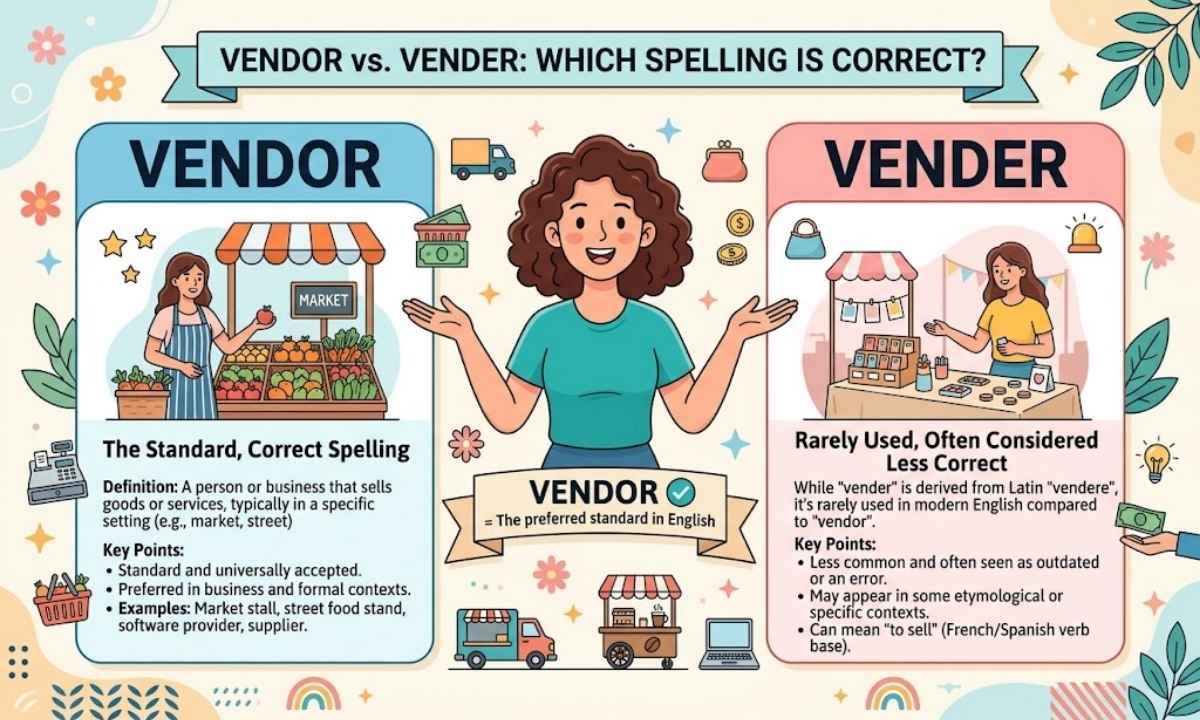
Vendor is the standard modern spelling for a person or business that sells goods or services, while vender is a rare variant that still appears in a handful of dictionaries. If you have seen both forms and wondered which one to trust, you are not alone, since this is one of the most searched spelling questions in business writing.
This guide breaks down what each spelling means, where vender came from, how dictionaries actually treat it, and which form to use in emails, contracts, and everyday sentences so you never second guess yourself again.
Vendor vs Vender: Quick Answer
Vendor means a person or company that sells goods or services, and it is the spelling used in almost every professional, legal, and everyday context today. Vender is an older, much less frequent variant of the same word that survives mainly in a few dictionary entries rather than in common writing.
Is Vendor or Vender Correct?
Vendor is correct and expected in modern writing. Vender is not technically wrong, but it is rare and can look like a typo to most readers.
Is Vender a Real Word?
Yes, vender is a real, recognized variant listed by Merriam Webster and other reference sources as a less common alternative spelling of vendor.
| Feature | Vendor | Vender | Notes |
| Meaning | Person or business that sells goods or services | Same meaning, older variant spelling | Identical core meaning |
| Modern usage | Standard and widely used everywhere | Rare, mostly in older or dictionary entries | Vendor dominates today |
| Dictionary status | Primary headword in nearly all dictionaries | Listed as a secondary variant in some | See Merriam Webster, AHD |
| Example | software vendor, food vendor | historical or informal appearance | Use vendor for new writing |
| Best for | Business, legal, and everyday writing | Not recommended for new writing | Default to vendor |
What Does Vendor Mean?
Vendor describes anyone who sells something, whether that is a street seller, a large company, or a party in a legal sale. Dictionary sources define it simply as one who sells or vends, covering everything from a street vendor to a vendor of software products online.
Vendor Definition in Simple English
A vendor is a person, shop, or company that offers goods or services for sale to others.
Examples of a Vendor
● A food vendor selling snacks at a fair
● A software vendor providing business tools
● An online vendor shipping products worldwide
● A vendor listed in a company procurement system
What Does Vender Mean?
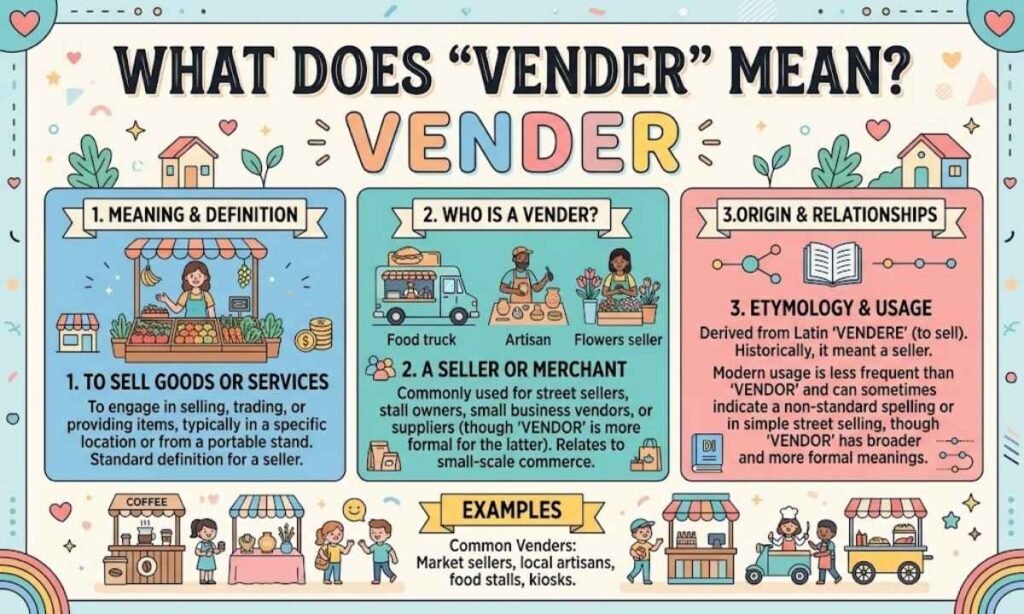
Vender carries the exact same core meaning as vendor, a seller of goods or services, but it is treated by most dictionaries as a secondary or dated spelling rather than the primary form.
Is Vender a Standard Spelling?
Not in current everyday English. Reference works generally list vendor as the headword and vender as a variant seen occasionally in legal or older texts.
When Might You See Vender?
You may spot vender in older literature, some legal writing, or informal online content, though it remains uncommon compared to vendor.
Vendor vs Vender: Key Differences Explained
The real difference between these two words is not meaning but frequency and formality. Both trace back to the same root, yet only one has become the accepted professional standard.
● Spelling: vendor ends in or, vender ends in er.
● Meaning: identical in both forms, a seller of goods or services.
● Usage: vendor dominates business, tech, and legal writing.
● Formality: vendor is safe everywhere, vender can appear inconsistent or careless in professional documents.
Vendor vs Vender in Dictionaries
Merriam Webster lists vendor with vender noted as a less common variant, defining the word simply as one that vends or sells. Its legal definition section repeats this pattern, again recording vender as a secondary variant of vendor. The American Heritage Dictionary similarly defines vendor as one that sells or vends, giving examples such as a street vendor and a vendor of software products on the Web, without treating vender as the main entry.
Some older reference works go further, with the Century Dictionary describing vendor as essentially the same word as vender but more common in legal use, which explains why vender still lingers in certain formal or historical texts.
Why Vendor Became the Standard Spelling
Vendor traces back through Anglo French to the Latin venditor, meaning seller, itself formed from vendere, to sell. Etymology sources describe vendor as borrowed from Anglo Norman vendor, from Old French vendeor, ultimately from the Latin vendere meaning to sell or cry up for sale.
Because the or ending matched a large family of English agent nouns such as actor, editor, and director, vendor settled into everyday and legal English as the accepted form, while the er ending version faded into occasional use.
Vendor vs Supplier vs Vender: Clearing the Confusion
People sometimes mix up vendor with supplier, and occasionally with vender.
● Vendor: sells directly to a buyer, often at the point of sale.
● Supplier: provides goods regularly, often to businesses further up a supply chain.
● Vender: simply an older spelling of vendor, not a different role at all.
How to Use Vendor and Vender in a Sentence?
● We hired a new vendor to manage our office supplies.
● The vendor sent an invoice within two business days.
● She works closely with several vendors across three countries.
● An older text may read, the vender sold goods at the market, using the rarer spelling for the same meaning.
Vendor Plural, Possessive and Related Forms
● Plural: vendors, as in three vendors attended the trade show.
● Possessive singular: vendor’s, as in the vendor’s contract was signed.
● Possessive plural: vendors’, as in the vendors’ booths lined the street.
● Common phrases: vendor management, vendor agreement, vendor contract, authorized vendor.
Tips for Choosing the Right Spelling in Your Writing
● Default to vendor in every business, legal, or academic document.
● Run a quick spell check if you are unsure, since most tools will flag vender.
● Reserve vender only for direct quotes from older or legal texts.
● When editing content written by others, standardize on vendor for consistency.
Vendor and Vender Across Different Industries
In technology, a vendor typically supplies software, hardware, or cloud services to businesses. In retail and food service, a vendor often means an individual seller such as a street vendor or market stall operator. In law and real estate, vendor commonly refers to the party selling property, with vender occasionally surfacing in older statutes or legal commentary rather than current filings.
Frequently Asked Questions
Is Vendor or Vender the Correct Spelling?
Vendor is correct for modern use. Vender is a rare, dictionary recognized variant.
Is Vender a Word?
Yes, it is a real variant spelling of vendor, though it is uncommon today.
Is Vender an American Spelling?
No, it is not specifically American. It appears occasionally across older or legal English generally.
What Is the Difference Between Vendor and Vender?
They share the same meaning, seller of goods or services. The difference is spelling frequency and formality only.
What Does Vendor Mean?
A vendor is a person, shop, or company that sells goods or services to buyers.
What Is the Plural of Vendor?
The plural is vendors, formed simply by adding an s.
Can Vender Be Used in Formal Writing?
It is technically acceptable but not recommended, since vendor is the expected and professional standard.
Conclusion
Vendor is the spelling you should use in virtually all modern writing, from business emails to legal contracts to everyday conversation.
Vender is a real but rare variant that mainly survives in select dictionary entries and older texts, so unless you are quoting historical material, vendor is the safe and expected choice.