
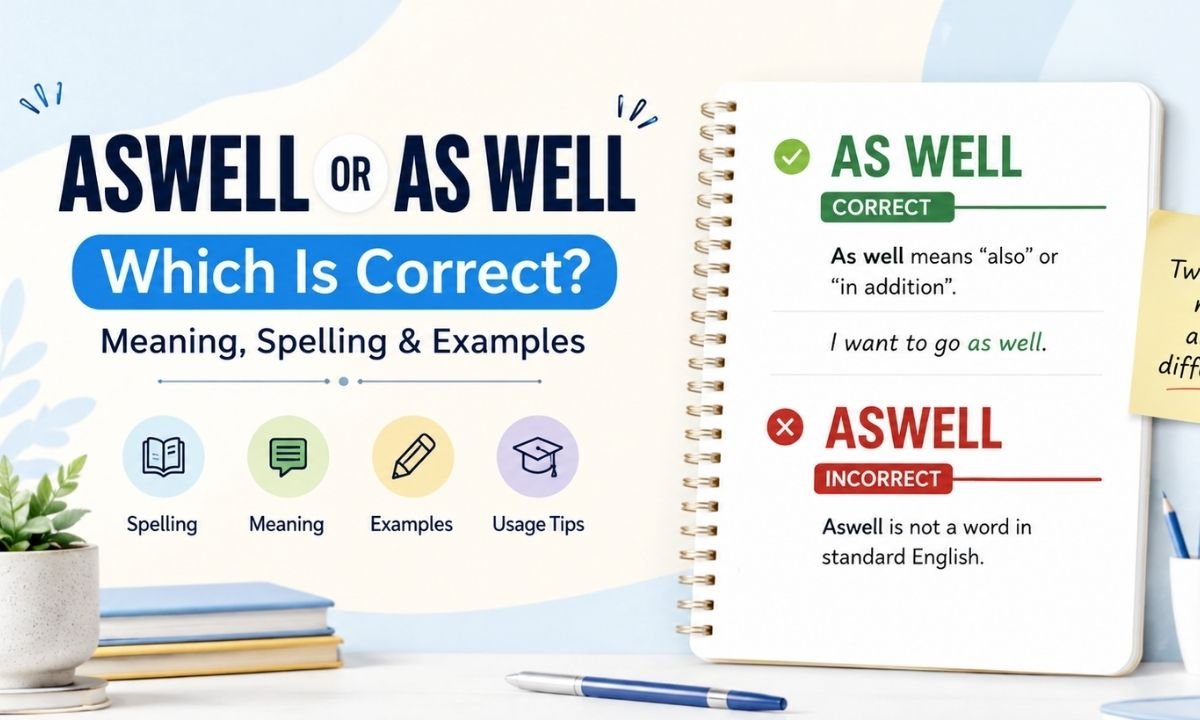
Many English learners and even native speakers pause when typing this phrase, unsure whether it should be one word or two. Aswell or As Well is a common spelling confusion because the phrase flows together so smoothly when spoken aloud that the written form starts to feel optional.
This guide breaks down the correct spelling, the meaning behind the phrase, and how to use it naturally in everyday writing. By the end, you will know exactly why one version is standard English and the other is a spelling error to avoid.
As Well Is the Correct Spelling
The two-word form, as well, is the only version accepted in standard English. It functions as an adverbial phrase meaning also, too, or in addition. Dictionaries, grammar authorities, and style guides consistently treat the single-word form as nonstandard, regardless of the context in which it appears.
Why Aswell Feels Natural to Write?
Spoken English blends sounds together, so as well often comes out sounding like a single unit. This auditory shortcut is the main reason typists merge the two words without realizing the written rule differs from the spoken rhythm.
Why Aswell Is Still Wrong?
Written English preserves grammatical roles that speech tends to blur. As functions as a conjunction while well acts as an adverb, and merging them erases that distinction, which is why grammar checkers and editors consistently flag the single-word version.
What Does As Well Mean in Everyday English?
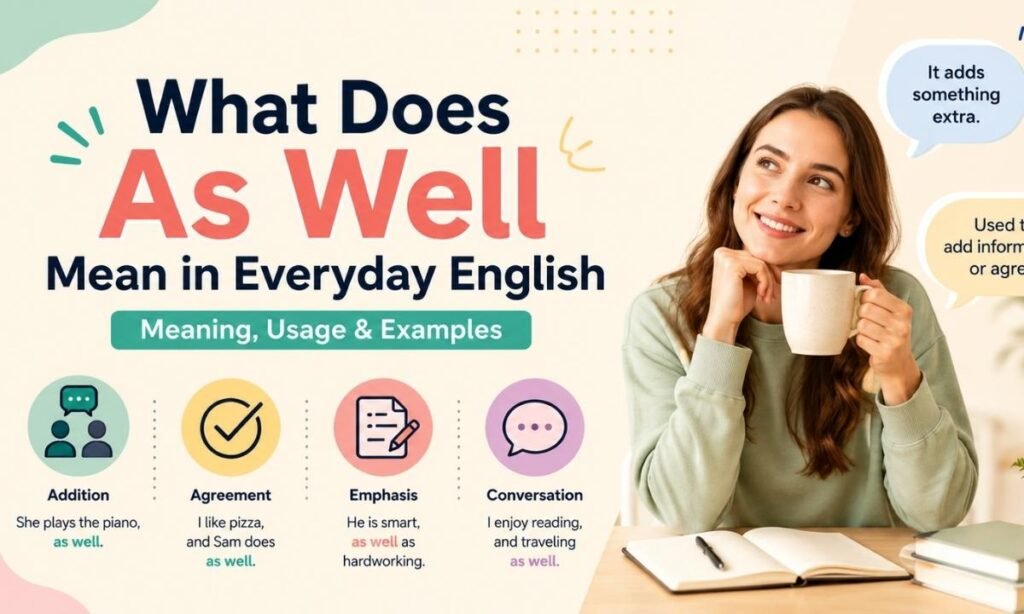
At its core, the phrase signals that something additional is true alongside what was already stated. It works much like too or also, though its placement and tone can shift depending on the sentence.
As Well Meaning Also or Too
When someone says they enjoy hiking as well, they mean hiking is an addition to something already mentioned, similar to saying they enjoy hiking too.
As Well Meaning In Addition
The phrase can also introduce an extra detail or item, showing that a list or statement is being extended rather than replaced.
Also Read This: Realy or Really: Which Spelling Is Correct? (Complete Guide With Examples)
Contextual Shades of Meaning
Depending on tone, as well can sound neutral in casual speech, slightly more polished in professional emails, or perfectly natural in academic writing, making it one of the more flexible additional words in English.
Aswell vs As Well: Spotting the Difference Instantly
| Form | Standard English | Common Meaning | Typical Use |
| Aswell | Not accepted | None, considered a spelling error | Should never appear in writing |
| As well | Accepted | Also, too, in addition | Casual, professional, and academic writing |
| As well as | Accepted | In addition to, together with | Connecting two nouns, clauses, or actions |
Is As Well One Word or Two?
As well is always written as two separate words. There is no context, formal or informal, where combining them into one word becomes acceptable.
How Native Speakers Remember the Rule?
A simple trick is to replace as well with too in the sentence. If the sentence still reads naturally, the spaced form is the one to use, since too is also always written as a standalone word.
How to Use As Well in a Sentence?
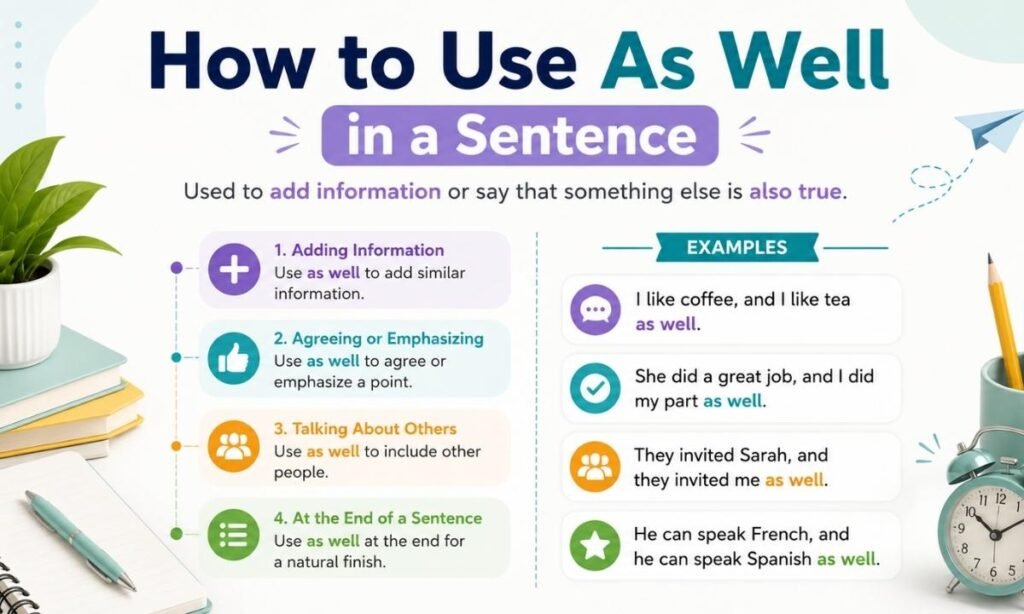
Placement matters when using this phrase correctly, and most native speakers position it toward the end of a clause rather than at the start.
As Well at the End of a Sentence
The most common placement puts the phrase after the main clause, as in I would like to come as well, which reads smoothly and mirrors natural speech patterns.
As Well After a Subject or Object
Sometimes the phrase follows directly after the noun it modifies, giving extra emphasis to that specific subject rather than the whole sentence.
As Well With Verbs
When paired with action verbs, the phrase typically trails the main verb phrase, reinforcing that the action applies to an additional person or item.
As Well in Questions and Short Replies
In conversation, short replies like you as well are common when responding to a greeting, functioning almost identically to you too in informal exchanges.
As Well vs Also vs Too
These three words share meaning but differ slightly in tone and sentence position, which affects how natural each one sounds in different situations.
As Well vs Too
Too usually sits at the very end of a sentence and feels slightly more casual, while as well can shift position and often reads a touch more polished.
As Well vs Also
Also frequently appears near the beginning or middle of a sentence, while as well almost always trails at the end, giving writers flexibility depending on rhythm.
As Well vs In Addition
In addition, it tends to sound more formal and is common in reports or academic writing, whereas it also suits both casual and semi-formal contexts equally well.
What Does As Well As Mean?
This related phrase carries a slightly different grammatical job than as well on its own, and mixing the two up is a frequent source of errors.
As Well As Means In Addition To
Unlike as well, which typically closes a sentence, as well as functions as a connector joining two nouns, actions, or ideas within the same clause.
As Well As vs And
While and simply joins two equal items, as well as often places subtle emphasis on the second item, making the two phrases close but not perfectly interchangeable.
As Well As in a Sentence
A typical example reads, she manages the team as well as the budget, showing how the phrase links two responsibilities without needing a separate clause.
When to Use As Well vs As Well As?
| Situation | Correct Choice | Example |
| Adding a final point to a sentence | As well | He plays guitar as well |
| Connecting two items within one clause | As well as | He plays guitar as well as piano |
| Comparing two skills or qualities | As well as | She writes as well as she speaks |
| Closing a casual statement | As well | I want to join as well |
Quick Test to Choose the Right Form
If the phrase sits at the very end and adds one extra idea, choose as well. If it links two nouns or actions mid-sentence, as well as is the correct choice.
The Origin of As Well in English Grammar
Understanding where a phrase comes from often explains why the modern rule exists. This background also helps writers see why the spaced spelling has remained fixed over centuries.
A Brief Word History
The phrase traces back to Middle English, pairing the conjunction as with the adverb well, and both words have always retained separate grammatical functions rather than merging into a compound.
Why English Never Standardized the Merged Form?
Unlike words such as however or already, which evolved into single compounds over time, as well never followed that path because its two components continued functioning independently within a sentence.
Common Mistakes People Make With As Well
Even confident writers slip into a few predictable errors when using this phrase, and recognizing them helps avoid repeating the same mistakes.
Writing Aswell as One Word
This remains the single most frequent error, especially in fast typing, texting, or casual online writing where spelling checks are often skipped.
Confusing As Well With As Well As
Writers sometimes drop the second as, turning a two-item connector into an incomplete phrase that reads awkwardly and breaks sentence flow.
Stacking Redundant Addition Words
Phrases like also as well double up on meaning and should be trimmed to just one addition word for cleaner, more professional writing.
Overusing As Well in Formal Documents
While grammatically correct, repeating the phrase too often within a short passage can feel repetitive, so alternating with also or too keeps formal writing varied.
As Well in American and British English
Regional variation rarely affects this phrase, which is part of why it remains one of the more stable expressions across English dialects.
Also Read This: Refer or Reffer: Which Spelling Is Correct? Meaning, Rules & Examples
Consistency Across Dialects
Both American and British English treat as well identically in spelling and meaning, with no regional variant favoring the merged form under any circumstance.
Everyday Use in the United States
American writing, from business emails to casual text messages, relies on as well just as frequently as British English does, reinforcing its universal acceptance.
Practical Tips for Remembering the Rule
A few memory tricks make it easier to avoid the common spelling mistake permanently, especially for learners who type quickly without pausing to check.
The Too Substitution Trick
Swap as well for too mentally. Since too is never written as one word, this reminder reinforces that its cousin phrase should also remain separated.
Reading Aloud Slowly
Slowing down while reading a sentence aloud often reveals the natural pause between as and well, making the two-word structure easier to internalize.
Using a Grammar Checker
Modern grammar tools automatically flag aswell as an error, offering a quick safety net for writers who want to double check before publishing.
Frequently Asked Questions
Is aswell grammatically correct?
No. Aswell is not recognized in standard English and should always be written as as well.
Is as well one word or two?
As well is always two separate words in every context, formal or casual.
How do you spell as well correctly?
Write it as two words, a-s space w-e-l-l, never combined into one term.
What is the meaning of as well?
It means also, too, or in addition, depending on how it fits the sentence.
Can I use as well in formal writing?
Yes, it works fine in formal writing, though also or in addition may sound slightly more polished.
Is as well as the same as and?
Not exactly. As well as often adds slight emphasis to the second item, unlike a plain and.
What is the difference between as well and too?
Both mean the same thing, but too usually sits at the very end while as well offers more placement flexibility.
Conclusion
As well stands as the only correct form in standard English, while aswell remains a common but avoidable spelling error. Keeping the two words separated preserves clarity, professionalism, and grammatical accuracy across every type of writing, from quick messages to formal reports.
Once the habit of spacing the phrase correctly becomes automatic, this small grammar point stops being something to second-guess and simply becomes second nature.