
Many professionals in Singapore rely on “noted with thanks” every single day, often without thinking twice about it. It feels safe, polite and quick to type, which is exactly why it shows up in so many inboxes across offices in the Central Business District and beyond.
But relying on the same short reply for every situation can start to feel repetitive or even a little distant. This guide breaks down natural, professional alternatives you can use depending on who you are writing to, what the message is about and how much warmth or action you want to show.
What Does Noted With Thanks Mean?
“Noted with thanks” simply means you have read and understood a message, and you appreciate that the sender took the time to share it. It combines acknowledgment with gratitude in one short phrase, which is why it became so common in Singapore workplace English and across many Asian business settings that value politeness and efficiency in equal measure.
The phrase is generally seen as professional and acceptable, especially for internal updates, confirmations and routine correspondence. It is neither rude nor overly formal, though it can sound flat if used for every single message regardless of context.
What Can You Say Instead of Noted With Thanks?
Below is a quick list of commonly used, professional alternatives that fit naturally into most business emails without sounding stiff or robotic.
- Thanks for the update
- Thank you for letting me know
- Understood, thank you
- Received, thank you
- I have noted the update
- Acknowledged
- Thanks for the information
- I appreciate the update
These phrases already appear frequently across professional writing guides because they cover the same intent as “noted with thanks” while sounding slightly more conversational and specific.
15 Best Alternatives to Noted With Thanks in Singapore
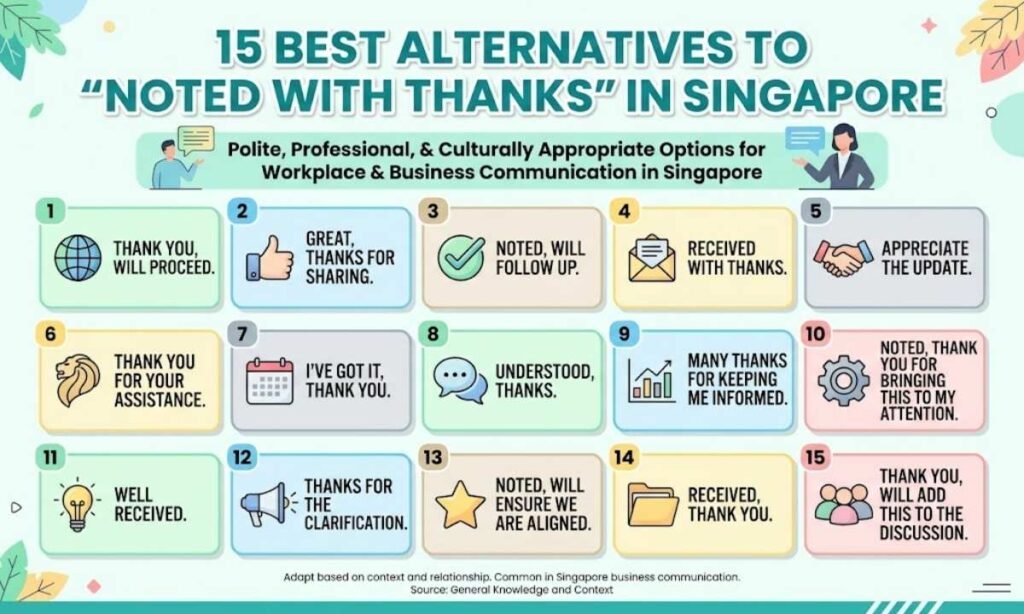
1. Thanks for the Update
A friendly, general purpose reply that works for most internal emails.
2. Thank You for Letting Me Know
Shows genuine appreciation when someone shares new information.
3. Understood, Thank You
Best used when someone gives you an instruction or clarification.
4. Received, Thank You
Confirms that a document, file or message has safely arrived.
5. I Have Noted the Update
A slightly more personal version of the original phrase.
6. Acknowledged
Short, formal and often used in corporate or government correspondence.
7. Thanks for the Information
Suitable when the sender has answered a question you asked.
8. I Appreciate the Update
Adds warmth, ideal for replies to managers or clients.
9. Thanks for the Clarification
Perfect when confusion has been resolved through the message.
10. I Have Taken Note of This
Slightly formal, works well for policy or compliance related emails.
11. I Understand
Direct and simple, useful for quick internal exchanges.
12. Message Received
Neutral and efficient, common in fast paced work environments.
13. I Will Keep That in Mind
Good for feedback, reminders or advice from a senior colleague.
14. I Will Proceed Accordingly
Signals that action will follow, not just passive acknowledgment.
15. Thank You for Bringing This to My Attention
Ideal when someone flags an issue, error or concern.
Best Noted With Thanks Alternatives Based on Who You Are Replying To
The right phrase often depends on your relationship with the sender. A reply to a manager should feel respectful and clear, while a message to a close colleague can be more relaxed.
- To your manager: “Understood, thank you. I will proceed accordingly.”
- To a colleague: “Got it, thanks for the heads up.”
- To a client: “Thank you for the update. We will action this promptly.”
- To a vendor: “Received, thank you. We will review and confirm shortly.”
- To a senior executive: “Acknowledged with thanks. I will follow up as needed.”
- To a new business contact: “Thank you for reaching out, this is much appreciated.”
Professional Alternatives for Different Email Situations
Different situations call for different tones. Here is how to adjust your acknowledgment email phrases based on context.
- Important update: “Thank you for the update, this is very helpful.”
- Manager’s instruction: “Understood, I will get started right away.”
- Document received: “Received, thank you for sending this over.”
- Meeting time change: “Noted, I have updated my calendar accordingly.”
- Feedback given: “Thank you for the feedback, I will take this on board.”
- Problem pointed out: “Thank you for flagging this, I will look into it.”
- Confirming receipt: “This has been received, thank you.”
- Confirming next action: “Understood, I will proceed and update you soon.”
Best Alternatives When You Need to Show Action

A bare acknowledgment does not always tell the sender what happens next. These action oriented replies are more useful when a task is involved.
- “Understood, I will take care of it.”
- “Thank you. I will proceed accordingly.”
- “Understood, I will complete this by Friday.”
- “Thanks for the update. I will make the necessary changes.”
- “I have noted this and will follow up.”
- “Received. I will review it and get back to you.”
How Singapore Business Culture Shapes Everyday Email Language?
Singapore’s multicultural, multilingual work environment blends British formality, Chinese workplace values and Southeast Asian politeness norms into one distinct communication style. This mix explains why compact, respectful phrases like “noted with thanks” became a workplace default rather than an exception.
Many Singaporean professionals grew up using formal English in school and government settings, which naturally carried into corporate email habits. As a result, short acknowledgment phrases are viewed as efficient rather than cold, especially compared to more expressive email cultures found in some Western countries.
Digital Communication Trends Changing Email Etiquette Today
Workplace messaging has shifted quickly with the rise of Slack, Microsoft Teams and other instant platforms, and email etiquette is adapting alongside it. Even so, email remains the preferred channel for formal confirmations, client communication and anything that needs a documented paper trail.
Modern professionals increasingly favour warmer, more specific acknowledgment lines instead of generic ones, partly because clear communication reduces back and forth clarification. Adding a short action statement after your acknowledgment, such as confirming a deadline or next step, has become a small but noticeable trend across professional email writing today.
How Tone Affects Trust and Collaboration at Work?
The tone of a simple acknowledgment reply can quietly influence how colleagues perceive your professionalism and approachability. A reply that only says “Noted” may come across as abrupt, even if that was never the intention behind it.
Choosing a slightly warmer, more specific alternative helps build trust over time, particularly with clients and cross department teams who cannot read your body language or tone of voice. Small wording choices in daily emails often shape long term working relationships more than people realise.
Ready to Use Templates You Can Save
Here are a few short, reusable templates for common workplace scenarios.
- “Hi [Name], thank you for the update. Noted with thanks, and I will follow up by [date].”
- “Thanks for sending this over. I have reviewed it and will revert with feedback shortly.”
- “Understood, thank you for the clarification. I will proceed accordingly.”
- “Received with thanks. Please let me know if there is anything further needed from my end.”
Expert Tips From Communication and HR Professionals
Communication trainers often suggest pairing acknowledgment with a clear next step, since this reduces unnecessary follow up questions from senders. HR professionals also note that varying your email phrases, rather than repeating the same line in every thread, helps you sound more attentive and genuine.
A useful habit recommended by workplace communication coaches is to briefly restate what you understood from the message before confirming receipt. This small addition reassures the sender that their message was actually read and understood, not just skimmed.
Noted With Thanks vs Noted, Thank You
“Noted, thank you” tends to sound slightly more natural in spoken and written English compared to “noted with thanks,” which can feel more formal or translated. Both are acceptable, but “noted, thank you” is often preferred in day to day internal communication, while “noted with thanks” remains common in more formal or traditional Singapore workplaces.
Noted With Thanks vs Thanks for the Update
“Thanks for the update” generally sounds warmer and more conversational, making it a strong choice for client facing emails. “Noted with thanks” feels slightly more formal and works well for internal confirmations where brevity matters more than warmth.
Is Noted With Thanks Rude or Unprofessional
“Noted with thanks” is not rude, but it can sound a little cold or robotic if used repeatedly without variation. A short acknowledgment is perfectly fine for routine updates, but longer or more sensitive messages usually deserve a fuller, warmer response that shows genuine engagement.
Singapore English vs American English: Which Reply Sounds More Natural
“Noted with thanks” is widely used and understood across Singapore workplaces, though it is far less common in American business English, where phrases like “thanks for the update” or “got it, thank you” are more typical. If you regularly correspond with international clients, it is worth leaning toward simpler, more universally understood phrases to avoid sounding unfamiliar or overly formal.
Formal, Neutral and Casual Alternatives
| Tone | Example Phrase |
| Formal | I acknowledge receipt of your message and thank you for the update. |
| Neutral | Thanks for the update, noted. |
| Friendly | Got it, thanks so much for letting me know. |
| Casual | Cool, got it, thanks. |
| Client facing | Thank you for the update, we appreciate you keeping us informed. |
Noted With Thanks Email Examples You Can Copy
- To a manager: “Understood, thank you. I will complete this by end of day and update you afterward.”
- To a colleague: “Thanks for the heads up, noted and appreciated.”
- To a client: “Thank you for sharing this update, we will review it and respond shortly.”
- To a vendor: “Received with thanks, we will confirm the details on our end shortly.”
- Confirming a document: “Thank you, the document has been received and reviewed.”
- Meeting change: “Noted, thank you, I have updated my schedule accordingly.”
- Responding to feedback: “Thank you for the feedback, this is genuinely helpful and I will apply it going forward.”
- Action required: “Understood, thank you, I will proceed and keep you posted.”
Common Mistakes When Replacing Noted With Thanks
- Using only “Noted” when the sender actually expects action from you.
- Sounding too casual with clients or senior stakeholders.
- Overcorrecting into overly formal, stiff sounding language.
- Repeating “thank you” more than once in the same short reply.
- Confirming receipt without confirming what happens next.
Quick Guide: Which Alternative Should You Use
| Situation | Best Reply |
| General update | Thanks for the update. |
| Instruction given | Understood, thank you. |
| Document received | Received, thank you. |
| Client feedback | Thank you for the feedback. |
| Important issue raised | Thank you for bringing this to my attention. |
| Action required | Understood, I will proceed accordingly. |
| Casual colleague chat | Got it, thanks. |
| Formal communication | I acknowledge receipt of your message. |
Frequently Asked Questions
What is the best alternative to noted with thanks?
“Thanks for the update” or “Understood, thank you” are the most versatile and widely accepted alternatives.
Is noted with thanks commonly used in Singapore?
Yes, it is a very common phrase in Singapore workplace emails, especially for internal communication.
Is noted with thanks professional?
Yes, it is generally seen as professional, though it can sound repetitive if overused.
What is a polite way to say noted in an email?
“Understood, thank you” or “Received, thank you” are polite, natural sounding options.
What can I say instead of noted to my boss?
Try “Understood, thank you, I will proceed accordingly” for a respectful and clear reply.
How do you acknowledge an email professionally?
Confirm you received the message, show appreciation, and mention the next step if relevant.
Is thanks for the update better than noted with thanks?
It often sounds warmer and more natural, especially for client facing communication.
What is the best reply to a client instead of noted with thanks?
“Thank you for the update, we will review this and respond shortly” works very well.
Conclusion
“Noted with thanks” is not wrong, and it remains a perfectly acceptable phrase in Singapore workplaces. Still, mixing in more specific, action oriented alternatives can make your emails sound warmer, more thoughtful and more professional overall.
The right choice always depends on context, relationship and how much detail the situation actually calls for. Keeping a small mental list of alternatives, like the ones shared above, makes it easy to respond naturally without falling back on the same line every time.