
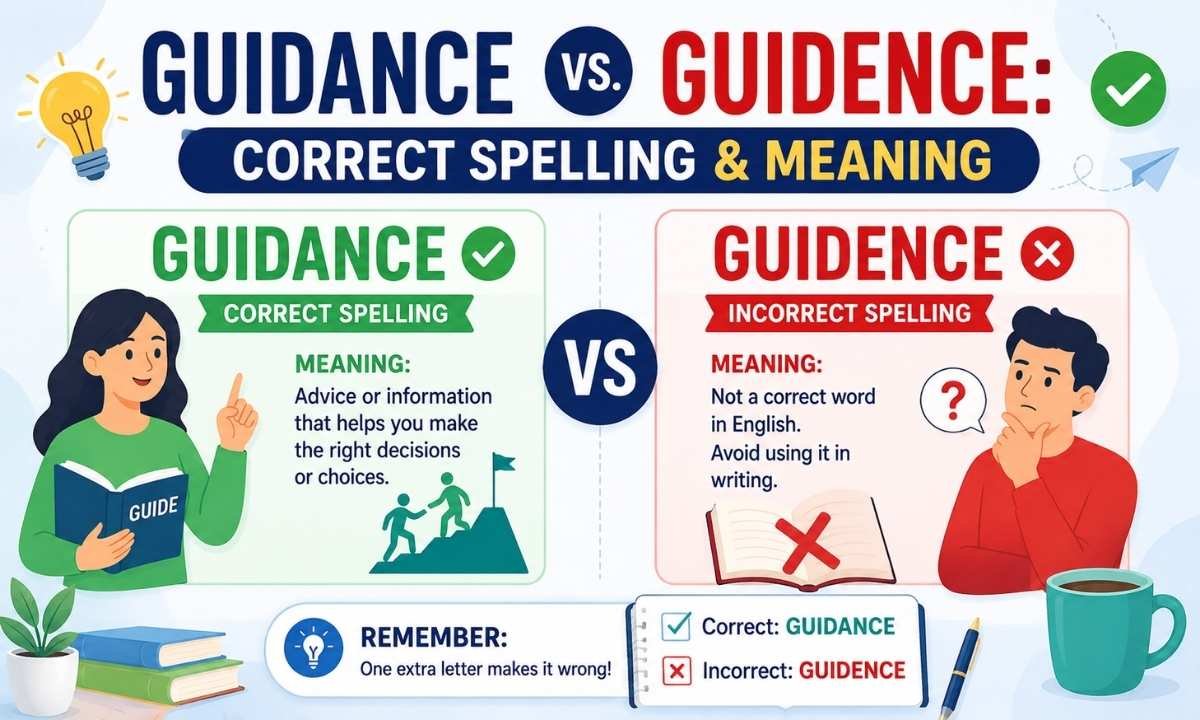
English learners and even native speakers often pause before typing this word, unsure whether it ends in “ance” or “ence.” A single letter can change how professional your writing looks, and search engines see thousands of people typing the wrong version every month while looking for the right one.
This guide settles the debate for good. You will learn the correct spelling, the meaning, real usage examples, common mix-ups with similar words, and simple memory tricks so you never second guess this word again.
Quick Answer: Is It Guidance or Guidence?
- Guidance is the correct spelling.
- Guidence is a common misspelling with no dictionary entry.
- Guidance means advice, direction, help, or support given to someone.
- Example: Thank you for your guidance during this project.
Guidance vs Guidence at a Glance
| Feature | Guidance (Correct) | Guidence (Incorrect) |
| Dictionary status | Listed in every major dictionary | Not a recognized word |
| Part of speech | Noun | None, misspelling only |
| Root word | Guide + ance | Guide + ence (wrong suffix) |
| Common use | Education, career, business, life advice | Typing or spelling error |
| Correct usage | She gave clear guidance | Should be replaced with guidance |
What Does Guidance Mean?
Guidance refers to advice, direction, or help that leads someone toward a decision or a solution. It is used when a person, document, or organization offers support to help someone move in the right direction.
- Part of speech: noun, uncountable
- Simple meaning: help or advice that shows someone what to do
- Example sentence: The teacher offered guidance on choosing the right career path.
In everyday English, people ask for guidance when they need direction from someone with more experience, such as a mentor, counselor, manager, or official document.
Why Do People Spell Guidance as Guidence?
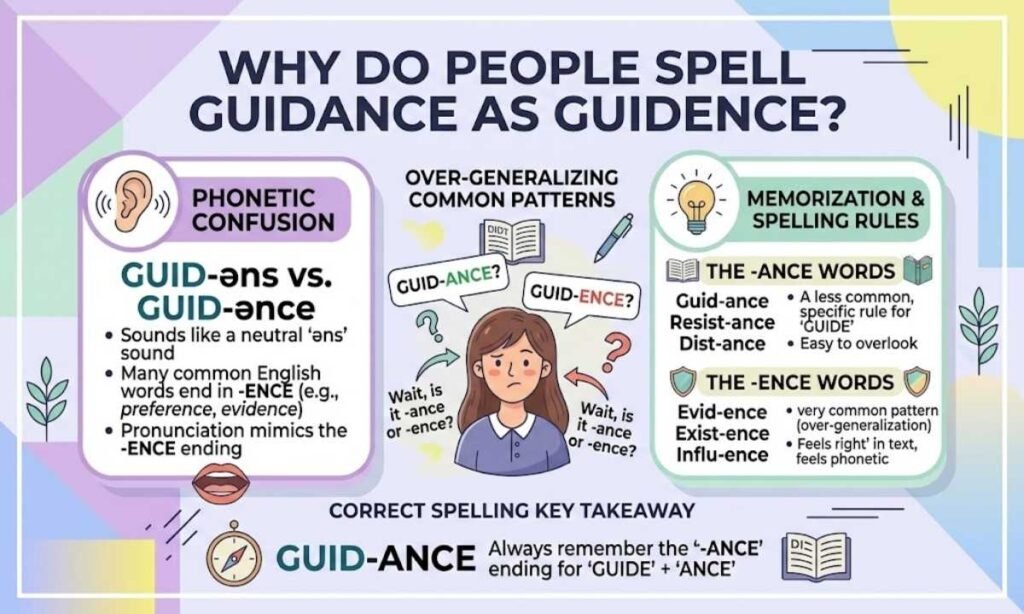
The mix up usually comes from confusion between the “ance” and “ence” word endings, which sound almost identical when spoken quickly. English has hundreds of words ending in each suffix, and there is no fixed rule that instantly tells a writer which one applies.
- Words like guidance, appearance, and performance use “ance.”
- Words like confidence, difference, and existence use “ence.”
- Since guidance comes from the verb guide, adding “ance” keeps the base spelling of guide almost intact, which is why remembering the root word helps.
Pronunciation also plays a role, because the unstressed vowel sound in both endings is often reduced to a soft “uh” sound in casual speech, making the ending hard to identify by ear alone.
How Do You Spell Guidance Correctly?
The correct spelling is G-U-I-D-A-N-C-E, made up of eight letters. A simple trick is to remember that guidance comes directly from the word guide, so the spelling keeps the letters g-u-i-d before adding ance at the end.
- Step 1: Start with a guide.
- Step 2: Drop the silent e.
- Step 3: Add ance to form guidance.
This guide plus ance formula works for many related words and can be used as a quick mental check whenever the spelling feels uncertain.
How Do You Pronounce Guidance?
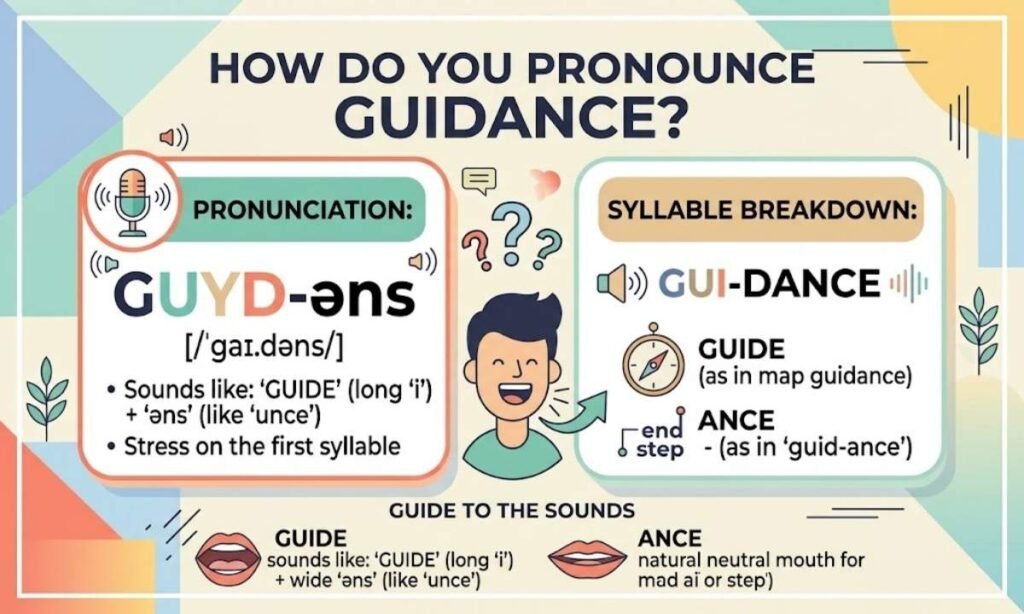
Guidance is pronounced as GUY-duhns in American English, with the stress placed firmly on the first syllable. The ending sounds soft and quick, almost blending into the word, which is part of why the spelling gets confused.
Many learners assume the ending sounds like “ence” because the vowel is barely pronounced, but the written form always stays “ance.” Listening carefully to native speakers and repeating the word slowly can help train both the ear and the memory for correct spelling.
Is Guidence a Word
No, guidence is not a recognized English word. It does not appear in Merriam-Webster, Oxford, Cambridge, or any standard dictionary. It is simply a spelling mistake that should always be corrected to guidance in any type of writing, whether formal or casual.
Autocorrect tools and spell checkers will usually flag guidence automatically, but relying only on software is not always safe, especially in fast typing or messaging apps where errors can slip through unnoticed.
Guidance vs Guidence: Example Sentences
Correct Examples With Guidance
- I appreciate your guidance on this matter.
- The counselor provided helpful guidance for new students.
- We followed government guidance during the process.
- Her guidance helped me choose the right college.
Incorrect Examples With Guidence
- I appreciate your guidence on this matter. (wrong)
- The counselor provided helpful guidence. (wrong)
- Replace every instance of guidence with guidance to keep writing accurate and professional.
Guidance in School, Business, and Daily Life
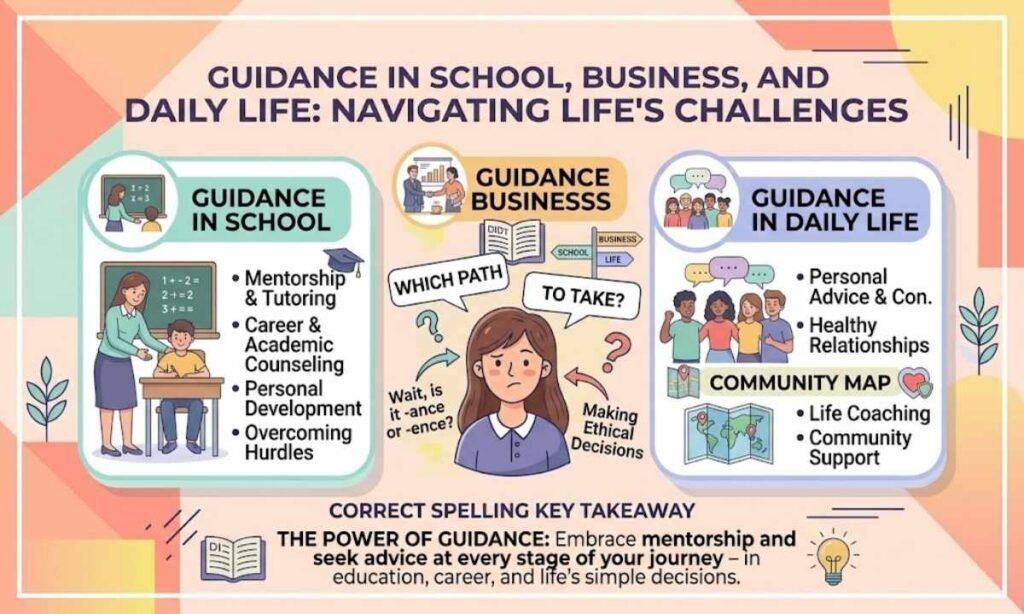
- In education, students often visit a guidance counselor for academic and career support.
- In business, managers give guidance to employees to help them meet goals and expectations.
- In daily conversation, friends and family offer guidance during major life decisions like moving, relationships, or finances.
- In government and legal contexts, official guidance refers to published instructions or recommendations that explain how rules should be followed.
Guidance vs Advice: What Is the Difference
Guidance and advice are close in meaning but not identical. Guidance usually involves ongoing direction or support, often from someone in a position of authority or experience, while advice tends to be a single suggestion or opinion offered at one moment.
- Use guidance when referring to continued support or structured direction, such as career guidance or parental guidance.
- Use advice when referring to a specific suggestion, such as advice on which laptop to buy.
- Example: A mentor provides guidance over months, while a friend gives advice about one decision.
Guidance vs Guide: Are They the Same
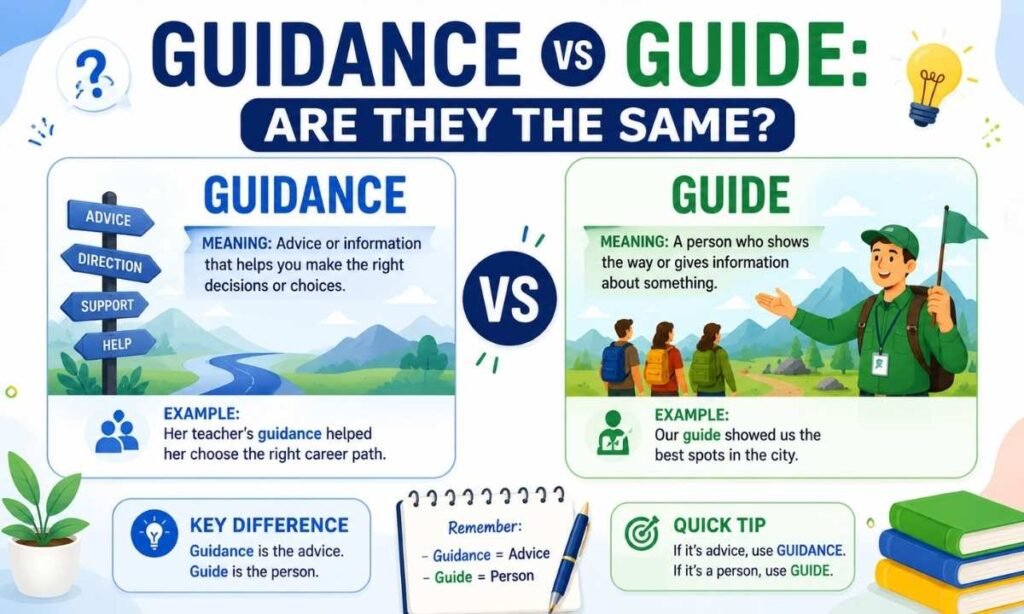
Guide and guidance are related but serve different grammatical roles. Guide can function as a noun, meaning a person or resource that shows the way, or as a verb, meaning to direct someone.
- Guide as a noun: The guide led us through the museum.
- Guide as a verb: Please guide me through this process.
- Guidance as a noun: I need your guidance to finish this report.
Guidance is always a noun and cannot be used as a verb, which is a common error to avoid.
Guidance vs Guidelines: What Is the Difference
Guidelines are specific rules or instructions, often written down, that explain how something should be done. Guidance is broader and can include advice, direction, or written instructions.
- Use guidelines when referring to a numbered or structured set of rules, such as safety guidelines.
- Use guidance when referring to general support or direction, such as parental guidance or professional guidance.
- Guidelines are usually more formal and specific, while guidance can be informal or formal.
Is Guidance Countable or Uncountable?
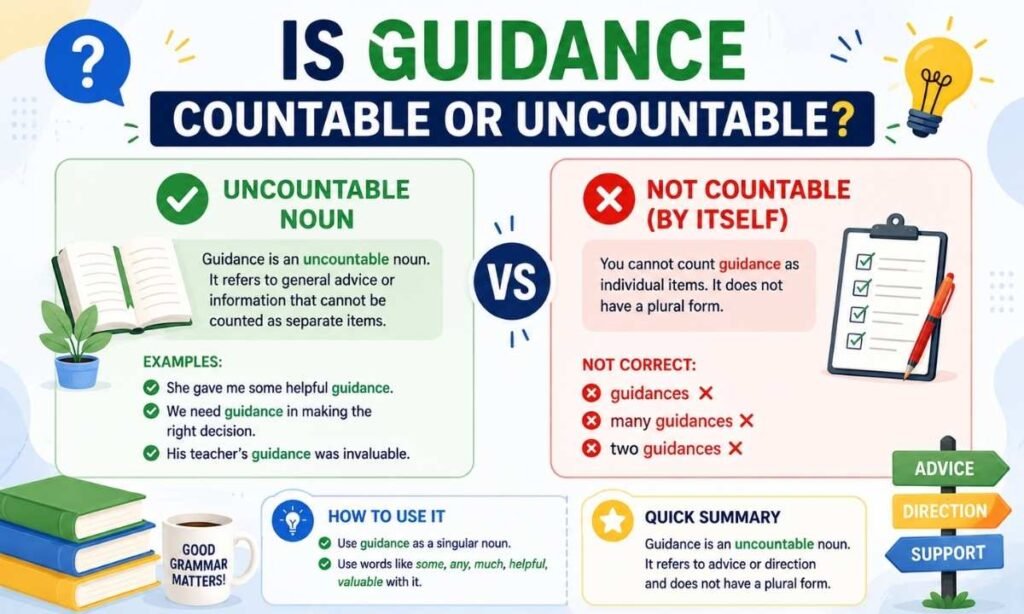
Guidance is an uncountable noun, which means it does not have a plural form and cannot be paired with the article “a” in most standard usage.
- Correct: I need some guidance.
- Incorrect: I need guidance.
- Incorrect: There are many guidelines available.
- Correct: There are many pieces of guidance available, or many forms of guidance.
Common Mistakes to Avoid
| Mistake | Correction |
| Guidence | Guidance |
| A guidance | Some guidance |
| Guidances | Pieces of guidance |
| Guidance the team | Guide the team |
Guidance in American vs British English
Guidance is spelled the same way in both American and British English. There is no regional variation, and guidence is considered incorrect everywhere, regardless of dialect or spelling convention differences between the two versions of the language.
Easy Ways to Remember the Spelling of Guidance
- Remember that a guide gives guidance, keeping the connection between the two words clear.
- Focus on the letter “a” appearing right after guid, since guidance always uses ance, never ence.
- Practice writing the full sentence: guide plus ance equals guidance, until it becomes automatic.
Synonyms for Guidance
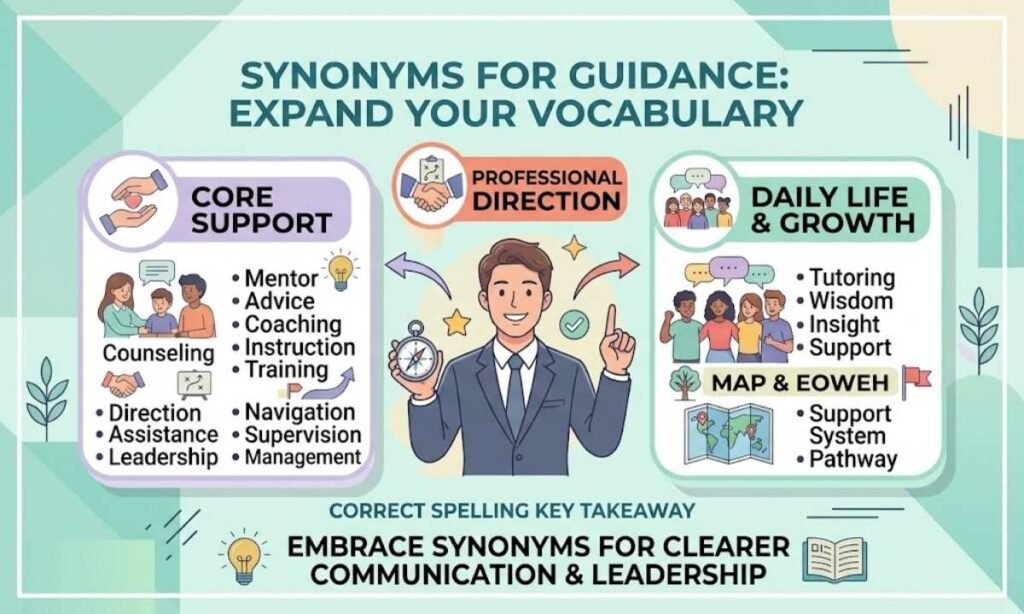
Guidance shares meaning with several related words, which can also help writers avoid repetition in longer content.
- Advice and direction
- Support and instruction
- Counsel and mentorship
- Leadership and supervision
Choosing the right synonym depends on context, since counsel often suits formal or professional settings, while support fits everyday conversation.
15 Correct Sentences Using Guidance
- The new employee needed guidance from a senior colleague.
- Parental guidance is required for children under thirteen.
- The report offers guidance on reducing workplace stress.
- Students sought guidance before choosing their college major.
- His guidance helped the small business grow steadily.
- The manual provides guidance for first time users.
- She thanked her professor for years of academic guidance.
- The committee released updated guidance for public health.
- I always trust his guidance when making big decisions.
- The coach gave guidance on improving technique.
- Their guidance made the transition much smoother.
- The website offers guidance on writing a strong resume.
- Government guidance changed several times during the year.
- The therapist offered gentle guidance through a difficult period.
- Without proper guidance, the project would have failed.
Frequently Asked Questions
Is guidance or guidence correct?
Guidance is the correct spelling. Guidence is a common misspelling with no dictionary listing.
Is guidence a real word?
No, guidence is not a recognized word in any standard English dictionary.
How do you spell guidance?
It is spelled G-U-I-D-A-N-C-E, formed from guide plus the suffix ance.
What does guidance mean?
Guidance means advice, direction, or support given to help someone make a decision.
Is guidance a noun?
Yes, guidance is an uncountable noun and cannot be used as a verb.
How do you pronounce guidance?
It is pronounced GUY-duhns, with stress on the first syllable.
Is guidance spelled the same in American and British English?
Yes, the spelling stays identical in both American and British English.
Can you give me some guidance?
No, guidance is uncountable, so say some guidance instead.
What is the plural of guidance?
Guidance has no plural form; use pieces of guidance or forms of guidance instead.
What is the difference between guidance and advice?
Guidance often means ongoing support, while advice is usually a single suggestion.
What is the difference between guidance and guidelines?
Guidelines are specific written rules, while guidance is broader, general direction or support.
Conclusion
Guidance is the standard, dictionary approved spelling, while guidence is simply an error that should always be corrected. Remembering that guidance comes directly from guide, with the ance ending attached, makes the correct spelling easy to recall in any writing situation, whether academic, professional, or casual.