
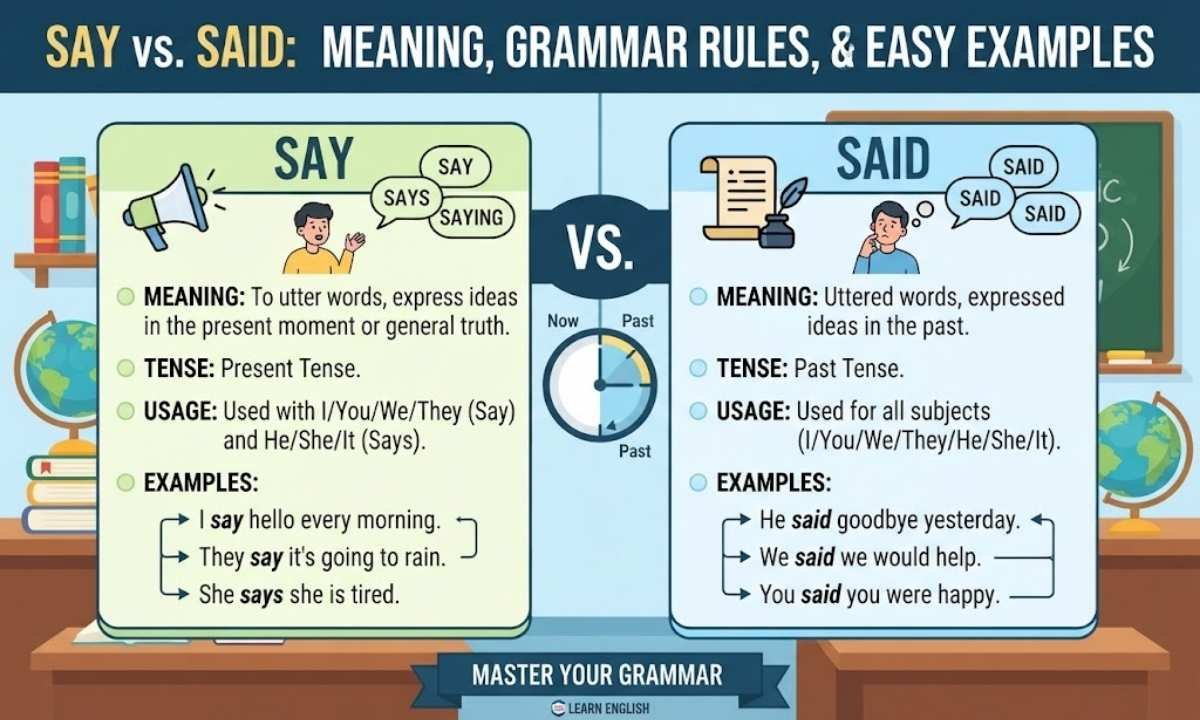
Say and said often cause confusion because they come from the same irregular verb but belong to different tenses. Say vs Said is a common grammar question. Say is used for present and general statements, while said is the past tense and past participle form used for anything that already happened.
This guide breaks the difference down in plain language, with verb charts, real sentence examples, common mistakes learners make, and simple tricks to help you choose the right word every single time you write or speak.
The Core Difference Between Say and Said
Say is the base form of the verb, used in present simple sentences with I, you, we, and they. Said is the simple past and past participle, used for completed actions and with helping verbs like have, has, and had.
| Word | Tense | Example |
| Say | Present, base form | I say what I think. |
| Says | Present, third person | She says the same thing. |
| Said | Simple past | I said that yesterday. |
| Said | Past participle | She has said it before. |
What Say Means and How to Use It?
Say means to express words, opinions, facts, or feelings out loud or in writing. It is commonly paired with subjects like I, we, you, and they, and it also appears in future tense sentences with will.
Typical uses of say include:
- Present habits, such as I say good morning to my coworkers
- General truths, such as people say honesty matters
- Future plans, such as I will say a few words at the event
- Direct questions, such as what do you say about this plan
What Said Means and When It Applies?
Said refers to something a person expressed in the past, whether spoken aloud or written down earlier. It works as both the simple past tense and the past participle, which makes it one of the more flexible irregular verbs in English.
Said is the right choice in these situations:
- Completed conversations, such as she said she was busy
- Reported statements, such as they said the trip was cancelled
- Quoted dialogue in writing, such as he said, I will be there soon
- Perfect tense sentences, such as we have said this many times
Say Versus Says: Subject Agreement Rules
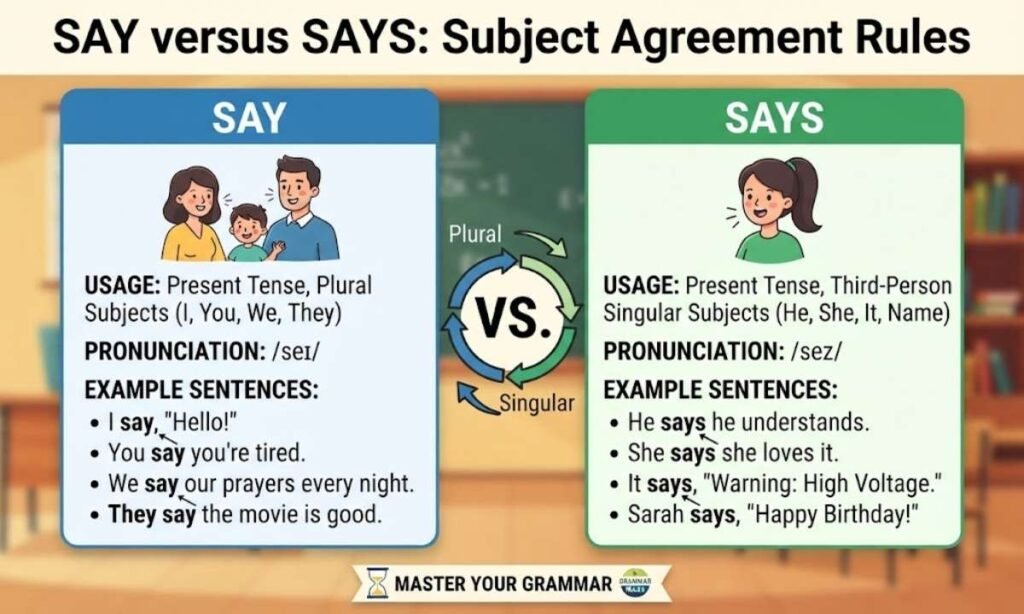
One of the most common grammar slips involves choosing between say and says. Says is used only with third person singular subjects such as he, she, it, or a singular noun, while say is used with everyone else.
| Subject | Correct verb | Example |
| I / You / We / They | Say | They say the food is amazing. |
| He / She / It | Says | He says he is running late. |
Irregular Verb Pattern of Say
Say does not follow the regular pattern of adding ed to form the past tense, which is why sayed is never correct in standard English. Instead, the verb changes internally to become said in both the past simple and past participle forms, a pattern shared by other irregular verbs like pay and lay.
| Verb form | Correct word |
| Base form | Say |
| Third person present | Says |
| Simple past | Said |
| Present participle | Saying |
| Past participle | Said |
Say and Said in Everyday Sentences
Seeing these words used naturally makes the rule easier to remember.
Present examples I say hello to my neighbors every morning. They say the new restaurant is worth trying. She says the report is almost finished.
Past examples He said the movie was better than expected. We said goodbye before catching our flight. The teacher said the exam would be easy.
Question examples What did she say about the schedule? What does he say when you ask him? Did you say something a moment ago?
Say and Said in Reported Speech
Reported speech often shifts a sentence from present to past, which changes say into said. If someone says I am tired right now, reporting that statement later becomes she said she was tired.
- Direct: I am happy, she says
- Reported: She said that she was happy
- Direct: We will help, they say
- Reported: They said that they would help
Say Versus Tell: A Quick Related Comparison
Say and tell are closely related but not interchangeable. Say focuses on the words themselves, while tell usually requires a listener as its object.
- Correct: She said hello to him
- Correct: She told him hello
- Incorrect: She said him hello
Regional Usage Notes in American English
American English generally favors said for narration and dialogue tags in writing, while says is often used in casual storytelling to make a past event feel more immediate, such as so she says to me, guess what happened. This informal present tense narration is common in spoken American English but should be avoided in formal writing.
Say and Said in Professional Writing
Business and academic writing rely heavily on said for accurate reporting of past statements, meetings, and interviews. Using said correctly adds credibility and clarity to professional communication.
- The manager said the deadline would move to Friday
- The spokesperson said the company plans to expand next year
- The client said the proposal needed revisions
Common Mistakes With Say and Said
Even confident English speakers slip up with these two words. Watching for these patterns helps avoid awkward or incorrect sentences.
- Writing sayed instead of said
- Using say for something that already happened
- Mixing up says and said within the same paragraph
- Saying he said me instead of he told me
- Forgetting said after have, has, or had in perfect tense sentences
Quick Memory Trick for Say and Said
A simple way to remember the rule is thinking of say and says as now words, while said always points to the past. If the sentence describes something happening currently or generally, use say or says. If it already happened, said is almost always correct.
Frequently Asked Questions
What is the difference between say and said?
Say is the present or base form, while said is the simple past and past participle form.
Is said the past tense of say?
Yes, said is both the simple past tense and the past participle of the irregular verb say.
Is sayed a real word?
No, sayed is incorrect in standard English. The correct past form is always said.
What is the past participle of say?
The past participle of say is said, used after have, has, or had.
Is says the same as said?
No, says is present tense used with he, she, or it, while said refers to the past.
Can say and said appear in the same sentence?
Yes, for example she says she said that yesterday is grammatically correct.
What is the difference between say and tell?
Say focuses on the words spoken, while tell usually includes the person receiving them.
Conclusion
Say and said follow one simple rule once you understand the pattern: say and says belong to the present, while said belongs to the past. Practicing with real sentences and paying attention to subject agreement will make switching between these two forms feel automatic in both writing and everyday conversation.