
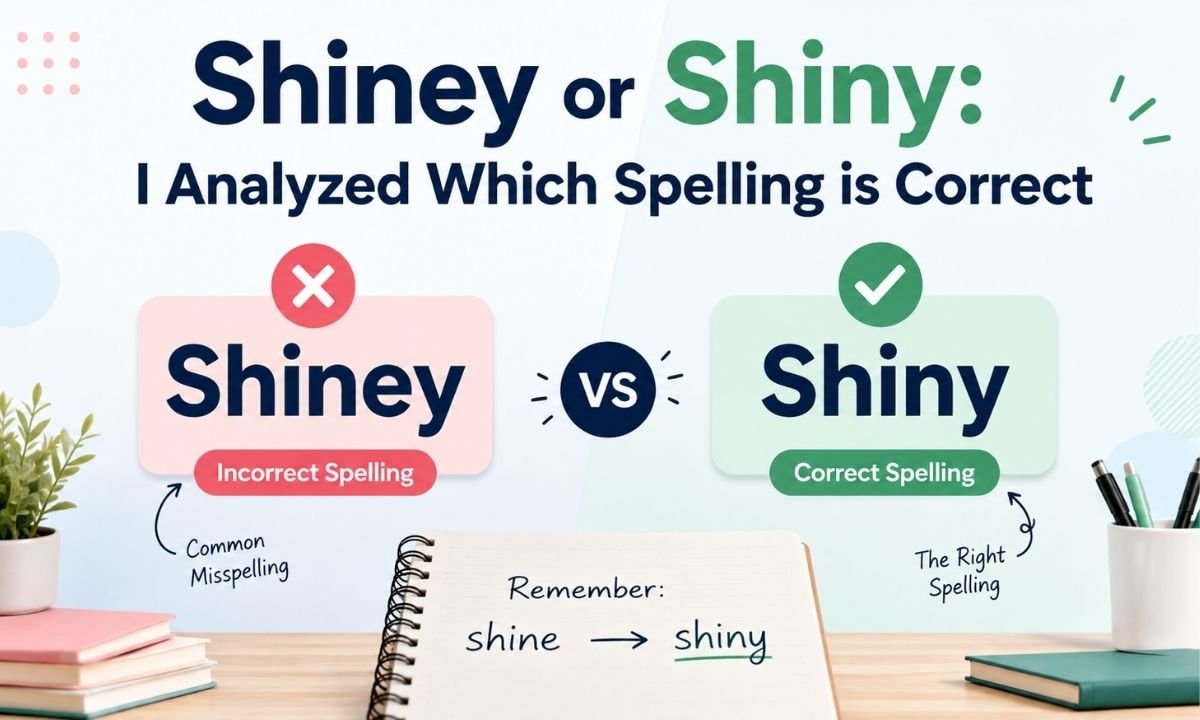
Anyone who has typed a product description, a school essay, or a quick text message has probably paused for a second on this exact word. Does that new phone look Shiney or Shiny? It is a small spelling question, but it trips up writers constantly because the base word, shine, ends in a silent e that seems like it should carry over.
The short answer is that shiny is the only standard spelling recognized in dictionaries and style guides, while shiney is treated as a common misspelling. This guide breaks down why that is the case, where the confusion comes from, and how to use the word correctly in real sentences, comparatives, and everyday writing.
Shiney or Shiny: Quick Answer
If you only read one section, read this one. Shiny is correct. Shiney is not a recognized standard spelling, even though it shows up often online. The word describes something that reflects light, looks glossy, or has a polished, lustrous surface.
| Spelling | Status | Notes |
| Shiny | Correct | Standard adjective form used in dictionaries |
| Shiney | Incorrect | Common typo; occasionally a proper name |
Why Shine Becomes Shiny Instead of Shiney?
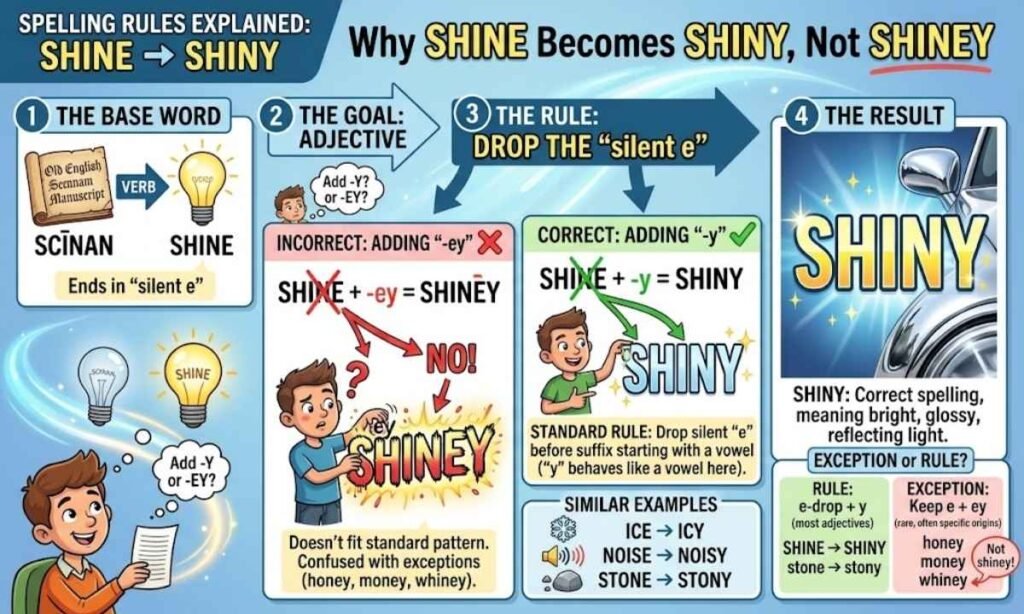
English has a reliable spelling pattern for turning short, one-syllable words that end in a silent e into adjectives ending in -y. The rule is simple: drop the final e, then add y.
- shine becomes shiny
- ice becomes icy
- spice becomes spicy
- smoke becomes smoky
- noise becomes noisy
- haze becomes hazy
This pattern is not an obscure exception. It is one of the more consistent rules in English spelling, which is exactly why “shiney,” with the extra e retained, looks like a mistake to trained editors even though it feels intuitive to a casual writer.
Where the Shiney Misspelling Comes From
Most spelling errors have a logical root, and this one is no different.
- The base word shine already contains an e, so writers assume it should stay.
- Say the word out loud, and “shiny” and “shiney” sound identical, which removes any auditory clue.
- Other adjectives, such as homey or matey, do keep an e before the y, so some writers apply that pattern here by mistake.
- Autocomplete and casual social media posts spread the incorrect spelling further, making it look more familiar than it should.
None of these reasons make shiney correct. They simply explain why the mistake is so widespread.
How to Spell Shiny Correctly?
The correct spelling, letter by letter, is S H I N Y. A simple memory trick makes this stick permanently: picture the word shine, physically remove the final e, then attach y.
shine, minus e, plus y, equals shiny
The same drop-the-e pattern applies to ice becoming icy and noise becoming noisy, so once the rule clicks for one of these words, it applies cleanly to the rest.
Shiny vs Shining: Key Difference
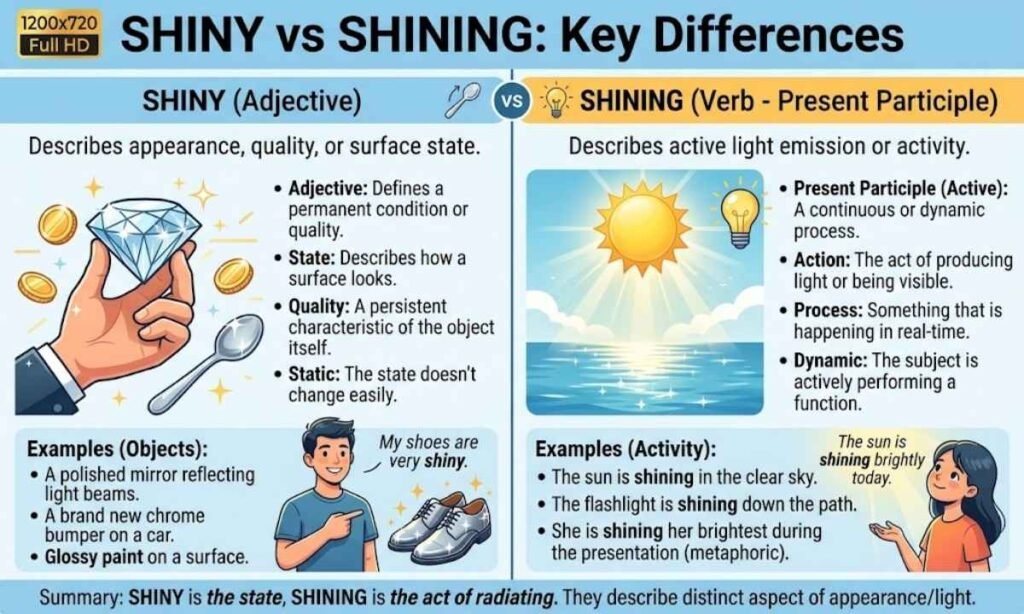
These two words are related but not interchangeable, and mixing them up is a separate common mistake.
- Shiny is a plain adjective describing a surface quality, such as a shiny coin or a shiny floor.
- Shining is typically the present participle of the verb shine, describing something actively giving off or reflecting light in the moment, as in “the sun is shining” or “her shining performance.”
A quick test: if you can swap in the word glossy without changing the meaning, shiny is usually the right choice. If the sentence is about an ongoing action of light or excellence, shining fits better.
Shiny vs Glossy: Are They the Same Thing
Shiny and glossy overlap heavily but are not perfect synonyms. Shiny is the broader, everyday term for anything that reflects light. Glossy leans more technical and is common in contexts involving finishes, coatings, and printed materials.
| Context | Preferred word | Example |
| Magazine paper or photo prints | Glossy | a glossy magazine cover |
| Paint or nail polish finish | Glossy | glossy paint on the trim |
| Hair, jewelry, metal, eyes | Shiny | shiny hair after a trim |
| General everyday objects | Shiny | a shiny new bicycle |
Comparative and Superlative Forms
Because shiny follows the standard short-adjective pattern, the comparative and superlative forms use -er and -est rather than “more” and “most.”
- Comparative: shinier, not “more shiny.” Example: This countertop is shinier than the last one we installed.
- Superlative: shiniest, not “most shiny.” Example: That was the shiniest trophy in the entire display case.
Using “more shiny” or “most shiny” is not technically illegal in casual speech, but it reads as awkward and unpolished next to shinier and shiniest, which are the forms accepted in formal writing.
Is Shiney Ever Acceptable?
There are a few narrow situations where the letters s h i n e y appear legitimately, but none of them make it the correct spelling of the adjective.
- As a surname, such as actor Shiney Ahuja.
- As a username, brand name, or stylized product name.
- Inside a direct quotation where someone else originally misspelled the word.
Outside of proper nouns and quoted material, shiney should always be corrected to shiny in standard writing, academic work, and professional content.
Shiny in American and British English
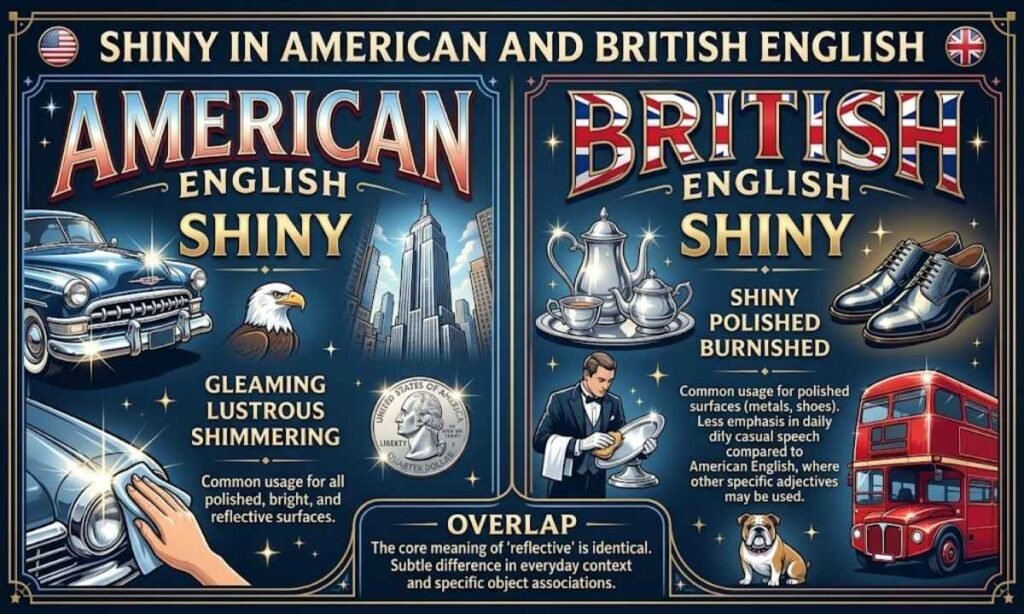
Good news for anyone worried about regional spelling differences: shiny is spelled the same way in both American and British English. Unlike color versus colour or organize versus organise, this word does not split along regional lines.
- American English: “He polished the shiny hood of the truck.”
- British English: “The children admired the shiny conkers they had collected.”
No matter which side of the Atlantic the writing is aimed at, shiny remains the safe, universally correct spelling.
Synonyms for Shiny by Context
Choosing the right synonym depends heavily on what is being described.
| Synonym | Best used for |
| Glossy | Smooth, coated, or printed surfaces |
| Polished | Metal, wood, or stone that has been buffed |
| Gleaming | Very bright or spotlessly clean objects |
| Lustrous | Hair, silk, pearls, and fine fabric |
| Reflective | Surfaces built to bounce back light, like signs |
| Glistening | Wet or lightly dewy surfaces |
| Radiant | Skin, faces, or anything associated with glow |
Rotating through these synonyms also helps writing sound more natural and avoids repeating the word shiny too many times in one paragraph.
Common Sentences Using Shiny
- Everyday speech: “Look at that shiny puddle after the rain.”
- Product writing: “This blender features a shiny stainless steel finish.”
- School or professional writing: “The report highlighted the shiny new packaging as a key selling point.”
- Creative writing: “Moonlight turned the lake into a sheet of shiny glass.”
Frequently Asked Questions
Is shiney or shiny correct?
Shiny is the correct standard spelling. Shiney is a common misspelling and should be avoided in formal writing.
How do you spell shiny?
It is spelled S H I N Y, formed by dropping the final e from shine and adding y.
Why is shiny spelled without an e?
English drops the silent e before adding y in short adjectives, the same pattern seen in ice to icy and spice to spicy.
Is shiney a real word?
Not as a standard adjective. It mainly appears as a surname, username, or brand name.
What does shiny mean?
It describes something bright, glossy, polished, or reflective, like a shiny coin or shiny hair.
Is shiny used differently in American and British English?
No, shiny is spelled and used the same way in both American and British English.
Is it shinier or more shiny?
Shinier is the correct comparative form; “more shiny” is grammatically awkward and best avoided.
Conclusion
Shiny is the correct, dictionary-approved spelling, and shiney is a misspelling with only a handful of proper-noun exceptions. The easiest way to lock this in permanently is to remember the pattern behind it: shine loses its e and gains a y to become shiny, exactly the same way ice becomes icy and noise becomes noisy. Keep that rule in mind, and the shiny versus shiney mix-up disappears for good.