

If someone keeps asking questions that are none of their business, you already know the feeling this word describes. But when you sit down to type it, a small doubt creeps in. Is it nosey or nosy? Both spellings show up online, in books, and in casual conversation, which only adds to the confusion.
The short answer is that nosy is the standard, more widely accepted spelling, especially in American English, while nosey is a recognized variant that some writers still use. Below, we break down the meaning, origin, pronunciation, and correct usage of both forms with real examples.
Nosey or Nosy: Which Spelling Is Actually Correct
Nosy is the spelling most dictionaries list as the primary entry. Nosey appears as an alternate form, meaning it is not wrong, just less common in modern writing, news articles, and academic content.
If you are writing for school, work, or a professional audience, nosy is the safer and more polished choice. Nosey will still be understood, but it can read as slightly informal or old fashioned to some readers.
The Real Meaning Behind Nosy and Nosey
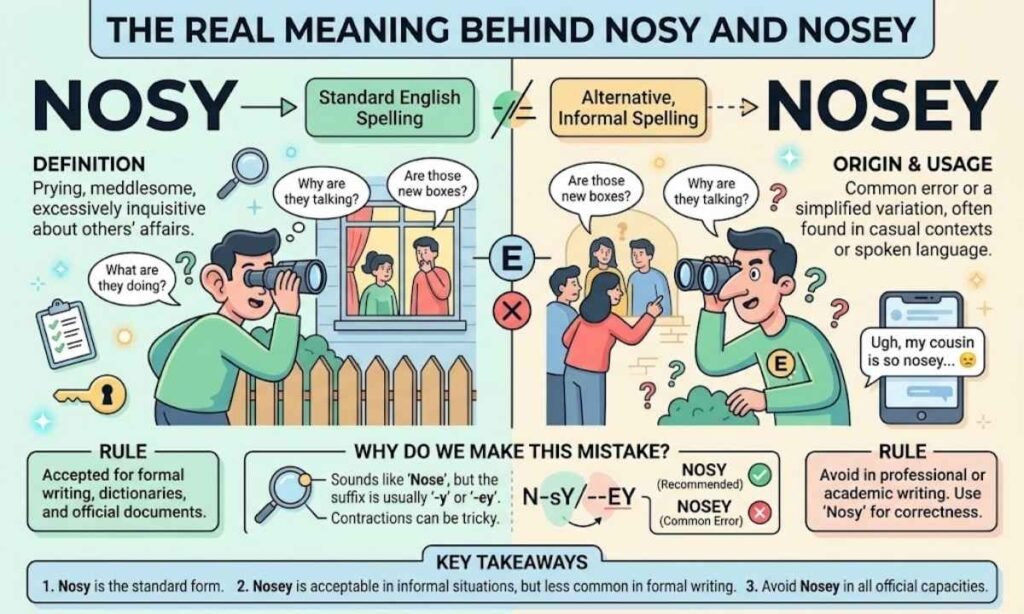
Both words carry the exact same meaning: someone who is excessively curious about other people’s private business, personal lives, or affairs that do not concern them. It describes a person who pries, snoops, or asks overly personal questions.
Common everyday uses include:
- A nosy neighbor who watches everyone’s comings and goings
- A nosy coworker who asks about your salary or relationship status
- A nosy friend who wants details you were not ready to share
- Nosy parents who read their teenager’s private messages
- A nosy question at a party that catches you off guard
The tone can range from mildly annoying to outright intrusive, depending on the situation and how the question is asked.
Nosey or Nosy: Quick Comparison Table
| Feature | Nosy | Nosey |
| Meaning | Overly curious about others | Same meaning, no difference |
| Preferred in | American English, formal writing | Casual or informal writing |
| Dictionary status | Main entry in most dictionaries | Listed as a variant spelling |
| Pronunciation | Identical | Identical |
| Common usage | More frequently used online and in print | Used occasionally, mostly in speech |
| Best for resumes, essays, emails | Yes | Not recommended |
Why Two Spellings Exist for the Same Word?
Nosy comes directly from the noun nose, combined with the suffix y, which is typically used to turn nouns into descriptive adjectives, similar to words like messy from mess or greasy from grease.
Over time, some writers added an extra e before the y, producing nosey, likely influenced by how the word sounds when spoken aloud. This kind of spelling drift is common in English, where pronunciation sometimes shapes informal written forms that later stick around as accepted variants.
American English vs British English Usage
There is a popular myth that nosy is American and nosey is British, but current dictionary data does not fully support a strict split. Nosy is dominant in both American and British published content, while nosey survives mainly in casual, spoken, and informal contexts across both regions.
If your content targets a US audience, search engines and style guides consistently favor nosy as the standard form. British publications lean the same way, though nosey appears slightly more often in informal UK writing than in the US.
How to Pronounce Nosy and Nosey Correctly
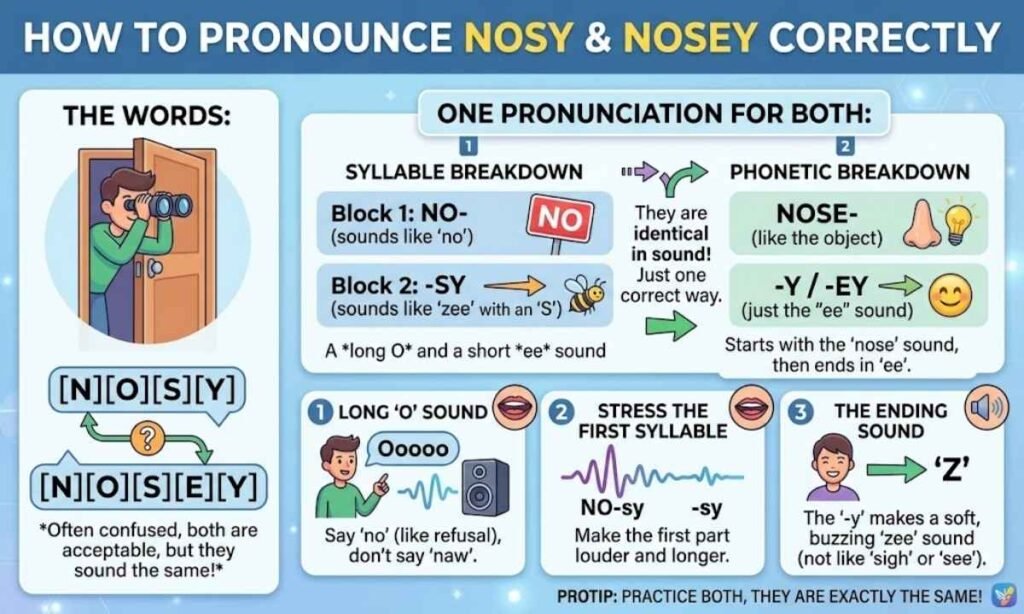
Despite the spelling difference, both words are pronounced exactly the same way: noh zee. The stress falls on the first syllable, and the ending sounds like the letter Z, not an S sound.
This is one reason the two spellings coexist so easily. Since listeners cannot hear a difference, many writers default to whichever spelling feels more natural to them, without realizing one form is technically more standard.
Nosy in a Sentence: Real-Life Examples
Seeing the word in context makes the meaning click faster than any definition alone. Here are a few natural examples:
- My neighbor is so nosy that she asks about every visitor at my house.
- Try not to be nosy about other people’s finances.
- He gave a nosy look when he saw the private letter on my desk.
- Their nosy questions made the interview feel uncomfortable.
- She hates nosy coworkers who gossip about everyone’s personal life.
Is Calling Someone Nosy Rude or Playful
Context decides the tone entirely. Calling someone nosy can sound like a light, teasing jab between friends, or it can come across as a sharp criticism if said in a serious moment.
Used playfully, it works fine in casual banter, such as teasing a sibling who keeps checking your phone. Used seriously, it signals that someone has crossed a boundary and needs to back off. If you want to soften the blow, phrases like a little too curious or overly interested can express the same idea more gently.
Synonyms for Nosy and When to Use Them
Several words share meaning with nosy, but each carries a slightly different weight or formality level.
| Synonym | Best Used When |
| Curious | Neutral, not necessarily negative |
| Prying | Strongly negative, implies pushing boundaries |
| Intrusive | Formal tone, suggests invading privacy |
| Inquisitive | Slightly positive, suggests intellectual curiosity |
| Meddlesome | Implies interfering in someone’s affairs |
| Snoopy | Casual, often used playfully |
Choosing the right synonym depends on whether you want to sound harsh, neutral, or lighthearted.
Nosy in Idioms and Common Phrases
English has several idioms built around the same idea of being nosy without using the word directly. Recognizing these helps with both writing and everyday conversation.
- Sticking your nose in someone’s business means interfering where you are not wanted.
- A nose for gossip describes someone naturally drawn to other people’s secrets.
- Poking your nose where it does not belong is another common way to describe nosy behavior.
These phrases reinforce the connection between the literal nose and the figurative idea of prying into private matters.
Nosy in Different Word Forms
Like most adjectives, nosy changes form depending on how it is used in a sentence.
- Nosier is the comparative form, used when comparing two people, such as she is nosier than her sister.
- Nosiest is the superlative form, used for the most extreme case, such as he is the nosiest person in the office.
- Nosily is the adverb form, describing how an action is done, such as she nosily peeked through the blinds.
Note that nosey rarely takes these extended forms in modern usage, which is another reason nosy remains the more practical spelling choice.
How to Politely Deal With a Nosy Person?
Dealing with nosy behavior does not always require confrontation. A calm, direct response usually works best.
- Redirect the conversation with a simple, I would rather not discuss that.
- Use humor to deflect without sounding harsh.
- Set a clear boundary by saying that topic is private for me.
- Ask a question back to shift focus away from yourself.
- Walk away from the conversation if the questions continue after you have set a boundary.
Staying calm and firm usually stops nosy questioning faster than getting visibly annoyed.
Nosy vs Curious: What Sets Them Apart
Curious and nosy both describe interest in something, but the difference lies in appropriateness. Curiosity is generally seen as a positive trait tied to learning and discovery, while nosy behavior crosses into territory that is not the person’s business.
Someone curious about a new restaurant is simply interested. Someone nosy about your medical history without being asked has overstepped a personal boundary. The line between the two often comes down to whether the information was offered or actively pried out.
Nosy in Pop Culture and Everyday Media
The word shows up frequently in television, movies, and everyday storytelling, almost always attached to a specific character type. Nosy neighbors, nosy coworkers, and nosy relatives are common comedic figures because the behavior is instantly relatable to most audiences.
This widespread cultural use is part of why nosy remains such a frequently searched and frequently written word, appearing naturally in scripts, dialogue, and casual online writing.
Which Spelling Should You Use in Formal Writing?
For essays, resumes, business emails, and professional content, nosy is the recommended spelling. It matches what most style guides and dictionaries treat as standard, and it avoids any impression of informality.
Nosey is not incorrect, but it is better suited for casual texts, social media captions, or dialogue meant to sound conversational rather than polished.
Final Verdict: Nosy or Nosey
Nosy wins as the correct, standard, and more widely accepted spelling across American and British English alike. Nosey remains a valid variant, particularly in casual or spoken contexts, but it is not the preferred choice for formal or professional writing.
When in doubt, default to nosy. It is the spelling readers expect, the one search engines favor, and the one that keeps your writing looking polished.
Frequently Asked Questions
Is nosy or nosey correct?
Nosy is the standard and more widely accepted spelling. Nosey is an accepted variant used mainly in casual writing.
Is nosey a real word?
Yes, nosey is a real, recognized variant spelling of nosy, and it carries the exact same meaning.
Which is more common, nosy or nosey?
Nosy is far more common in dictionaries, published writing, and everyday online content than nosey.
Is nosy American or British?
Nosy is dominant in both American and British English, so it is not exclusively tied to either region.
Do nosy and nosey sound the same?
Yes, both spellings are pronounced identically as noh zee, with no audible difference between them.
What does it mean when someone is nosy?
It means the person is overly curious about other people’s private business, personal life, or affairs that do not concern them.
Is being nosy rude?
It can be, depending on tone and context. Playful curiosity among friends feels different from prying into serious personal matters.
Conclusion
Nosy and nosey mean exactly the same thing, describing someone who is overly curious about matters that are not theirs to know. Nosy stands out as the more standard, widely used, and formally accepted spelling, while nosey remains a legitimate but less common variant best saved for casual writing.
Whether you are describing a curious neighbor, an overly inquisitive coworker, or simply want to use the correct spelling in your next piece of writing, choosing nosy keeps your content clear, professional, and aligned with how most readers expect to see it written.