
So is the correct spelling in standard English. It works as an adverb, a conjunction, and an interjection, as in “I am so tired” and “It was late, so we left.” Soo is not a standard word. Writers use it informally to stretch the sound and add emphasis.
The difference matters because spelling affects how polished your writing looks. This guide explains what so means, why soo appears online, and how both differ from too. It also covers SOO as an uppercase abbreviation in business and construction, so you can choose the right form with confidence. You will also find clear examples and a quick comparison table.
“Soo” vs “So” at a Glance
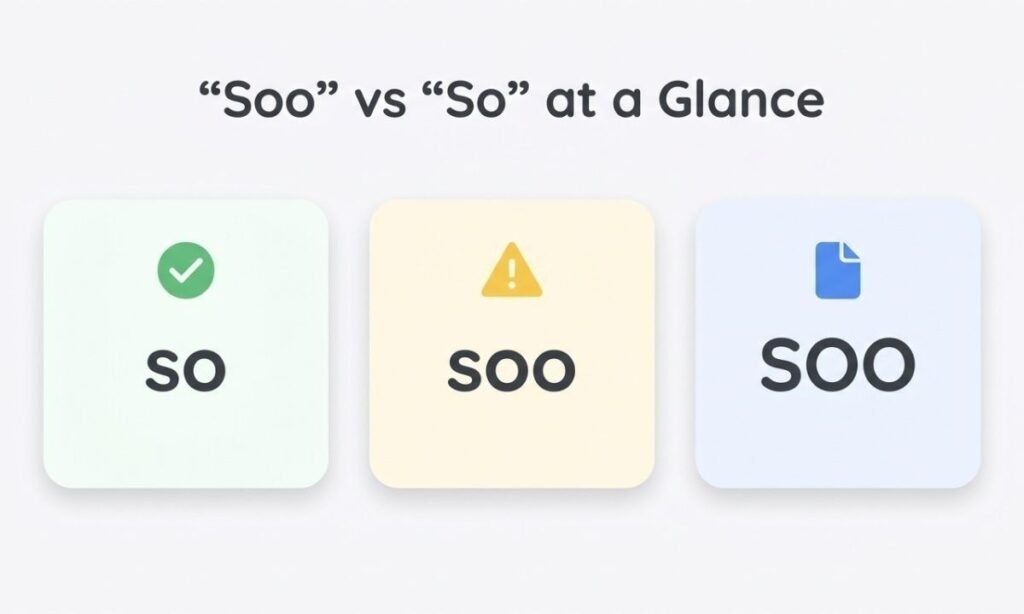
| Form | Status | Meaning or Function | Example |
| so | Standard English | Very, therefore, in this way, or also | The soup is so hot. |
| soo | Informal, nonstandard | A stretched spelling of so for emphasis | I’m soo excited! (casual messages only) |
| SOO | Abbreviation | Often “Statement of Objectives” in contracting | The SOO lists the project goals. |
In short, use so in any writing that needs to look correct. Use soo only when you deliberately want a casual, drawn-out tone, and use SOO only when you mean the abbreviation.
What Does “So” Mean?
So is one of the most flexible small words in English. Its core ideas are degree (to what extent), manner (in what way), result (as a consequence), and agreement (also or the same).
The word traces back to Old English swa, according to the Online Etymology Dictionary. That long history helps explain why so now covers so many jobs.
How “So” Works as Different Parts of Speech
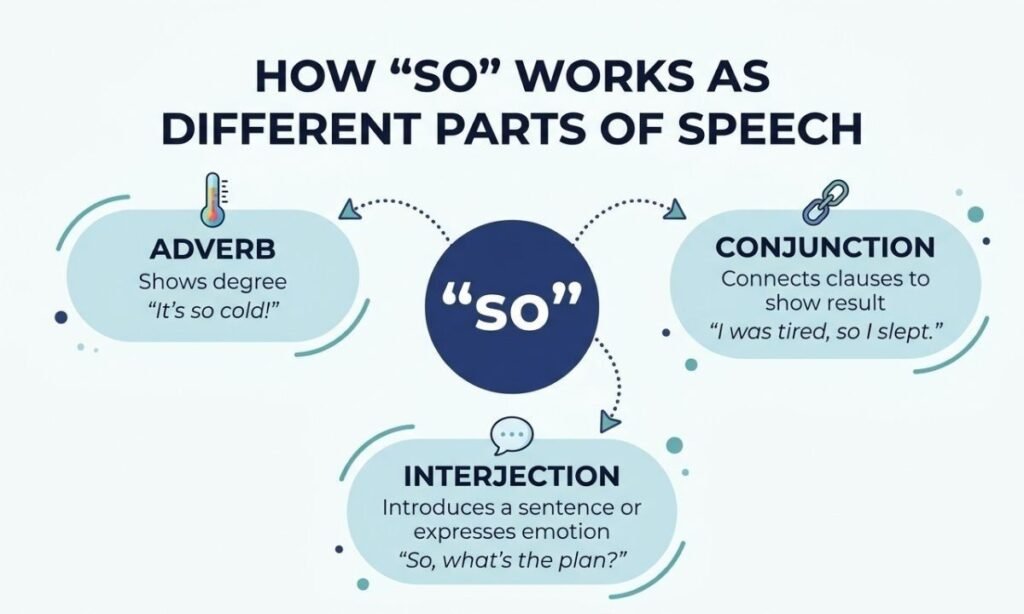
Most spelling confusion disappears once you see that so is a real word with several grammatical roles. Each role has its own pattern.
“So” as an Adverb
As an adverb, so can show degree, manner, or stand in for an earlier idea.
- Degree: “The movie was so long that we took a break.”
- Manner: “Hold the brush so, with your thumb on top.”
- Substitute for a clause: “Is the store open? I think so.”
- Agreement: “She loves hiking, and so does her brother.”
Dictionary.com notes that so meaning “very” or “extremely” occurs chiefly in informal speech. In formal writing, very or extremely is often a safer choice.
“So” as a Conjunction
As a conjunction, so introduces a result or a purpose.
- Result: “It rained all morning, so we stayed inside.”
- Purpose: “She left early so she could catch the train.”
- Purpose, more formal: “She left early so that she could catch the train.”
Both purpose forms are standard. The longer so that is somewhat more common in formal writing.
“So” as an Interjection and in Fixed Phrases
So can open a sentence to start a topic or signal a transition: “So, what happens next?” A short “So?” can also dismiss an idea.
So also appears in many set expressions:
- so far
- so what
- so to speak
- or so (“about five or so”)
- so-so (mediocre)
None of these ever use a double “o.”
Is “Soo” a Word?
In standard usage, no. Mainstream dictionaries list so, not soo, for the meanings above. When you see “soo” in a sentence, it is almost always so with extra letters added.
Why People Write “Soo”
Stretched spellings imitate the way people draw out a word in speech. Linguists often call this expressive lengthening. It is common in texts, chats, and social media captions.
- “I’m soo happy for you!”
- “That was soo good.”
- “It’s sooo cold today.” (more letters mean more emphasis)
The extra letters add feeling, not meaning. The sentence means exactly what it would with so. Because this is a casual habit, it does not belong in essays, reports, emails to clients, or published articles.
When “Soo” Is Spelled Correctly
Some capitalized proper nouns really do contain Soo:
- “The Soo” is a nickname for Sault Ste. Marie, the twin cities in Michigan and Ontario.
- The Soo Locks are a well-known set of locks on the St. Marys River.
- The Soo Line is a railroad name.
- Soo is also a given name and surname in several languages, including Korean.
In each case, Soo is a name, not a spelling of the word so.
What Does “SOO” Mean in Business and Construction?
Written in capital letters, SOO is an abbreviation, not a misspelling. Its meaning depends on the document and the industry, so always check the glossary or the project documents when in doubt.
SOO Meaning in Business
In government contracting and procurement, SOO commonly stands for Statement of Objectives. It describes the goals a buyer wants to achieve and lets bidders propose how to reach them. A Statement of Work (SOW), by contrast, spells out the specific tasks the contractor must perform.
Because the letters are pronounced individually (“ess-oh-oh”), the correct article is an: “The agency released an SOO instead of a detailed SOW.”
SOO Meaning in Construction
In construction, SOO appears mainly in design-build and public-sector bid packages, usually with the same meaning: a statement of the owner’s objectives for the project. It tells design-build teams what outcomes the owner expects, such as performance goals, budget limits, and schedule targets.
Some companies may use the letters for something else internally, so confirm the meaning in the project glossary before assuming.
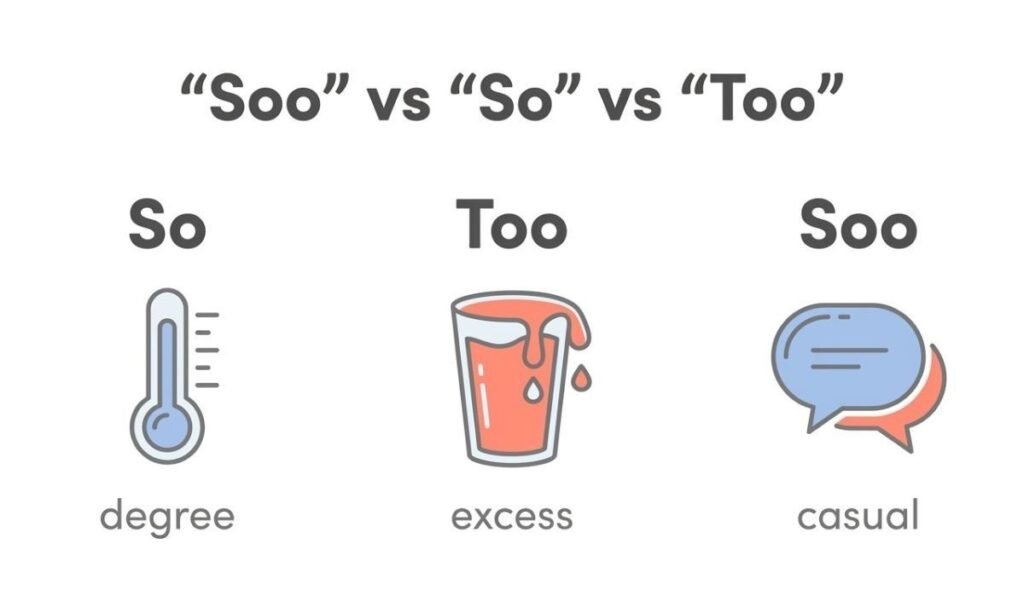
“Soo” vs “So” vs “Too”
Many writers also mix up so and too, because they sound different but often appear in similar spots. Too is a separate word with its own meanings. It means “also” or “more than is acceptable or possible.”
| Word | Function | Meaning | Example |
| so | Adverb or conjunction | Very, therefore, in this way | I was so tired that I fell asleep. |
| too | Adverb | Also, or excessively | I was too tired to drive. |
| soo | Informal spelling | Emphatic so | I was soo tired. (casual only) |
Two quick tests help:
- Replace the word with very. If the sentence still works, so is usually correct.
- Replace the word with excessively or also. If that works, use too.
Compare “This soup is so hot” (it is very hot) with “This soup is too hot to eat” (it is hotter than acceptable). Soo never replaces too.
When to Use “So” and When “Soo” Appears
There is no American versus British split here. Both varieties spell the word so, and neither treats soo as standard.
Always Use “So” in Standard Writing
Choose so in all of these situations:
- Academic papers, reports, and business emails
- News articles, blog posts, and websites
- Resumes, cover letters, and applications
- Any sentence where you mean degree, result, purpose, or agreement
Example: “The deadline moved, so the team adjusted the plan.”
“Soo” Appears Only in Limited Cases
You may see soo in these situations:
- Casual texts and social posts, where it adds emphasis
- Fiction or dialogue that imitates a drawn-out voice
- Proper names such as the Soo Locks or a person named Soo
- Uppercase SOO as an abbreviation
If you are unsure, use so. It is always acceptable, and nobody will question it.
Common Mistakes to Avoid
Most errors with these words come from five patterns. Check each one against the table below.
| # | Mistake | Incorrect | Correct | Why It Is Wrong |
| 1 | Using “soo” in formal writing | The results were soo surprising. | The results were so surprising. | Soo is a casual, stretched spelling and reads as a typo in professional text. |
| 2 | Using “so” when “too” is needed | The box is so heavy to lift. | The box is too heavy to lift. | A limit followed by an infinitive (“to lift”) calls for too. |
| 3 | Using “too” when “so” is needed | I’m too glad you came. | I’m so glad you came. | Too implies excess. So expresses degree. |
| 4 | Omitting the comma before conjunction “so” | It was raining so we stayed home. | It was raining, so we stayed home. | A comma usually separates two independent clauses joined by so. Some style guides allow dropping it in very short sentences. |
| 5 | Writing the abbreviation in lowercase | The soo was approved on Monday. | The SOO was approved on Monday. | Abbreviations of this kind are written in capital letters. |
Quick rule: If the sentence works with very, use so. If it works with excessively or also, use too. Never use soo in professional writing.
Frequently Asked Questions
Is it “so” or “soo”?
It is so. Soo is an informal, stretched spelling used for emphasis in casual messages. Standard dictionaries and style guides use so.
Is “soo” a real word?
Not as a standard English word. It appears as a casual variant of so, in names such as the Soo Locks, and as the abbreviation SOO. It does not have a separate dictionary meaning of its own.
What does “soo” mean in texting?
It means the same as so, with added emphasis. “I’m soo tired” and “I’m so tired” carry the same meaning, but the first sounds more expressive and informal.
What does SOO mean in business?
In procurement and government contracting, SOO usually means Statement of Objectives. It outlines what a buyer wants to achieve rather than listing every task, which is the role of a Statement of Work.
What does SOO mean in construction?
It typically refers to a statement of the owner’s objectives in design-build and public bid documents. Meanings can vary by company, so check the project glossary.
What is the difference between “so” and “too”?
So shows degree or result, as in “so cold” or “so we left.” Too means “also” or “excessively,” as in “too cold to swim.” They are not interchangeable.
Can I use “so” to mean “very” in formal writing?
It is acceptable but chiefly informal, according to Dictionary.com. In formal writing, very, extremely, or a result clause such as “so cold that the lake froze” is usually the better choice.
Conclusion
Use so whenever you mean “very,” “therefore,” “in this way,” or “also.” Treat soo as a casual, emphatic spelling that belongs in texts and playful dialogue, not in professional writing. Reserve Soo for proper names and SOO for the contracting abbreviation, and remember that too is a different word with its own meaning.