
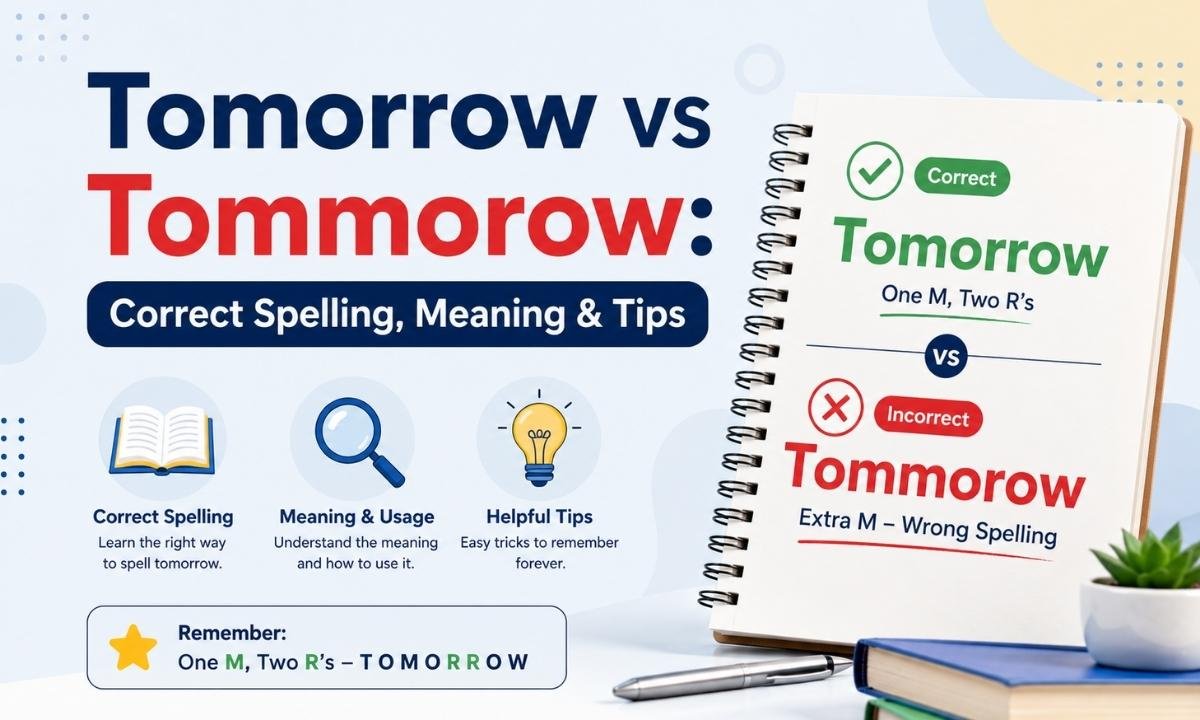
Tomorrow is the only correct spelling in English. Tommorow, with an extra M, is a common typing mistake rather than an accepted variant. The word is built from one M and two R’s, spelled T-O-M-O-R-R-O-W, and it refers to the day right after today.
For anyone searching Tomorrow vs Tommorow, the key is to remember that the double R comes before the final “ow,” while there is only one M. Most people mistype tomorrow because the double R sits in an unexpected spot and the word is typed quickly in messages and emails. This guide breaks down the correct spelling, where it comes from, how to use it in a sentence, and the mistakes worth avoiding.
Tomorrow vs Tommorow: Which Spelling Wins
Only one of these two spellings appears in any English dictionary, and it is tomorrow.
| Word | Status | Structure |
| tomorrow | Correct | One M, two R’s |
| tommorow | Incorrect | Extra M, missing an R placement error |
| tomorow | Incorrect | Missing one R |
| tommorrow | Incorrect | Extra M and correct R count, still wrong |
Tommorow is not listed in Merriam-Webster, Cambridge, or Oxford dictionaries, which confirms it has no standing as an alternate spelling, only as a frequent typo.
How Do You Spell Tomorrow Correctly?
Spelled out letter by letter, tomorrow reads T, O, M, O, R, R, O, W. That gives the word three O’s, a single M, and a double R sitting in the middle. A simple way to check yourself is to count on your fingers as you write it: one M near the start, then the R-R pair right before the final row.
- Number of M’s in tomorrow: one
- Number of R’s in tomorrow: two
- Number of O’s in tomorrow: three
- Is tomorrow one word: yes, it is always written as a single word with no space or hyphen in modern English
What Tomorrow Actually Means?
The Day After Today
In its most literal sense, tomorrow names the calendar day that follows today. If today is Tuesday, tomorrow is Wednesday, and the word shifts forward every single day.
A Stand-In for the Future
Tomorrow also works figuratively to describe the future in general, as in phrases like the leaders of tomorrow or planning for tomorrow, where it means times ahead rather than one specific date.
Quick Examples
- I have a dentist appointment tomorrow.
- Tomorrow always feels far away when today is stressful.
- Investing early is really about building tomorrow.
Why So Many People Type Tommorow by Mistake?
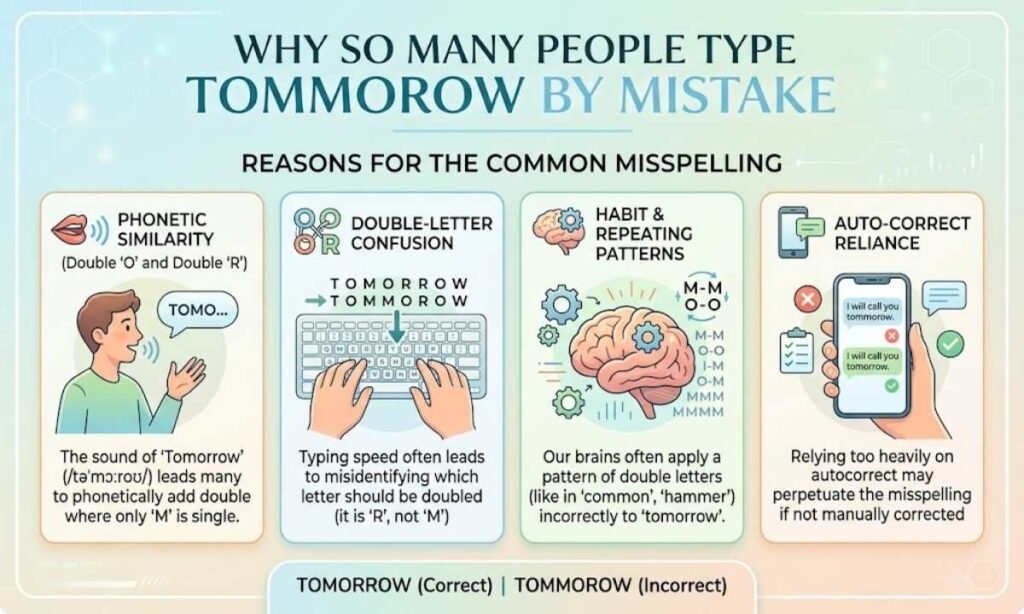
The word tomorrow is one of the more commonly misspelled words in everyday English, and the mix-up is rarely about not knowing the word. A few real patterns explain it:
- The M and R sounds blend together in fast speech, so writers instinctively add a second M instead of a second R.
- Autocorrect and predictive text on phones sometimes lock in the wrong version before a writer notices.
- Typing at speed causes finger slips, especially since M and the following letters sit close together on a standard keyboard.
- English pronunciation does not clearly signal where the double letter belongs, unlike words with a more phonetic spelling pattern.
An Easy Trick to Remember the Spelling
The cleanest memory aid comes straight from where the word originated. Tomorrow developed from two Old English words, to and morgen (later morwen), which literally meant to the morning or the coming day. Over time, to plus morrow fused into a single word, and English writers even hyphenated it as to-morrow well into the twentieth century before the modern closed form took over.
Two memory tricks that work well:
- Break it into plus morrow, and remember that morrow already contains the double R.
- Say it out loud as two syllables, “to” and “morrow,” so the extra R lands naturally in the second half rather than the first.
Is Tomorrow an Adverb or a Noun?
Tomorrow is unusual in English because it functions as both parts of speech, and only the sentence structure tells you which one is in use.
| Role | Function | Example |
| Adverb | Describes when an action happens | Call me tomorrow. |
| Noun | Names the day itself as a subject or object | Tomorrow is a holiday. |
As an adverb, tomorrow modifies a verb and answers the question when. As a noun, it can take a subject position, an article, or a possessive form, which is not something typical adverbs allow.
Tomorrow vs Tomorrow’s vs Tomorrows
These three forms look related but serve different grammatical jobs, and mixing them up is a common writing mistake.
| Form | Meaning | Example |
| tomorrow | The day after today | I will see you tomorrow. |
| tomorrow’s | Possessive, showing something belongs to tomorrow | Tomorrow’s forecast looks sunny. |
| tomorrows | Rare plural, meaning multiple future days | She spoke of endless tomorrows ahead. |
Tomorrow always needs an apostrophe before the S when showing possession, such as tomorrow’s meeting or tomorrow’s schedule. Tomorrows without an apostrophe is a true plural and appears mostly in reflective or poetic writing rather than everyday messages.
Common Misspellings of Tomorrow to Watch For
Spell-checkers regularly flag these variations, and recognizing them helps you catch mistakes before hitting send.
- Tommorow (extra M)
- Tomorow (missing an R)
- Tommorrow (extra M, correct R count)
- Tomarrow (wrong vowel)
- Tomorro (missing the final W)
How to Pronounce Tomorrow?
American English pronunciation lands closer to “tuh-MOR-oh,” while British English often produces a slightly more clipped “tuh-MOR-uh.” Both versions carry the stress on the middle syllable, which explains why the double R gets swallowed in speech and rarely gives a spelling clue. This mismatch between how the word sounds and how it is spelled is a major reason the tommorow typo persists even among fluent speakers.
Is Tommorow Ever Acceptable in Casual Texting?
No standard style guide, dictionary, or grammar authority treats tommorow as acceptable, even in informal writing. Autocorrect on most phones will fix it automatically, but relying on that is risky in apps or platforms where autocorrect is disabled. For texts, emails, and social captions alike, tomorrow remains the only version worth typing.
Tomorrow in Formal and Casual Writing
The spelling of tomorrow never changes across contexts, but tone and phrasing around it often do.
- School and academic writing: tomorrow’s assignment is due at the start of class.
- Work emails: please confirm your availability for tomorrow’s call.
- Text messages: see you tomorrow, can’t wait.
- Formal reports: projections for tomorrow’s market conditions remain uncertain.
Common Grammar Mistakes Involving Tomorrow
- Writing tommorow instead of tomorrow, by far the most frequent error.
- Confusing tomorrow with tomorrow’s in possessive contexts, such as writing tomorrow meeting instead of tomorrow’s meeting.
- Adding an unnecessary article, like saying “the tomorrow,” which does not fit standard English usage.
- Pairing tomorrow with the wrong tense, such as combining it with past-tense verbs instead of future or present forms.
Popular Phrases That Use Tomorrow
English has built several lasting expressions around this word, and native speakers use them constantly.
- Tomorrow morning, tomorrow afternoon, tomorrow night: standard time pairings
- The day after tomorrow: two days from now
- See you tomorrow: a common goodbye
- Tomorrow is another day: an idiom about hope and fresh starts
- Like there’s no tomorrow: doing something with total intensity
More Example Sentences With Tomorrow
- We are painting the fence tomorrow morning.
- Tomorrow’s flight leaves at six.
- The store reopens tomorrow after the holiday.
- I have been dreaming about tomorrows filled with less stress.
- Please submit the report before tomorrow’s deadline.
Frequently Asked Questions
Is it tomorrow or tommorow?
Tomorrow is correct. Tommorow is a misspelling with an unnecessary extra M.
How do you spell tomorrow?
T-O-M-O-R-R-O-W, with one M and two R’s placed in the middle of the word.
Does tomorrow have one M or two?
It has only one M, positioned right after the first O.
Does tomorrow have one R or two?
It has two R’s, which sit together in the middle of the word.
What does tomorrow mean?
It means the day right after today, and it can also refer to the future in general.
Is tomorrow an adverb or a noun?
It can be either, depending on whether it describes when something happens or acts as the subject of a sentence.
Is tommorow a word?
No, it is not recognized by any major dictionary and is considered a spelling error.
Is tomorrow one word?
Yes, tomorrow is always written as a single word in modern English.
What is the difference between tomorrow and tomorrow’s?
Tomorrow refers to the day itself, while tomorrow shows possession, as in tomorrow’s weather.
What is the plural of tomorrow?
Tomorrows, used mainly in reflective or literary writing about multiple future days.
Conclusion
Tomorrow is the only correct spelling, built from one M and two R’s, and it traces back to the Old English phrase to the morning. Remembering the to plus morrow origin, along with the fact that autocorrect will not always save you, is the simplest way to avoid the tommorow typo for good.