
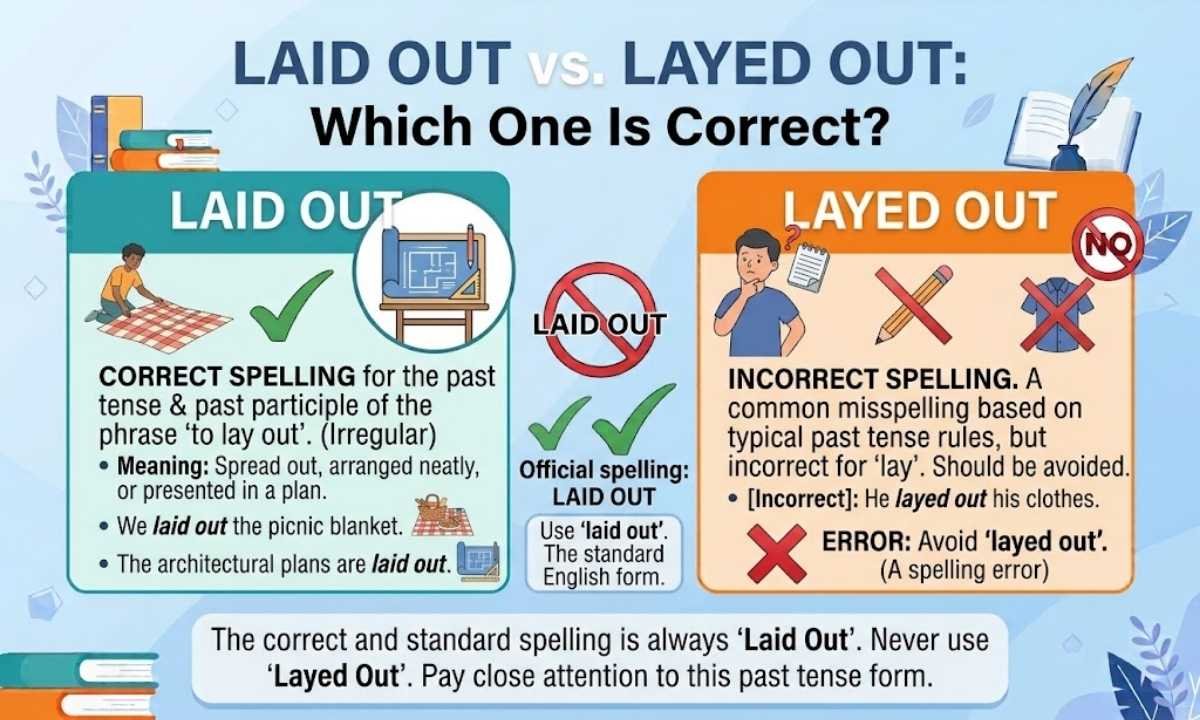
Few spelling mix ups trip up writers as often as laid out and layed out. Both look right at a glance, and both are said the same way, so the wrong version slips into emails, reports, and blog posts all the time. The quick answer is that only one of them is correct.
This guide explains what laid out means, why layed out is wrong, and how the verb lay really works. You will also find clear examples, a simple memory trick, and answers to the most common questions, so you can write with confidence and never second guess this phrase again. It is written for students, professionals, and busy writers.
Laid Out vs. Layed Out: Quick Answer
• Laid out is correct.
• Layed out is incorrect in standard English.
• The rule to remember: lay becomes laid, never layed.
What Does “Laid Out” Mean?
Laid Out Meaning in English
Laid out means arranged, presented, or explained in an organized way. It describes something that has been placed or planned with care.
Laid Out as a Past Tense Verb
Laid out is the past tense and past participle of the phrasal verb lay out. It works with or without a helper verb: “She laid out the plan” and “She has laid out the plan.”
What Does “Laid Out” Mean in Different Contexts?
• Explained: He laid out his argument clearly.
• Arranged: She laid out her clothes for the trip.
• Designed: The architect laid out the floor plan.
• Informal: The punch laid him out cold, meaning it knocked him down.
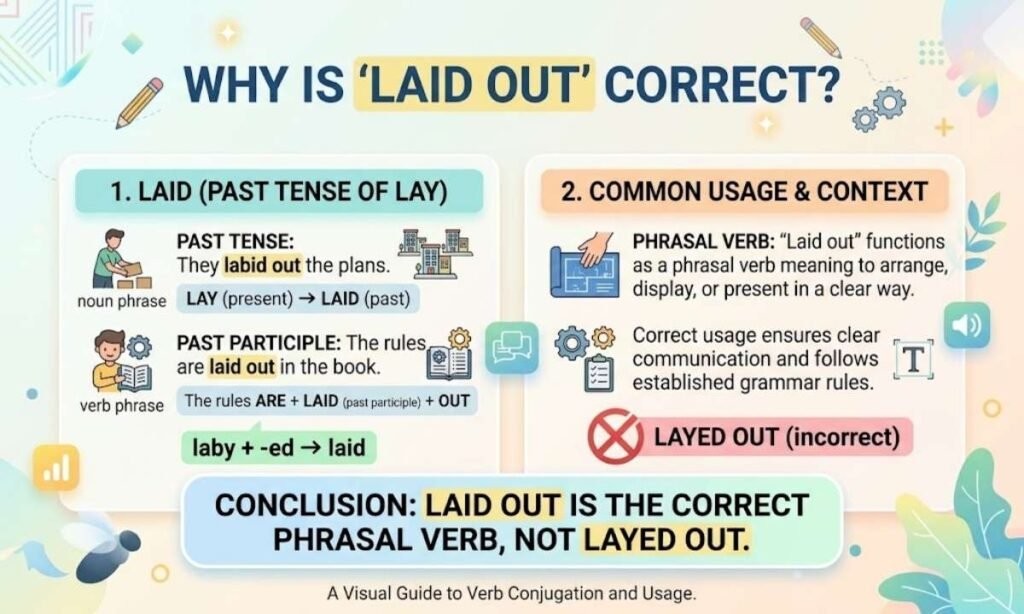
Why Is “Laid Out” Correct?
The Verb Forms of Lay
Lay is an irregular verb, so its forms must be memorized.
| Form | Word | Example |
| Base form | lay | I lay out the cards. |
| Third person | lays | She lays out the rules. |
| Past tense | laid | I laid out the cards. |
| Past participle | laid | I have laid out the cards. |
| Present participle | laying | I am laying out the cards. |
Lay vs. Laid vs. Laying
Lay is the present form, laid covers anything finished, and laying shows an action in progress. Every past form uses laid.
Why “Lay” Does Not Become “Layed”
Plenty of English verbs change their spelling in the past tense. Pay becomes paid, say becomes said, and lay becomes laid. The y turns into an i, and no extra e is added.
Why Is “Layed Out” Incorrect?
Why People Commonly Write “Layed”
Most verbs simply add ed, such as played and stayed, so writers apply the same pattern to lay. The words also sound identical when spoken, which makes the error easy to miss.
Is “Layed” Ever a Standard English Word?
No. Standard dictionaries do not list layed as a valid past tense of lay. It appears only as a misspelling.
Is “Layed Out” Correct in American English?
No. Both American and British English use laid out, and style guides on both sides treat layed as an error.
Laid Out vs. Layed Out Examples
Correct Examples With “Laid Out”
• The manager laid out the budget for the year.
• The rules were laid out in the handbook.
• We have laid out the tables for the event.
Incorrect Examples With “Layed Out”
• The manager layed out the budget for the year.
• The rules were layed out in the handbook.
Correcting Common Sentences
| Incorrect | Correct |
| She layed out the plan. | She laid out the plan. |
| They layed out the facts. | They laid out the facts. |
| The park was layed out in 1920. | The park was laid out in 1920. |
| He has layed out his clothes. | He has laid out his clothes. |
When to Use “Lay Out,” “Laid Out,” and “Laying Out”
Lay Out for Present or Future
Use lay out for habits and plans: “I will lay out the schedule tomorrow.”
Laid Out for Past or Completed Action
Use laid out for finished actions: “I laid out the schedule yesterday.”
Laying Out for Action in Progress
Use laying out while something is happening: “She is laying out the pages now.”
Laid Out Examples in Everyday English
• Laid out a plan: The coach laid out a plan for the season.
• Laid out the rules: The teacher laid out the rules on day one.
• Laid out the facts: The lawyer laid out the facts for the jury.
• Laid out clothes or objects: He laid out his tools on the bench.
• Laid out a design or floor plan: The editor laid out the magazine in a week.
Laid Out vs. Layout: What’s the Difference?
“Laid Out” as a Verb Phrase
Laid out is an action. Something was arranged or explained.
“Layout” as a Noun
Layout is a thing. It names the arrangement itself, such as a page layout or a kitchen layout.
Examples of “Laid Out” vs. “Layout”
• She laid out the page carefully. (verb)
• The page layout looks clean. (noun)
Laid vs. Lay: A Simple Grammar Trick
Remember: Lay → Laid → Laid
Say the three forms together like a chant. The second and third forms are the same word, and neither has an e before the d.
How to Avoid the “Layed” Mistake
Compare it with paid and said. You would never write payed or sayed, so do not write layed. Use that check any time you doubt yourself.
Lay vs. Lie: Clearing Up the Confusion
Lay needs an object, as in “lay the book down.” Lie does not, as in “lie down.” The past tense of lie is lay, which causes much of the confusion. Laid always goes with an object: you laid something out.
Common Phrases That Use “Laid”
• Laid down the law
• Laid to rest
• Laid bare
• Laid the groundwork
• Laid off
None of these is ever spelled with layed.
Laid Out in Formal and Informal Writing
Laid out suits both styles. In formal writing, it signals a clear explanation, as in “The report laid out three options.” In casual writing, it can mean knocked flat or exhausted. The spelling stays the same in every register.
Common Mistakes to Avoid
“She Layed Out the Plan”
Fix: She laid out the plan.
“The Rules Were Layed Out”
Fix: The rules were laid out.
Confusing “Laid Out” With “Lay Out”
Do not write “I lay out the plan yesterday.” Yesterday needs the past form: “I laid out the plan yesterday.”
Quick Proofreading Checklist
• Search your draft for layed and replace it with laid.
• Check that the sentence is in the past tense.
• Confirm that a noun follows, such as plan, rules, or clothes.
• Use layout only when you mean the noun.
Why This Mistake Matters for Your Writing
Small errors can weaken trust in a resume, a proposal, or a published article. Readers often notice layed even when they cannot say why a sentence feels off. Getting it right keeps your writing polished.
Frequently Asked Questions
Is “laid out” or “layed out” correct?
Laid out is correct. Layed out is a common misspelling.
Is “layed out” ever correct?
No. It is not accepted in standard American or British English.
What does “laid out” mean?
It means arranged, planned, explained, or presented in an organized way.
What is the past tense of “lay out”?
The past tense is laid out. The past participle is also laid out.
Can I say “have laid out”?
Yes. “Have laid out” is the correct present perfect form, as in “We have laid out the plan.”
Is “laid out” used in American and British English?
Yes. Both varieties use laid out in exactly the same way.
What is the difference between “laid out” and “layout”?
Laid out is a verb phrase for an action. Layout is a noun for the arrangement itself.
Conclusion
Laid out is the only correct choice. The verb lay is irregular, so its past tense and past participle are both laid, and no e is ever added. Remember the chant lay, laid, laid, compare it with paid and said, and you will get it right every time.