
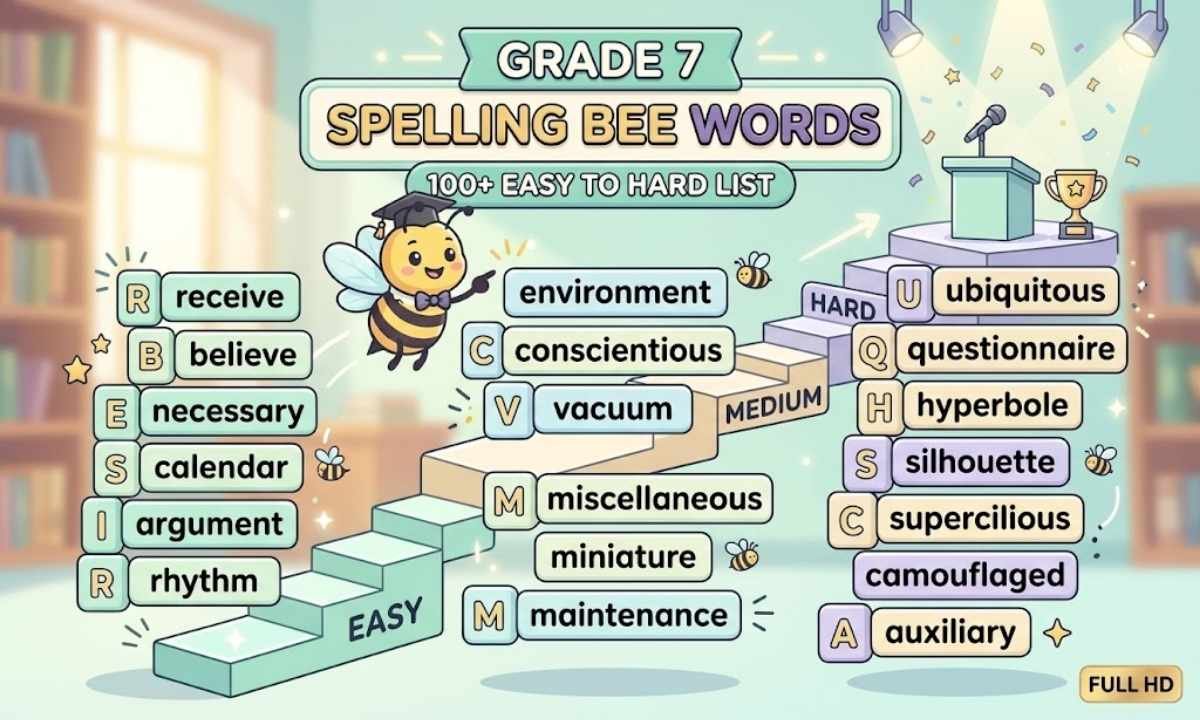
Looking for a solid Grade 7 spelling bee words list? This guide gathers over 100 words organised from easy to challenging, along with definitions, spelling patterns, tricky homophones, and a step by step study plan. Students preparing for a school competition or a weekly spelling test will find real, usable vocabulary here instead of a short generic list.
Along with the word bank, this article covers word origins, prefixes and suffixes, commonly confused terms, and a practice quiz you can attempt right away. Everything is grouped by difficulty so learners can build confidence gradually instead of jumping straight into advanced vocabulary.
100+ Grade 7 Spelling Bee Words
This core section brings together a broad word bank spanning every difficulty tier.
| Word | Difficulty | Meaning |
| Necessary | Easy | Required or essential |
| Fortunate | Easy | Lucky or favourable |
| Vacuum | Medium | A space empty of matter |
| Rhythm | Medium | A repeated pattern of sound |
| Bureaucracy | Hard | A system of officials running government |
| Silhouette | Hard | An outline filled with a solid colour |
| Onomatopoeia | Expert | A word that imitates a sound |
| Entrepreneur | Expert | A person who starts a business |
Easy Grade 7 Spelling Bee Words
Words such as necessary, fortunate, calendar, guarantee, and separate suit beginners since they appear often in everyday reading.
Medium Grade 7 Spelling Bee Words
Words like vacuum, rhythm, questionnaire, privilege, and embarrass push students slightly beyond basic vocabulary.
Hard Grade 7 Spelling Bee Words
Words such as bureaucracy, silhouette, conscientious, reminiscent, and hierarchy demand careful attention to letter order.
Expert Challenge Spelling Words
Words like onomatopoeia, entrepreneur, idiosyncrasy, and pharaoh work well as final round tiebreakers in a competitive spelling bee.
Easy Grade 7 Spelling Words to Start With
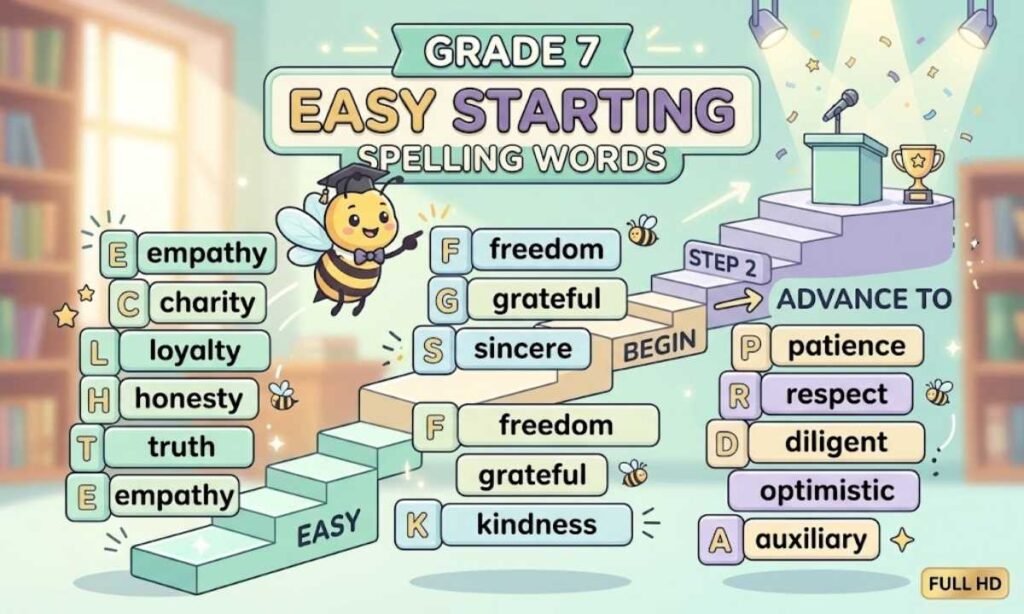
Beginning with familiar vocabulary builds a strong foundation before harder words appear.
Common 7th Grade Words
Words including opinion, favourite, definitely, government, and beautiful show up constantly in school writing tasks.
Everyday Words That Are Easy to Practise
Simple words such as calendar, February, restaurant, and neighbour offer low-pressure practice for early sessions.
Easy Words With Tricky Spellings
Words like receive, believe, and achieve look simple but often get reversed due to the i before e rule.
Hard Grade 7 Spelling Bee Words
Hard words separate confident spellers from beginners during competitions.
Difficult Words for 7th Graders
Words such as conscientious, questionnaire, and mischievous require students to slow down and spell syllable by syllable.
Long Words That Are Hard to Spell
Words like unconstitutional, extraordinary, and characteristic are long enough that breaking them into chunks becomes essential.
Words With Silent Letters
Words including knowledge, autumn, and Wednesday hide letters that are never pronounced aloud.
Words With Unexpected Vowels
Words like colonel and rhythm follow vowel patterns that do not match how they sound.
Competition-Level Challenge Words
Words such as idiosyncrasy, bureaucracy, and onomatopoeia are commonly reserved for final competition rounds.
Grade 7 Spelling Bee Words With Definitions
Adding meaning to vocabulary strengthens both spelling accuracy and comprehension.
Words With Simple Meanings
Guarantee means a firm promise, while calendar refers to a system for organising days and months.
Academic Vocabulary for Grade 7
Hypothesis refers to a proposed explanation, while analysis means a detailed examination of something.
Advanced Vocabulary Words to Know
Bureaucracy describes a system run by officials, and idiosyncrasy refers to a unique personal habit.
Grade 7 Spelling Words by Difficulty Level
Sorting words into clear levels helps teachers and parents plan lessons efficiently.
Level 1 — Easy
Necessary, calendar, favourite, guarantee, separate
Level 2 — Medium
Vacuum, rhythm, embarrass, privilege, questionnaire
Level 3 — Hard
Bureaucracy, silhouette, conscientious, hierarchy, reminiscent
Level 4 — Spelling Bee Challenge
Onomatopoeia, entrepreneur, idiosyncrasy, pharaoh, chiaroscuro
Tricky Grade 7 Spelling Words You Should Know
Certain words consistently trip up students regardless of overall spelling ability.
Words With Silent Letters
Silent letters in words like gnome and knowledge require visual memory rather than sounding words out.
Words With Double Consonants
Words such as occurrence and necessary double a consonant in a spot many students miss.
Words With Unusual Vowel Combinations
Words like beautiful and Mediterranean combine vowels in ways that do not follow common phonics rules.
Words That Sound Different From Their Spelling
Words such as colonel and queue sound nothing like their written form, which makes memorisation necessary.
Commonly Misspelled Grade 7 Words
Definitely, separate, receive, argument, and accommodate remain frequent error patterns across Grade 7 classrooms.
Grade 7 Spelling Words by Pattern
Recognising spelling patterns allows students to apply one rule across many similar words.
Words With -tion and -sion
Education, decision, and celebration follow predictable endings based on the root word.
Words With -ance and -ence
Performance, difference, and confidence often confuse students since both endings sound alike.
Words With -able and -ible
Comfortable and responsible follow different suffix rules depending on whether the root is a full word.
Words With -ant and -ent
Important and different show how these endings shift depending on Latin origin.
Words With -ous and -ious
Dangerous and mysterious both add descriptive meaning through a similar sounding suffix.
Words With Silent GH
Words like though and thought carry a silent gh that has faded from pronunciation over time.
Words With PH
Phone, phrase, and alphabet all use ph to create an f sound.
Words With Double Letters
Occurrence, embarrass, and necessary each contain doubled letters that require memorisation.
Words With Difficult Vowel Patterns
Words like receive and neighbour combine vowels in sequences that break typical phonics rules.
Grade 7 Spelling Words With Prefixes and Suffixes
Word parts give students a shortcut for decoding unfamiliar vocabulary.
Common Prefixes to Learn
Prefixes such as un, dis, re, and mis change meaning while keeping the root spelling intact.
Common Suffixes to Learn
Suffixes like able, ible, ful, and less attach to root words with predictable spelling adjustments.
How Word Parts Make Spelling Easier
Breaking a word into prefix, root, and suffix turns a long word into three manageable pieces.
Examples of Prefix and Suffix Spelling Changes
Disappoint, unnecessary, and responsibility all demonstrate how prefixes and suffixes combine with a stable root.
Greek and Latin Root Words for Grade 7
Word origins explain why many difficult words are spelled the way they are.
Common Greek Roots
Roots such as photo meaning light and graph meaning writing appear in words like photograph.
Common Latin Roots
Roots like dict meaning speak and port meaning carry show up in words like dictionary and transport.
How Word Roots Help You Spell Difficult Words
Recognising a root allows students to predict spelling in related words they have never seen before.
Grade 7 Words Built From Greek and Latin Roots
Words such as biology, telephone, and transport all trace back to classical root words.
French and Foreign-Origin Spelling Bee Words
Many advanced spelling bee words come directly from other languages.
French Words Commonly Used in English
Words like restaurant, ballet, and bouquet retain French spelling patterns within English text.
Greek-Origin Spelling Words
Words such as chorus and rhythm carry spelling traits borrowed directly from Greek.
Latin-Origin Spelling Words
Words like vacuum and stadium keep their original Latin spelling almost unchanged.
Why Foreign Words Can Be Hard to Spell
Borrowed words often ignore standard English phonics rules, which is why memorisation becomes essential.
Commonly Confused Grade 7 Spelling Words
| Confused Pair | Meaning | Example Sentence |
| Their / There / They’re | Possession, location, contraction | Their books are there, and they’re ready to study. |
| Your / You’re | Possession, contraction | Is that your pencil, or are you’re mistaken? |
| Its / It’s | Possession, contraction | The dog wagged its tail because it’s happy. |
| Affect / Effect | Verb, noun | Stress can affect focus, and the effect lingers. |
| Advice / Advise | Noun, verb | I will advise you, then give further advice. |
| Accept / Except | Agree, exclude | I accept every answer except the last one. |
| Principal / Principle | Person, rule | The principal explained the school’s key principle. |
| Then / Than | Time, comparison | First we studied, then we tested, better than before. |
Their, There and They’re
These homophones sound alike but serve entirely separate grammatical purposes in a sentence.
Your and You’re
Your shows ownership, while you’re is simply short for you are.
Its and It’s
Its shows possession without an apostrophe, while it’s always means it is or it has.
Affect and Effect
Affect usually works as a verb, while effect usually functions as the resulting noun.
Advice and Advise
Advice is the noun form, while advise is the verb form of the same idea.
Accept and Except
Accept means to receive willingly, while except means to leave something out.
Principal and Principle
A principal refers to a person or main item, while a principle refers to a rule or belief.
Then and Than
Then relates to time or sequence, while than is used for comparisons.
7th Grade Spelling Words for a Spelling Test
Test preparation benefits from a clearly tiered word bank.
20 Easy Test Words
Necessary, calendar, favourite, guarantee, separate, opinion, definitely, government, beautiful, February, restaurant, neighbour, receive, believe, achieve, holiday, uniform, library, timetable, assembly
20 Medium Test Words
Vacuum, rhythm, embarrass, privilege, questionnaire, sincerely, immediately, occurrence, argument, disappoint, tomorrow, environment, temperature, satisfactory, characteristic, communication, congratulations, responsibility, unnecessary, extraordinary
20 Hard Test Words
Bureaucracy, silhouette, conscientious, hierarchy, reminiscent, mischievous, unconstitutional, chiaroscuro, phenomenon, hypothesis, analysis, vocabulary, Mediterranean, colonel, gnome, autumn, Wednesday, knowledge, queue, catalogue
10 Challenge Words
Onomatopoeia, entrepreneur, idiosyncrasy, pharaoh, connoisseur, questionnaire, silhouette, bureaucracy, hierarchy, chiaroscuro
Grade 7 Spelling Bee Practice List
A round based structure mirrors an actual competition format.
Round 1 — Warm-Up Words
Necessary, calendar, favourite, guarantee, separate
Round 2 — Medium Words
Vacuum, rhythm, embarrass, privilege, questionnaire
Round 3 — Difficult Words
Bureaucracy, silhouette, conscientious, hierarchy, reminiscent
Final Round — Challenge Words
Onomatopoeia, entrepreneur, idiosyncrasy, pharaoh, connoisseur
How to Study Grade 7 Spelling Bee Words?
A repeatable study method matters more than random memorisation.
Say the Word Out Loud
Hearing a word repeated aloud helps students internalise pronunciation before attempting to write it.
Break the Word Into Parts
Splitting a word into syllables makes long vocabulary feel far more manageable.
Learn the Word’s Origin
Understanding whether a word comes from Greek, Latin, or French often explains its spelling pattern.
Write the Word From Memory
Writing without looking at the original word strengthens recall far more than copying.
Use the Word in a Sentence
Placing a word in context helps students remember both spelling and meaning together.
Review Words You Missed
Keeping a running list of missed words prevents the same mistakes from repeating.
7-Day Grade 7 Spelling Bee Practice Plan
A short daily plan keeps preparation realistic rather than overwhelming.
Day 1 — Learn the Easy Words
Read through the easy word tier and note any words that feel unfamiliar.
Day 2 — Practise Medium Words
Write each medium level word three times while saying it aloud.
Day 3 — Study Difficult Words
Break hard words into syllables and review their meaning alongside spelling.
Day 4 — Learn Word Roots
Study Greek and Latin roots connected to the current word list.
Day 5 — Take a Practice Test
Complete a short self-test covering every word studied so far.
Day 6 — Review Mistakes
Focus only on words missed during the practice test from the previous day.
Day 7 — Final Spelling Bee
Simulate a real competition by having someone read words aloud for a final check.
Grade 7 Spelling Bee Practice Quiz
A quick quiz confirms whether students have retained their practice words.
Choose the Correct Spelling
Ask students to choose between necessary, neccessary, and necesary to test recognition skills.
Fill in the Missing Letters
Provide partial words such as sep_r_te and ask students to complete them correctly.
Spell the Word From Its Definition
Give a definition such as a firm promise and ask students to spell guarantee correctly.
Challenge Round
Ask students to spell onomatopoeia and idiosyncrasy without any visual reference.
Answer Key
Necessary, separate, guarantee, onomatopoeia, and idiosyncrasy are the correct answers for this quiz.
Printable Grade 7 Spelling Bee Word List
A printable format makes offline practice simple for classrooms and home study.
100-Word Printable List
Combine every tier above into a single printable sheet organised from easy to expert level.
Easy-to-Hard Practice Sheet
Arrange words in ascending difficulty so students can track their progress naturally.
Weekly Spelling Practice Sheet
Split the full word bank into weekly sets of 15 to 20 words for manageable practice.
Grade 7 Spelling Bee Tips for Students
Small strategic habits often matter as much as vocabulary knowledge.
Don’t Memorise Every Word the Same Way
Mix visual, auditory, and written practice methods rather than relying on one single technique.
Look for Familiar Word Patterns
Spotting a known prefix or suffix often reveals how an unfamiliar word is spelled.
Learn the Word’s Origin
Knowing whether a word is Greek, Latin, or French often reveals its spelling logic.
Ask for the Definition
Requesting a definition during a real spelling bee often provides useful spelling context.
Ask for the Word in a Sentence
Hearing a word in context can clarify pronunciation and prevent simple mistakes.
Stay Calm During the Competition
Steady breathing and a brief pause before spelling reduce careless errors under pressure.
Frequently Asked Questions
What are good spelling bee words for Grade 7?
Words like necessary, rhythm, bureaucracy, and onomatopoeia work well across different difficulty levels.
What are the hardest Grade 7 spelling words?
Onomatopoeia, idiosyncrasy, and bureaucracy are consistently ranked among the hardest words for this grade.
How many words should a 7th grader study for a spelling bee?
Most students benefit from studying 100 to 150 words across easy, medium, and hard tiers.
What are some difficult words to spell in Grade 7?
Silhouette, conscientious, and hierarchy commonly challenge even strong Grade 7 spellers.
What words are commonly used in Grade 7 spelling bees?
Competitions typically draw from academic vocabulary, Greek and Latin roots, and French-origin words.
How can I prepare for a Grade 7 spelling bee?
Follow a structured plan combining daily word review, root study, and regular practice tests.
What is the best way to memorize spelling bee words?
Combining spoken repetition, written practice, and sentence usage produces the strongest long term retention.
Conclusion
Preparing for a Grade 7 spelling bee works best with a clear, gradual approach. Start with easy words to build confidence, then move through medium and hard tiers before tackling true challenge vocabulary. Learning roots, patterns, and commonly confused words strengthens both spelling accuracy and overall vocabulary.
Review mistakes regularly, test yourself often, and use the seven day plan above to stay consistent. With steady daily practice, students can approach their next spelling bee with genuine confidence rather than last minute cramming.