
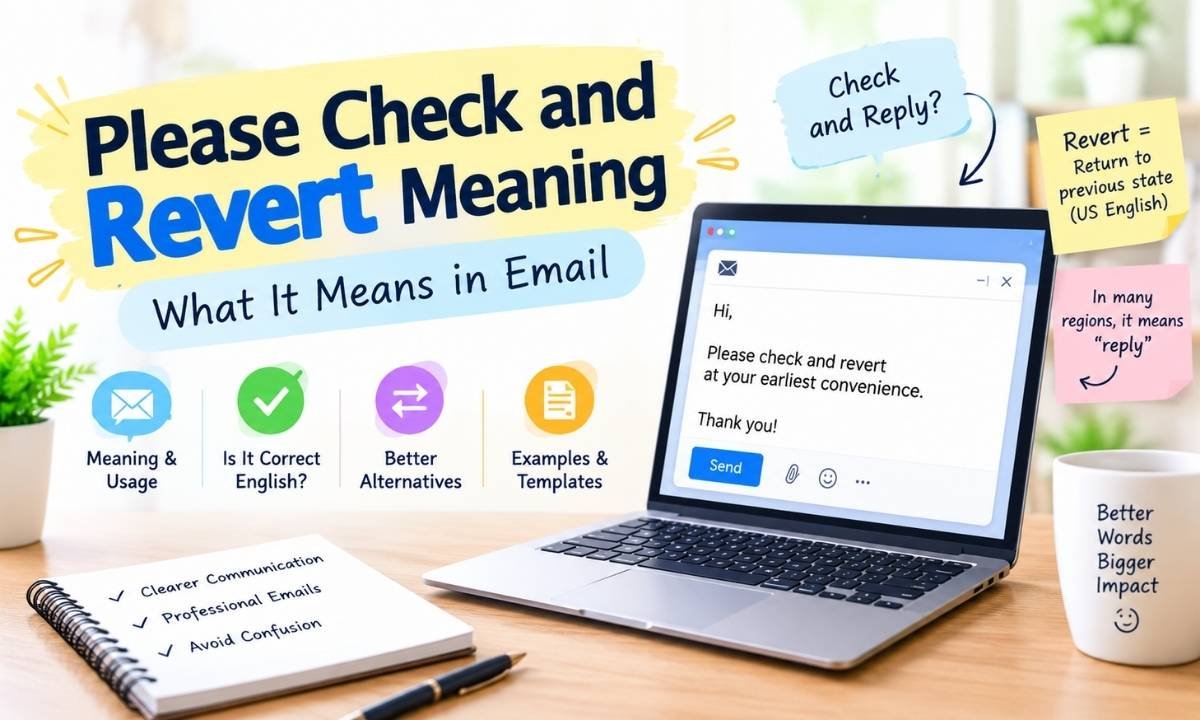
You open an email and see the line please check and revert, and if you are used to American English, that phrase can feel oddly vague. Does it mean reply, undo something, or go back to an earlier version?
In most cases, please check and revert simply means please review this and get back to me. It is common in Indian, Singaporean, and wider Southeast Asian business English, though it can confuse readers who expect revert to mean returning to a previous state.
What Does Please Check and Revert Mean?
Please check and revert is a request asking someone to look something over and then respond with feedback, approval, or an answer.
- Review or check the information provided
- Send a reply once the review is complete
- Provide feedback, confirmation, or approval
Please Check and Revert Meaning in Email
In workplace emails, this phrase usually appears after sharing a document, proposal, or update, asking the recipient to look it over and respond.
What Does Check and Revert Mean in Simple English?
In plain English, it translates to please review this and get back to me.
Is Please Check and Revert Correct English?
The phrase is grammatically valid, but its meaning shifts depending on the reader’s regional English background.
Is Please Check and Revert Grammatically Correct?
Yes, grammatically it forms a valid instruction, even though the word revert is used differently than in standard American usage.
Why Revert Can Sound Unusual in American English
In the US, revert almost always means to return to a previous state, not to reply, which is why the phrase can feel confusing to American readers.
When Revert Actually Means Return to an Earlier State
- Revert to the original version
- Revert to the previous plan
- Revert a software change
Cambridge Dictionary defines the standard sense of revert as returning to a former state, while separately noting that the reply meaning is common in Indian English.
Why Do People Say Please Check and Revert?
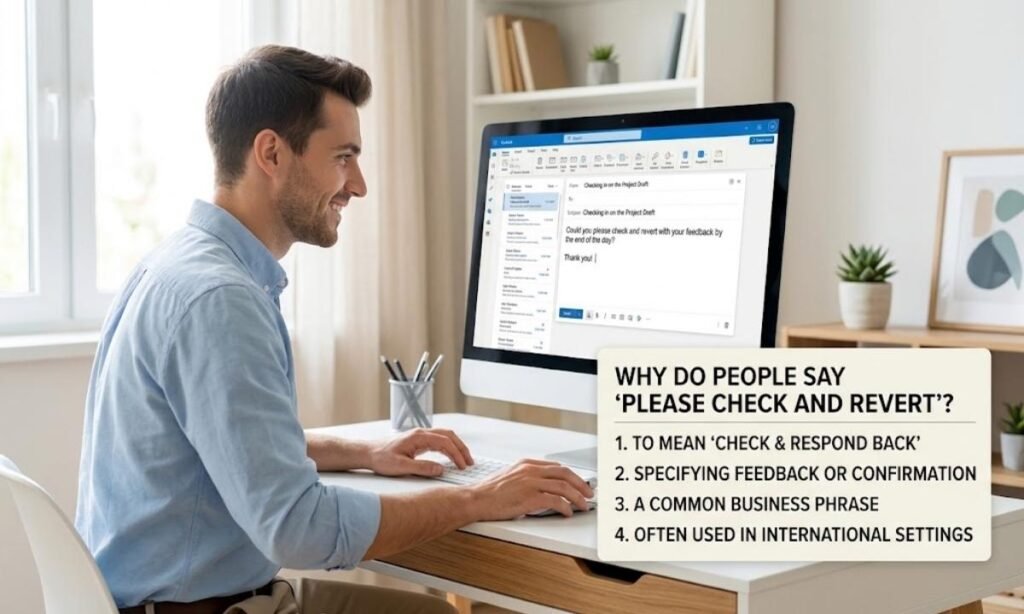
This phrasing comes from a specific regional business English tradition rather than being a grammar mistake.
The Regional Business English Meaning
In Indian and Singaporean workplace English, revert commonly means to reply, and this usage is widely understood within those business communities.
Please Check and Revert vs Please Reply
Please reply is universally understood, while please check and revert carries a regional meaning that not every English speaker recognizes.
Why US Readers May Find It Confusing
American readers associate revert with reversing or undoing something, so the request to review and reply can feel unclear without added context.
What Is the Best Alternative to Please Check and Revert?
- Please review and let me know, a strong general purpose option
- Please review and reply, direct and professional
- Please check and get back to me, natural conversational business English
- Please review and share your feedback, useful when feedback is requested
- Please confirm after reviewing, best when confirmation is needed
15 Professional Alternatives to Please Check and Revert
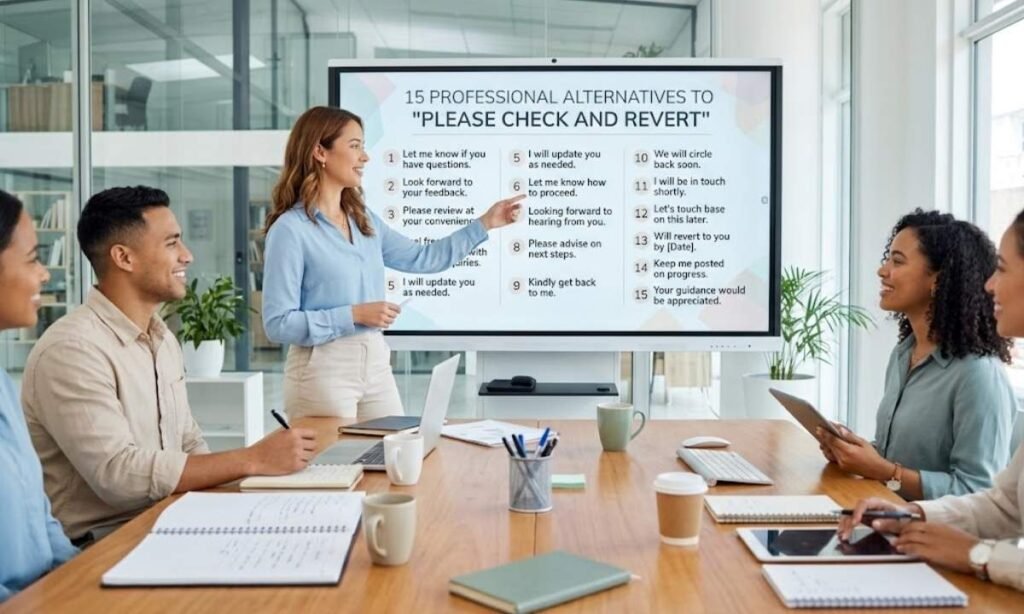
| Instead Of | Better Alternative | Best For |
| Please check and revert | Please review and let me know | General use |
| Please check and revert | Please review and reply | Formal email |
| Please check and revert | Please get back to me | Natural business English |
| Please check and revert | Please share your feedback | Feedback requests |
| Please check and revert | Please confirm once reviewed | Confirmation needed |
| Please check and revert | Please let me know your thoughts | Friendly tone |
| Please check and revert | Could you review this and respond | Polite request |
| Please check and revert | Please review and advise | Formal instruction |
| Please check and revert | Please check the attachment and confirm | Attachments |
| Please check and revert ASAP | Please respond as soon as possible | Urgent requests |
Please Check and Revert vs Please Reply vs Please Respond
Please Check and Revert
A regional business English phrase asking someone to review and reply.
Please Reply
Simple, direct, and universally clear across all English dialects.
Please Respond
Slightly more formal than please reply, suitable for professional settings.
Please Get Back to Me
Natural, conversational, and easily understood in American workplaces.
Which One Is Best for US Emails
Please reply, please respond, or please get back to me are safer, clearer choices for American readers.
Please Check and Revert Email Examples

- Client review: Please check the attached proposal and revert with your feedback by Friday
- Approval request: Kindly review the budget and confirm once approved
- Feedback request: Please go through the draft and share your feedback
- Follow-up: Just checking in, please get back to me when you have a moment
- Urgent request: Please review this by end of day and respond as soon as possible
Is Please Revert Back Correct?
What Does Please Revert Back Mean?
It is typically used the same way as please revert, meaning please reply.
Why Revert Back Is Usually Redundant?
Since revert already implies returning or responding, adding back repeats the same meaning unnecessarily.
Better Alternatives to Please Revert Back
Please reply, please respond, or please get back to me are cleaner, non redundant options.
What Does Please Revert Soonest Mean?
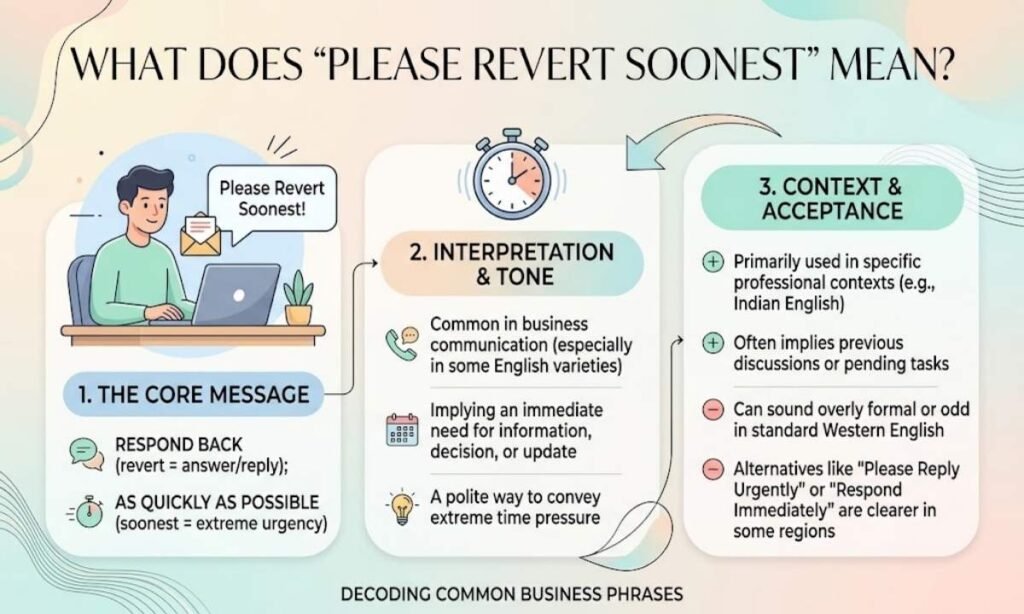
Please Revert Soonest Meaning
It is a request for a quick reply, often used in urgent business communication.
Why Soonest Can Be Unclear
Soonest does not specify an actual deadline, which can leave the recipient guessing on timing.
Better Ways to Request a Fast Reply
Stating a specific time, such as please respond by 3 PM today, removes any ambiguity.
Common Revert Email Phrases and Their Meanings
- Please revert, meaning please reply
- Kindly revert, a slightly more polite version of the same request
- Please revert with your feedback, asking specifically for comments or input
- Please revert by email, requesting the reply through email rather than another channel
- Please revert at your earliest convenience, a polite way to request a timely reply
- Please revert in case of any query, inviting a response only if questions arise
How to Say Please Check and Revert Professionally?
- For a client, use please review the attached document and share your feedback
- For your manager, use please review when convenient and let me know your thoughts
- For a coworker, use can you take a look and get back to me
- For a formal business email, use please review and respond at your earliest convenience
- For an urgent request, use please review and respond by end of day
Copy and Paste Email Templates
- Professional review request, please find the attached document for your review, kindly share your feedback at your convenience
- Polite follow up, following up on my previous email, please let me know if you have any updates
- Approval request, could you please review and approve the attached proposal
- Feedback request, please review the draft and share any comments or suggestions
- Urgent response request, this requires your review today, please respond by end of business
Regional English Differences Worth Knowing
Understanding where a phrase originates helps avoid unnecessary confusion in cross border communication.
- Indian English commonly uses revert to mean reply
- Singaporean workplace English follows a similar pattern
- American and British English typically reserve revert for returning to an earlier state
- Global teams often benefit from clarifying intent the first time a term is used
Why Clear Email Wording Matters in Global Teams?
- Reduces miscommunication between colleagues from different English speaking regions
- Saves time by avoiding follow up emails asking for clarification
- Builds a more professional tone across international business communication
- Helps new employees understand company email norms faster
Signs Your Email Wording May Confuse International Readers
- Using regional idioms without added context
- Assuming every reader shares the same definition of a word
- Skipping a clear call to action at the end of the message
- Relying on vague timing words instead of specific deadlines
Quick Checklist for Writing Clear Professional Emails
- State the purpose of the email in the first line
- Use direct, universally understood phrasing such as please reply or please respond
- Include a specific deadline rather than vague terms like soonest
- Close with a clear, single call to action
Grammar Notes on Using Revert Correctly
| Usage | Correct In | Example |
| Revert meaning reply | Indian and Singaporean business English | Please revert with your comments |
| Revert meaning return to a former state | Standard American and British English | The document reverted to its original format |
| Revert back | Considered redundant in standard English | Avoid using back after revert |
Frequently Asked Questions
What does please check and revert mean?
It means please review this and reply with your feedback or confirmation.
Is please check and revert correct English?
It is grammatically valid but reflects regional business English rather than standard American usage.
Is please check and revert professional?
Yes within regions where it is commonly used, though clearer alternatives work better for global audiences.
What is a better way to say please check and revert?
Please review and reply or please get back to me are clearer alternatives.
Is please check and revert used in American English?
It is uncommon in standard American English, where revert usually means to return to an earlier state.
Is please revert the same as please reply?
In regional business English, yes, both are used to request a response.
Is please revert back grammatically correct?
It is often considered redundant since revert already implies a response.
Conclusion
Please check and revert is a widely used phrase in Indian, Singaporean, and Southeast Asian business English, generally meaning please review this and reply. For American readers, using please reply, please respond, or please get back to me communicates the same request with far less confusion.
Choosing clear, universally understood wording strengthens professional communication across international teams and helps every email reader respond exactly the way you intended.