
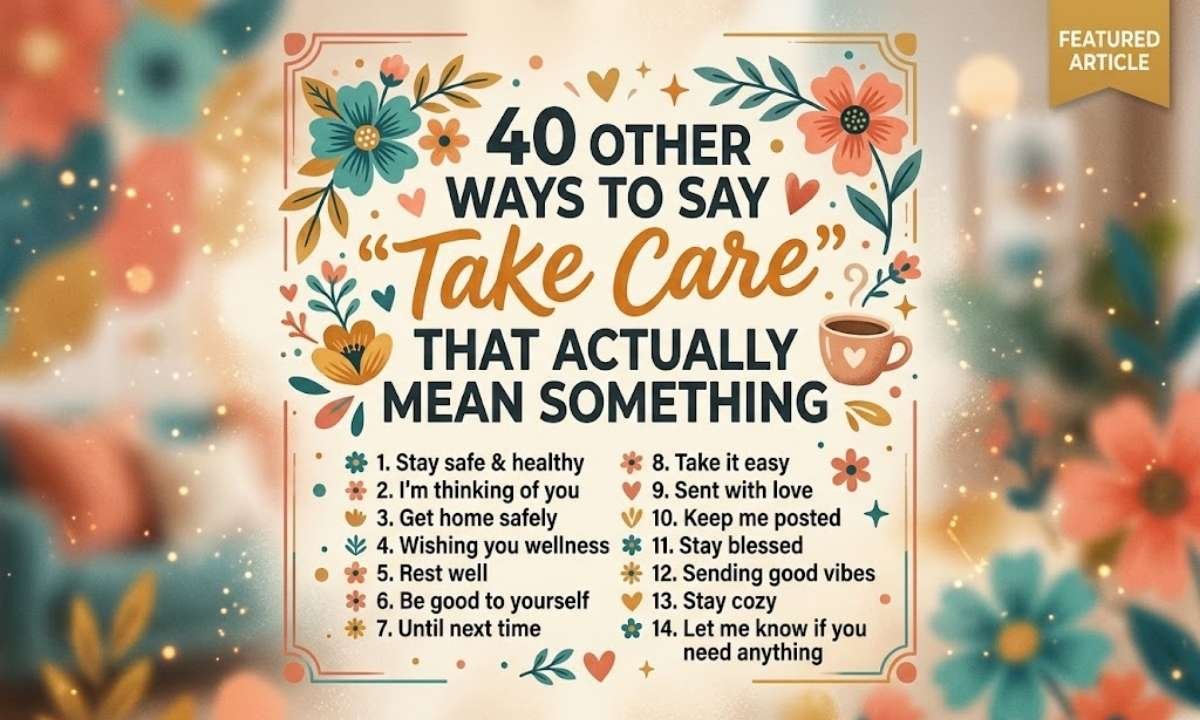
Hearing “take care” is one of the most common ways people say goodbye, but replying to it can feel oddly tricky in the moment. Do you repeat it back, thank the person, or say something more personal? The right answer depends on who is speaking, the setting, and how close you are to them.
This guide breaks down the best take care reply options for friends, family, coworkers, and even someone you’re texting. You’ll find short answers, warm ones, professional lines, and a few creative alternatives that go beyond the usual “you too.”
What Is the Best Reply to “Take Care”?
The best reply to “take care” is simple, sincere, and matches the tone of the person who said it. In most everyday situations, a short reciprocal phrase works perfectly because it acknowledges their goodwill without overcomplicating the exchange.
- “You too, take care!”
- “Thanks, you too!”
- “I will, you take care too.”
- “Thanks, I appreciate it.”
These responses fit almost any casual or semi-formal conversation, whether spoken in person, over the phone, or sent as a quick message.
Short and Casual Replies to “Take Care”
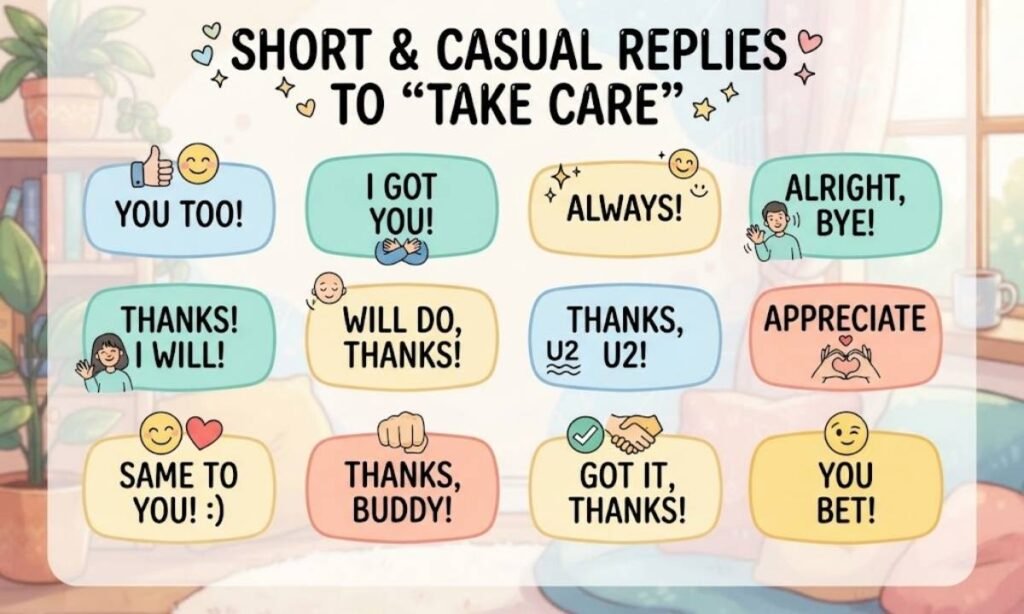
When you’re in a rush or just want to keep things light, a brief reciprocal line does the job well. Short replies work best with people you talk to often, like coworkers, neighbors, or classmates.
| Situation | Quick Reply |
| Passing a coworker in the hallway | “You too!” |
| Ending a phone call with a friend | “Same to you!” |
| Wrapping up a text conversation | “Will do!” |
| Saying bye to an acquaintance | “You as well.” |
Short replies are effective because they mirror the sender’s energy without sounding dismissive.
Warm and Friendly Replies to “Take Care”
With close friends or family, a slightly warmer reply feels more natural and shows genuine affection. These lines add a personal touch while still staying easy to say.
- “Thanks! You take care too, okay?”
- “You too — talk soon!”
- “Take care, my friend.”
- “Stay safe and have a great day.”
Adding a follow-up phrase like “talk soon” or using the person’s name turns a routine farewell into something more meaningful.
Professional Replies to “Take Care” at Work
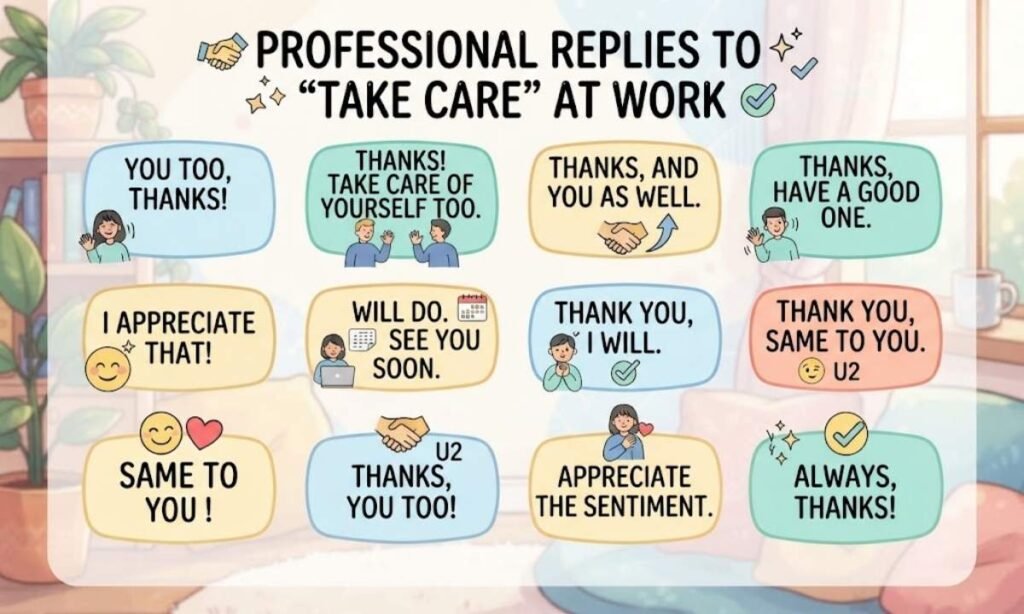
In workplace emails, client calls, or formal messages, replies to “take care” should stay polite and reciprocal without becoming overly personal. Professional communication favors gratitude paired with a brief return wish.
- “Thank you, you too.”
- “Thank you, take care as well.”
- “I appreciate it. Have a great day.”
- “Thank you. Wishing you the same.”
Sticking to these neutral, courteous lines keeps the tone respectful, which matters most in client-facing or supervisor conversations.
The Origin and History Behind “Take Care”
The phrase traces back to older English usage where “care” referred to concern, worry, or responsibility rather than a light sentiment. Over centuries, “take care” evolved from a cautionary warning into a gentle farewell that signals goodwill instead of alarm.
Linguists note that many parting phrases across languages follow this same pattern — they start as practical warnings and soften into everyday politeness. That history is part of why “take care” still feels sincere even in casual use.
What Does “Take Care” Really Mean?
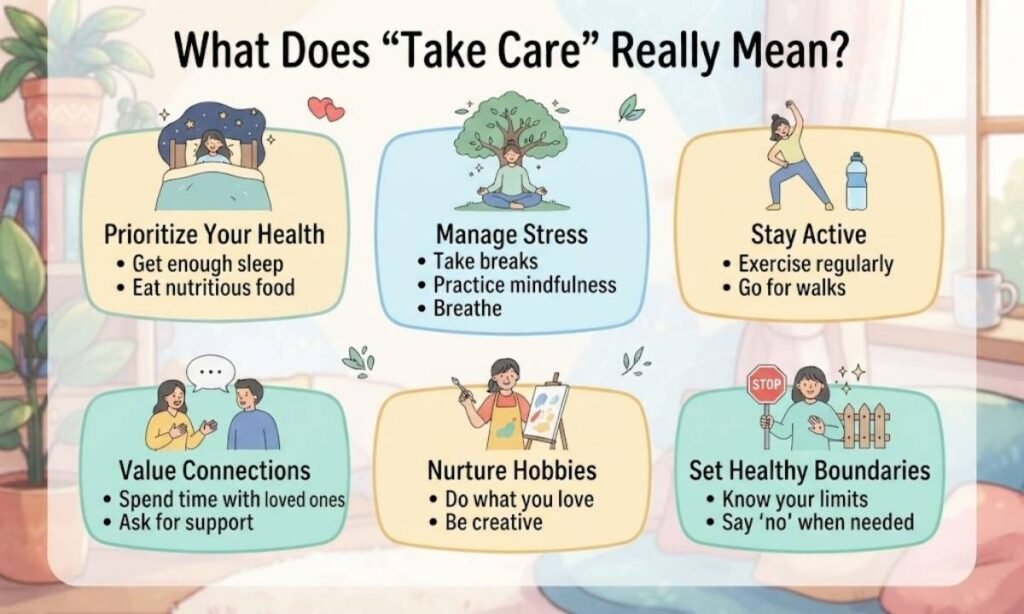
“Take care” functions as both a goodbye and a small expression of concern for the other person’s well-being. It tells the listener that the speaker hopes they stay safe, healthy, and well until they meet again.
- As a goodbye: Used casually at the end of most conversations, similar to “bye” or “see you later.”
- As a sign of concern: Suggests the speaker genuinely cares about the listener’s safety or health.
- Formal or casual: It works in both settings, which is part of why it’s used so widely.
Whether it feels deeply caring or just polite usually depends on tone, timing, and the relationship between the two people.
Take Care vs. Take Care of Yourself: What’s the Difference?
“Take care” is a quick, general farewell, while “take care of yourself” carries a stronger, more personal tone. The longer phrase is often used when someone is going through a difficult time, traveling, or facing a challenge.
| Phrase | Common Use | Emotional Weight |
| Take care | General goodbye, everyday chat | Light, polite |
| Take care of yourself | After sharing bad news or before a trip | Stronger, more caring |
If someone chooses the longer version, they’re usually signaling extra concern, so a warmer reply back is a nice touch.
How Tone of Voice Changes Your Reply?
The same words can sound completely different depending on delivery, so tone matters as much as wording when you reply to “take care.” A flat, quick “you too” reads as routine politeness, while a slower, warmer delivery signals real affection.
In text messages, where tone isn’t audible, word choice and punctuation carry that weight instead. Adding a name, an exclamation point, or a short extra phrase — like “you too, stay safe!” — helps convey warmth that a bare “ok, you too” cannot.
Best Replies by Relationship
Matching your response to the relationship keeps the exchange natural instead of stiff or overly casual.
| Relationship | Suggested Reply |
| Close friend | “Thanks, you too!” |
| Coworker | “Thank you, take care as well.” |
| Boss or manager | “Thank you. You too.” |
| Family member | “You too! Take good care.” |
| Someone you like | “You too 😊” (or simply “You too!”) |
| Serious conversation | “Thank you. Please take care too.” |
| Quick text message | “Will do! You too.” |
Take Care Replies Across Email, Text, and WhatsApp
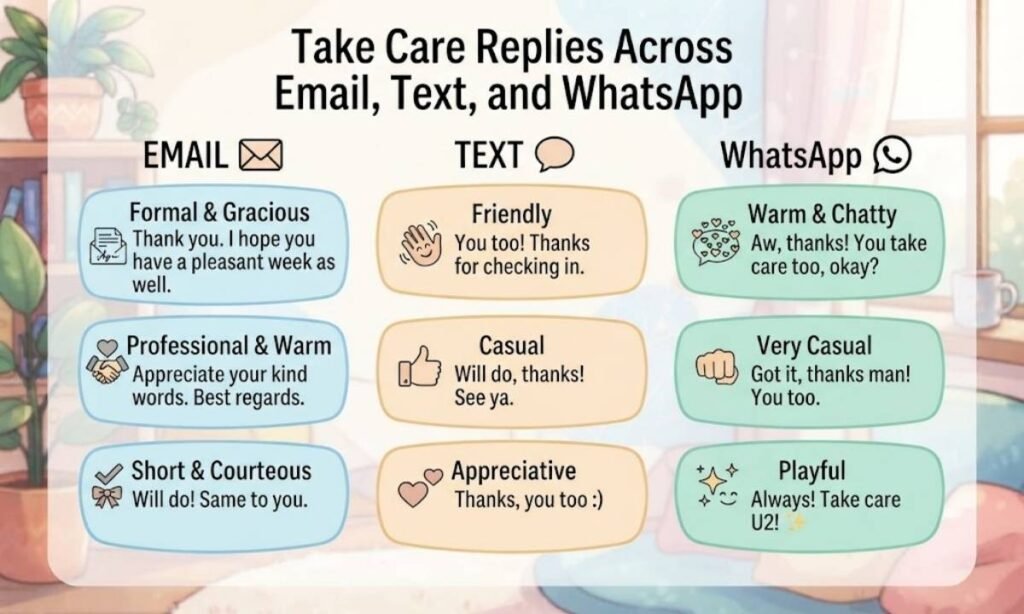
Different platforms call for slightly different phrasing, even though the sentiment stays the same. Emails tend to favor complete, polished sentences, while texting and WhatsApp allow for shorter, more relaxed replies.
- Email: “Thank you for your message. Take care, and speak soon.”
- Text message: “Thanks, you too!”
- WhatsApp: “TC too!” or “You too, take care 🙂”
On WhatsApp specifically, abbreviations like “TC” are common shorthand for “take care,” especially among friends who message frequently.
Take Care Replies Around the World: Cultural Variations
Farewell customs vary by culture, and “take care” doesn’t always translate directly into an equally casual phrase elsewhere. In many Asian cultures, for example, a similar sentiment is expressed through phrases that closely resemble wishing someone good health or a safe journey rather than a generic goodbye.
In more formal cultures, replying with a simple nod or a brief acknowledgment can be just as appropriate as a spoken reply. Being aware of these differences helps when communicating with international coworkers, clients, or friends.
Creative Alternatives to Saying “You Too”
If “you too” feels repetitive, several alternative phrases carry the same reciprocal warmth without echoing the exact words back.
- “Thanks, I will.”
- “I appreciate that.”
- “Stay safe too.”
- “Have a wonderful day.”
- “Talk to you soon.”
These options work well in longer conversations where repeating the same phrase back-to-back might feel a little robotic.
When Not to Reply to “Take Care”
Not every instance of “take care” requires a spoken or typed response, especially when it’s used as a closing line in a long email thread or a group chat that’s already winding down. In these cases, a simple acknowledgment like a thumbs-up or no reply at all is perfectly acceptable.
It’s also fine to skip a reply during a quick, in-person goodbye where a nod, smile, or wave already communicates the same sentiment. Overthinking a routine farewell can sometimes make the interaction feel more awkward than leaving it simple.
Common Mistakes to Avoid When Replying
- Being overly formal in a casual chat: A stiff reply like “Much obliged” feels out of place with close friends.
- Making a professional reply too personal: Save affectionate language for people outside of work settings.
- Using humor in a serious moment: Jokes can land poorly if someone said “take care” after sharing difficult news.
- Overanalyzing a simple goodbye: Not every “take care” needs a long or creative response — sometimes short and sincere is best.
Frequently Asked Questions
What is the best reply to “take care”?
A simple, sincere reply like “Thanks, you too!” works in almost any situation and relationship.
How do you reply to “take care” in a text?
Keep it short and friendly, such as “You too!” or “Will do, thanks!”
Is “you too” a good reply to “take care”?
Yes, it’s one of the most natural and widely accepted responses in casual and semi-formal conversations.
How do you reply to “take care” professionally?
Use a polite, reciprocal line like “Thank you, you too” to keep the tone respectful.
What is a cute reply to “take care”?
Try something warm like “You take good care of yourself too” or “I will, promise.”
What does “take care” mean in a text?
It generally means the sender is saying goodbye while wishing you well and staying safe.
Is “take care” a friendly or romantic phrase?
It’s usually friendly and platonic, though tone and context can make it feel more affectionate between close partners.
Conclusion
Replying to “take care” doesn’t need to be complicated — the right response almost always comes down to matching the other person’s tone and your relationship with them. A quick “you too” covers most everyday moments, a warmer line suits close friends and family, and a polite, reciprocal phrase keeps things professional at work.
Once you know the small variations by platform, culture, and context, this simple goodbye becomes an easy chance to sound genuine instead of robotic. Keep a few of these replies in mind, and you’ll never be stuck wondering what to say next.