
Mixing up “neice” and “niece” is one of the most common spelling slips in English, and it happens because the “ie” sound doesn’t give any clue about letter order. If you’ve ever paused mid-sentence wondering which version looks right, you’re far from alone.
The good news is that only one spelling is standard in dictionaries and everyday writing. This guide explains the correct form, why the mistake happens so often, and gives you simple tricks so you never second-guess it again.
Neice or Niece: Which Spelling Is Correct?
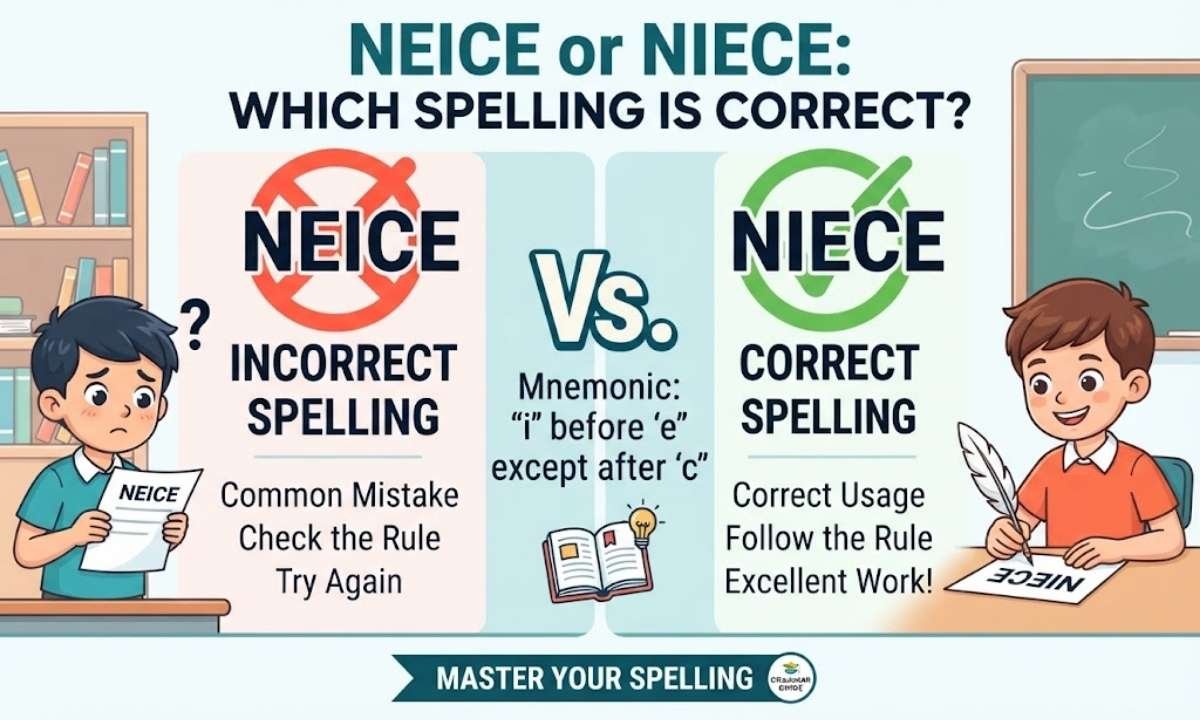
Niece is correct, and neice is incorrect. A niece is the daughter of your brother or sister, and in many families, the term also extends to the daughter of a spouse’s sibling.
- Correct: niece
- Incorrect: neice
- Meaning: your sibling’s daughter
Every major English dictionary lists only “niece” as a valid entry, which makes this one of the clearer spelling questions in the language.
How to Spell Niece the Right Way?
The correct spelling follows the pattern N I E C E, with the “i” placed before the “e.” This word belongs to a small family of English terms where “ie” appears together to create a long “ee” sound.
People often write “neice” because they’re applying the familiar “i before e, except after c” rule incorrectly. Since niece contains a “c,” some writers assume the letters should flip, but that rule does not apply here the way it does in words like “receive.”
What Does Niece Mean in English?
A niece is a female relative, specifically the daughter of your sibling or, in broader usage, the daughter of your spouse’s sibling. The word describes a specific position within a family tree rather than a general term for a young female relative.
- Your niece is your brother’s or sister’s daughter.
- Some families also use the term for a spouse’s sibling’s daughter.
- The male equivalent of this relationship is “nephew.”
Understanding the family relationship makes the spelling easier to remember, since the word always refers to a real, specific connection rather than an abstract idea.
Why “Neice” Is a Common Misspelling
The mistake usually comes from mixing up two very similar-looking letter patterns. English contains dozens of words where “ie” and “ei” both appear, and the pronunciation rarely tells you which one is correct.
- The letters look nearly identical when written quickly.
- The “i before e” spelling rule gets misapplied to words containing “c.”
- Autocorrect on some older devices doesn’t always flag the error immediately.
Because the visual difference between the two spellings is so small, this remains one of the most frequently searched family-related spelling questions online.
How Niece Is Pronounced?
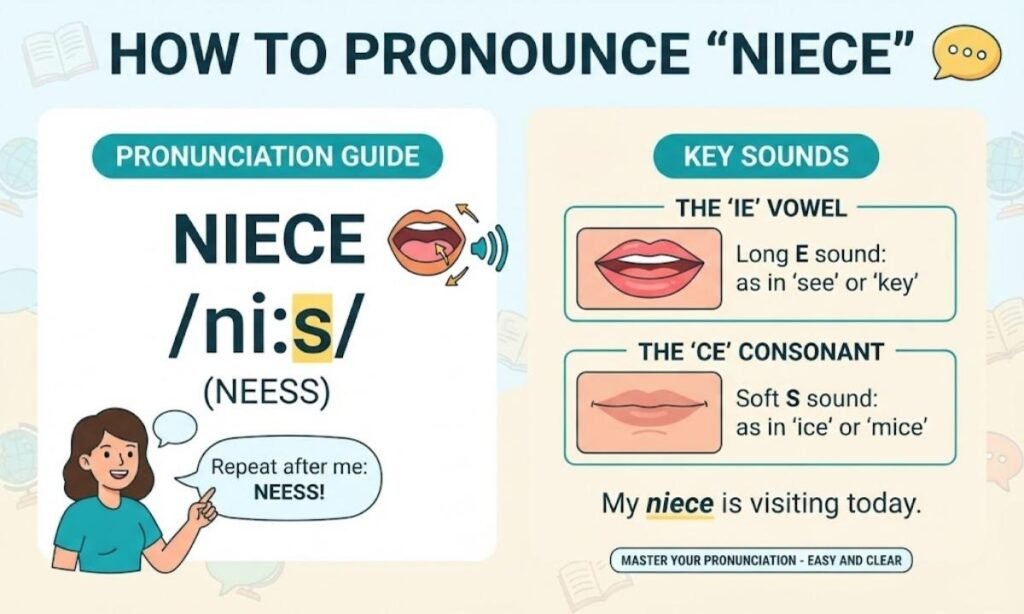
Niece is pronounced “neess,” rhyming with words like “peace” and “fleece.” The pronunciation stays exactly the same regardless of which spelling a person mistakenly uses, which is part of why the error is so easy to make without noticing.
Since sound alone won’t reveal the correct letter order, relying on visual memory or a simple spelling trick works far better than trying to sound the word out.
The History and Origin of the Word Niece
Niece entered English through Old French “nece,” which itself developed from the Latin word “neptis,” meaning a granddaughter or female descendant. Over time, English narrowed the meaning specifically to a sibling’s daughter, separate from broader descendant terms.
This French influence explains the unusual “ie” spelling pattern, since many English words borrowed from French during the medieval period kept their original vowel combinations rather than adopting a more phonetic English spelling.
Easy Tricks to Remember the Spelling
A short memory trick can make this spelling permanent within a few uses. One of the most effective phrases writers recommend is simply linking the word to something familiar sounding.
- Remember: “My niece is nice.” Both words share the same “ie” pattern.
- Niece rhymes with piece, and both use the same letter order.
- Break the word into small chunks: “N,” “IE,” “C,” “E.”
Repeating a short phrase like this a few times is often enough to permanently fix the spelling in memory.
Niece, Nieces, Niece’s, and Nieces’: Singular and Possessive Forms
Knowing how the word changes in plural and possessive form prevents a second common mistake once the basic spelling is fixed.
| Form | Use | Example |
| Niece | Singular | My niece is visiting this weekend. |
| Nieces | Plural | I have three nieces. |
| Niece’s | Singular possessive | My niece’s graduation is in June. |
| Nieces’ | Plural possessive | My nieces’ room is upstairs. |
The apostrophe placement follows standard English possessive rules, with a single apostrophe plus “s” for one niece and just an apostrophe after the “s” for more than one.
Niece vs. Nephew Explained
A niece is a sibling’s daughter, while a nephew is a sibling’s son, making the two words direct male and female counterparts of the same family relationship.
- Niece: female, sibling’s daughter
- Nephew: male, sibling’s son
- Easy memory link: “niece” and “she” both contain the letter “e” early on
Keeping this pairing in mind also helps writers avoid accidentally swapping the two terms in family-related writing.
Does Spelling Change Between American and British English?
Niece is spelled exactly the same in American English and British English, with no regional variation. This makes it different from words like “color” and “colour,” where spelling genuinely shifts between the two dialects.
Since there’s no US or UK version of this word, writers in either region only need to remember one correct spelling, which simplifies things considerably compared to other commonly confused English terms.
Why Autocorrect Sometimes Misses “Neice”
Many spellcheck tools rely on common misspelling databases, and “neice” is frequent enough that some systems auto-correct it instantly. Others, particularly on messaging apps with limited dictionaries, may not catch the error at all, especially if the surrounding sentence still reads smoothly.
This inconsistency across platforms is one reason the mistake continues to appear in emails, social media captions, and text messages even among careful writers.
Other Words With the Same “IE” Spelling Pattern
Several other everyday English words follow the same “ie” structure as niece, which can reinforce the correct pattern through repetition.
- Piece
- Fierce
- Pierce
- Grieve
Practicing with this small group of related words helps train the eye to expect “ie” rather than “ei” in similar-sounding terms.
Niece in Different Languages Around the World
Many languages use entirely different word structures for this family relationship, which shows how uniquely English borrowed its term from French. In Spanish, the word is “sobrina,” in German it’s “Nichte,” and in Italian it’s “nipote,” a term that can refer to either a niece or a nephew depending on context.
Comparing these variations highlights why English speakers can’t rely on translation instincts and instead need to memorize the specific English spelling directly.
Niece in Everyday Sentences and Examples
Seeing the word used naturally across different settings makes the correct spelling easier to internalize.
- My niece just started kindergarten this fall.
- We’re throwing a surprise party for my niece’s birthday.
- Both of my nieces play soccer on the weekends.
- I sent my niece a card for her graduation.
- My niece and nephew are visiting for the holidays.
Reading and writing the word in real sentences reinforces the correct pattern far more effectively than memorizing the spelling on its own.
Niece Spelling Cheat Sheet
| Form | Correct? | Example |
| niece | Yes | My niece is visiting. |
| neice | No | Common misspelling |
| nieces | Yes | My nieces are visiting. |
| niece’s | Yes | My niece’s birthday is today. |
| nieces’ | Yes | My nieces’ room is upstairs. |
Common Niece-Related Terms You Should Know
A few extended family terms build directly on the word niece and are worth knowing for clearer, more precise writing.
- Great-niece: your niece’s daughter, or your sibling’s granddaughter
- Grandniece: another accepted term for a great-niece
- Niece-in-law: the niece of your spouse
Learning these related terms rounds out your understanding of extended family vocabulary and prevents confusion in more detailed family discussions.
Frequently Asked Questions
Is it neice or niece?
Niece is the correct spelling; neice is a common but incorrect variation.
How do you spell niece?
The correct spelling is N-I-E-C-E, with the “i” placed before the “e.”
What is the correct spelling of niece?
Niece is the only recognized spelling in standard English dictionaries.
Why is “neice” wrong?
It reverses the correct “ie” letter order, likely from misapplying the “i before e” rule.
What does niece mean?
A niece is the daughter of your brother or sister, and sometimes your spouse’s sibling.
How do you pronounce niece?
Niece is pronounced “neess,” rhyming with words like peace and fleece.
What is the plural of niece?
The plural form is “nieces,” as in “I have two nieces.”
Conclusion
The spelling question between neice and niece has a clear, simple answer: niece is correct, and neice should be avoided in all standard English writing. Once you connect the word to its meaning, pronunciation, and a quick memory trick like “my niece is nice,” the correct spelling becomes second nature.
Whether you’re writing a birthday card, a family email, or a quick text message, using the right spelling adds a small but noticeable layer of polish to your writing.