

Ingrained is the standard spelling, and engrained is a less common variant of the same word. They sound nearly identical, and both mean deeply fixed or firmly established, as in ingrained habits or engrained beliefs. Dictionaries list engrained as a less common spelling of ingrained, not as a separate word.
Spelling it correctly matters because readers notice small errors, especially in professional writing. In American English, ingrained is the safer choice every time, whatever the context. This guide covers the meaning, the history of the spelling, regional differences, and the rare cases where engrained is acceptable. It also separates both words from engraved, which means something else entirely.
What Does Ingrained Mean?
Ingrained describes something that has become so deeply fixed that it is hard to change or remove. It is an adjective formed from the verb ingrain, which means to work something firmly into a person, a surface, or a material.
Dictionaries recognize three uses:
- Figurative: habits, attitudes, and beliefs that are deeply rooted in a person or group.
- Literal: dirt, stains, or marks pressed deep into a surface.
- Textile: fabric made from fiber or yarn that was dyed before spinning or weaving. This sense is specialized and rare in everyday writing.
The word grew out of textile dyeing, where color worked deep into the fiber would not wash out. That image survives in the modern meaning. Whatever is ingrained resists being scrubbed away or unlearned.
Two quick examples:
- Punctuality was ingrained in her long before she started her first job.
- Decades of soot had left the brick ingrained with black.
Ingrained in Different Contexts
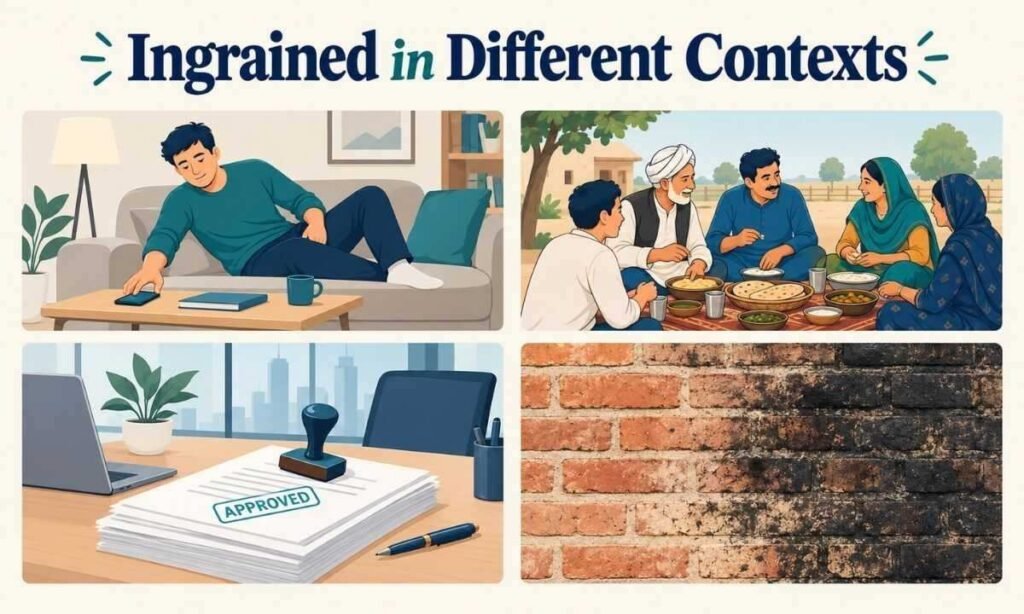
The word stays the same across settings. What changes is the noun it describes.
Personal habits. Ingrained often describes routines people follow without thinking. It suggests long repetition. For example: Reaching for his phone first thing in the morning had become an ingrained reflex.
Culture and beliefs. In writing about society, it describes attitudes passed down through families, schools, and institutions. For example: Mistrust of outsiders was ingrained in the village’s customs.
Workplaces and organizations. It can describe processes that people no longer question. For example: Ingrained approval layers slowed every product launch.
Physical surfaces. The literal sense covers marks that cleaning cannot easily remove. For example: Ingrained grime had settled into the grout.
Writers often add intensifiers such as deeply, firmly, or long to stress how established something is. Ingrained itself is neutral. It can describe a positive trait like generosity as easily as a negative one like prejudice.
What Does Engrained Mean?
Engrained has the same meaning as ingrained. It is the adjective and past participle of the verb engrain, a variant of ingrain. Both spellings cover the same figurative, literal, and textile senses.
The verb forms mirror each other:
- ingrain, ingrains, ingrained, ingraining
- engrain, engrains, engrained, engraining
An example: Her engrained caution made her read every contract twice.
A common claim is that engrained is for physical marks and ingrained is for ideas. Dictionaries do not support that split. They treat the two spellings as interchangeable variants of one word. The difference lies in how often each is used, not in what each means.
Engrained vs Ingrained Comparison Table
| Feature | Ingrained | Engrained |
| Status | Standard spelling | Less common variant |
| Meaning | Deeply fixed or firmly established | Same meaning |
| Verb form | Ingrain | Engrain |
| Figurative use | Yes: habits, beliefs, values | Yes, but rarer |
| Literal use | Yes: dirt, stains, marks | Yes, but rarer |
| Safe for formal writing | Yes | Use with caution |
| Example | An ingrained sense of fairness guided her decisions. | An engrained sense of fairness guided her decisions. |
The Key Difference — Convention Over Correctness
Neither spelling is a grammatical error. The real difference is convention. Writers, editors, and publishers have settled on one form, and readers expect to see it.
Choosing engrained will not make a sentence wrong, but it may look like a typo to readers who rarely see it. Choosing ingrained never raises that question.
Why “Ingrained” Won
English has many pairs that differ only in an en- or in- prefix, such as ensure and insure, or enquire and inquire. In most pairs, usage gradually favors one form. For this word, ingrained is by far the more common spelling in published writing.
Once one form dominates, the pattern reinforces itself. Editors and style guides tend to follow the dominant form, readers grow used to it, and the variant starts to look odd. Dictionaries reflect this by listing engrained as the less common spelling.
When to Use Ingrained vs Engrained
The simplest rule is to default to ingrained. The two lists below show when that default is clearly right and when you have room to choose.
Always Use “Ingrained” When:
- You are writing for an American audience.
- You are writing for school, work, publication, or a client.
- Your style guide or editor does not specify a preference.
- You want your spelling to match what most readers expect.
- You are unsure which spelling to use.
“Engrained” Is Acceptable When:
- You are quoting or reprinting a text that uses that spelling.
- A publisher, editor, or house style specifically allows it.
- You are writing informally and prefer that spelling.
- You are editing a document that already uses engrained consistently.
Even in these cases, stay consistent. Do not use both spellings in the same piece.
Ingrained vs Engrained in British and American English
The two spellings are not tied to a national divide the way color and colour are. Ingrained is the standard form in both American and British English.
Some usage guides suggest engrained draws fewer objections in British writing. That is a matter of tolerance, not a rule. For American English, which this article follows, ingrained is the clear default.
Ingrained and Engrained Example Sentences
Seeing both spellings in context makes the pattern clear.
Ingrained:
- The nurse’s careful hand-washing routine was so ingrained that she did it without thinking.
- Parents often pass along ingrained ideas about money without realizing it.
- Paint had become ingrained in the carpenter’s work gloves.
- The training program aims to make safety checks ingrained from the first day.
Engrained:
- A habit engrained over many years rarely disappears overnight.
- Grease had become engrained in the cracks of the old engine block.
- Their engrained loyalty to the local team survived every losing season.
Each engrained sentence would read just as naturally with ingrained, and most editors would make that change.
Synonyms for Ingrained and Engrained
Synonyms help you avoid repetition. Each one carries a slightly different shade of meaning, so choose carefully.
| Synonym | Shade of Meaning | Example |
| Deep-rooted | Long established and hard to remove | Deep-rooted traditions shape the festival. |
| Deep-seated | Strongly held, usually beliefs or feelings | She had a deep-seated fear of public speaking. |
| Entrenched | Firmly established and resistant to change | Entrenched routines slowed the project. |
| Habitual | Done out of habit | His habitual lateness frustrated the team. |
| Embedded | Set firmly within something | Safety checks are embedded in every workflow. |
| Instilled (verb) | Gradually put into someone’s mind | Her parents instilled a love of reading. |
Note that the correct phrase is deep-seated, not deep-seeded.
Common Mistakes to Avoid
- Using engrained in formal American writing
- Incorrect: Prejudice was engrained in the policy.
- Correct: Prejudice was ingrained in the policy.
- Engrained is not an error, but ingrained is the expected spelling.
- Mixing both spellings in one document
- Incorrect: Ingrained habits and engrained attitudes shaped the office.
- Correct: Ingrained habits and ingrained attitudes shaped the office.
- Pick one spelling and keep it throughout.
- Treating engrained as a form of engraved
- Incorrect: The couple’s names were engrained on the ring.
- Correct: The couple’s names were engraved on the ring.
- Engrained never means carved or cut.
- Linking ingrained to ingrown
- Incorrect: an ingrown belief
- Correct: an ingrained belief
- Ingrain and ingrown are unrelated words. Ingrown describes growth into the skin, as with a nail.
- Using ingrained for something new or easily changed
- Weak: Her ingrained habit of drinking tea began last week.
- Better: Her habit of drinking tea began last week.
- Ingrained implies something long established.
Ingrained vs Engraved — An Important Distinction

Ingrained and engraved look similar, but they are different words with different meanings.
- Ingrained means deeply fixed or firmly established. Example: An ingrained love of music ran through the family.
- Engraved means carved or cut into a surface. Example: The retirement gift was engraved with his initials.
Engraved can also be figurative. A phrase such as “engraved in memory” means permanently preserved in the mind. Because of this overlap, writers sometimes confuse the two.
A quick test helps. If something is physically carved, use engraved. If it is a habit, belief, or deeply set mark, use ingrained.
Frequently Asked Questions
Is engrained a real word?
Yes. Engrained is a recognized variant spelling of ingrained. Dictionaries list it, but they identify it as the less common form.
Is it “deeply ingrained” or “deeply engrained”?
Deeply ingrained is the standard choice and appears far more often. Deeply engrained is understood but may look like an error to some readers.
Is engrained more acceptable in British English?
Some usage guides say engrained draws fewer objections in British writing. Ingrained remains the standard spelling in both American and British English.
How do you pronounce ingrained?
It is pronounced in-GRAYND, with the stress on the second syllable. Engrained is typically pronounced the same way, which helps explain why the spellings get mixed up.
Do you hyphenate “deeply ingrained”?
Not usually. When an adverb ending in -ly modifies a participle, standard style guides do not add a hyphen. Write “deeply ingrained habits,” not “deeply-ingrained habits.”
Can ingrained describe something positive?
Yes. Ingrained is neutral. You can describe an ingrained sense of kindness just as easily as an ingrained prejudice. The context supplies the tone.
What is the difference between ingrain and ingrained?
Ingrain is the base verb. Ingrained is its past tense and past participle, and it also works as an adjective. For example: “Teachers ingrain good habits” and “Ingrained habits are difficult to change.”
Conclusion
Ingrained and engrained mean the same thing, but ingrained is the standard spelling and the safest choice, especially in American English. Engrained is a recognized variant, not a mistake, yet it is rarer and may distract readers.
Keep your spelling consistent, and do not confuse either word with engraved, which means carved or cut.