
Few phrases get misspelled as often as this one. You type it in a hurry, the word looks slightly off, and you wonder whether it ends in “ys” or “ies.” If you have ever paused over time flies or flys in an email or a caption, you are in good company.
The short answer is simple, and the reasoning behind it is even more useful. This guide explains the correct spelling, the grammar rule that decides it, the meaning of the saying, and easy ways to remember it.
Quick Answer: Time Flies or Flys?
The Correct Spelling
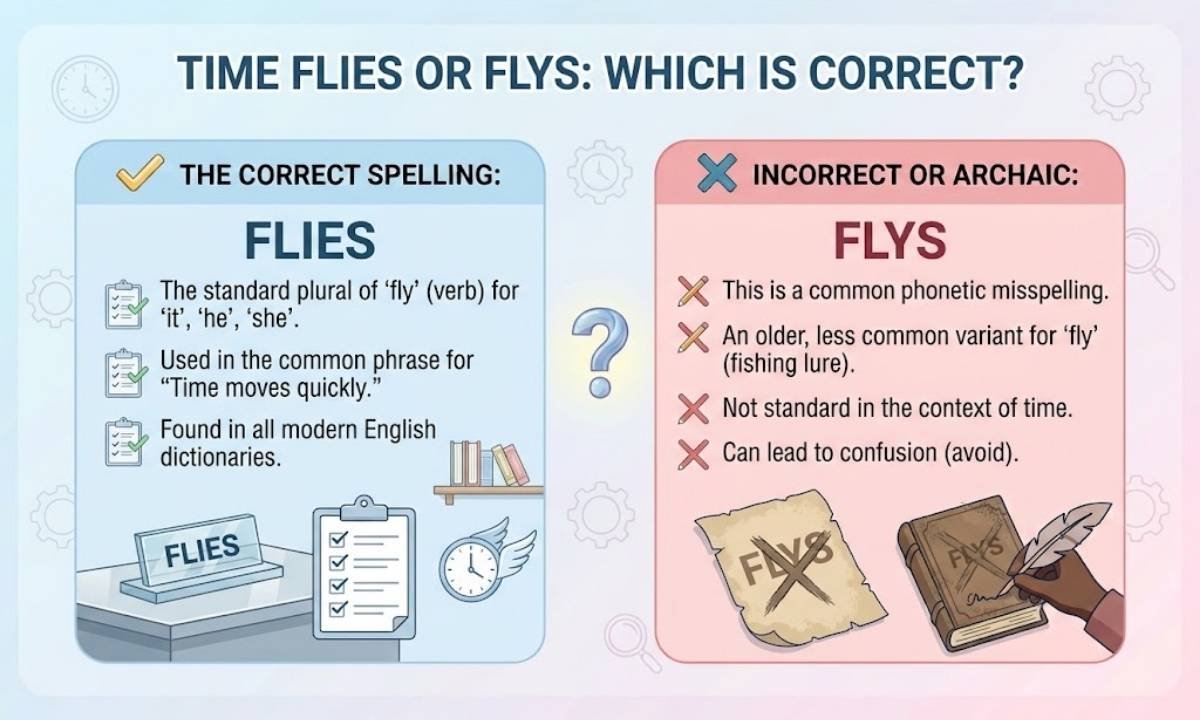
The correct spelling is “time flies.” The word “flys” is not standard English in this phrase.
Quick Example
• Correct: Time flies when you are busy.
• Incorrect: Time flys when you are busy.
“Flies” is the present tense form of the verb “fly” when the subject is a singular noun like “time.”
What Does Time Flies Mean?
Simple Meaning
“Time flies” is an idiom that means time seems to pass very quickly. People use it when days, weeks, or years feel shorter than expected.
When People Use It
You will hear it at birthdays, graduations, and family gatherings. It is a gentle way of saying, “I cannot believe how fast this went.”
Why Is Flies Correct Instead of Flys?
The Y to IES Spelling Rule
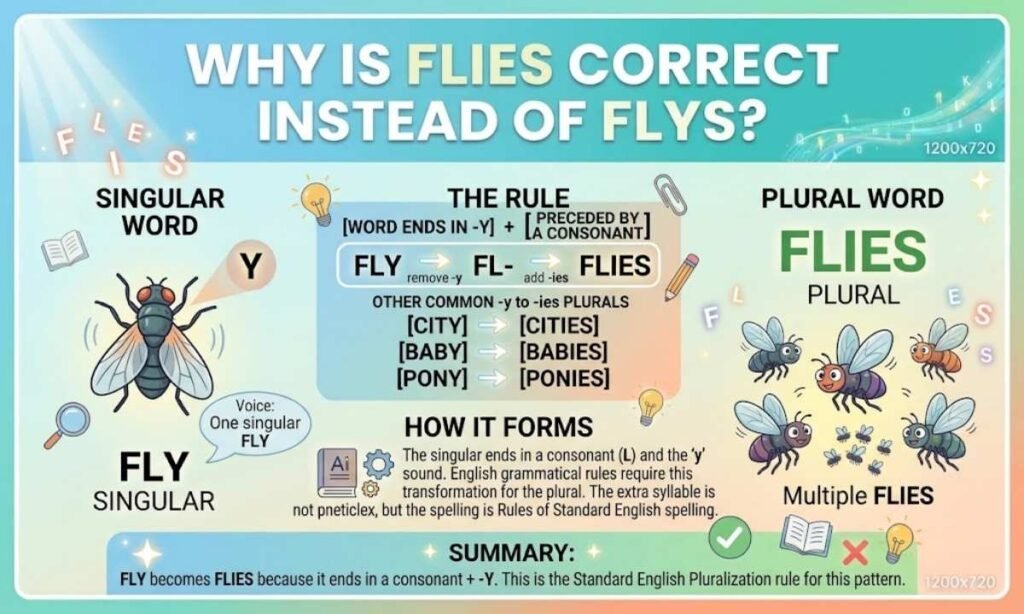
English has a spelling rule for words that end in a consonant plus “y.” You drop the “y” and add “ies” when you form a third person singular verb or a plural noun.
Why Adding S Does Not Work
The word “fly” ends in the consonant “l” followed by “y,” so it becomes “flies.” Simply adding an “s” would create “flys,” which breaks the pattern and looks wrong to trained readers.
Flies vs. Flys at a Glance
| Word | Standard English? | Main Use |
| Flies | Yes | Verb form of “fly” or plural of the noun “fly” |
| Flys | Generally no | Usually a spelling mistake |
Flies as a Verb and a Plural Noun
“Flies” does two jobs. It works as a verb (“A bird flies”) and as a plural noun (“Flies buzzed around the fruit”). Context tells you which one is meant.
Flys as a Nonstandard Spelling
Dictionaries and style guides list “flies,” not “flys.” Treat “flys” as an error in normal writing.
Grammar Breakdown of Time Flies
Subject and Verb
1. “Time” is the subject.
2. “Flies” is the verb.
3. The subject is singular, so the verb takes the “s” form.
Why the Singular Subject Takes Flies
This is the same reason we say “she runs” and “the clock ticks.” The verb agrees with the subject, and that agreement is why “time fly” sounds wrong.
Examples of Time Flies in Sentences
Everyday Examples
• “My kids start school next week. Time flies!”
• “Our neighbors moved in five years ago. Time flies.”
Work and Formal Examples
• “It feels like we launched the project yesterday, but time flies.”
• “As the deadline approaches, time flies, and planning becomes critical.”
Social Media Examples
• “One year in this city already. Time flies.”
• “Time flies, so spend it on what matters.”
Common Mistakes With Time Flies
| Wrong Form | Why It Is Wrong | Correct Form |
| Time flys | Breaks the “y to ies” rule | Time flies |
| Time fly | Verb does not agree with a singular subject | Time flies |
| Time fly’s | The apostrophe suggests possession or a contraction | Time flies |
How to Avoid These Errors?
Say the sentence aloud and ask whether the verb matches the subject. Then check the ending against the spelling rule.
Fly, Flies, Flew, Flown, and Flying Explained
“Fly” is an irregular verb, so its forms are worth knowing.
| Form | Name | Example |
| Fly | Base form | Birds fly south. |
| Flies | Third person singular present | Time flies. |
| Flew | Simple past | We flew to Dubai last year. |
| Flown | Past participle | She has flown many times. |
| Flying | Present participle | They are flying tonight. |
A Small Baseball Exception
In baseball, a batter “flied out,” which is a regular past tense used only in that sport.
Is Flys a Word?
Why Flys Looks Incorrect
In everyday writing, no. Standard dictionaries list “flies” as the correct form for both the verb and the plural noun.
Where Flys Still Appears
You may see “flys” in surnames, brand names, usernames, and casual typos. These are not standard usage. In school, business, and professional writing, always choose “flies.”
Time Flies in American and British English
Is the Spelling Different?
Both American and British English use the same spelling: “time flies.” There is no regional split here.
Why Regional Rules Do Not Apply
Differences like “color” and “colour” do not affect this phrase. Whether you write for a US or a UK audience, the answer stays the same.
Time Flies When You’re Having Fun
What the Saying Means
The full saying is “time flies when you’re having fun.” It suggests that enjoyable moments feel shorter than boring ones.
Example Sentences
• “The trip was amazing. Time flies when you’re having fun.”
• “We chatted for hours, and time flew by.”
Notice that “flew” appears when you talk about the past, while “flies” fits general truths and the present.
Synonyms and Similar Expressions
Other Ways to Say It
• Time passes quickly
• Time goes by fast
• Where did the time go?
• The days slipped away
• Time is racing by
Which One Should You Choose?
These carry a similar meaning, though “time flies” remains the most recognized and widely used version.
Where Does Time Flies Come From?
The Latin Roots
The idea is ancient. The Roman poet Virgil wrote a line in the Georgics often summed up as “tempus fugit,” meaning time flees or escapes.
How It Reached English
Over the centuries, the thought moved into English as “time flies.” Its long history explains why the phrase appears on clocks, sundials, and greeting cards.
Why Time Seems to Speed Up With Age?
The Memory Effect
Psychologists often explain that new experiences create richer memories, which makes a period feel longer when we look back on it. Routine days blend together and feel shorter.
How to Slow It Down
Adults repeat more patterns than children do, so years seem to shrink. Staying curious and trying new things can help slow that feeling.
Easy Tricks to Remember the Right Spelling
Three Simple Memory Aids
1. Think of the insect. If you can write “house flies,” you can write “time flies.”
2. Compare it with “cries” and “tries.” You would never write “crys” or “trys.”
3. Say the word slowly. The “eez” sound after the “l” reminds you of the “ie.”
Tips for Writers and Editors
Proofreading Habits
Watch for verbs that end in “y” after a consonant. Run a quick search for “flys,” “trys,” and “crys” in your draft.
Using the Phrase Sparingly
One well placed “time flies” adds a human touch, while repeating it makes writing feel tired. Also note that “Time flies like an arrow” can be read two ways, which linguists use to show how grammar creates ambiguity.
Frequently Asked Questions About
Is it “time flies” or “time flys”?
The correct spelling is “time flies.” “Flys” is a common misspelling.
Why is “time flies” correct?
“Time” is a singular subject, so the verb takes the “s” form. Since “fly” ends in a consonant plus “y,” it becomes “flies.”
Is “flys” a word?
Not in standard English. It only appears in names, brands, or typos.
What does “time flies” mean?
It means time seems to pass very quickly. People say it when days or years feel shorter than expected.
Is “time flies when you’re having fun” correct?
Yes, it is a correct and widely used idiom. It means enjoyable moments pass faster than dull ones.
What is the past tense of fly?
The simple past is “flew,” and the past participle is “flown.” For example, “She flew home” and “She has flown home.”
What is the difference between fly and flies?
“Fly” is the base verb or a singular noun. “Flies” is the third person singular verb or the plural noun.
Conclusion
The correct form is “time flies,” never “time flys.” The spelling follows a reliable rule: after a consonant, change “y” to “ies” for third person singular verbs and plural nouns.
Remember the meaning, watch for the common mistakes, and use the memory tricks above. With a little practice, this small spelling question becomes an easy win in your writing.