
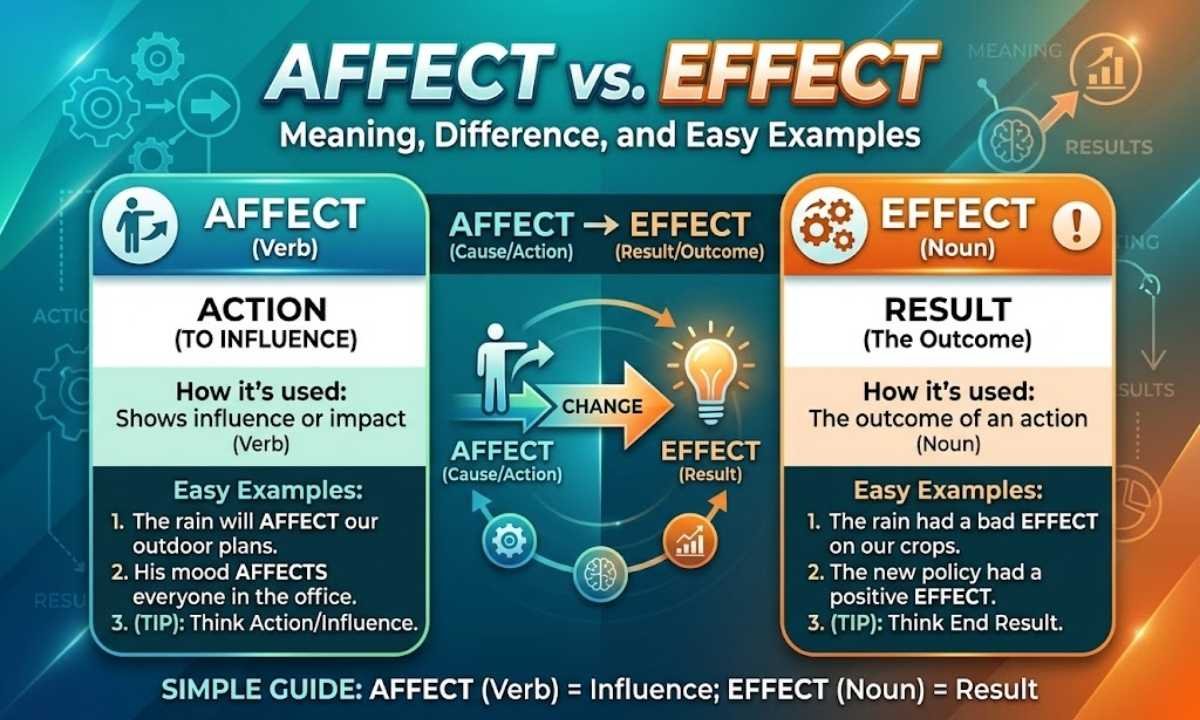
Affect and effect look almost identical, sound nearly the same, and trip up even confident writers. Here is the short answer you came for: affect is usually a verb meaning to influence, while effect is usually a noun meaning a result. Lack of sleep can affect your focus, and the effect shows up by noon.
This Affect vs Effect guide explains each word in plain English, with real examples from school, work, emails, and health. Every example is short and easy to reuse. You will also find memory tricks, the rare exceptions, common mistakes, a comparison chart, and answers to the questions people ask most, so you can choose the right word in seconds.
The Quick Answer: Affect or Effect?
Affect is usually a verb meaning to influence or change something. Effect is usually a noun meaning the result or outcome of that change.
- Affect (verb): The delay will affect our schedule.
- Effect (noun): The delay had a big effect on our schedule.
If something acts on another thing, use affect. If you are naming what happened afterward, use effect.
Why These Two Words Confuse So Many Writers
Three things cause the mix up. The words sound alike, they differ by only one letter, and both deal with change. Each word also has a rarer second job, which breaks the simple rule in a few sentences.
Teachers and editors flag this pair constantly in student essays and workplace emails, and native speakers mix them up too. Spotting the pattern once saves you from second guessing every time.
This guide draws on major dictionaries, university writing resources, and grammar references. The fix they all share is simple: look at the grammatical role of the word, not the sound.
When to Use Affect?
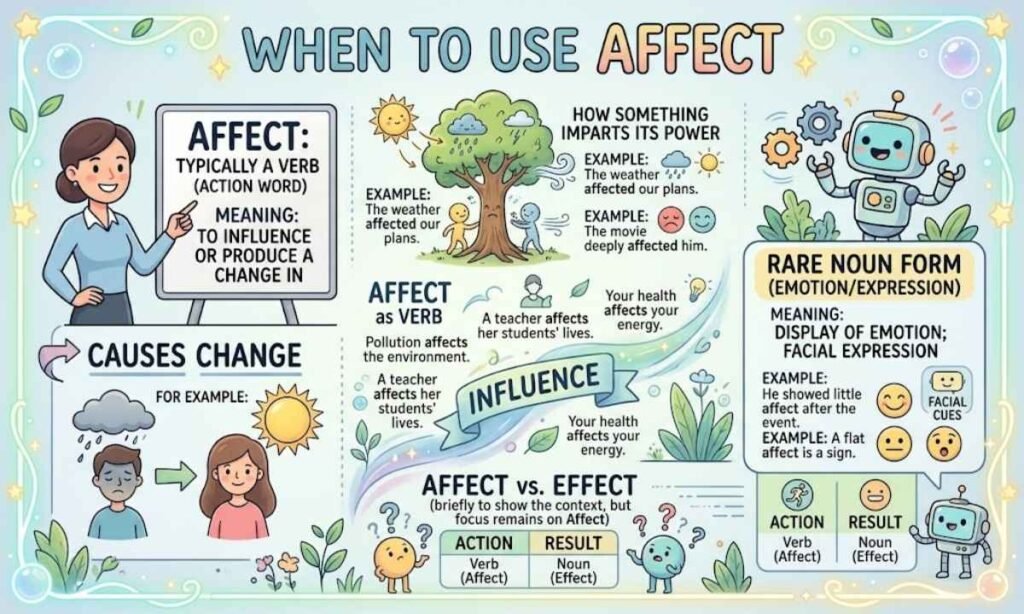
Use affect when you mean to influence, change, or move someone’s feelings. It works with people, things, and situations, and it normally takes an object.
- Weather can affect travel plans.
- Her feedback did not affect his decision.
- The news deeply affected the whole team.
Affect also covers emotions. A sad film can affect you deeply, which means it moved you. In every case, something is doing the influencing, and something else is being influenced.
When to Use Effect?
Use effect when you mean a result, outcome, or consequence. You can usually place the, an, or any before it, or a describing word such as positive or major.
- The new policy had a positive effect on morale.
- Side effects may include drowsiness.
- The special effects in the film looked real.
Effect also has a plural, effects. Depending on context, effects can mean results, movie techniques, or personal belongings. The related adjective is effective, which describes something that produces the result you wanted.
Affect vs Effect Comparison Chart
| Question | Affect | Effect |
| Usually a | Verb | Noun |
| Main meaning | Influence or change | Result or outcome |
| Think | Action | End result |
| Swap in | Influence, change, alter | Result, outcome, consequence |
| Example | Noise affects my focus. | Noise has an effect on my focus. |
| Common phrase | Affect behavior | Cause and effect |
Memory Tricks That Actually Work
- Action and End result: The A in affect stands for action. The E in effect stands for end result.
- RAVEN: Remember, Affect is a Verb, Effect is a Noun.
- Alphabet order: A comes before E, and an action happens before a result appears.
Treat these as memory aids, not laws. Both words have rare second uses, covered below.
The Substitution Test in 10 Seconds
Swap the word and see whether the sentence still works.
- If influence or change fits, choose affect.
- If result or outcome fits, choose effect.
Try it: “The storm will ___ traffic.” Influence fits, so the answer is affect. Now try “The storm had an ___ on traffic.” The word an points to a noun, so the answer is effect.
One more: “Her speech may ___ the vote.” Change fits, so use affect. If the sentence says “Her speech may have an ___ on the vote,” the word an again signals a noun, so use effect.
Exceptions Worth Knowing
Affect as a Noun
In psychology, affect is a noun meaning a person’s visible emotional expression. The stress falls on the first syllable. Example: The patient showed a flat affect.
Effect as a Verb
Effect can also be a verb meaning to bring about or accomplish. Example: The new manager hopes to effect real change. Merriam Webster also lists the sense of putting something into operation.
Affect as Pretending
Affect can mean to put on a show, as in affecting a British accent. This is why the adjective affected can describe behavior that feels fake.
These exceptions confuse people because they are formal or technical. Noun affect lives in psychology, and verb effect lives in government, law, and business writing. Unless you write in those fields, you will rarely need either one.
Affected vs Effected and Affecting vs Effecting
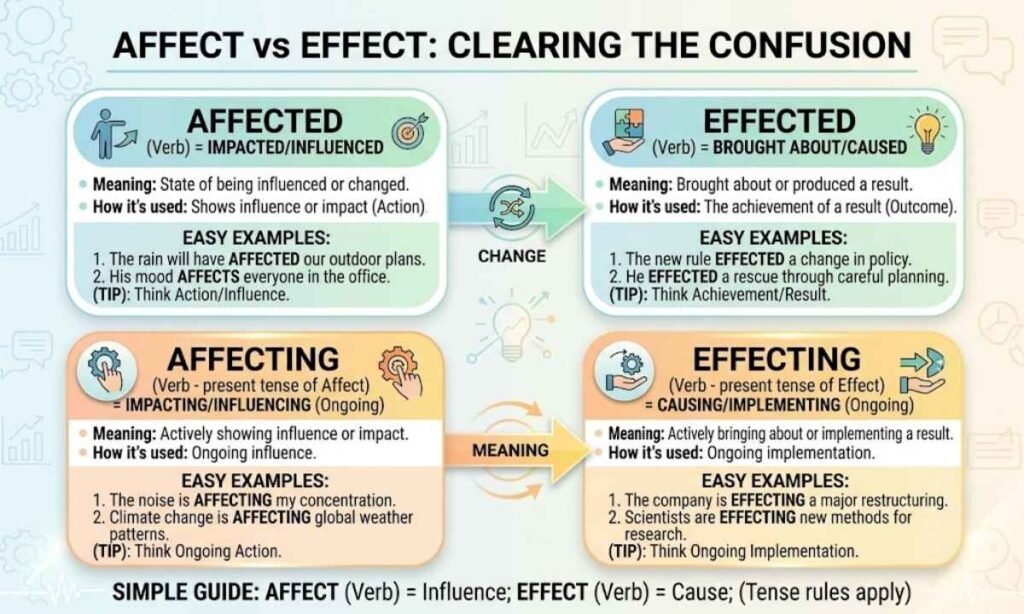
Affected is the past tense of affect. It can also be an adjective, as in the affected areas. Effected is the past tense of the verb effect and means brought about.
- Affected: The outage affected thousands of customers.
- Effected: The council effected a policy change.
- Affecting: Stress is affecting your sleep. It was also an affecting story.
- Effecting: The team is effecting change across the company.
Effected and effecting sound formal and appear rarely. Most everyday sentences need affected or affecting.
Common Phrases With Effect and Affect
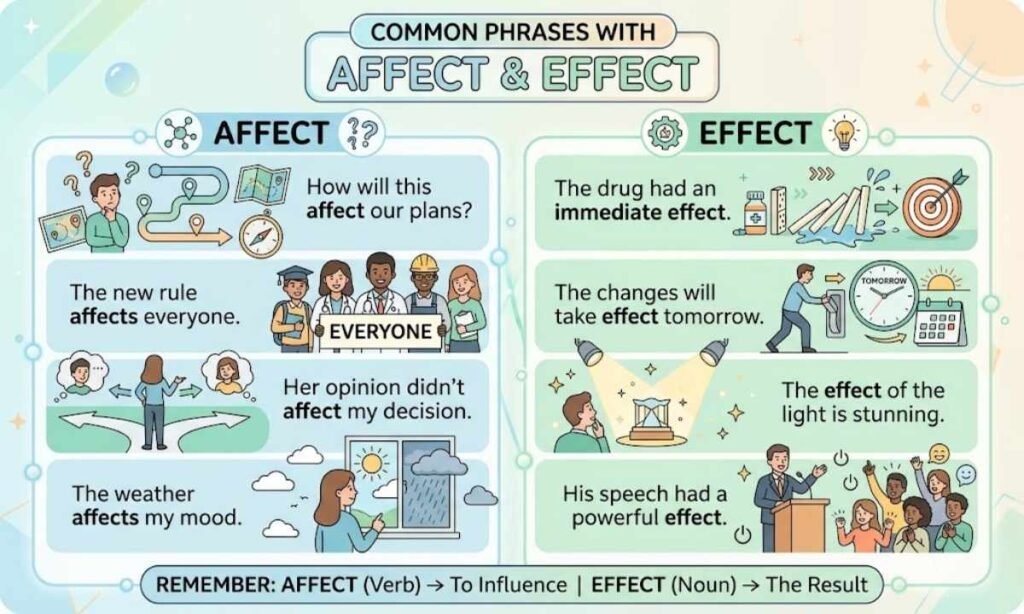
- Take effect: The new rule takes effect on Monday.
- In effect: The offer is, in effect, a discount.
- Side effect: Headaches are a common side effect.
- Cause and effect: Scientists study cause and effect in every experiment.
- Affect the outcome: One mistake can affect the outcome.
- Affect someone’s decision: Price will affect her decision.
How to Pronounce Affect and Effect
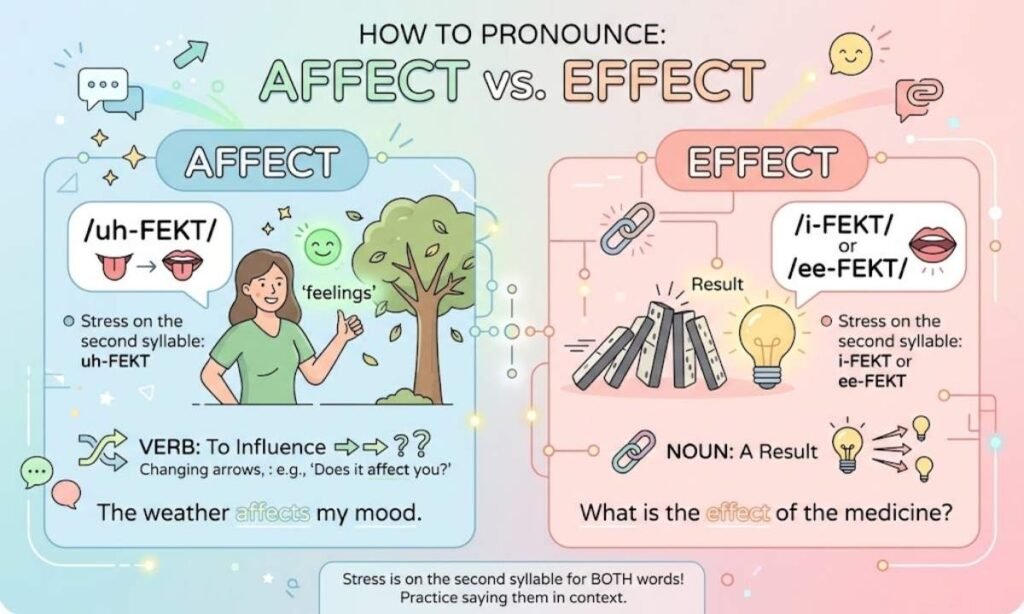
The verb affect sounds like uh FEKT, and effect sounds like ih FEKT. In casual speech the two are almost the same. The psychology noun affect is different, with stress on the first syllable, like AF ekt.
Because speech will not help you here, rely on the grammar tests above when you write.
Real World Examples From School, Work and Health
- School: Missing class can affect your grade. Extra practice had a strong effect on her scores.
- Work emails: Budget cuts will affect every department. The reorganization had an immediate effect on morale.
- Health: Caffeine can affect sleep. Dizziness is one side effect of the medicine.
- Weather and travel: Fog will affect flights. The fog had a delaying effect.
- Everyday life: Your mood can affect how you shop. The store’s music had a calming effect.
Common Mistakes and How to Fix Them
| Incorrect | Correct | Why |
| This will effect me. | This will affect me. | You need a verb meaning influence. |
| The affect of the rule was clear. | The effect of the rule was clear. | The word the signals a noun. |
| It had a big affect on sales. | It had a big effect on sales. | Have an effect on is the standard pattern. |
| Rain effected our plans. | Rain affected our plans. | Rain influenced the plans. It did not bring them about. |
What Dictionaries and Style Guides Say
Merriam Webster lists effect as a noun meaning result and as a verb meaning to accomplish. Dictionary.com treats affect as mainly a verb and offers RAVEN as a memory aid. A university health style guide advises using the noun affect only in psychology and neuroscience.
For everyday and business writing, the safe default holds: affect for actions, effect for results.
A Quick Checklist Before You Publish
- Is the word describing an action? Use affect.
- Is the word naming a result? Use effect.
- Is there a, an, the, or any before it? Use effect.
- Does influence fit in its place? Use affect.
- Do you mean bring about, as in effect change? Effect can be a verb here.
Frequently Asked Questions
What is the difference between affect and effect?
Affect is usually a verb meaning to influence. Effect is usually a noun meaning the result.
Is affect a verb or a noun?
Mostly a verb. It is a noun only in psychology, where it means visible emotional expression.
Is effect a verb or a noun?
Mostly a noun. As a formal verb, it means to bring about, as in effect change.
Is it affect on or effect on?
Use effect on, as in “an effect on sales.” Affect is a verb, so it takes a direct object instead.
Is it affect me or effect me?
Use affect me. You need a verb meaning influence, as in “This will affect me.”
What is the easiest way to remember the difference?
Use RAVEN: Remember, Affect is a Verb, Effect is a Noun. Action and End result also works.
What is the difference between affected and effected?
Affected means influenced or artificial. Effected means brought about, and it is far less common.
Conclusion
Use affect when you mean influence or change. Use effect when you mean the result or outcome. Remember the exceptions: effect can mean to bring about, and affect can name an emotional expression in psychology.
When in doubt, run the substitution test. It solves nearly every case in seconds.