
Racking is the safer spelling in most everyday phrases, including racking my brain, racking up points and nerve-racking. Wracking is not a random mistake, though. It carries an older sense of ruin and destruction, and it still appears in some fixed expressions and accepted variants found in major dictionaries.
The two words sound identical, which is why writers mix them up so often. This guide explains what each word means, shows which phrases take which spelling and gives clear examples, so you can choose with confidence the next time you write an email, an essay, a school paper or a social media post.
Wracking or Racking: Which One Should You Use?
Use racking for thinking, strain, nervous tension and accumulation. Use wracking or wracked mainly when the meaning points to destruction or devastation, or when you want an accepted variant such as nerve-wracking.
Quick answer: Racking my brain and racking up are the standard forms. Nerve-racking is preferred, while nerve-wracking is an accepted alternative.
- Racking covers strain, effort, accumulation and physical racks.
- Wracking and wracked cover ruin, wreckage and severe suffering.
- Racking my brain is the preferred form.
- Racking up is the standard form for gaining points, miles or costs.
- Nerve-racking is preferred, and nerve-wracking is accepted.
Wracking vs. Racking at a Glance
This table shows the main differences.
| Feature | Racking | Wracking |
| Core meaning | Stretching, straining, piling up | Ruin, wreckage, severe damage |
| Common phrases | Racking my brain, racking up, nerve-racking | Wrack and ruin, wracked with guilt |
| Typical context | Effort, stress, scoring, storage | Disaster, grief, destruction |
| Safe for everyday writing | Yes, in nearly all cases | Only in specific uses |
| Example | She kept racking her brain for the answer. | The coast was wracked by storms. |
What Does “Racking” Mean?
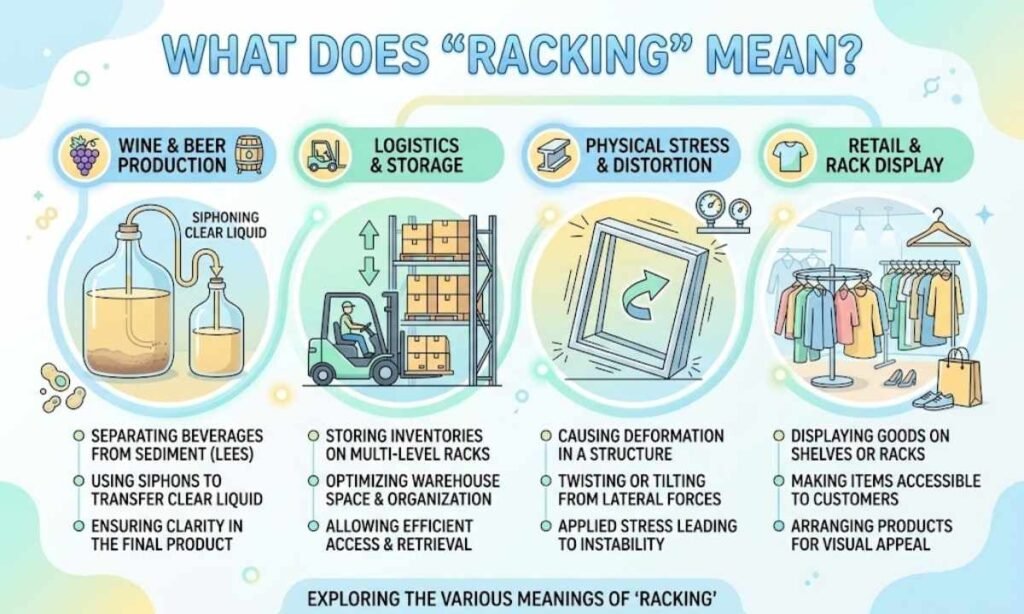
Racking comes from the verb rack, which started with a frame used to stretch things. That picture of stretching explains most of its modern meanings.
When to Use Racking for Mental Effort and Strain
Racking describes intense effort or pressure. Racking your brain means thinking very hard, and a racking cough describes a painful, shaking cough.
Racking Up Means Accumulating or Gaining
To rack up is to collect points, miles, fines or debt. Phrases such as racking up a bill or racking up wins always use this spelling.
Racking for Physical or Rack-Related Uses
Racking also covers literal racks. Winemakers rack wine into a clean barrel, players rack pool balls and technicians rack servers in a data center cabinet. In all of these cases, wracking would be wrong.
What Does “Wracking” Mean?
Wrack is generally linked to wreck and wreckage. It points to destruction, damage and the debris left behind. The same word also names the seaweed that washes up on a beach.
Wracking and Wracked for Destruction or Severe Damage
Wracked can describe something badly damaged, such as a region wracked by war or a town wracked by floods.
Wracked With Grief, Pain, or Guilt
People write wracked with guilt or wracked with sobs to show heavy suffering. Here the meaning of torment overlaps with rack, so both forms are common.
Why “Wrack and Ruin” Still Uses Wrack
This fixed phrase means complete destruction, and the traditional form keeps the older word. Rack and ruin also appears in print, but wrack and ruin is the version most readers expect.
Racking My Brain or Wracking My Brain?
Racking my brain is the form to use.
Why “Racking My Brain” Is the Preferred Form
The expression paints a picture of your mind being stretched to its limit, just like something placed on a rack. Most usage guides recommend racking.
Is “Wracking My Brain” Technically Wrong?
Not strictly. Some dictionaries record wrack as a variant spelling, so you may see it in print. It still looks less standard, and editors often change it to racking.
Racking Your Brain vs. Racking Your Brains
Both appear in real writing. Racking my brain is more common in everyday American writing, while racking my brains is often seen in British usage.
Nerve-Racking or Nerve-Wracking?
This adjective describes something that strains your nerves, such as a job interview or a driving test.
Which Spelling Is Preferred in American English?
Dictionaries usually list nerve-racking first, and most American editors choose it.
Is “Nerve-Wracking” Also Correct?
Yes. Cambridge and Oxford both list nerve-wracking as an alternative, so it is not an error. Choose one spelling and keep it consistent throughout your article.
Why “Nerve-Wrecking” Is Usually Not the Standard Phrase
Nerve-wrecking sounds logical because wreck means to ruin, but it is usually treated as a mistake. The accepted forms are nerve-racking and nerve-wracking.
Racked or Wracked With Pain, Grief, or Guilt?
Both spellings appear before these emotional nouns.
When “Racked With” Is the Better Choice
Pick racked with when a feeling stretches or tortures a person, as in racked with doubt or racked with pain. It is the form most writers and readers expect.
When “Wracked With” Fits the Meaning
Wracked with works when you want to suggest devastation, such as a family wracked with grief after a sudden loss.
Why Both Forms Appear in Real Writing
The meanings overlap and the words sound the same, so authors and publishers use both. Neither is a serious error here, but consistency matters.
How to Choose Between Rack and Wrack
Use “Rack” for Strain, Thought, and Accumulation
Choose rack for brains, nerves, points, costs, shelves and equipment.
Use “Wrack” for Ruin, Destruction, and Devastation
Choose wrack for wrack and ruin, wreckage and places or people left badly damaged.
A Simple Memory Trick for Remembering the Difference
Link the W in wrack to the W in wreck. If the sentence is about ruin, use wrack. For everything else, use rack.
Common Wracking and Racking Mistakes
Wracking Up vs. Racking Up
Wracking up is incorrect. You rack up points, miles and bills, as in racking up late fees or racking up views.
Wracking My Brain vs. Racking My Brain
Use racking my brain in formal writing, resumes and published articles. Wracking my brain may pass in a casual text, but it can look careless.
Mixing Racking, Wracking, and Wrecking
Wrecking means destroying, as in a wrecking ball. It does not belong in phrases such as racking my brain or racking up costs.
Why Are Wracking and Racking So Easy to Confuse?
They Sound the Same
The W is silent, so both words are pronounced the same way.
Their Meanings Overlap in Some Expressions
Torment, strain and suffering fit both words, so racked with pain and wracked with pain feel equally natural to many readers.
How Their Historical Origins Differ
Rack is generally traced to an old word for a framework or stretching device. Wrack is linked to wreck and wreckage. Over time, writers blended the two.
Wracking vs. Racking in American and British English
There is no strict regional rule.
Preferred Usage in American English
American writers and editors lean toward racking in nerve-racking and racking my brain. Wracking exists, but it is the less expected choice.
Why You May Still See “Wracking” in Published English
Variant spellings in dictionaries, older literary writing and different editorial style choices keep wracking alive in books and articles on both sides of the Atlantic.
Examples of Racking and Wracking in Sentences
Examples With Racking
- I spent an hour racking my brain for her name.
- He is racking up frequent flyer miles every month.
- The speech was nerve-racking, but it went well.
Examples With Wracking or Wracked
- The coast was wracked by storms all winter.
- She sat wracked with guilt after the argument.
- The old mill fell into wrack and ruin.
Correct and Incorrect Sentence Pairs
| Correct | Incorrect or Less Standard |
| She is racking up points. | She is wracking up points. |
| I am racking my brain. | I am wracking my brain. |
| The test was nerve-racking. | The test was nerve-wrecking. |
| He was racked with guilt. | He was wrecked with guilt. |
Frequently Asked Questions
Is it racking my brain or wracking my brain?
Racking my brain is the preferred and most widely accepted form. Wracking my brain appears as a variant but looks less standard.
Is wracking my brain grammatically correct?
It is not a grammar error, only a spelling variant. Most editors still prefer racking my brain.
Is it nerve-racking or nerve-wracking?
Both are accepted, but nerve-racking is usually preferred. Pick one and use it consistently.
Is racking up or wracking up correct?
Racking up is correct. Wracking up is a common spelling mistake.
What does wracking mean?
Wracking relates to wreck, ruin and severe damage, as in wrack and ruin. It also appears in phrases like wracked with pain or grief.
What does racking mean?
Racking means straining, stretching or accumulating, and it also covers physical racks. Common examples are racking my brain and racking up points.
Are racking and wracking pronounced the same?
Yes, both sound the same because the W in wracking is silent. That is why spelling mistakes are so common.
Conclusion
Choose racking for thinking, strain, nerves, points and physical racks. Keep wrack for wreckage and the fixed phrase wrack and ruin, and treat nerve-wracking and wracked with as accepted variants.
Pick one form, stay consistent and your writing will read clean and professional.