
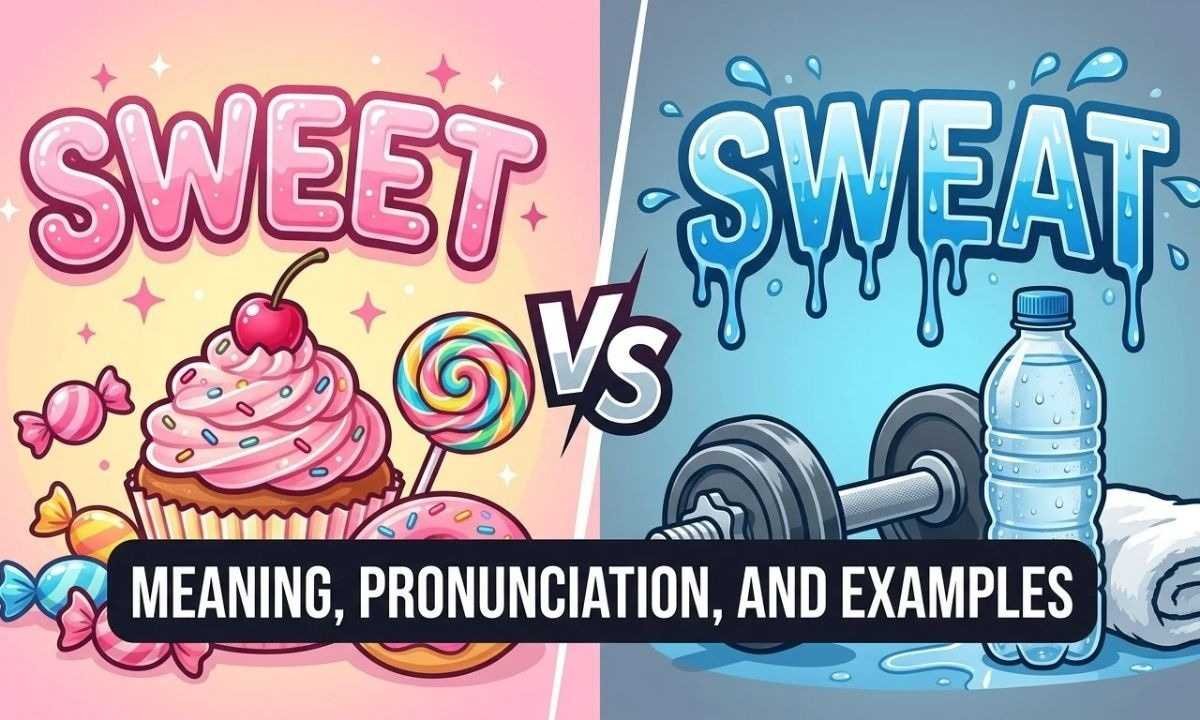
Sweet vs sweat comes down to taste and body. Sweet is mainly an adjective for sugary flavors and pleasant, kind things. Sweat is the salty moisture your skin produces, and also a verb meaning to perspire or work very hard. Mixing them up changes the meaning of a sentence completely.
The two words look alike and share most of their letters, yet they sound different: sweet rhymes with meet, and sweat rhymes with bet. This guide explains each meaning, pronunciation, grammar form, and idiom, so you can choose the right word in writing and speech. Short examples and a practice quiz are included.
Quick Answer: Sweet vs Sweat Meaning
- Sweet describes a sugary taste or something pleasant, kind, or charming. Example: “The tea was too sweet for me.”
- Sweat is the liquid released by your skin, or the act of releasing it. Example: “He began to sweat during the long climb.”
If the sentence is about flavor, kindness, or charm, use sweet. If it is about body moisture, heat, effort, or worry, use sweat.
Sweet Meaning
Dictionaries list several senses of sweet. The main ones are:
- Taste: having the flavor of sugar or honey. “The mango was ripe and sweet.”
- Smell or sound: pleasing to the senses. “The garden smelled sweet after the rain.”
- Personality or behavior: kind, gentle, or thoughtful. “It was sweet of you to call.”
- Food (noun): a sugary treat. In British English, “sweets” means what Americans call candy, and “a sweet” can mean a dessert.
- Informal approval: great or cool. “You got tickets? Sweet!”
The informal sense is common in casual speech, but it is not suitable for formal writing.
Sweat Meaning
Sweat has two main grammatical roles, noun and verb.
- Noun: the fluid released by sweat glands to cool the body. “Sweat ran down his face.”
- Verb (physical): to produce that fluid. “Runners sweat more in humid weather.”
- Verb (figurative): to work very hard, or to worry. “She sweated over the final report.”
- Noun (figurative): hard work or effort. “The project took a lot of blood, sweat, and tears.”
The related adjective is sweaty, and the noun is also used in compounds such as sweatshirt, sweatpants, and sweatband.
Why “Sweet” and “Sweat” Are Often Confused
The confusion has three common causes.
- Similar spelling: both words begin with “swe” and end in “t,” and only the vowel pair differs (ee versus ea).
- Misleading “ea” pattern: in many English words, “ea” sounds like “ee,” as in “beat” and “heat.” In sweat, it sounds like the short “e” in “bed,” as in “head” and “bread.”
- Fast typing and autocorrect: one swapped letter produces a real word, so spellcheck often misses the error.
Because both are real words, a mistake is easy to overlook while proofreading.
Understanding the Core Difference Between Sweet and Sweat
The simplest way to separate them is by what each word describes. Sweet usually points to a pleasant quality, while sweat points to a bodily process or effort. They are not interchangeable in any standard context.
Sweet – Meaning and Emotional Use
Sweet often carries warmth and approval. People use it for gestures, smiles, and personalities. “That was a sweet message” praises the person’s thoughtfulness, not a flavor. This emotional use is why sweet appears so often in compliments and greeting cards.
Sweat – Meaning and Physical Use
Sweat is grounded in the body and in physical effort. Even its figurative uses, such as worrying or struggling, come from the idea of strain. “Don’t sweat it” tells someone not to stress, as if the problem were not worth the effort.
Pronunciation Guide: Sweet vs Sweat
The two words differ only in the vowel, and that vowel is the whole difference.
- Sweet: /swiːt/. It has a long “ee” sound, like meet, feet, and treat.
- Sweat: /swɛt/. It has a short “e” sound, like bet, set, and wet.
Both have one syllable and both start with the same “sw” sound. For practice, say “sweet treat” and then “wet sweat” aloud, and hold the vowel slightly longer in sweet. Sweet is also a homophone of “suite,” the set of rooms or musical set, which is pronounced the same way. Sweet and sweat, however, are not homophones.
Grammar and Word Forms Compared
| Feature | Sweet | Sweat |
| Main parts of speech | Adjective, noun | Noun, verb |
| Related forms | sweeter, sweetest, sweetly, sweetness | sweats, sweating, sweated, sweaty |
| Plural noun | sweets (British: candy) | sweats (also means sweatpants, informal US) |
| Example | “The sauce is sweet.” | “I sweat a lot in summer.” |
For the past tense of the verb, sweated is the standard form. Some American dictionaries also record “sweat” as a past form, but it is less common, so sweated is the safer choice.
Usage in Everyday Contexts
Seeing both words in realistic sentences makes the difference easier to remember.
Using “Sweet” in Daily Life
- “These strawberries are very sweet this season.”
- “Thank you for the flowers. That was so sweet.”
- “I’d like something sweet after dinner.”
- “The baby has a sweet smile.”
Using “Sweat” in Daily Life
- “Wipe the sweat off your forehead before the interview.”
- “I always sweat when I speak in front of a crowd.”
- “The movers were sweating after carrying the sofa upstairs.”
- “He sweated over the exam questions.”
Easy Tips to Remember Sweet vs Sweat
- Look at the double letter. Sweet has two e’s, like the “ee” in feet. Think of sweet treats.
- Look for the “ea.” Sweat has “ea,” as in heat and head. Heat makes you sweat.
- Link to a word you know. Sweater and sweatshirt share the “ea” spelling and the short “e” sound, so they pair naturally with sweat.
- Test the sentence. If you can replace the word with “sugary” or “kind,” choose sweet. If you can replace it with “perspire” or “perspiration,” choose sweat.
Idioms and Common Expressions
Both words appear in many fixed expressions, and the idioms keep the same split between pleasant and effortful.
Idioms with “Sweet”
- Sweet tooth: a strong liking for sugary food. “My brother has a sweet tooth.”
- Sweet spot: the ideal point or balance. “We found the sweet spot for pricing.”
- Short and sweet: brief and pleasing. “Her speech was short and sweet.”
- Sweet talk: to flatter someone to persuade them. “He tried to sweet-talk the manager.”
- Home sweet home: a happy phrase about returning home.
- Sweeten the deal: to make an offer more attractive.
Idioms with “Sweat”
- No sweat: no problem. “Can you finish by noon? No sweat.”
- Don’t sweat it: do not worry about it.
- Break a sweat: to start perspiring from effort. Also used for any real effort.
- Sweat equity: work contributed instead of money.
- Sweat blood: to work extremely hard or worry intensely.
- Sweat it out: to endure a stressful wait.
- In a cold sweat: sweating from fear or anxiety.
Common Mistakes and Confusions
- Incorrect: The cake was too sweat.
Correct: The cake was too sweet.
Taste is described by sweet. - Incorrect: I always sweet when I run.
Correct: I always sweat when I run.
The verb meaning to perspire is sweat. - Incorrect: It was a sweat gesture.
Correct: It was a sweet gesture.
Kindness is described by sweet. - Incorrect: No sweet, I can help.
Correct: No sweat, I can help.
The idiom is “no sweat.” - Incorrect: She was wearing a sweet shirt to the gym.
Correct: She was wearing a sweatshirt to the gym.
The garment is a sweatshirt, which is one word.
Comparison Table: Sweet vs Sweat
| Point | Sweet | Sweat |
| Pronunciation | /swiːt/ (rhymes with meet) | /swɛt/ (rhymes with bet) |
| Main meaning | Sugary, pleasant, kind | Body moisture, to perspire, effort |
| Part of speech | Adjective, noun | Noun, verb |
| Typical context | Food, gestures, personality | Heat, exercise, stress |
| Example sentence | “That was a sweet surprise.” | “The heat made him sweat.” |
| Common mistake | Writing “sweat” for taste | Writing “sweet” for perspiration |
Linguistic Insight: Why Small Vowels Change Meaning
English has many minimal pairs, which are words that differ by only one sound. Sweet and sweat are one such pair, since the vowel alone changes the meaning. Historical dictionaries trace the two words to different Old English roots: sweet from Old English swēte, and sweat from Old English swāt. Their similar modern spelling is partly a historical coincidence, which is why the resemblance is not a reliable guide to meaning.
The spelling “ea” is also unstable in English. It can sound like “ee” in “leaf,” like “e” in “head,” or like “ay” in “steak.” Learning each word with its sound, not just its spelling, prevents most errors.
Expert Opinion: Choosing the Right Word Confidently
A reliable habit among careful writers is to decide by meaning first and spelling second. Ask what the sentence is about: flavor or kindness points to sweet, and perspiration or effort points to sweat. Then read the sentence aloud. If the vowel you hear does not match the word you typed, correct it.
Also keep register in mind. Using “Sweet!” as an exclamation of approval is fine in conversation, but formal writing should use words such as “excellent” or “pleasing.” Likewise, “sweat” for worry suits informal speech better than formal reports.
Practice Section: Choose Sweet or Sweat
Choose the correct word for each sentence.
- The honey was very ______.
- Hard workouts make me ______.
- Thank you for the card. That was ______ of you.
- He wiped the ______ from his neck.
- Don’t ______ the small stuff.
- I have a ______ tooth for chocolate.
- The mechanic was covered in oil and ______.
- She gave a ______ smile to the child.
- “Can you cover my shift?” “No ______.”
- We tried to find the ______ spot between price and quality.
Practice Answers
- sweet
- sweat
- sweet
- sweat
- sweat
- sweet
- sweat
- sweet
- sweat
- sweet
Frequently Asked Questions
What is the main difference between sweet and sweat?
Sweet describes sugary taste or something pleasant and kind. Sweat is the fluid released by the skin, or the verb meaning to perspire or to work hard.
Are sweet and sweat homophones?
No. Sweet is /swiːt/ and sweat is /swɛt/, so they sound different. Sweet does share its pronunciation with “suite.”
How do you pronounce sweet and sweat?
Say sweet with a long “ee” like meet. Say sweat with a short “e” like bet. Both words have one syllable.
Can sweat be both a noun and a verb?
Yes. As a noun, it names the fluid (“sweat on his brow”). As a verb, it means to produce that fluid or to work or worry hard (“I sweat in summer”).
What is the past tense of sweat?
Sweated is the standard past tense and past participle. Some American dictionaries also list “sweat” as a past form, but it is less common.
Does sweet mean anything besides taste?
Yes. It can describe kindness, a pleasant smell or sound, or a treat such as candy. Informally, “sweet” can also mean “great.”
Is it “no sweat” or “no sweet”?
The correct idiom is “no sweat,” meaning “no problem.” “No sweet” is a spelling error.
Conclusion
Sweet and sweat differ in both sound and meaning. Sweet (/swiːt/) describes sugary taste or pleasant, kind qualities. Sweat (/swɛt/) is body moisture, the act of perspiring, or figurative hard work and worry. When in doubt, ask whether the sentence is about flavor or kindness, or about heat and effort, and read it aloud to check the vowel.