
Few spelling questions trip up writers as often as this one. You type a sentence about improving a process, and suddenly you doubt whether the word ends in a z or an s. Spell checkers flag one version, your colleague prefers the other, and both look right.
Here is the good news. Both spellings are correct, and the choice depends on your audience. This guide explains the difference, the rules behind it, and how to stay consistent in emails, reports, and web content.
Optimize or Optimise: What Is the Correct Spelling?
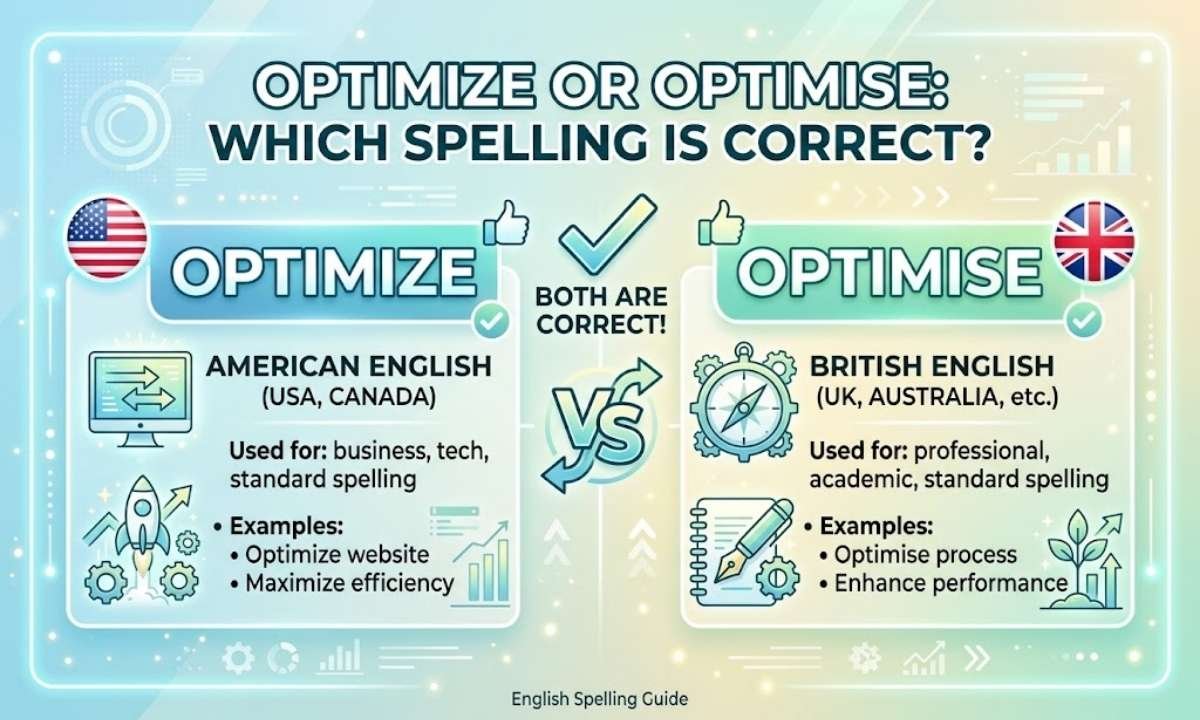
Both are correct. “Optimize” is the standard American spelling, while “optimise” is the common British spelling. The meaning, pronunciation, and grammar are identical. Use “optimize” for a US audience and “optimise” for a UK audience, then keep your choice consistent throughout the piece.
What Do Optimize and Optimise Mean?
Both words mean to make something as effective, efficient, or useful as possible. You can optimize a website, a workout plan, a budget, or a delivery route. Only the spelling changes, never the definition.
Optimize vs Optimise: What Is the Difference?
The difference is regional spelling convention. Nothing else separates the two words.
| Feature | American English | British English |
| Verb | optimize | optimise |
| Past tense | optimized | optimised |
| Present participle | optimizing | optimising |
| Noun | optimization | optimisation |
| Meaning | Same | Same |
| Main usage | United States | United Kingdom |
Optimize or Optimise in American English
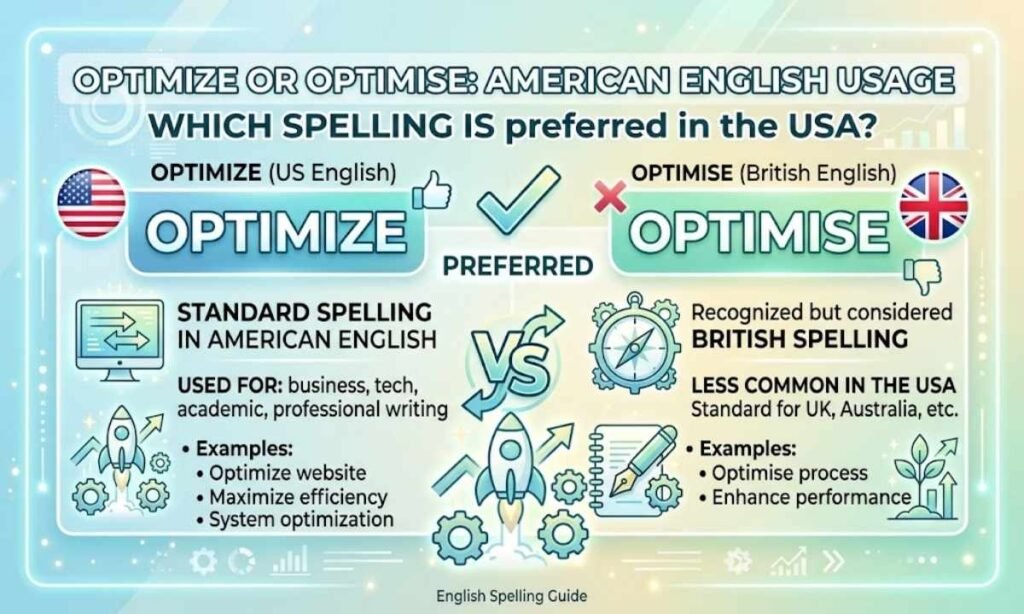
American English uses the z spelling for nearly all words of this type. Major US dictionaries, style guides, and newsrooms list “optimize” as the standard form.
Should You Use Optimize in the USA?
Yes. If your readers are in the United States, “optimize” is the safe and expected choice. Using “optimise” may look like a typo to many American readers and can weaken trust in your writing.
Optimize Examples in American English
• Our team will optimize the checkout page this quarter.
• She optimized her morning routine to save thirty minutes.
• Optimizing images can speed up page loading.
• The optimization process took two weeks.
Optimise or Optimize in British English
British English commonly uses “optimise,” and you will see it in UK newspapers, business reports, and government websites. Many British publishers follow the ise pattern for verbs such as organise, recognise, and realise.
Is the Ize Spelling Also Used in Britain?
Yes, and this is the detail many writers miss. Oxford University Press and several academic publishers prefer the ize ending, even for British content. This style is often called Oxford spelling. So “optimize” is not strictly American only, although “optimise” remains the everyday UK norm.
Optimise Examples in British English
• We need to optimise our delivery schedule before winter.
• The council optimised bus routes across the city.
• Optimising energy use will lower your bills.
• Her optimisation plan impressed the board.
Optimization or Optimisation: Which Noun Is Correct?
The same rule applies to the noun. “Optimization” is American, and “optimisation” is British. Both refer to the act of making something work as well as possible.
Full Word Family for US and UK English
Here is the full word family so you can match every form to your audience:
• US: optimize, optimized, optimizing, optimization, optimizer
• UK: optimise, optimised, optimising, optimisation, optimiser
Pick one column and stick with it. Mixing forms, such as “optimize” in one paragraph and “optimisation” in the next, makes an article look careless.
Why Are Optimize and Optimise Spelled Differently?
Where Does the Word Come From?
The word comes from “optimum,” a Latin term meaning the best. English writers added a verb ending to create “optimize” in the nineteenth century.
How Did the Ize and Ise Split Happen?
That ending traces back to the Greek suffix izein, which passed into Latin and then into English. French later developed the iser form, and many British writers began favoring ise under that influence. American spelling reform, led by Noah Webster in the early 1800s, promoted the simpler ize pattern and helped make it standard in the United States.
Other Words That Follow the Same Pattern
Once you understand this rule, you can apply it to hundreds of other words. The split works the same way for many verbs and their related nouns.
| American English | British English |
| organize | organise |
| recognize | recognise |
| realize | realise |
| summarize | summarise |
| customize | customise |
| prioritize | prioritise |
A few words end in ise everywhere, including advertise, exercise, revise, and surprise. These are not part of the regional split, so never change them to ize.
Canadian, Australian, and Other English Varieties
English is not just American and British. Canadian English generally follows the ize pattern, so Canadian writers usually choose “optimize.” Australian and New Zealand English lean toward ise, so “optimise” is standard there. South African and Indian English often follow British conventions, although usage can vary by publisher.
If your audience is global, decide on one variety and state it in your style guide. Consistency matters more than which option you pick.
Optimize or Optimise in Tech and Programming
Technical writers meet this word constantly. Software documentation, code comments, and developer tools often use “optimize” because much of the industry standardized on American English. You will see terms like “query optimizer,” “compiler optimization,” and “image optimizer” in most documentation.
Even so, British companies frequently publish “optimise” in their own guides. When you edit technical content, follow the spelling used by the product or brand you are writing for.
Optimize or Optimise in Business, Academic, and Email Writing
Context changes the best choice more than personal taste does.
• Email: match the spelling used by your recipient’s country.
• Business writing: follow your company style guide.
• Academic writing: follow the journal or university guidelines, which may allow Oxford spelling.
• SEO writing: use the spelling your target readers type into search.
Easy Memory Tricks to Choose the Right Spelling
A few simple habits remove the guesswork:
1. Think “Z for the USA.” Americans say the letter as “zee,” which makes the link easy to remember.
2. Ask who will read the piece before you start typing.
3. Set your editor to the correct language variant, such as English (US) or English (UK).
4. Search the finished draft for both spellings and make them match.
Style Guide and Spell Checker Settings
Most word processors let you choose a proofing language. Selecting English (United States) will flag “optimise,” while English (United Kingdom) will flag “optimize” in many cases. Some UK settings accept both forms, depending on the software.
For teams, a short style guide helps. Note your chosen spelling, list common word pairs, and decide how to handle quotations and brand names. This one page saves hours of editing later.
Common Mistakes With Optimize and Optimise
• Mixing both spellings in the same article.
• Believing that “optimise” is simply wrong.
• Assuming that “optimize” can never appear in British writing.
• Ignoring the audience and using whichever spelling feels natural.
• Changing spelling inside a direct quotation, which alters the original text.
Does Spelling Matter for SEO?
Search engines are good at understanding spelling variants, and Google treats “optimize” and “optimise” as closely related terms. The spelling alone will not boost or hurt rankings. What matters is matching your audience, keeping the language consistent, and answering the search intent clearly.
Quick Comparison Table
| Question | Practical Answer |
| Are both spellings correct? | Yes |
| US spelling? | Optimize |
| UK spelling? | Optimise |
| Different meaning? | No |
| Different pronunciation? | No |
| US noun? | Optimization |
| UK noun? | Optimisation |
If you run a US website, use “optimize” in headings, titles, and body text. For a UK website, use “optimise.” Mentioning the other form once, as this article does, can help readers who search with either spelling.
Frequently Asked Questions
Is optimize or optimise correct?
Both are correct. Optimize is the US spelling, and optimise is the common UK spelling.
Is optimize American or British English?
Optimize is the standard American form. It is also accepted in Oxford style British writing.
Is optimise British English?
Yes, optimise is the typical British spelling. You will see it across UK media and business content.
Can I use optimize in British English?
Yes, some British publishers and universities prefer the ize ending. Just stay consistent within the document.
What is the difference between optimize and optimise?
The only difference is regional spelling. The meaning and pronunciation stay exactly the same.
Is optimization or optimisation correct?
Both are correct. Optimization is American, and optimisation is British.
Can you use both optimize and optimise in one article?
You should not. Choose one spelling for your audience and apply it everywhere, except inside direct quotes.
Conclusion
For a US audience, use “optimize.” For a UK audience, “optimise” is the usual choice, though Oxford style accepts the z form. The meaning never changes, so focus on your readers and keep your spelling consistent from the first line to the last.