
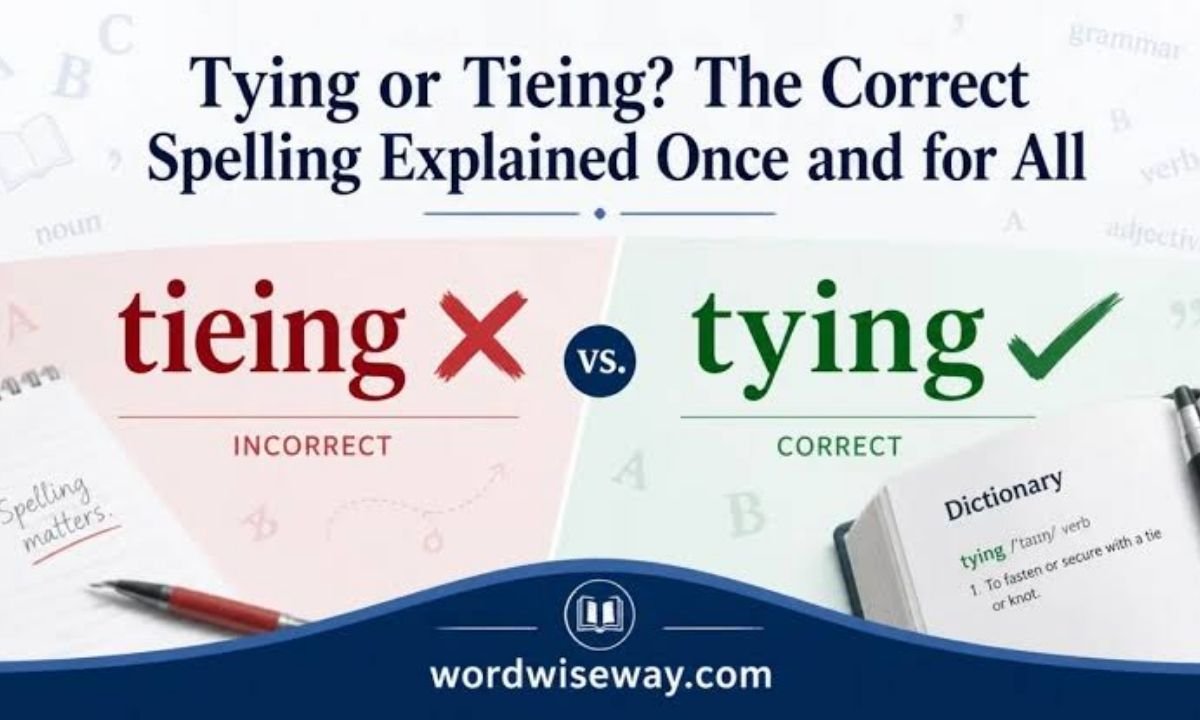
People type this word every day and still pause before sending it. A shoelace gets tied, a game ends in a tie, and suddenly the keyboard shows two possible spellings staring back at the screen.
The short answer is that Tying or Tieing? Tying is the correct and widely accepted spelling, while tieing is treated as a rare variant that most style guides avoid. This guide walks through the spelling rule, real examples, common mix-ups, and a memory trick so you never second-guess it again.
What Does Tying Mean?
Tying is the present participle and gerund form of the verb tie. It describes the ongoing action of fastening, securing, connecting, or binding something, and it also appears when two scores or results are equal.
- Fastening a shoelace, ribbon, or knot
- Connecting or linking two ideas, systems, or objects
- Equalizing a score during a game or contest
- Restraining or limiting someone’s freedom of choice
Why Tie Becomes Tying Instead of Tieing?
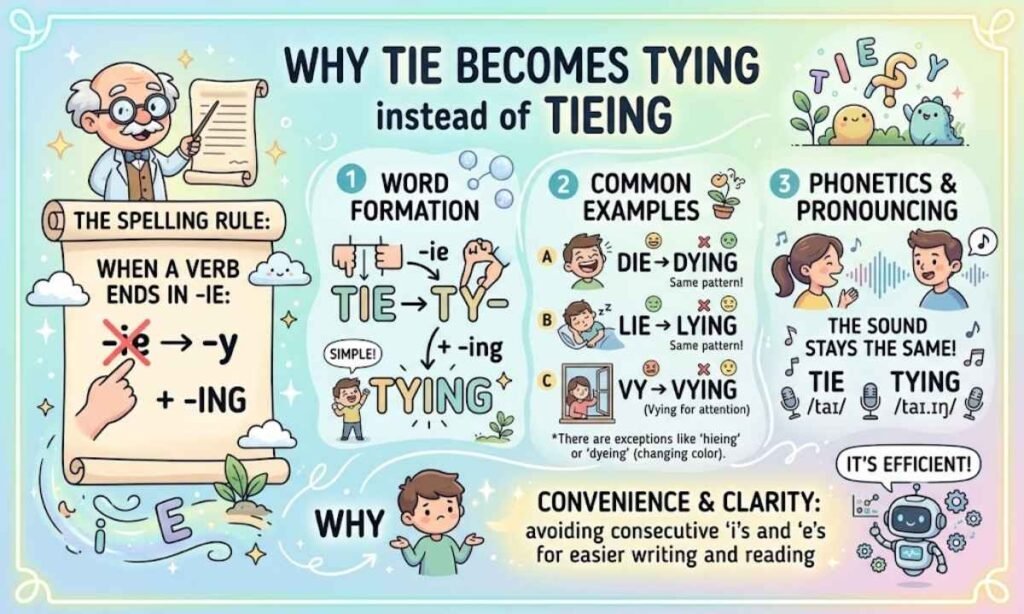
English has a reliable spelling rule for verbs that end in ie. When adding ing, the ie changes to y before the suffix is attached. That single adjustment is the entire reason tying looks the way it does.
| Base Word | Rule Applied | Result |
| tie | ie changes to y, then add ing | tying |
| die | ie changes to y, then add ing | dying |
| lie | ie changes to y, then add ing | lying |
Tying vs Tieing Which One Should You Use
Tying is the version you will find in dictionaries, textbooks, news writing, and professional documents. Tieing shows up occasionally in casual or older writing, but style guides and editors consistently correct it back to tying.
| Spelling | Status | Example |
| tying | Standard and preferred | She is tying her shoes before the race. |
| tieing | Rare variant, generally avoided | She is tieing her shoes before the race. |
Words That Follow the Same Pattern as Tying
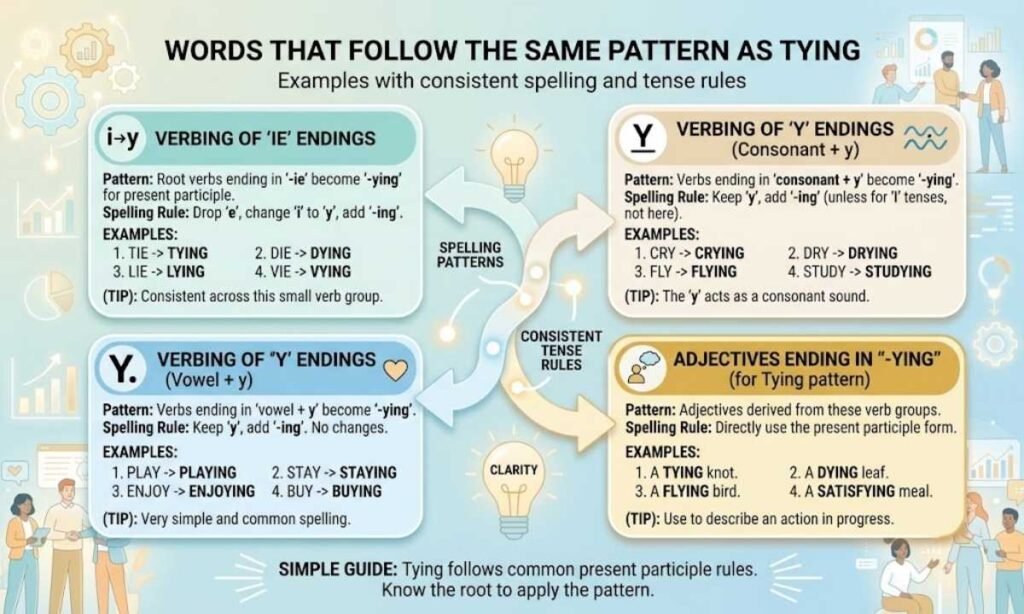
Once this rule clicks for one word, it applies smoothly to a small family of similar verbs.
- tie becomes tying
- die becomes dying
- lie becomes lying
- vie becomes vying
Notice that each base word ends in ie, and each one swaps that ending for a y before ing joins the word.
Common Examples of Tying in a Sentence
- Tying your shoes properly prevents you from tripping during a run.
- He spent ten minutes tying a knot that would hold under pressure.
- She is tying her hair back before starting the workout.
- They were tying ribbons onto the gift boxes for the event.
- The dog leash needs tying to the post before you walk away.
- A late goal ended up tying the match in the final minute.
Tying vs Tie vs Tied vs Ties
These four forms cover nearly every situation you will run into, and mixing them up is one of the most common grammar slips in everyday writing.
| Form | Grammar Role | Example |
| tie | Base verb | I tie my shoes every morning. |
| ties | Third person present | She ties her shoes quickly. |
| tied | Past tense | He tied the rope to the fence. |
| tying | Present participle or gerund | They are tying the rope right now. |
Common Mistakes People Make With Tying
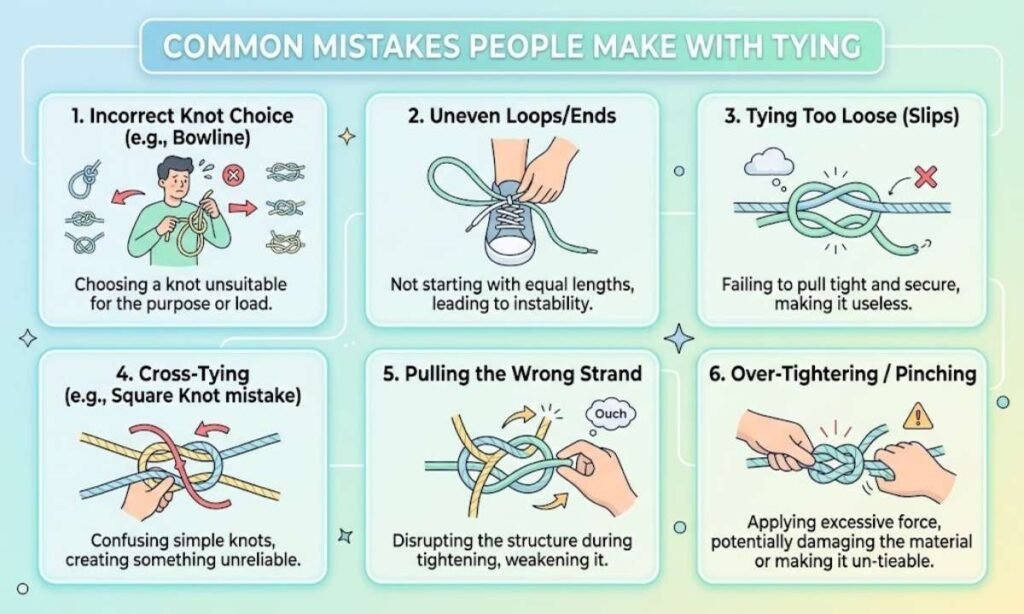
Most writers who type tieing are not careless, they are simply applying a different rule by habit.
- Assuming ing always attaches directly to the base word without changes
- Confusing tie with words like agree or free, which do not follow the same pattern
- Relying on autocomplete suggestions that sometimes miss the correction
- Copying the spelling from an old document without checking it
How to Use Tying in Different Types of Writing?
Tying fits naturally into almost any writing style, formal or casual.
- School writing: Explaining a science experiment involving tying materials together.
- Professional writing: Describing a project as tying multiple departments into one workflow.
- Casual messages: Texting a friend that you are tying your shoes and will be out in a minute.
- Sports reporting: Covering a play that ended with the visiting team tying the score.
Is Tying Used the Same Way in American and British English
Tying is the accepted spelling in both American and British English. There is no regional split for this word the way there is for colour and color, so writers on either side of the Atlantic can use it without adjustment.
Is Tieing Ever Considered a Real Word
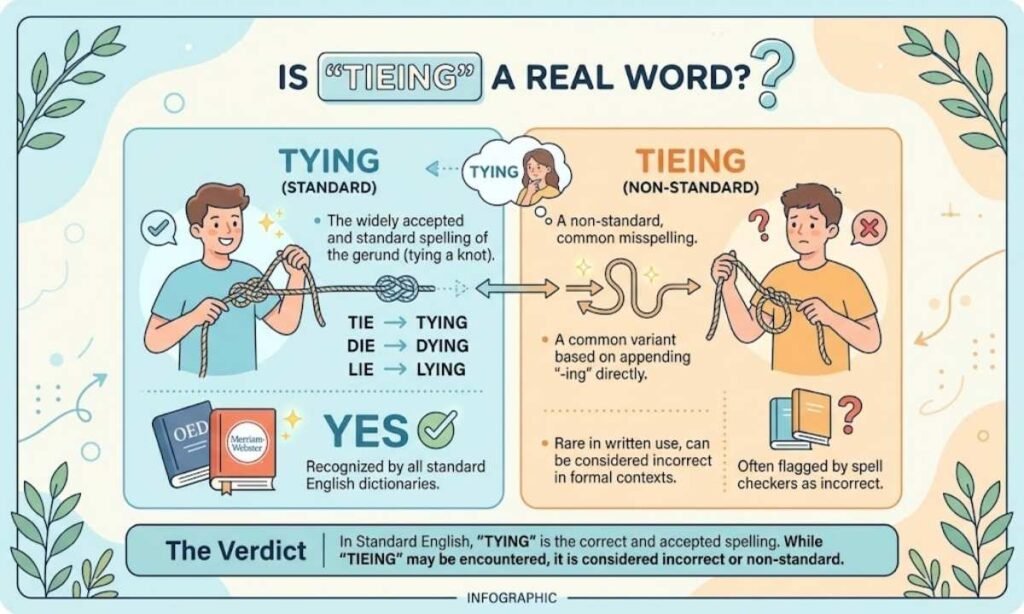
Merriam Webster lists tieing as a recorded variant of tying, which means it has appeared in real usage over time rather than being a pure typo. Even so, it is not the form taught in schools or recommended in professional style guides, so tying remains the safer and more polished choice.
A Simple Trick to Remember the Spelling
Keep this short formula in mind whenever you are unsure:
ie turns into y before ing joins the word.
Picture the pattern with familiar examples: tie to tying, die to dying, lie to lying. Once you can recall one of these, the others follow the exact same shift.
Tying in Common Idioms and Phrases
English has built several everyday expressions around this word, and none of them use the tieing spelling.
- Tying the knot, meaning getting married
- Tying up loose ends, meaning finishing small remaining tasks
- Tying someone’s hands, meaning preventing them from taking action
- Tying the score, meaning making a game even
How Autocorrect and Spell Checkers Treat Tieing?
Most modern word processors and mobile keyboards flag tieing with a red underline and suggest tying as the fix. This is a useful, quick signal that the standard spelling is expected, and it is one reason tieing rarely survives into published content.
Tying in Business and Legal Writing
In business and antitrust law, a tying arrangement refers to a seller requiring a buyer to purchase one product only if they also purchase a separate product. This specific legal term always uses the tying spelling, and it shows how deeply the correct form is embedded even in formal, technical contexts.
Tying in Sports and Competition Language
Commentators and sports writers rely on tying constantly, from a tying run in baseball to a tying goal in soccer. This high frequency, high visibility usage is part of why the correct spelling stays so consistent across news outlets and broadcasts.
Quick Spelling Checklist Before You Publish
- Search the document for the word tieing and replace it with tying
- Confirm the sentence describes an ongoing action, not a completed one
- Check that autocorrect has not silently reverted a correction
- Read the sentence aloud to make sure tying still fits the context
Frequently Asked Questions
Is it tying or tieing?
Tying is the correct and standard spelling used in modern English writing.
How do you spell tying?
It is spelled t y i n g, formed by changing the ie in tie to y before adding ing.
Why is tying spelled with a y?
English grammar rules require ie to shift to y whenever ing is added to a word.
Is tieing ever correct?
It is recorded as a rare variant in some dictionaries, but it is not the preferred or taught form.
What is the meaning of tying?
It means fastening, securing, or connecting something, or making a score equal in a contest.
What is the past tense of tie?
The past tense is tied, as in he tied the rope to the post.
What are other words like tying?
Dying, lying, and vying follow the exact same ie to y spelling pattern.
Conclusion
Tying is the spelling worth remembering, and the rule behind it is easy to apply once you see the pattern in tie, die, lie, and vie. Keep the simple formula in mind, run a quick check before you publish, and tieing will stop showing up in your writing altogether.