
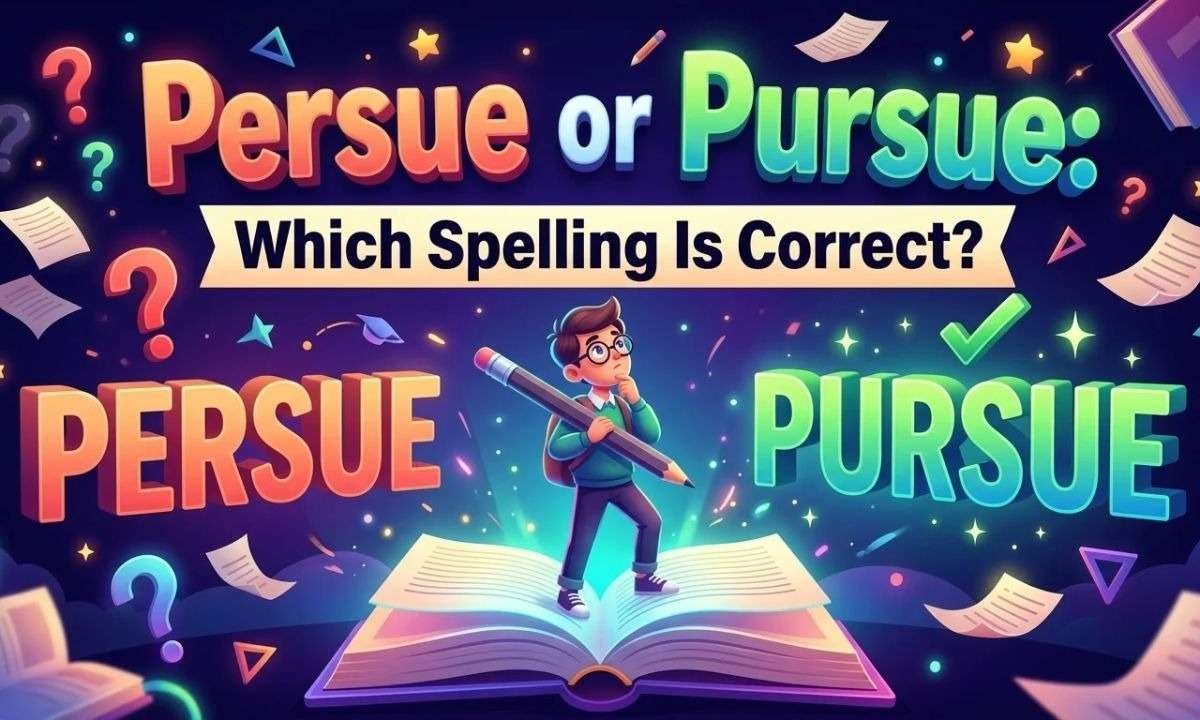
The correct spelling is pursue, not persue. Pursue is a verb that means to follow, chase, or work toward something, such as a goal, a career, or a person. The form persue is not standard in modern dictionaries, so it counts as a spelling error. Getting it right matters in resumes, essays, and professional emails.
The mix-up is common because the word pursue sounds as if it begins with “per,” like persuade. This guide explains the meaning, pronunciation, and use of pursue, shows how to avoid persue and persuing, and gives simple, practical memory tricks so you can spell it correctly every time.
Persuing or Pursuing: What’s the Difference?
Only one of these is a real word. Pursuing is the standard -ing form of pursue, while persuing is a misspelling.
Pursuing
Pursuing is the present participle of pursue. It describes an action in progress or names an activity.
- She is pursuing a degree in nursing.
- Pursuing a hobby can lower stress.
Persuing
Persuing is not a standard English word. It appears when writers copy the wrong spelling of persue and add -ing.
- Incorrect: He is persuing a new hobby.
- Correct: He is pursuing a new hobby.
Key Difference (Persue or Pursue)
| Form | Status | Meaning | Example |
| pursue | Correct verb | To follow or work toward | I want to pursue photography. |
| pursuing | Correct participle | Following or working toward | She is pursuing a promotion. |
| persue | Misspelling | None | Not used in standard English |
| persuing | Misspelling | None | Not used in standard English |
The Correct Spelling: “Pursue”
Pursue is spelled p-u-r-s-u-e. It has six letters, and the letter u appears twice: once after the p and once before the final e.
Examples
- Many students pursue a master’s degree after gaining work experience.
- The dog pursued the ball across the yard.
- If you pursue this idea, test it on a small scale first.
Why “Persue” Is Always Incorrect
Persue has no separate meaning. Some sources describe it as an old variant spelling, but modern dictionaries and style guides do not accept it, so treat it as an error in current writing.
The confusion comes from sound. English speakers hear “per-SOO” and write what they hear, and words like perform and person reinforce the “per” pattern. Spelling follows word history, not sound alone.
Pursue vs Persuade: Do Not Mix Them Up
Pursue and persuade look alike, but they are different verbs with different jobs. The “per” in persuade is the source of the typo persue.
| Word | Meaning | Example |
| pursue | To chase or work toward | She will pursue a degree in design. |
| persuade | To convince someone | She will persuade the board to approve it. |
If the sentence is about convincing, use persuade. If it is about chasing or working toward a goal, use pursue.
Meaning and Usage of “Pursue” in American English
Pursue has four main senses:
- To chase or follow someone or something in order to catch it.
- To work toward a goal, such as a degree or a career.
- To engage in an activity, such as a hobby or a line of research.
- To continue with something, such as a claim or an argument.
Merriam-Webster notes that pursue suggests a continuing effort to overtake, reach, or attain. That sense of sustained effort separates it from simple words like follow. American and British English share the same meaning and spelling. Only the pronunciation differs slightly.
Pursue Pronunciation: How to Say It Correctly
In American English, pursue is usually pronounced “per-SOO.” Many British speakers say “puh-SYOO,” with a small “y” sound before the final vowel. Merriam-Webster also lists a variant with the “y” sound, so both versions are accepted. The stress falls on the second syllable in both.
Spelling does not change with accent. Whether you say “per-SOO” or “puh-SYOO,” you still write p-u-r-s-u-e. Major dictionaries, including Oxford and Merriam-Webster, use pursue as the headword. Use the audio buttons on their pages to hear each version.
Synonyms of “Pursue” and Proper Context
Synonyms are not always interchangeable. Choose the one that fits the situation.
- Chase: Informal and physical. “The kids chased the ice cream truck.”
- Follow: Neutral and general. “Follow the path to the lake.”
- Seek: Formal and goal-focused. “She seeks a role in public policy.”
- Go after: Informal and determined. “He went after the job he wanted.”
- Strive for: Formal and effortful. “The team strives for accuracy.”
- Prosecute: Legal. Used for carrying a case through court.
- Hunt: Physical or figurative. “They hunted for a better offer.”
Use pursue when you want a balanced, neutral tone that suggests steady effort.
Daily English Example Sentences
- I plan to pursue a certificate in graphic design.
- The cat pursued a moth around the living room.
- Why not pursue that idea during the weekend?
- Rina pursued her dream of opening a bakery.
- They are pursuing a better work-life balance.
- He pursued the matter with his landlord until it was fixed.
Contextual Applications of “Pursue”
The meaning stays the same across fields, but the surrounding words change.
Legal Context
In law, pursue often means to continue a formal action. A person may pursue a claim, pursue damages, or pursue legal action. Police use the related noun in the phrase “hot pursuit.”
- The company decided to pursue legal action over the unpaid invoice.
Academic and Research Context
Students pursue degrees, and researchers pursue questions or lines of inquiry.
- She will pursue a doctorate in linguistics next year.
- The team pursued a new hypothesis after the first results.
Career and Professional Context
In the workplace, pursue describes active steps toward a role, goal, or opportunity.
- He is pursuing a managerial position at his firm.
- Our department will pursue new clients this quarter.
Personal Goals and Life Context
In everyday life, pursue links to passions, habits, and long-term plans.
- Many adults pursue fitness goals in the new year.
- She finally pursued her love of painting.
Relationships and Romantic Context
In a relationship, to pursue someone means to show active interest in them, for example by asking them out, staying in touch, or making plans. The phrase “pursue a relationship” works the same way.
- He decided to pursue her after months of friendship.
- They chose to pursue a long-distance relationship.
Tone matters here. Pursue can sound warm and confident, but it can also suggest persistence that the other person may not want. Respectful pursuit means listening to the response and stopping if the interest is not shared. Gentler alternatives include “ask out” and “get to know.”
Literal vs Figurative Use of “Pursue”
Literal use means a real, physical chase. Figurative use means working toward something that cannot be physically caught.
| Type | Meaning | Example |
| Literal | Physically following to catch | The lifeguard pursued the swimmer in trouble. |
| Figurative | Working toward a goal or interest | He pursued a career in teaching. |
Most modern uses are figurative. Context makes the sense clear, so you rarely need extra explanation.
How to Remember the Correct Spelling
These tricks help fix the spelling in memory:
- Think of pur-sue: the word ends in “sue,” as in “to sue someone.”
- Remember that pursue has two U’s and ends in -ue.
- Link it to pursuit, which also begins with “pur.”
- Say it slowly as “pur-sue” while writing it a few times.
Mini Quiz
Choose the correct spelling or answer.
- My cousin hopes to (persue / pursue) a pilot’s license.
- The committee is (pursuing / persuing) funding for the project.
- How many U’s are in pursue?
Answers: 1. pursue. 2. pursuing. 3. two.
Etymology and Historical Roots of “Pursue”
According to Merriam-Webster, pursue comes from Middle English pursuen, from early French, which came from Latin prosequi, built from pro- (forward) and sequi (to follow). It is related to the word sequel, which also comes from the idea of following. The same dictionary dates the earliest known use of pursue to the 14th century.
The Latin root explains the “su” sound inside the word, which is similar to “sequel” and “sequence.” It has nothing to do with the “per” in persuade.
“Pursue” in Literature and Famous Quotes
Classic Literature References
Pursue appears in long-standing public domain texts. Psalm 34:14 in the King James Bible says: “Seek peace, and pursue it.” The United States Declaration of Independence names “the pursuit of Happiness” among its unalienable rights, which uses the noun form of the same word.
Inspirational Quotes
To avoid misattribution, here are original motivational lines using the word:
- Pursue progress, not perfection.
- Pursue the work you would do without applause.
- Pursue one goal at a time, and finish it.
Common Mistakes and How to Avoid Them
Frequent Wrong Spellings
- Incorrect: persued. Correct: pursued. The past tense keeps the u after the p.
- Incorrect: persuit. Correct: pursuit. The noun follows the same pattern as the verb.
- Incorrect: pursueing. Correct: pursuing. Drop the final e before adding -ing.
Quick Fix Tips
- Search your draft for “pers-” and check whether you meant “purs-.”
- Run spell check, then read each sentence aloud to confirm the meaning.
- Keep a short list of your own common errors and review it before publishing.
Using “Pursue” in Different Writing Styles
Pursue is neutral, which makes it safe in most registers.
- Academic: “Researchers pursued a longitudinal design.”
- Business: “We will pursue partnerships in new markets.”
- Casual: “I’m pursuing a side project on weekends.” For a lighter tone, “going after” is also common.
- Creative: “The detective pursued every faint clue through the fog.”
Choose a stronger or softer synonym when you want to change formality.
Correction Examples from Real Sentences
| Incorrect | Corrected | Why |
| I will persue a law degree. | I will pursue a law degree. | The correct spelling is pursue. |
| He kept persuing the idea. | He kept pursuing the idea. | The -ing form is pursuing. |
| The persuit of funding took months. | The pursuit of funding took months. | The noun is pursuit. |
| He pursued his boss to approve the budget. | He persuaded his boss to approve the budget. | The sentence means convince, not chase. |
Case Study: Why Spelling Accuracy Matters Professionally
Consider a hypothetical job applicant who writes, “I am persuing a role in project management,” in a cover letter. A hiring manager may notice the error before reading the applicant’s skills. Small slips can raise doubts about attention to detail, even when the experience is strong.
This is an illustrative example, not research data. The practical point is simple: proofread key words in resumes, proposals, and emails, especially common words that spell checkers sometimes miss.
Self-Assessment Check
Fix the error in each sentence.
- My brother wants to persue a career in music.
- We are persuing several leads this week.
- The detective persued the suspect through the market.
- Their persuit of the title ended in the semifinals.
- She tried to pursue her sister to join the club.
Answer to Self-Assessment
- My brother wants to pursue a career in music.
- We are pursuing several leads this week.
- The detective pursued the suspect through the market.
- Their pursuit of the title ended in the semifinals.
- She tried to persuade her sister to join the club.
Related Grammar Guides
Add internal links here to your own guides on common spelling mistakes and similar word pairs.
Frequently Asked Questions
What is the difference between pursue and peruse?
Pursue means to chase or work toward something. Peruse means to read or examine something, traditionally with care, though some writers use it for casual reading.
Do you say “pursue for” or “pursue after”?
Neither is needed. Pursue takes its object directly, as in “pursue a goal.” Adding a preposition is unnecessary.
What does “in pursuit of” mean?
It means “in the process of chasing or seeking.” For example, “She moved abroad in pursuit of better research opportunities.”
What are the noun forms of pursue?
The activity is called a pursuit, and the person doing it is a pursuer. Pursuit is pronounced “per-SOOT,” with the stress on the second syllable, as in pursue.
What are all the forms of pursue?
The forms are pursue, pursues, pursued, and pursuing. Pursued works as both the past tense and the past participle.
Can pursue be used in the passive voice?
Yes. “The suspect was pursued by two officers” is correct and natural, especially in news writing.
How many syllables does pursue have?
Two: pur-sue. The word pursuing has three: pur-su-ing.
Conclusion
Pursue is the only standard spelling. Persue and persuing are mistakes caused by the “per” sound in similar words. Remember the two U’s, the “sue” ending, and the link to pursuit, and your writing will stay accurate.