
Year 7 marks a noticeable jump in NAPLAN spelling difficulty. Students move past simple phonics rules and into multisyllabic words, silent letters, tricky suffixes and vocabulary drawn from English, science and humanities subjects.
This guide organises practice words by pattern rather than a random alphabetical dump, adds Australian English spelling conventions, and includes a short self checking practice test so you can see where extra work is needed.
Year 7 NAPLAN Spelling Practice at a Glance
Year 7 spelling assessment looks at how well students handle less common vocabulary, irregular patterns and words with silent letters, rather than everyday high frequency words.
What Year 7 Students Need to Practice?
At this level, students are generally expected to correct errors in multisyllable words with regular patterns, plus a smaller set of trickier words involving silent letters and irregular spelling.
How This Word List Is Organized?
Instead of one long list, the words below are grouped by spelling pattern, since recognising a pattern helps far more than memorising isolated words.
Quick 10 Word Warm Up
Try spelling these before reading further: necessary, embarrassed, definitely, separate, immediately, occurred, mischievous, privilege, rhythm, conscious.
100 Plus Year 7 NAPLAN Spelling Words
Below is a practical working list drawn from common Year 7 curriculum vocabulary and typical proficiency expectations, rather than an official published test list.
| Category | Example Words |
| Common Year 7 words | separate, definitely, business, February, government |
| Challenging words | conscience, rhythm, questionnaire, entrepreneur, silhouette |
| Frequently misspelled | embarrassed, mischievous, accommodate, committee, occurred |
| Academic and subject vocabulary | hypothesis, coherent, evaluate, persuasive, analyse |
Common Year 7 Spelling Words
Words such as separate, definitely, business and government appear constantly across subjects and are worth mastering early.
Challenging Year 7 Spelling Words
Terms like rhythm, questionnaire and entrepreneur combine unusual letter patterns with less familiar pronunciation.
Difficult Words to Spell in Year 7
Commonly misspelled entries such as accommodate, embarrassed and mischievous trip up even confident spellers because of doubled letters and silent sounds.
Academic and Subject Specific Words
English, science and humanities all introduce their own vocabulary, including hypothesis, coherent, persuasive and evaluate.
Year 7 Spelling Words by Pattern
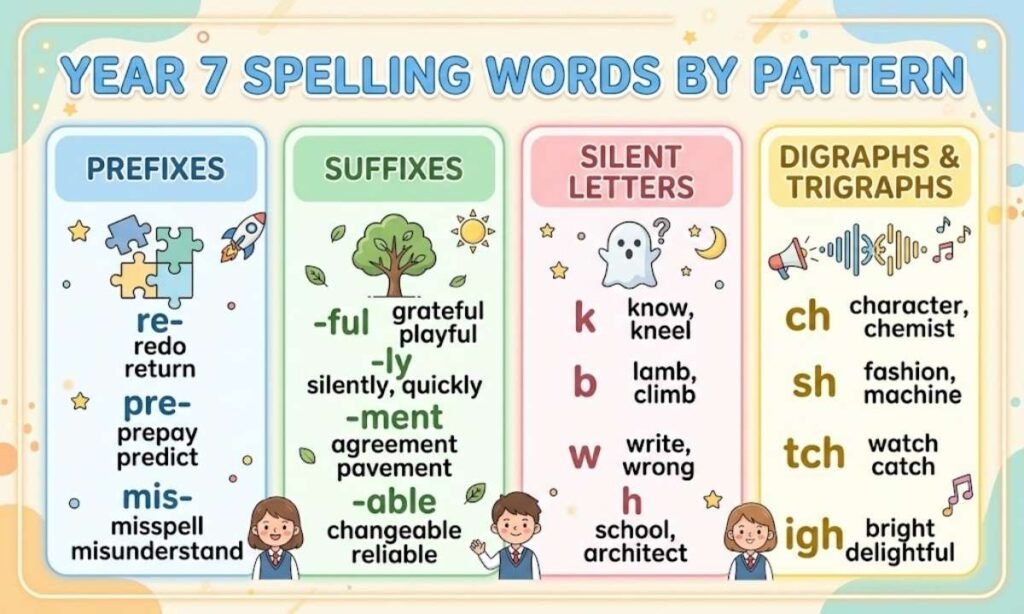
Grouping words by pattern is one of the most effective ways to build lasting spelling skill, since the brain remembers rules more easily than random letter strings.
Words With Silent Letters
Examples include island, knowledge, listen, calm and Wednesday, where a letter appears in writing but is not pronounced.
Words With Double Letters
Committee, accommodate, occurred, necessary and embarrassed all rely on doubled consonants that are easy to miss.
Tricky Vowel Patterns
Believe, receive, weird and foreign challenge the usual “i before e” rule, which is why they show up so often in spelling tests.
Words Ending in tion, sion and cian
Invention, decision, discussion and musician all use these endings to turn a verb or concept into a noun.
Words Ending in ous and ious
Dangerous, mysterious, curious and nervous follow this common adjective pattern.
Words Ending in able and ible
Comfortable, responsible, possible and reliable both sound similar but follow different spelling rules depending on the word’s root.
Words With Prefixes and Suffixes
Disappear, irregular, unnecessary and misspell show how adding a prefix or suffix can change meaning without changing the core spelling of the root word.
Australian English Spelling for Year 7
Australian schools follow British based spelling conventions, which differ from American spelling in several consistent ways.
ise and ize Spellings
Australian English almost always uses ise rather than ize, as in organise, recognise, emphasise and analyse.
our and or Spellings
Words like colour, favour, humour and behaviour keep the u, unlike their American equivalents.
re and er Spellings
Centre, theatre and metre use the re ending rather than the American er form.
Common Australian Spelling Differences
Students moving between American media and Australian schoolwork sometimes mix conventions, so it helps to consciously practise the Australian versions of these word families.
NAPLAN Year 7 Spelling Practice Test
Use this short self check to identify weak spots before moving on to targeted revision.
| Question | Correct Spelling |
| Identify the error: embarassed | embarrassed |
| Identify the error: recieve | receive |
| Identify the error: seperate | separate |
| Identify the error: definately | definitely |
| Identify the error: occured | occurred |
Practice Test 1: Common Spelling Errors
Cover the answer column above and try correcting each misspelled word before checking yourself.
Practice Test 2: Tricky Words
Add rhythm, conscience, questionnaire and privilege to your own list and test yourself again after a few days.
Practice Test 3: Advanced Year 7 Words
Try hypothesis, coherent, persuasive and entrepreneur for a harder round once the basics feel solid.
Practice Test 4: Spelling in Context
Write a full sentence using each word correctly, since spelling in context mirrors how NAPLAN actually presents questions.
What Spelling Skills Does NAPLAN Test in Year 7?
NAPLAN language conventions questions assess whether students can identify an error and supply the correct spelling, often within a sentence rather than as an isolated word.
Multisyllabic Words
Longer words with three or more syllables require students to track each sound in sequence.
Silent Letter Words
Words like knowledge and island test whether students remember letters that are not heard when spoken aloud.
Irregular Spelling Patterns
Words that break normal phonics rules, such as balance or measure, need to be learned individually.
Compound Words
Words like peanut and playground combine two smaller words and often lose or add letters in the process.
Less Common Vocabulary
Words used less often in daily speech but common in schoolwork, such as coherent or persuasive, are a regular feature of Year 7 testing.
Confusable Word Pairs That Trip Up Year 7 Students
Some of the trickiest Year 7 spelling questions do not involve hard words at all, but pairs that sound alike and are easy to confuse.
- Principal and principle
- Stationery and stationary
- Complement and compliment
- Desert and dessert
- Affect and effect
Learning these in pairs, alongside a short meaning for each, helps far more than memorising them separately.
Subject Specific Spelling Words Year 7 Students Need
Spelling accuracy in Year 7 is not limited to English class, since science, humanities and maths all introduce their own vocabulary.
- English: narrative, persuasive, evaluate, coherent
- Science: hypothesis, temperature, environment, experiment
- Humanities: government, civilisation, economy, geography
- Maths: equation, perimeter, calculate, estimate
Reading widely across subjects naturally exposes students to this vocabulary far more effectively than an isolated word list.
Hardest Spelling Words for Year 7 Students
A small set of words consistently causes the most trouble, regardless of a student’s general ability.
Commonly Misspelled Year 7 Words
Committee, embarrassed, mischievous, accommodate and necessary appear on almost every difficult word list for this age group.
Words With Tricky Pronunciations
Rhythm and conscience are hard partly because their spelling does not closely match how they sound when spoken.
Long Multisyllabic Words
Entrepreneur and questionnaire combine length with borrowed spelling patterns from other languages.
Words Borrowed From Other Languages
Silhouette, rendezvous and questionnaire come from French, which explains their unusual letter combinations in English.
How to Improve Your Year 7 Spelling?
Consistent, structured practice beats last minute cramming for almost every student.
- Learn words by spelling pattern rather than in random order.
- Break long words into syllables before attempting to spell them.
- Use each new word in a full sentence to reinforce meaning.
- Keep a personal list of words you get wrong and revisit it weekly.
- Practise a little every day rather than in one long session.
How Long Should Year 7 Spelling Practice Take Each Week?
Short, frequent sessions work better than occasional long ones for building lasting spelling memory.
- Fifteen minutes a day, four to five days a week, is generally enough for steady progress.
- A single twenty minute session focused on a small batch of new words is more effective than an hour of passive reading through a list.
- Reviewing previously learned words for five minutes keeps earlier progress from fading.
NAPLAN Spelling Mistakes to Watch For
Recognising common error patterns helps students catch mistakes before they become habits.
Missing Silent Letters
Dropping the silent letter in words like knowledge or island is one of the most frequent errors.
Double Letter Errors
Students often use a single letter where a double is needed, or the reverse, as in necessary or embarrassed.
Confusing Vowel Combinations
Mixing up ie and ei, as in believe versus receive, remains a persistent source of errors.
Adding or Removing Suffixes Incorrectly
Errors often appear when a suffix is added without adjusting the root spelling correctly, such as with responsible or comfortable.
Mixing Australian and American Spellings
Using organize instead of organise, or color instead of colour, is a common slip caused by exposure to American media and software spellcheckers.
Signs Your Child Needs Extra Spelling Support
Some patterns suggest a student may benefit from more targeted help rather than general practice.
- Repeated errors on the same word family despite several practice sessions.
- Difficulty breaking longer words into syllables when reading aloud.
- Strong reading comprehension but noticeably weaker written spelling.
- Avoidance of writing tasks that involve longer or unfamiliar words.
A teacher or learning support specialist can help identify whether extra intervention would help.
How to Practice Spelling Before NAPLAN?
A short structured plan in the weeks before testing tends to work better than last minute revision.
A 7 Day Spelling Practice Plan
Spend each day on a different focus: silent letters, double letters, vowel patterns, suffixes, Australian spelling rules, confusable pairs, and a final mixed review.
A 15 Minute Daily Routine
Spend five minutes reviewing previous words, five minutes learning new ones, and five minutes writing sentences that use them.
How Parents Can Help With Practice?
Reading words aloud, quizzing casually during everyday activities and praising effort over perfection all support steady improvement.
How Students Can Track Their Progress?
A simple notebook listing words that were spelled incorrectly, reviewed weekly, shows clear progress over time.
Are These Official NAPLAN Year 7 Spelling Words?
No official published word list exists for NAPLAN spelling at any year level, including Year 7.
Does NAPLAN Publish Its Spelling Word List?
NAPLAN describes the skills and proficiency standards it assesses rather than releasing a fixed list of future test words.
What These Practice Words Are Based On?
The words in this guide reflect common Year 7 curriculum vocabulary, typical spelling patterns and frequently misspelled words reported by teachers and existing NAPLAN guidance.
How to Use Practice Lists Effectively?
Treat any word list as pattern practice rather than a guaranteed prediction of exact test content.
Frequently Asked Questions
What spelling words should a Year 7 student know?
Students should be comfortable with multisyllabic words, silent letters, common suffixes and everyday academic vocabulary.
What words are in the Year 7 NAPLAN spelling test?
The exact words are not published in advance, though they draw on patterns typical for this year level.
How can I practise Year 7 NAPLAN spelling?
Practise little and often, using pattern based word groups and short self checking tests.
How many spelling words should I learn for NAPLAN?
Focus on a manageable batch of ten to fifteen new words per week rather than memorising hundreds at once.
What are the hardest Year 7 spelling words?
Words like embarrassed, mischievous, rhythm and questionnaire are consistently reported as the most difficult.
Does NAPLAN provide an official spelling word list?
No, NAPLAN does not release an official word list for any year level.
How do I improve my spelling quickly?
Break words into syllables, learn by pattern, and revisit mistakes regularly rather than cramming once.
What Australian spelling rules should Year 7 students know?
Focus on ise instead of ize, our instead of or, and re instead of er in relevant word families.
Where can I find Year 7 NAPLAN practice tests?
School literacy resources, education department websites and dedicated spelling practice platforms all offer suitable practice material.
Conclusion
Year 7 spelling practice works best when it is organised by pattern, paired with short regular sessions, and grounded in realistic expectations about what NAPLAN actually tests.
Focusing on silent letters, double letters, Australian spelling conventions and commonly confused word pairs will cover the vast majority of what students encounter, without needing to memorize an enormous, unfocused word list.