
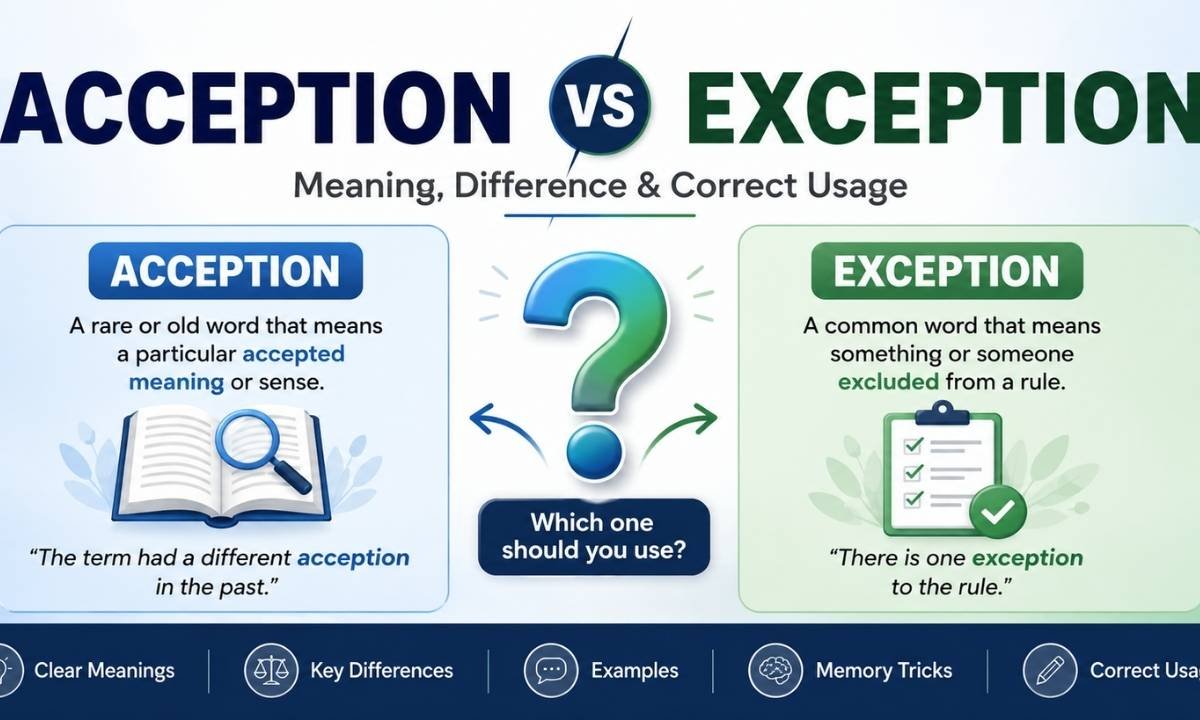
English is full of near-twin words that trip up even confident writers, and acception vs exception is a classic example. One word shows up in almost every conversation, while the other barely survives outside old dictionaries and legal texts.
If you have ever paused mid-sentence wondering which word fits, you are not alone. This guide breaks down both terms in plain language, shows you exactly when to use each one, and gives you a simple trick so the mix-up never happens again.
What Does Exception Mean?
An exception is a case, person, or thing that is left out of a general rule, pattern, or statement. It is one of the most common nouns in everyday English, used in schools, offices, contracts, and casual conversation alike.
At its core, an exception marks a break from the norm. When someone says “every rule has an exception,” they mean that a rule usually holds true, but at least one case does not follow it.
Simple examples:
- The store is open every day, with the exception of major holidays.
- She makes no exceptions when it comes to deadlines.
- This is an unusual exception to company policy.
Because exception describes something excluded from a rule, it pairs naturally with words like rule, policy, case, and pattern. This makes it a high-frequency word across academic writing, business communication, and legal documents.
What Does Acception Mean?
Acception is a much rarer word. It refers to a particular accepted meaning or sense of a word or phrase, essentially an older way of saying “the accepted sense” of something. It comes from the same root as “accept,” while exception traces back to “except.”
Acception was more common in older English and specialized or historical writing, where a scholar might discuss the acception of a term within a particular tradition or field. In modern day-to-day English, it has almost fully disappeared, replaced by clearer alternatives like meaning, sense, or interpretation.
Example of older usage:
- “The word carried a different acception among theologians of that era.”
You will rarely, if ever, need this word in modern writing, but recognizing it helps you understand why it sometimes appears as a supposed “fancy” alternative to exception, even though the two are unrelated in meaning.
Acception vs Exception: Side-by-Side Comparison
| Feature | Acception | Exception |
| Core meaning | An accepted sense or meaning of a term | A case excluded from a rule or pattern |
| Root word | Accept | Except |
| Modern usage | Rare, archaic, specialized | Extremely common |
| Typical context | Historical, linguistic, or theological texts | Everyday speech, business, law, academic writing |
| Example sentence | “The term had a different acception in that era.” | “There is one exception to the rule.” |
Why Do People Confuse These Two Words?
The confusion is not random. Several overlapping factors make acception and exception easy to mix up, especially for non-native speakers and fast typists.
- Visual similarity: The words differ by only two letters, so a quick glance or a typo can easily swap one for the other.
- Phonetic closeness: When spoken quickly, the opening syllables sound almost identical, which leads to mishearing and misspelling.
- Root confusion: Because “accept” and “except” already sound alike, their derived nouns inherit the same ambiguity.
- Autocorrect behavior: Some spellcheckers do not flag “acception” as wrong since it technically exists in dictionaries, so writers assume it is a safe, interchangeable choice.
- Overcorrection: Writers trying to sound formal sometimes reach for an unfamiliar word like acception, assuming it must be a more sophisticated version of exception.
Accept vs Except vs Acception vs Exception
Understanding the base verbs makes the noun forms much easier to remember.
- Accept means to receive, agree to, or approve of something. “She accepted the job offer.”
- Except means to leave out or exclude. “Everyone except John attended the meeting.”
- Acception is the rarely used noun tied to “accept,” referring to an accepted meaning.
- Exception is the common noun tied to “except,” referring to something excluded.
A quick memory trick: accept leads to exception, and except leads to exception. If your sentence is about leaving something out of a rule, you almost always want an exception.
Related Words and Synonyms
| Word | Related To | Common Synonym Options |
| Exception | Except | Exclusion, anomaly, deviation, special case, outlier |
| Acception | Accept | Meaning, sense, interpretation, connotation |
Using the right synonym can also help writers avoid the wrong word entirely. If you mean “excluded case,” reach for exception, exclusion, or special case. If you mean “accepted meaning,” reach for sense or interpretation instead of acceptance.
Common Sentence Mistakes to Avoid
- ❌ “There is one acception to this rule.” (Incorrect — should be exception)
- ✅ “There is one exception to this rule.”
- ❌ “He made an acception for late submissions.” (Incorrect)
- ✅ “He made an exception for late submissions.”
- ❌ “The word’s acception changed over the exception of history.” (Confused blend of both words)
- ✅ “The word’s meaning changed over the exception… ” should simply read: “The word’s meaning changed over time, with the exception of a few regional dialects.”
In nearly every modern sentence involving a rule, policy, or exclusion, exception is the correct choice. Acception should be reserved for rare, historical, or highly specialized discussions of word meaning.
Which Word Should You Use in American English?
In modern American English, exception is the standard, everyday word. It appears constantly in business writing, legal contracts, school assignments, and casual speech. Acception is essentially absent from contemporary American usage and would likely confuse most readers if used without context.
Unless you are writing about historical linguistics or quoting an older text, exception is almost always the safe and correct choice.
Conclusion
The takeaway is straightforward: exception is the everyday word for something excluded from a rule, pattern, or general statement, while acception is a rare, mostly historical term describing an accepted meaning of a word. When in doubt, exception is nearly always the word you are looking for in modern writing, whether you are drafting an email, writing an essay, or reviewing a contract.
Frequently Asked Questions
Is it acception or exception?
In almost all modern writing, exception is correct. Acception is a rare, archaic word with a different meaning.
Is acception a real English word?
Yes, it exists in dictionaries, but it is extremely rare and mostly limited to historical or specialized texts.
What is the difference between acception and exception?
Exception means something excluded from a rule; acception means an accepted sense or meaning of a word.
Is acception the same as acceptance?
No, they are different words. Acceptance means the act of accepting something, while acception refers to a word’s meaning.
What does exception mean in a sentence?
It marks a case that does not follow the general rule, as in “every rule has an exception.”
How can I remember the difference between exception and acception?
Link “except” to “exception” and “accept” to “acception,” matching each noun to its verb root.
Are acception and exception homophones?
No, they are not true homophones, but they sound similar enough when spoken quickly to cause confusion.