
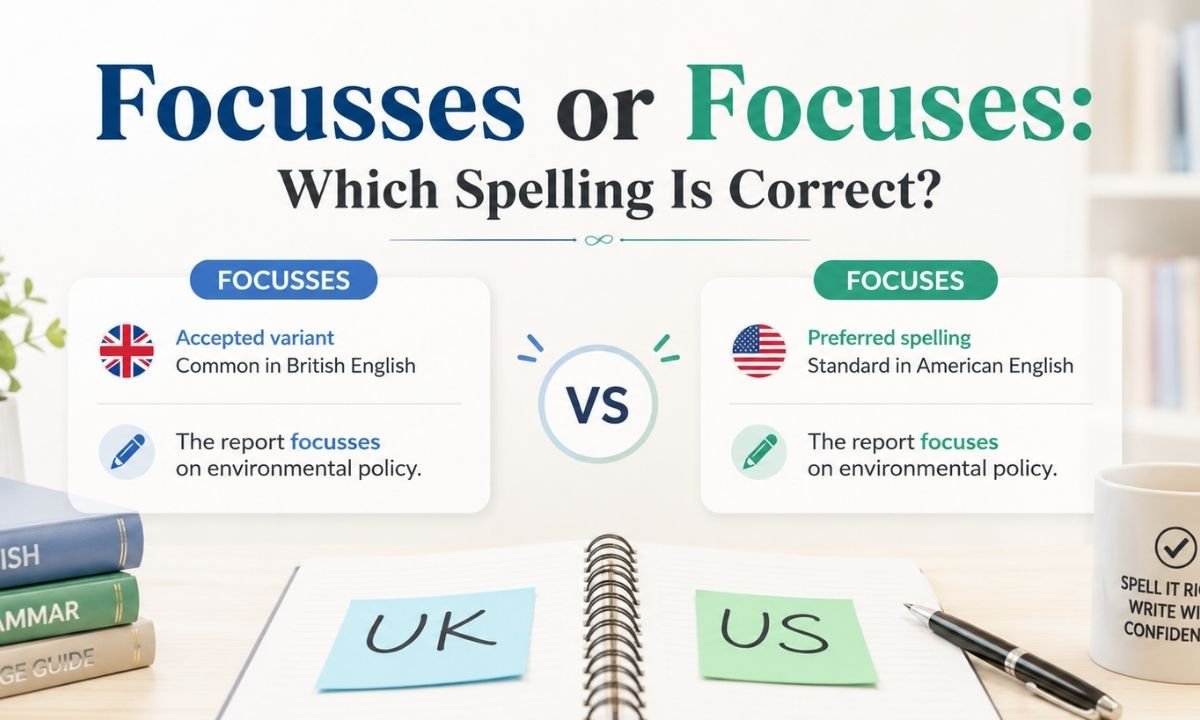
If you have ever paused mid sentence wondering whether to type focuses or focusses, you are not alone. This mix up trips up writers, students, and even professional editors on a regular basis, mostly because both versions show up in books, articles, and online content.
The short answer is that focuses is the standard spelling used across American English and most modern global writing, while focusses appears occasionally as a British variant. Understanding why these two forms exist, and when each one fits, will help you write with more confidence and consistency.
Focuses Is The Standard Spelling

Focuses is the widely accepted and grammatically standard form of the verb focus in its third person singular present tense. Dictionaries such as Merriam Webster, Cambridge, and Oxford list focuses as the primary spelling, while focusses shows up as a secondary or regional entry rather than the default choice.
- Focuses: standard, used in American and international English
- Focusses: rare variant, occasionally seen in older or British texts
- Meaning: identical in both cases
- Recommended choice: focuses, for nearly every writing situation
Why Focuses Is Preferred?
The English spelling rule for verbs ending in a single consonant after a stressed syllable usually doubles that consonant before adding a suffix, but focus does not follow this pattern in modern usage because the stress falls on the first syllable, not the second. This is the same reason words like benefit become benefited rather than benefitted in most contemporary style guides.
Where Focusses Comes From?
Focusses reflects an older British spelling convention where certain verbs doubled their final consonant regardless of syllable stress. While this pattern has mostly faded from modern British publishing, some older texts, academic papers, and regional writers still use it.
Focuses Vs Focusses At A Glance
| Feature | Focuses | Focusses |
| Grammatically correct | Yes | Yes, but rare |
| Common in American English | Yes | No |
| Common in British English | Yes | Occasionally |
| Dictionary preferred entry | Yes | No |
| Recommended for formal writing | Yes | Not usually |
| Used in academic and business writing | Yes | Rarely |
As the table shows, both spellings are technically valid, but focuses is the safer and more widely recognized option across nearly every context, audience, and publishing style guide.
Also Read This: Faring vs Fairing: The Complete Guide to Using Each Word Correctly
What Does Focuses Mean As A Verb?

Focuses functions as the third person singular present tense form of the verb focus, describing an action where attention, effort, or a lens is directed toward something specific. It pairs with singular subjects like he, she, it, or a singular noun.
- She focuses on her studies every evening.
- The lecture focuses on renewable energy solutions.
- His research focuses heavily on climate patterns.
- The camera focuses automatically in low light.
Focuses As A Noun: The Plural Form
Beyond its verb usage, focuses also serves as the regular English plural of the noun focus, referring to multiple points of attention, interest, or emphasis. This differs from foci, which is the Latin derived plural still used in scientific, mathematical, and academic writing.
- The company has three main focuses this quarter.
- Researchers identified several focuses within the data set.
- Foci: used in geometry, optics, and technical disciplines
- Focuses: used in everyday, business, and general writing
Is Focusses A Real Word?

Yes, focusses is a real and recognized spelling variant of focuses, though it appears far less frequently in modern published content. Search engines and style checkers often flag it as unusual, even though many dictionaries still list it as an accepted alternate form tied mainly to older British conventions.
When Focusses Still Appears
Some UK based academic journals, legal documents, and older reference materials continue using focusses out of tradition rather than current style preference. Writers targeting a British audience should still default to focuses unless a specific publication or style guide explicitly requests the double s version.
Focuses Or Focusses In American English
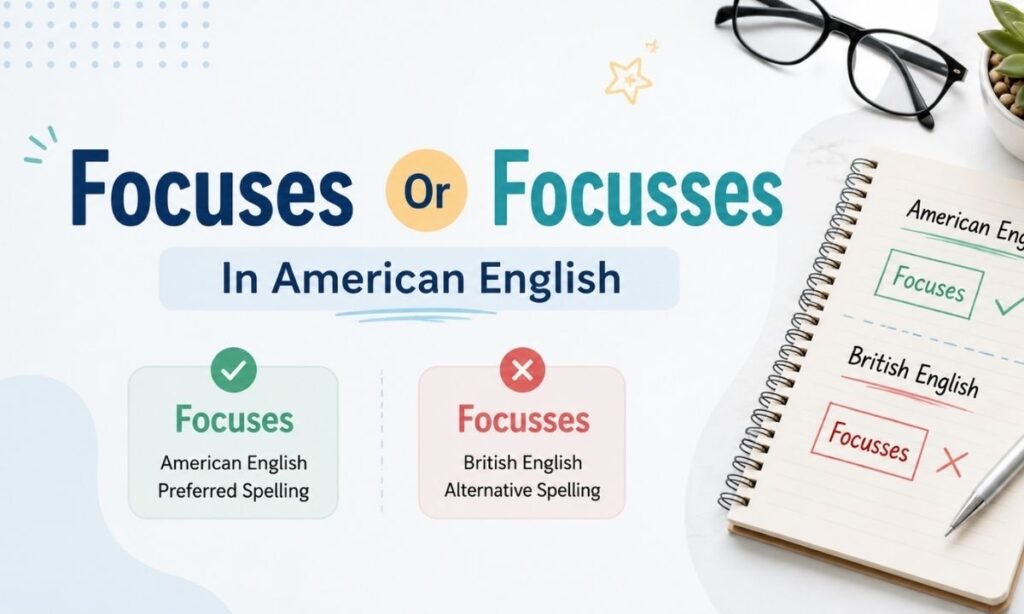
American English style guides, including AP and Chicago, consistently list focuses as correct and make no mention of focusses as an acceptable substitute. If you are writing for a US based audience, business, or platform, focus is the only form you should use.
- The startup focuses on mobile first design.
- Her thesis focuses on behavioral economics.
- The documentary focuses on wildlife conservation efforts.
Using focusses in American content can appear as a typo to readers and may even trigger spell check corrections, which signals to search engines that the content might contain errors.
Focuses Or Focusses In British English
British English offers slightly more flexibility, accepting both focuses and focusses depending on the publication and its internal style guide. That said, focus remains the dominant choice even across UK newspapers, universities, and corporate writing in recent decades.
| Category | Focuses | Focusses |
| UK newspapers | Common | Rare |
| UK academic writing | Common | Occasionally used |
| UK business content | Common | Rare |
| UK casual writing | Common | Very rare |
UK writers should default to focuses for consistency with modern conventions, reserving focusses only for contexts where a specific institution or editor requests it.
Also Read This: Compair vs Compare: The Correct Spelling Explained
Related Spelling Forms Worth Knowing
The focuses versus focusses debate extends into related word forms, and understanding these patterns helps writers stay consistent throughout longer pieces of content.
- Focusing vs focussing: focusing is standard, focussing is the rare variant
- Focused vs focussed: focused is standard, focussed appears occasionally in British texts
- Focus vs focuses: focus is the base verb, focuses is the third person singular form
- Refocuses vs refocusses: same pattern applies, refocuses is preferred
Common Mistakes To Avoid
Several related errors show up alongside the focuses and focusses confusion, and avoiding them strengthens your overall writing quality and credibility.
- Focuss is never correct in any form of English
- Focusess is a misspelling and should always be corrected to focuses
- Mixing focuses and focusses within the same document looks inconsistent
- Formal writing should always default to focuses regardless of audience location
How To Choose The Right Spelling For Your Audience
Selecting between these two forms depends largely on your target readers, publishing platform, and any specific style guide requirements your organization follows. When uncertain, focuses remains the statistically safer and more universally understood choice.
- Writing for a global or American audience: use focuses
- Writing for a UK institution with a specific style guide: check their preference first
- Writing academic or scientific content involving geometry or optics: use foci for the plural noun
- Writing everyday blog or business content: use focuses consistently throughout
Conclusion
Focuses stands out as the clear, modern, and widely accepted spelling across American, British, and international English writing. Focusses still exists as a legitimate but increasingly rare variant tied to older British conventions, appearing mainly in specific academic or traditional publishing contexts.
For nearly every writing situation, from business content to academic papers to casual blog posts, choosing focuses keeps your writing consistent, professional, and aligned with how modern readers and search engines expect the word to appear. When in doubt, stick with focuses, maintain that choice throughout your document, and reserve foci strictly for its technical plural use in scientific and mathematical writing.
Frequently Asked Questions
Is focusses correct?
Yes, focusses is grammatically correct but considered a rare, mostly outdated British variant of focuses.
Is focuses correct?
Yes, focuses is the standard and widely accepted spelling in both American and British English.
Is focusses a British spelling?
Focusses is sometimes associated with older British writing, though modern UK style guides mostly prefer focuses.
Is focuses American English?
Focuses is standard in American English, but it is also the dominant spelling used internationally today.
Which is more common, focuses or focusses?
Focuses is significantly more common across nearly all forms of English writing worldwide.
Is focusing or focussing correct?
Focusing is the standard spelling, while focussing is a rare variant seen occasionally in older British texts.
What is the plural of focus, focuses or foci?
Both are correct; focuses is used generally, while foci is reserved for scientific and mathematical contexts.