
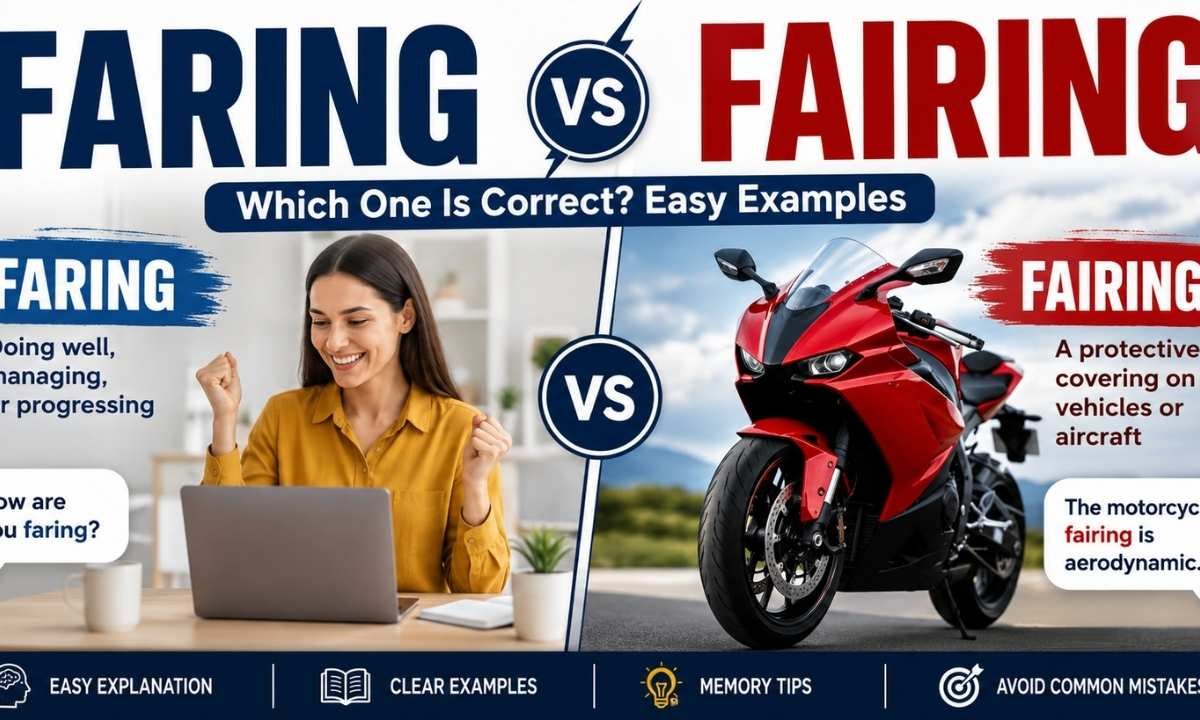
Two words that sound exactly alike can still mean completely different things, and faring and fairing are a perfect example. One belongs to everyday conversation about how a person or business is doing, while the other belongs to engineering and vehicle design.
Because they share the same pronunciation, writers mix them up constantly in emails, articles, and social posts. This guide breaks down the meaning, origin, and correct usage of both words so you can use each one with full confidence.
Faring vs Fairing: The Core Difference
At the simplest level, faring describes how someone or something is progressing, while fairing describes a physical covering built to reduce drag. Faring is a verb form that comes from fare, meaning to get along or manage. Fairing is a noun used mainly in engineering, motorsports, and aerospace.
- Faring relates to people, teams, businesses, and situations.
- Fairing relates to motorcycles, cars, aircraft, boats, and rockets.
- Both words are pronounced the same, which is the main reason people confuse them.
What Does Faring Mean in Everyday English?

Faring is the present participle of the verb fare, and it simply means doing, coping, managing, or progressing. It shows up naturally in questions about wellbeing and in reports about performance.
Simple equivalents for faring include:
- Doing
- Coping
- Managing
- Progressing
- Performing
- Getting along
How Faring Is Used in a Sentence
- How are you faring after the move?
- The startup is faring surprisingly well this quarter.
- Students are faring better with the new teaching method.
- The economy is faring poorly compared to last year.
Faring well means succeeding or handling a situation smoothly, while faring badly or faring poorly means struggling or falling behind expectations.
Fairing Explained: The Engineering Meaning
Fairing is a structural covering added to a vehicle, aircraft, or spacecraft to smooth airflow, cut wind resistance, and improve overall performance. Unlike faring, it is almost never used to describe a person.
| Term | Part of Speech | Field Used In | Main Purpose |
| Fairing | Noun | Automotive, aviation, aerospace, marine | Reduces drag and improves aerodynamics |
| Faring | Verb form | General conversation, business, sports | Describes progress or condition |
Engineers rely on fairings because a smoother outer shape allows a vehicle to move through air or water with less resistance, which improves speed, fuel efficiency, and stability.
Where Fairing Is Used: Motorcycles, Aircraft, and Rockets?
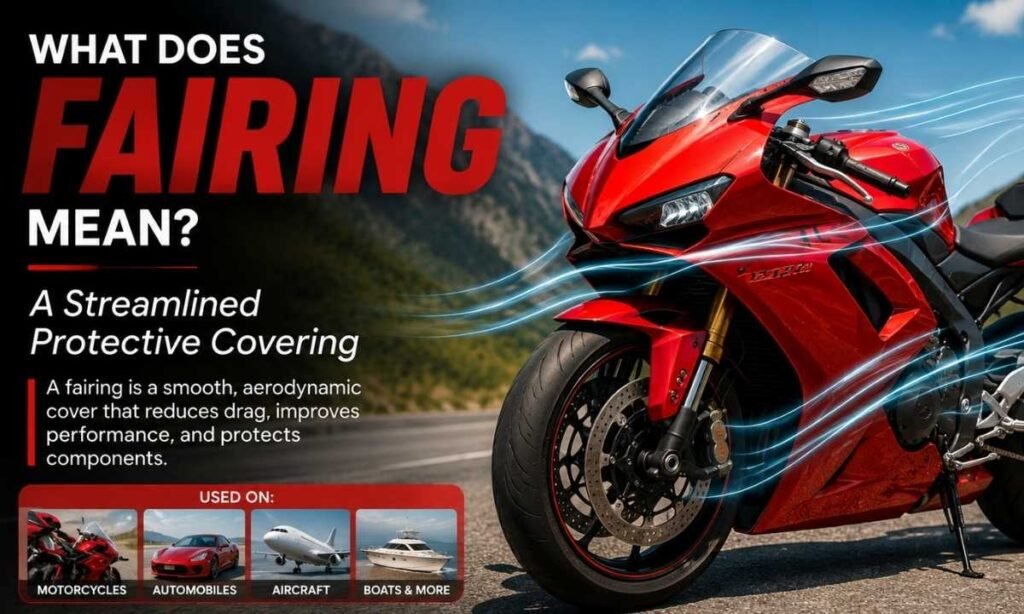
Fairings appear across almost every field of transportation design. Below is a quick breakdown of where the term is most common and what it does in each context.
| Vehicle Type | What the Fairing Does | Example |
| Motorcycles | Covers the frame and reduces wind resistance for the rider | The sport bike’s fairing was scratched in the fall |
| Aircraft | Smooths the joint between the wing and the body | Engineers redesigned the aircraft fairing to cut drag |
| Rockets | Protects the payload during launch and separates in orbit | The rocket’s fairing opened after reaching orbit |
| Boats | Reduces water resistance on the hull | The boat’s fairing improved its top speed |
| Bicycles | Improves aerodynamics for racing cyclists | The time trial bike used a lightweight fairing |
Faring vs Fairing Pronunciation and Why People Confuse Them
Faring and fairing are widely treated as homophones because they sound almost identical when spoken aloud, even though the spelling and meaning differ. This overlap in sound, combined with similar spelling, is exactly why spell checkers rarely catch the mistake, since both words are spelled correctly on their own.
Common Mistakes to Avoid
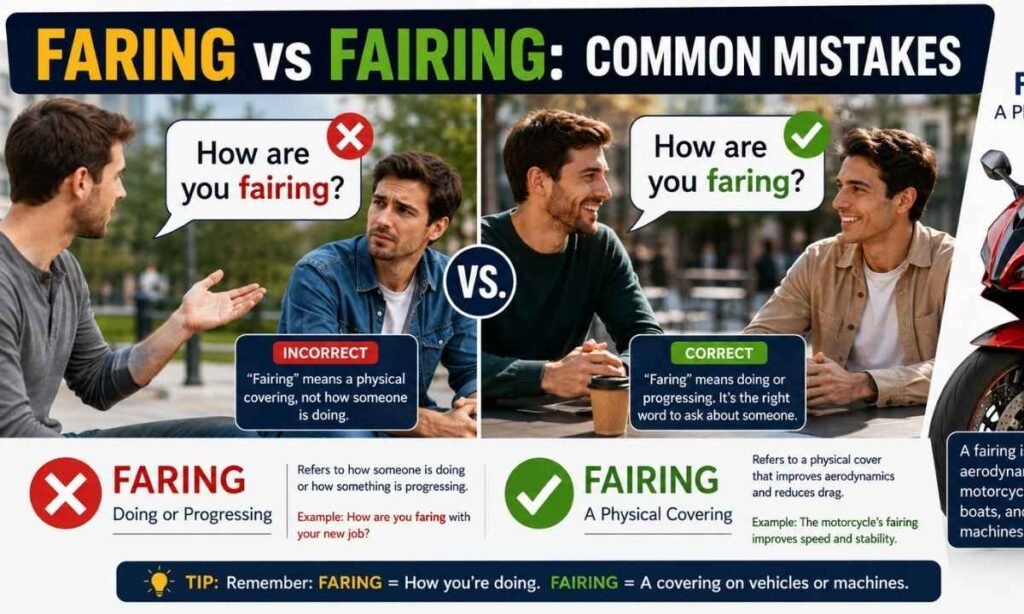
- Writing “How are you fairing?” instead of the correct “How are you faring?”
- Writing “The motorcycle’s faring” instead of the correct “The motorcycle’s fairing”
- Assuming fairing comes from the word fair, when it actually relates to smoothing or streamlining a surface
- Assuming faring is related to a fair or festival, when it actually comes from the verb fare
Also Read This: Compair vs Compare: The Correct Spelling Explained
Memory Trick to Never Mix Them Up
A simple way to lock in the difference is to connect each word to its root.
- Faring comes from fare, and fare relates to a journey or condition, just like farewell.
- Fairing comes from making something fair or smooth, which is exactly what an aerodynamic covering does.
Think of faring as a person’s journey and fairing as a machine’s smooth shell, and the confusion disappears almost instantly.
Faring vs Fairing in Professional and Business Writing

In business reports, journalism, and analysis, faring is the word you will see far more often, since writers frequently describe how a company, market, or team is performing.
- The retail sector is faring better than analysts predicted.
- Small businesses are faring unevenly across different regions.
- The team is faring well despite a difficult schedule.
Fairing almost never appears in this type of writing unless the topic is specifically about vehicle design, transportation engineering, or aerospace hardware.
Regional Usage: British vs American English
There is no spelling difference between British and American English for either word. Both regions use faring for progress and fairing for aerodynamic coverings.
- British writing sometimes leans toward the more formal “How are you faring?” in professional contexts.
- American writing often prefers the casual “How are you doing?” in everyday speech, while still recognizing faring as correct and understood.
Fairing in Nature and Everyday Objects
Beyond motorcycles and rockets, the concept of a fairing also appears in smaller everyday designs where reducing drag or resistance matters.
- Drones often include a fairing around the camera housing to reduce wind turbulence.
- Electric bikes sometimes add a fairing near the handlebars to shield riders from wind.
- Kayaks and canoes may use a fairing along the bow to help the hull move more efficiently through water.
Quick Self Test: Faring or Fairing
Try filling in the blank with the correct word before checking the answer below each line.
- How are you _____ in your new role?
- The motorcycle’s _____ was replaced after the accident.
- The company is _____ better than expected this year.
- Engineers tested the aircraft _____ before the flight.
- The team is _____ poorly this season.
Answers: 1. faring, 2. fairing, 3. faring, 4. fairing, 5. faring
Faring vs Fairing Synonyms and Related Words
Words close in meaning to faring include coping, managing, progressing, and performing. Words related to fairing include covering, shell, casing, streamlined panel, and aerodynamic structure.
Why Search Engines Confuse These Two Words?
Because faring and fairing are nearly identical in spelling and identical in sound, search engines and readers often land on the wrong page when looking for either meaning. Understanding the context of the sentence, whether it involves a person’s progress or a vehicle’s design, is the fastest way to identify which word actually belongs.
Conclusion
Use faring whenever you are describing how someone or something is doing, coping, or progressing. Use fairing whenever you are describing a physical covering built to reduce drag on a vehicle, aircraft, boat, or rocket. The two words may sound the same, but their meanings belong to entirely different worlds, one human and one mechanical.
Frequently Asked Questions
Is “How are you faring?” correct?
Yes, this is the correct spelling when asking about someone’s wellbeing or progress.
Is “How are you fairing?” correct?
No, this spelling is incorrect in this context since fairing refers to a vehicle part, not a person.
What does faring mean?
Faring means doing, coping, managing, or progressing in a situation or life event.
What does fairing mean?
Fairing is a streamlined covering used on vehicles, aircraft, boats, or rockets to reduce drag.
Are faring and fairing homophones?
Yes, they are commonly treated as homophones because they sound identical despite different spellings and meanings.
Is faring a word?
Yes, faring is a valid present participle form of the verb fare.
Is fairing a word?
Yes, fairing is a valid noun used mainly in engineering and transportation design.
What does faring well mean?
Faring well means doing well, succeeding, or managing a situation smoothly and successfully.
Can fairing ever describe a person?
No, fairing is reserved for physical objects and structures, never for describing a person’s condition.
Which word is used more often in daily conversation?
Faring is used far more often since it relates to everyday human experiences and business updates.