
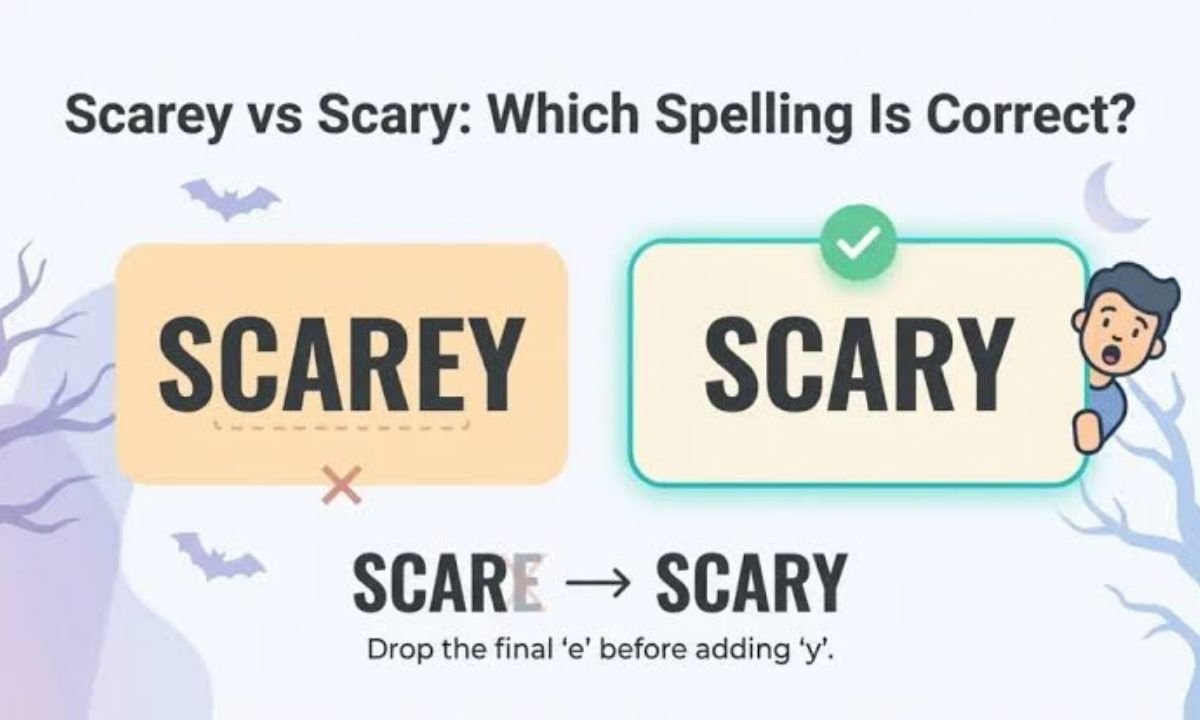
Is it scarey or scary? Most writers meet this question while typing a quick message, then pause because both versions look almost right. Let’s settle it fast. The short answer is simple: scary is the standard spelling in American English, and it is the form you should use in school, work, and online content.
Scarey vs scary is a common spelling question because the word can look as though it should keep the “e” from “scare.” Scarey shows up in a few dictionaries as a rare variant, but readers often treat it as a mistake. This guide explains the meaning, the spelling logic, related forms like scarier and scariest, and practical examples, so you can write the word correct
Quick Answer: Is It Scarey or Scary?
Scary is correct. It is the spelling used by major American publishers, schools, and style guides. If you want a safe choice, write scary and move on.
The Correct Standard Spelling in American English
The standard spelling is S, C, A, R, Y. There is no extra e. You will see it in news headlines, novels, textbooks, and dictionary headwords.
What Does Scary Mean?
Scary is an adjective. It describes something that causes fear, worry, or alarm. A dark hallway, a sudden noise, or a risky decision can all be scary.
Is Scarey Ever an Accepted Spelling?
Some references list scarey as a variant, which means it exists in print. Still, it is uncommon, and editors usually change it to scary. For professional writing, treat it as incorrect.
Scarey vs. Scary: What’s the Difference?
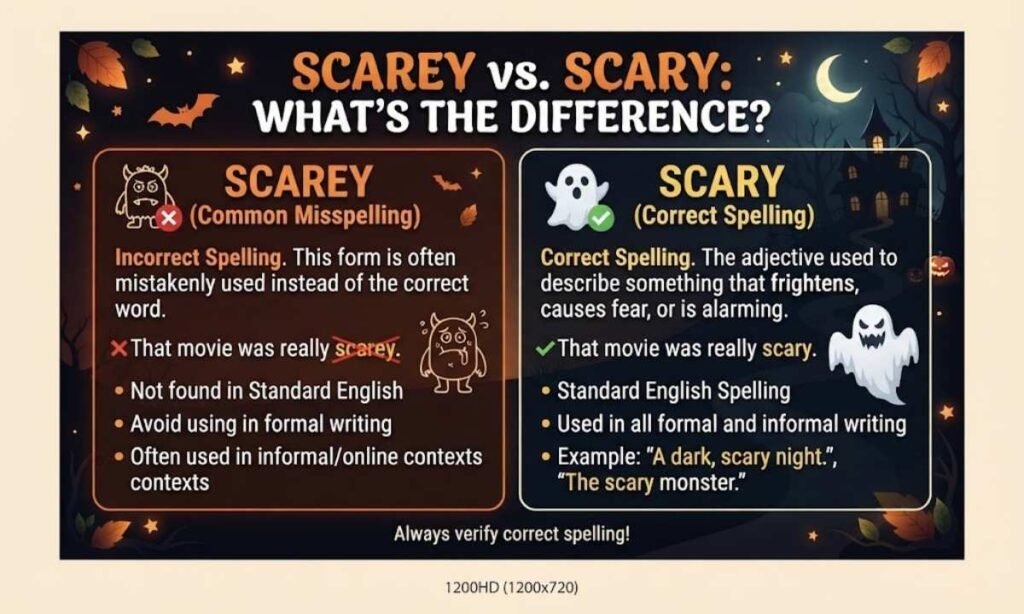
There is no difference in meaning. Both versions point to the same idea of fear. The only difference is how widely each spelling is accepted.
Scary vs. Scarey Meaning
Both are read as “causing fright.” Because the meaning is identical, the choice comes down to correctness and credibility. Readers notice odd spellings quickly.
Scary vs. Scarey Spelling Comparison
| Feature | Scary | Scarey |
| Status | Standard spelling | Rare variant |
| Usage in books and news | Very common | Very uncommon |
| Safe for school and work | Yes | No |
| Comparative form | Scarier | Not standard |
| Superlative form | Scariest | Not standard |
Which Spelling Should You Use in the USA?
Use scary. American editors, teachers, and search engines all treat it as the default. Choosing it also protects your writing from spelling flags.
Why Is Scary Spelled Without an E?
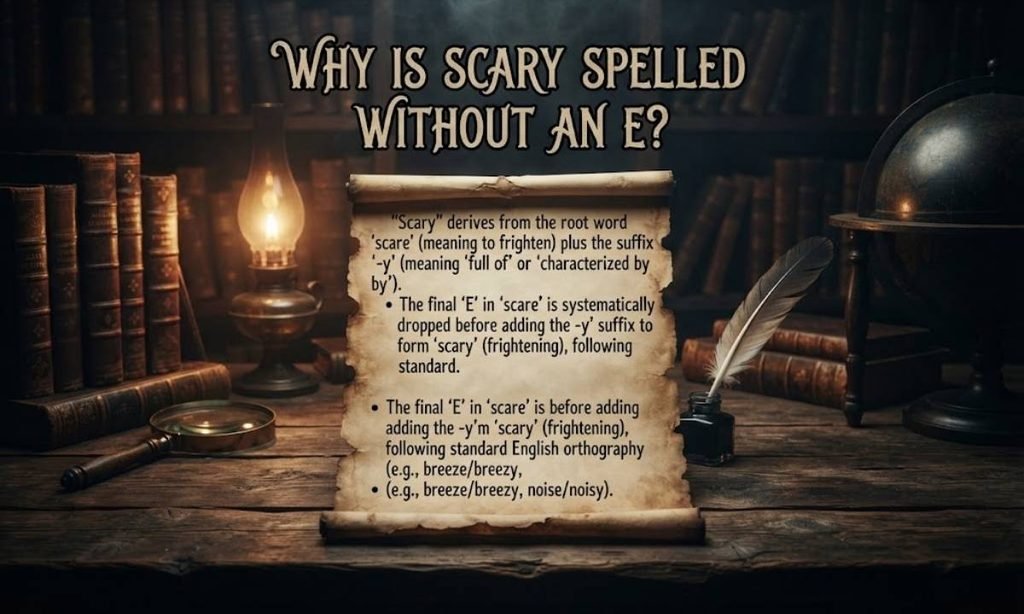
The word follows a common English pattern. When you add y to a word that ends in a silent e, the e usually drops away.
How the Word Scary Comes From Scare
Scare is the base word, a verb that means to frighten. Add y, remove the silent e, and you get scary. The same thing happens in other everyday words.
The Spelling Pattern Behind Scary
Look at these matching examples:
- Shade becomes shady
- Ice becomes icy
- Noise becomes noisy
- Stone becomes stony
- Bone becomes bony
Once you see the pattern, scarey looks out of place.
Scary, Scarier, and Scariest: Correct Word Forms
When an adjective ends in y after a consonant, the y changes to i before er or est. That gives you scary, scarier, and scariest.
A Short History of the Word Scary
Scare entered English centuries ago, and it traces back to older Norse words about frightening or driving away. The adjective scary grew from that base and became standard over time.
Spelling in English was less fixed in earlier periods, so variants like scarey could appear in print. As dictionaries and style guides matured, scary became the accepted form. That history explains why you still see the odd alternate spelling today, even though it is no longer recommended.
Scary vs. Scarey Examples in Everyday Sentences
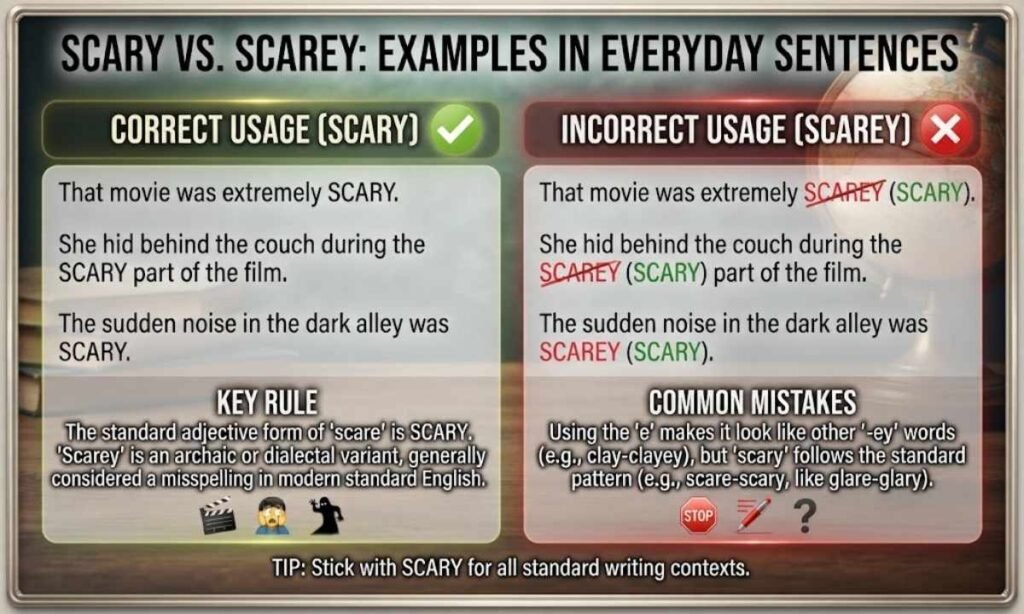
Seeing the word in context makes the right choice easier to remember.
Examples Using Scary in American English
- The haunted house at the fair was scary.
- Driving in heavy fog can be scary for new drivers.
- She told a scary story around the campfire.
How to Correct Scarey in a Sentence
Replace the spelling and keep everything else the same.
- Incorrect: That movie was really scarey.
- Correct: That movie was really scary.
Scary Examples for School, Work, and Text Messages
- School: The author uses dark settings to create a scary mood.
- Work: Missing the deadline was a scary moment for the team.
- Text message: That thunderstorm was so scary last night!
Scary vs. Scared vs. Scare: What’s the Difference?
These three words are related but do different jobs. Mixing them up is one of the most common grammar slips.
| Word | Part of Speech | Meaning | Example |
| Scary | Adjective | Causing fear | The cave was scary. |
| Scared | Adjective or past tense verb | Feeling fear | I was scared of the dark. |
| Scare | Verb or noun | To frighten, or a sudden fright | The noise made me jump with a scare. |
When to Use Scary
Use scary to describe the thing that creates fear. It points to the cause.
When to Use Scared
Use scared to describe the person or animal that feels fear. It points to the reaction. For example, “The dog was scared of the fireworks.”
How to Use Scare as a Verb and a Noun
As a verb, scare means to frighten someone: “Don’t scare the cat.” As a noun, it means a sudden fright or alarm: “The health scare passed quickly.”
Easy Memory Tricks to Spell Scary Correctly
A few small habits can lock in the right spelling.
- Think of scare, then drop the e and add y.
- Compare it with scary’s cousins, such as shady and icy.
- Say the word slowly: scar plus y.
- Remember that scarier and scariest never keep the e.
- Run a spell check, then read the sentence once aloud.
Common Scary Spelling Mistakes to Avoid
Most errors come from adding a letter that does not belong. Watch for these slips when you edit.
Scarey or Scary in Formal Writing?
Always choose scary in essays, reports, emails, and published content. A variant spelling can make polished writing look careless.
Scarier or Scareyer: Which Is Correct?
Scarier is correct. Scareyer is not a standard word. The y turns into i before the er ending.
Scariest or Scarest: Which Form Is Right?
Scariest is right. Scarest drops the i and breaks the pattern, so it looks wrong to most readers.
Does British English Accept Scarey?
Not really. British and American writers both use scary in everyday writing. Dictionaries on both sides may mention scarey as a variant, but neither side promotes it. If your audience is international, scary is the only safe option.
What Are Some Other Words for Scary?
Strong writing avoids repeating one word too often. Synonyms add variety and precision.
Common Synonyms for Scary
- Frightening
- Creepy
- Spooky
- Alarming
- Chilling
- Eerie
- Terrifying
Scary vs. Frightening vs. Terrifying
Scary is the general, everyday term. Frightening feels a bit more serious. Terrifying describes extreme fear, so save it for intense situations.
Choosing the Right Word for Your Sentence
Match the word to the mood. Use spooky for light Halloween fun, creepy for uneasy feelings, and alarming for real concern. Use scary when you want a clear, simple word that every reader understands.
Scarey in Titles, Names, and Pop Culture
Creative writers sometimes bend spelling on purpose for a brand, a band, or a joke. That choice works only when it is clearly intentional. For general content, stick with scary. Search engines also recognize the standard form more strongly, which helps your page match what people actually type.
Should You Use Scarey in Content Writing and SEO?
You should mention scarey only when your article is about the spelling question, like this one. In normal copy, use scary. If you are explaining the topic, include both forms once or twice, give a direct answer early, and link to trusted dictionary pages so readers can verify the facts.
Frequently Asked Questions
Is Scarey a Real Word?
Some dictionaries list scarey as a rare variant of scary. It is seldom used, so scary is the safer choice.
Is Scarey or Scary Correct in American English?
Scary is correct in American English. Use it in all formal and casual writing.
Do Scarey and Scary Mean the Same Thing?
Yes, both mean causing fear. Only scary is widely accepted.
How Do You Spell Scary Correctly?
Spell it S, C, A, R, Y. Think of scare, drop the e, and add y.
What Is the Plural or Comparative Form of Scary?
Scary is an adjective, so it has no plural. The comparative is scarier and the superlative is scariest.
What Is the Difference Between Scary and Scared?
Scary describes what causes fear, while scared describes who feels it. Example: the movie was scary, and I was scared.
Is Scareyer a Correct Word?
No, scareyer is not standard. The correct comparative is scarier.
Conclusion
Scary is the spelling to trust. It follows a simple rule, matches what dictionaries and editors prefer, and works in every kind of writing. Remember the pattern of scare, drop the e, add y, and use scarier and scariest for stronger comparisons.
Keep scarey for the rare moment when you are explaining the mistake itself, and your writing will stay clear, correct, and credible.