
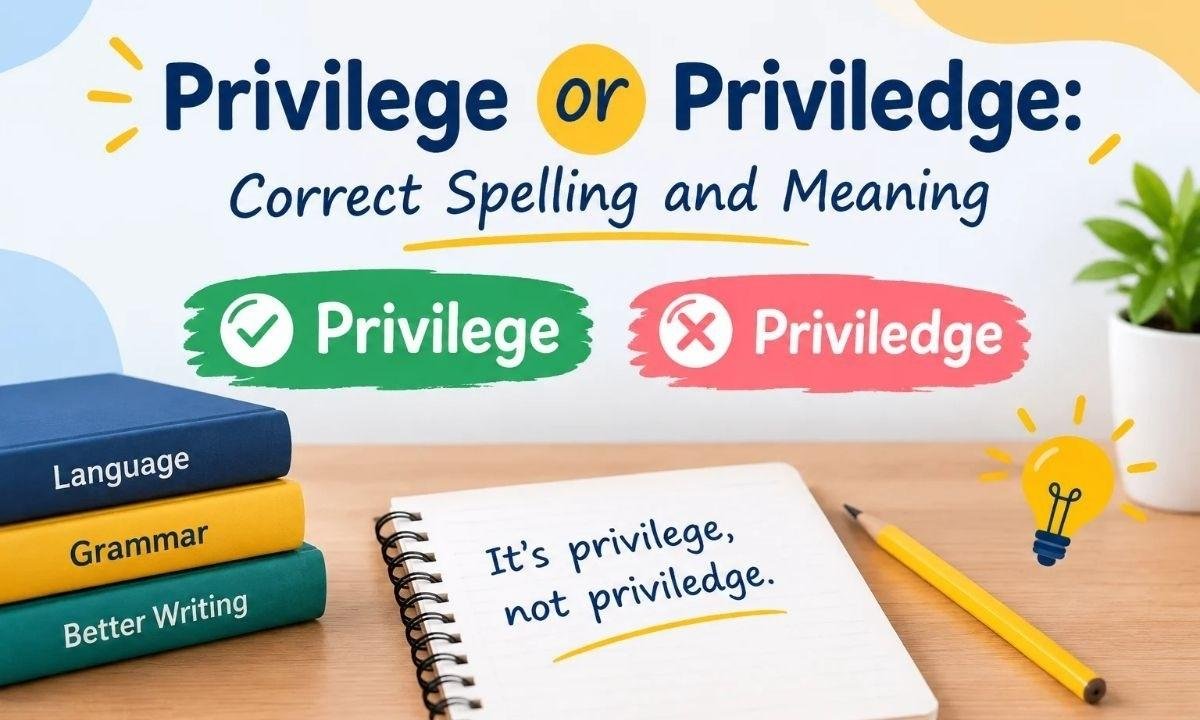
Privilege is the correct spelling. Priviledge is a common misspelling that adds an unnecessary d before the final ge. The correct spelling is the same in British and American English.
Privilege is a noun meaning a special right, advantage, benefit, or opportunity. It can also be used as a verb meaning to give an advantage to someone or something. For example, “It was a privilege to represent my school at the competition.”
The confusion often arises because the ending sounds like “ij,” leading people to spell it with -dge. This guide explains the meaning, pronunciation, spelling rules, common mistakes, and practical examples to help you remember the correct spelling.
Comparison Overview
Here is a quick comparison of the two spellings:
- Privilege: The correct standard English spelling.
- Priviledge: An incorrect spelling of privilege.
- Correct plural: Privileges, not priviledges.
- Correct adjective: Privileged, not priviledged.
- Regional differences: The standard spelling is the same in British and American English.
The key rule is simple: write privilege, with no d in the original word.
Definition of Privilege
Privilege refers to a special right, advantage, benefit, or opportunity available to a particular person or group. It can describe a formal entitlement, a social advantage, or an experience considered an honor.
According to the Cambridge Dictionary, the word has several meanings, including a special advantage, an enjoyable opportunity, and a particular legal protection.
The word comes from the Latin privilegium, historically referring to a law or arrangement applying to a particular person or group.
Privilege can function as both a noun and a verb. Its related forms include privileges, privileged, and underprivileged.
Examples of Privilege
Here are some examples showing how privilege is used in everyday English:
- It was a privilege to meet the author in person.
- Having access to a quality education is an opportunity not everyone enjoys.
- Club members receive certain privileges throughout the year.
- The lawyer explained the importance of attorney-client privilege.
- The new policy privileges experience over formal qualifications.
- She considered it a privilege to volunteer at the community center.
These sentences illustrate the word’s use as both a noun and a verb.
Definition of Priviledge
Priviledge is not a standard English spelling. It is a misspelling of privilege, usually caused by confusion about the word’s pronunciation.
For example:
- Incorrect: It was a priviledge to meet you.
- Correct: It was a privilege to meet you.
- Incorrect: Employees enjoy several priviledges.
- Correct: Employees enjoy several privileges.
- Incorrect: She had a priviledged upbringing.
- Correct: She had a privileged upbringing.
Remember that changing the ending or adding a suffix does not make the original misspelling correct. The standard forms are privilege, privileges, and privileged.
Main Differences Between Privilege and Priviledge
The difference is spelling, not meaning or regional usage. One form is standard English, while the other is an error.
| Feature | Privilege | Priviledge |
| Spelling status | Correct | Incorrect |
| Meaning | A special right, advantage, or opportunity | No standard meaning as a separate word |
| Part of speech | Noun and verb | Not a standard word |
| Plural | Privileges | Priviledges is incorrect |
| Adjective | Privileged | Priviledged is incorrect |
| UK and US English | Correct in both | Incorrect in both |
Key Difference
There is no need to choose between these spellings according to context. Whenever you mean a special advantage, right, or opportunity, use privilege.
For example, “It is a privilege to work with such a talented team” is correct. Writing “It is a priviledge” is not.
Why Do People Misspell Privilege?
Several factors can contribute to this spelling mistake.
- Pronunciation confusion: The ending sounds like “ij,” so writers may assume it contains -dge.
- Familiar spelling patterns: Words such as knowledge, pledge, and ledge can influence how people spell unfamiliar words.
- Unstressed syllables: The middle of privilege may be pronounced quickly, making its spelling less obvious.
- Typing habits: Fast typing, autocorrect, or repeatedly seeing an incorrect form can reinforce the mistake.
The best solution is to learn the correct spelling and recognize the word’s related forms.
Memory Trick to Remember the Spelling
Use this simple reminder:
Privilege has no d. Privileged gains one d in its written form.
Think of the correct sequence as priv-i-lege. This is a spelling aid, not a division into three meaningful word parts.
You can also connect the ending with words such as college and sacrilege. They share the written ending -lege, which can help you remember that privilege does not contain -ledge.
For an additional spelling tip, see Dictionary.com’s privilege entry, which discusses common spelling errors involving this word.
Comparison Table: Correct Word Forms
The following table summarizes the correct forms and their uses.
| Word | Correct? | Part of Speech | Example |
| Privilege | Yes | Noun, verb | It was a privilege to attend. |
| Privileges | Yes | Plural noun, verb | Members enjoy several privileges. |
| Privileged | Yes | Adjective, verb form | She had a privileged upbringing. |
| Underprivileged | Yes | Adjective | The program supports underprivileged children. |
| Priviledge | No | — | Incorrect spelling |
| Priviledges | No | — | Incorrect plural spelling |
| Priviledged | No | — | Incorrect spelling |
Grammar Guide
How Privilege Is Used in Sentences
Privilege is commonly used as a noun, but it can also function as a verb.
As a noun:
- Reading was a privilege she valued.
- It is a privilege to introduce today’s speaker.
- Employees receive certain workplace privileges.
As a verb:
- The policy privileges long-term customers.
- The exhibition privileges local artists over international names.
Related adjective:
- He grew up in a privileged household.
- She felt privileged to work with experienced teachers.
The misspelling priviledge should not be used in any of these grammatical roles.
Common Mistakes Learners Make
Here are several errors worth checking for when proofreading:
- Priviledge: Write privilege.
- Priviledged: Write privileged.
- Priviledges: Write privileges.
- Privelege: Write privilege.
- Privilage: Write privilege.
- A privilege background: Write a privileged background.
The last example is a grammatical error rather than a spelling error. Use privileged when you need an adjective to describe a person, background, or position.
Simple Rules to Remember
- Spell the word privilege, without a d.
- Add -s to form the plural: privileges.
- Use privileged as an adjective or the past form of the verb.
- Use underprivileged for a person or group lacking the advantages enjoyed by others.
- Check for an unnecessary d when proofreading.
Quick Tips for Writing and Speaking
- Learn the pronunciation and spelling together.
- Remember that the final sound does not determine whether the word contains a d.
- Use a dictionary when you are unsure about a word’s spelling.
- Add commonly used words to your personal spelling practice list.
- Proofread formal emails, academic work, and professional documents before sending them.
How to Pronounce Privilege Correctly
The word privilege is commonly pronounced approximately as PRIV-uh-lij.
The Cambridge Dictionary pronunciation guide provides audio and phonetic transcriptions for both British and American English.
The ending is pronounced with the sound /dʒ/, as in jump. Because that sound can be represented by different letter combinations in English, it is easy to guess the spelling incorrectly.
However, pronunciation does not change the spelling: the word is written privilege, not priviledge, in both British and American English.
Try saying the word slowly while writing it. Practicing the sound and the correct letter sequence together can help reinforce the spelling.
Other Common Misspellings of Privilege
The extra d is not the only error people make. The middle vowels can also cause confusion.
| Incorrect spelling | Correct spelling |
| Priviledge | Privilege |
| Privelege | Privilege |
| Privilage | Privilege |
| Privlege | Privilege |
| Priviledges | Privileges |
| Priviledged | Privileged |
When checking your writing, look at the complete word rather than correcting only its ending. The correct spelling is privilege, with the letter sequence p-r-i-v-i-l-e-g-e.
Privilege vs. Privileged: What Is the Difference?
Although the words are closely related, they do not always serve the same grammatical purpose.
Privilege is generally a noun referring to a special right, advantage, or opportunity. It can also be a verb.
Examples:
- It was a privilege to attend the ceremony.
- Members enjoy several privileges.
- The policy privileges customer safety.
Privileged is commonly an adjective describing someone who has a special advantage or benefit. It can also be the past form of the verb privilege.
Examples:
- She had a privileged upbringing.
- He felt privileged to receive the award.
- The organization privileged one approach over another.
Notice that privileged contains a d, but privilege does not. The extra letter belongs to the related form; it should not be inserted into the original word.
For dictionary definitions and additional examples, see the Cambridge Dictionary entry for privileged.
When to Use Each One
Use Privilege When
Use privilege when referring to a special advantage, benefit, right, or opportunity.
Examples:
- Everyday use: It was a privilege to meet the team.
- Workplace: Employees receive certain access privileges.
- Legal context: The lawyer explained attorney-client privilege.
- Formal occasion: It is my privilege to welcome our guests.
The word can also function as a verb when describing giving an advantage or greater importance to someone or something.
Use Priviledge When
There is no standard English context in which priviledge is the correct spelling.
You may use the misspelled form when discussing the error itself, such as in a spelling lesson:
“Priviledge is a common misspelling of privilege.”
Outside that explanatory context, correct the spelling to privilege.
When Not to Use Privilege Incorrectly
Even when the spelling is correct, the word can be used incorrectly in a sentence.
- Incorrect: She comes from a privilege background.
Correct: She comes from a privileged background. - Incorrect: It was a privileged to meet the speaker.
Correct: It was a privilege to meet the speaker. - Incorrect: The members enjoy several priviledges.
Correct: The members enjoy several privileges.
Also, do not automatically treat right and privilege as interchangeable. A right is an entitlement recognized by a legal or social system, whereas a privilege is generally a particular advantage, benefit, or permission. The precise distinction depends on the context.
Which One to Use: A Quick Decision Guide
Follow these steps whenever you are unsure about the spelling.
- If you mean a special advantage, benefit, or opportunity, start with privilege.
- Check the letters: the correct ending is -lege, not -ledge.
- For the plural, write privileges.
- For the adjective or past verb form, write privileged.
- If you have typed priviledge, remove the unnecessary d.
These simple checks can help you avoid the error in everyday and formal writing.
Real-World Practical Examples
Correct Examples of Privilege
- Education: It was a privilege to study under an experienced teacher.
- Workplace: Senior employees receive certain scheduling privileges.
- Technology: Only authorized users have administrator privileges.
- Formal occasion: It is a privilege to welcome our special guest.
- Community: She considered volunteering at the shelter a privilege.
Incorrect Examples of Priviledge
Compare each incorrect sentence with its corrected version.
- Incorrect: It is a priviledge to meet you.
Correct: It is a privilege to meet you. - Incorrect: He lost his driving priviledges.
Correct: He lost his driving privileges. - Incorrect: She had a priviledged upbringing.
Correct: She had a privileged upbringing. - Incorrect: The new policy priviledges one group.
Correct: The new policy privileges one group.
These examples cover the noun, plural, adjective, and verb forms of the word.
Self-Assessment: Fill in the Blanks
Test your understanding by completing each sentence with the correct form of the word.
- It was a great ______ to work with such a talented team.
- Club members receive additional ______.
- Attorney-client ______ can protect confidential legal communications.
- She grew up in a ______ environment.
- Administrators need elevated ______ to change system settings.
- Correct the spelling error: “He never took his priviledge for granted.”
Answers
- Privilege
- Privileges
- Privilege
- Privileged
- Privileges
- He never took his privilege for granted.
If you answered all six correctly, you understand the main spelling and word-form distinctions.
Frequently Asked Questions
Is it privilege or priviledge?
Privilege is the correct standard spelling. Priviledge is a misspelling and should be corrected in standard English writing.
Is privilege spelled differently in British and American English?
No. The standard spelling is privilege in both British and American English. Pronunciation can vary between speakers, but there is no standard regional spelling difference between these two forms.
What does privilege mean?
Privilege means a special right, advantage, benefit, or opportunity. It can also refer to certain legal protections or to giving someone or something an advantage.
Is it privileged or priviledged?
The correct spelling is privileged. The form priviledged incorrectly inserts a d into the original word before adding the related ending.
What is the plural of privilege?
The correct plural is privileges. For example, “Club members enjoy several privileges.”
What is the meaning of privilege in Hindi?
Privilege can be translated as विशेषाधिकार (visheshadhikar) when referring to a special right or advantage. In the expression “It is a privilege to meet you,” it may convey सौभाग्य or सम्मान, depending on the intended meaning.
How do you pronounce privilege?
It is commonly pronounced approximately as PRIV-uh-lij. You can listen to both British and American pronunciations using the Cambridge Dictionary audio guide.
What are some synonyms of privilege?
Depending on the context, synonyms may include advantage, benefit, honor, perk, entitlement, and prerogative. These words are not always interchangeable. For example, honor works well for a special opportunity, while prerogative often refers to a particular right associated with a position or role.
Conclusion
Privilege is the correct spelling, while priviledge is a misspelling. Remember the letter sequence p-r-i-v-i-l-e-g-e and avoid inserting an extra d. The related forms are privileges, privileged, and underprivileged.
With a little practice and careful proofreading, you can use the word confidently in academic, professional, and everyday writing.