

Finally is the correct spelling. Finaly is a misspelling. Finally is an adverb meaning “at last,” “eventually,” or “in conclusion.” The easiest spelling rule is final + ly = finally. Adjectives that already end in l keep that l when -ly is added, so final becomes finally, with two Ls.
Finaly vs Finally: Quick Answer
Is “Finaly” or “Finally” Correct?
Only one of these spellings is correct:
• Finally ✅ – the standard spelling
• Finaly ❌ – a common spelling mistake
Finaly vs Finally at a Glance
| Word | Correct? | Meaning |
| finally | ✅ | At last; eventually; in conclusion |
| finaly | ❌ | Misspelling of finally |
Why Is “Finally” Spelled With Two Ls?
Final + Ly = Finally
Finally is built from two parts: the adjective final and the suffix -ly, which turns many adjectives into adverbs. Because final already ends in an l, adding -ly puts a second l next to it. Nothing is dropped, and nothing is doubled by accident. Both letters are simply kept.
final + ly → finally
The same pattern appears in other words: usual becomes usually, real becomes really, and special becomes specially.
Why “Finaly” Is Incorrect
“Finaly” is not an alternative spelling. It is an error that happens when the writer drops one l, usually because the word is said quickly and the double l is not obvious in speech. Standard dictionaries list only one spelling of this adverb, and that spelling has two Ls. Any version with a single l after the a is simply a typo.
An Easy Trick to Remember “Finally”
Use this simple memory formula:
FINAL + LY = FINALLY
If you can spell final, you can spell finally. Just add -ly to the end of the whole word. You never need to remove a letter.
What Does “Finally” Mean?
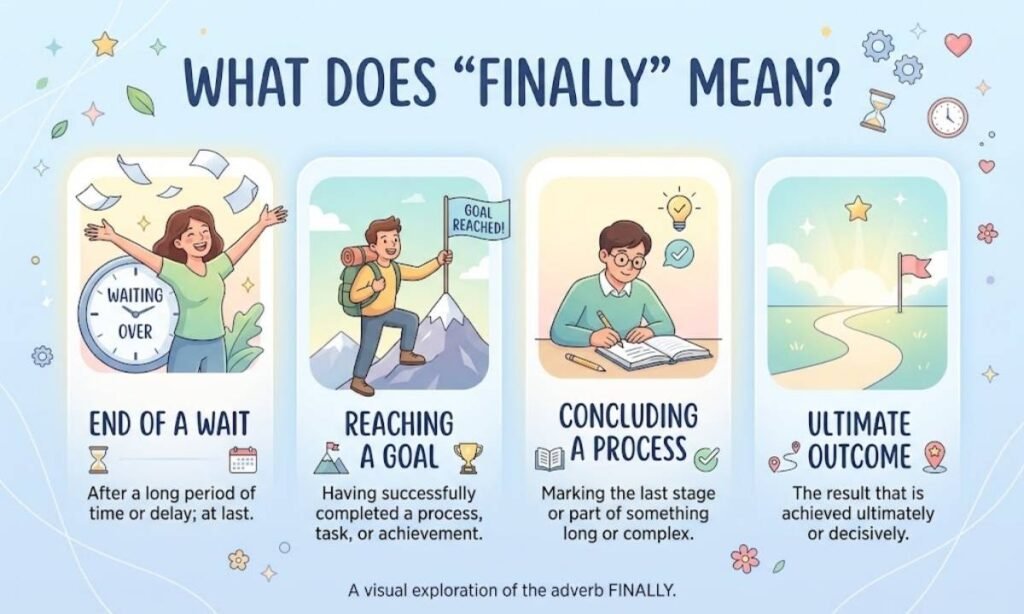
Finally has several closely related meanings. Context tells you which one is intended.
Finally Meaning “At Last”
Use it when something you expected or hoped for happens.
We finally arrived home.
Finally Meaning “After a Long Wait”
It often suggests delay, effort, or a long period of waiting.
She finally received her results.
Finally Meaning “In the End”
It can describe the outcome after discussion or a process.
Finally, the team agreed on a solution.
Finally as the Last Point in a List
In writing and speaking, finally can introduce the last item in a series of points or steps.
Finally, check your work before submitting it.
How to Use “Finally” in a Sentence
Finally can appear in different positions. The spelling never changes, but the position can change the emphasis.
“Finally” at the Beginning of a Sentence
Finally, we can begin.
At the start, finally usually signals the last step or a long-awaited moment, and it is followed by a comma.
“Finally” in the Middle of a Sentence
She finally understood the answer.
This is the most common position. It sits before the main verb and stresses that something happened after a delay.
“Finally” at the End of a Sentence
The problem was solved finally.
This position is possible but less common. It places extra weight on the result.
Finaly vs Finally Example Sentences
Correct Examples With “Finally”
• I finally finished my homework. ✅
• We finally found the missing keys. ✅
• She finally called me back. ✅
• Finally, we reached a decision. ✅
Incorrect Examples With “Finaly”
• ❌ I finaly finished my homework.
• ❌ She finaly arrived.
• ❌ Finaly, we can start.
Correct the Common Spelling Mistake
| Incorrect | Correct |
| I finaly finished my homework. | I finally finished my homework. |
| She finaly arrived. | She finally arrived. |
| Finaly, we can start. | Finally, we can start. |
| He finaly understood. | He finally understood. |
Is “Finaly” Ever Correct?
Is Finaly a Word?
No. “Finaly” is not a word in standard modern English. It is only a misspelling of the adverb finally.
Should You Use “Finaly” in Formal Writing?
No. Always correct it. A single-l “finaly” can make a piece of writing look careless, especially in:
• Essays
• Emails
• Academic writing
• Business writing
• Articles
• Professional communication
Final vs Finally: What Is the Difference?
Final and finally are related, but they do different jobs in a sentence.
“Final” Is an Adjective
An adjective describes a noun. Final means last or concluding.
This is the final decision.
“Finally” Is an Adverb
An adverb describes an action or a whole sentence. Finally tells you when or how something happened.
We finally made a decision.
Final vs Finally Examples
| Word | Part of speech | Example |
| final | Adjective | This is the final exam. |
| finally | Adverb | I finally passed the exam. |
Is “Finally” an Adverb?
What Part of Speech Is Finally?
Finally is an adverb. It is formed from the adjective final plus the suffix -ly.
What Does Finally Modify?
Depending on how it is used, finally can modify:
• A verb: She finally spoke.
• A clause: After months of work, the project finally succeeded.
• A whole sentence: Finally, we should talk about the budget.
How Do You Spell Finally?
Correct Spelling: F-I-N-A-L-L-Y
F-I-N-A-L-L-Y
Finally has seven letters, and the double L sits in the middle.
Common Misspelling: F-I-N-A-L-Y
This version has only six letters. It leaves out one l, and that is the whole mistake.
Finally Pronunciation and Spelling
Why Can “Finally” Be Easy to Misspell?
In everyday speech, the two Ls in finally blend into one smooth sound. Because pronunciation does not make every written letter obvious, it is easy to write only one.
Should You Spell It by Sound?
No. Remember the word structure instead:
final + ly
Finaly vs Finally in American and British English
Is “Finally” Spelled the Same in US and UK English?
Yes. American and British English both spell it finally, with two Ls.
Does “Finaly” Become Correct in British English?
No. The standard spelling remains finally. Unlike words such as color/colour, there is no regional variant here.
Common Mistakes With “Finally”
Using “Finaly” With One L
❌ I finaly understand.
✅ I finally understand.
Confusing “Final” and “Finally”
❌ This is the finally answer.
✅ This is the final answer.
Use final before a noun and finally to describe an action.
Forgetting the Comma After “Finally”
When finally opens a sentence as an introductory word, follow it with a comma.
Finally, we reached an agreement.
Finaly or Finally: Which One Should You Use?
Use “Finally” When You Mean “At Last”
Whenever something happens after waiting or effort, write finally.
Use “Finally” When Introducing the Last Point
To close a list of points or steps, start with Finally, followed by a comma.
Never Use “Finaly” in Standard English
There is no situation in standard English where the one-L spelling is correct.
Quick Quiz: Finaly or Finally?
Choose the Correct Spelling
1. I ___ finished the project.
2. She ___ arrived.
3. ___, we need to review the results.
4. He ___ understood the instructions.
Answers
All four answers: finally.
Frequently Asked Questions
Is “finaly” correct?
No, “finaly” is a misspelling. The correct spelling is finally, with two Ls.
Is “finally” the correct spelling?
Yes. Finally is the only standard spelling of this adverb in modern English.
Does finally have one L or two?
Finally has two Ls: f-i-n-a-l-l-y. The double L comes from final + ly.
Why does finally have two Ls?
It is formed from final + ly. The l in final stays, and the l in -ly is added after it.
What does finally mean?
It means “at last,” “after a long wait,” or “in the end.” It can also introduce the last point in a list.
Is finally an adjective or an adverb?
Finally is an adverb. The adjective form is final.
Can finally start a sentence?
Yes, and it is followed by a comma. For example: Finally, we can begin.
Is finaly a real English word?
No. It is not a real word, only a common misspelling of finally.
What is the difference between final and finally?
Final is an adjective (the final exam). Finally is an adverb (I finally passed the exam).
Is finally spelled the same in American and British English?
Yes. Both use the same spelling, finally, with two Ls.
How can I remember how to spell finally?
Use the formula FINAL + LY = FINALLY. Keep the l in final and add -ly.
Conclusion
Finally is the only correct spelling, and finaly is simply a typo caused by dropping one l. The rule is easy to remember: final + ly = finally. Keep both Ls, use a comma when finally opens a sentence, and do not confuse the adjective final with the adverb finally. With this one formula, you will never misspell it again.