
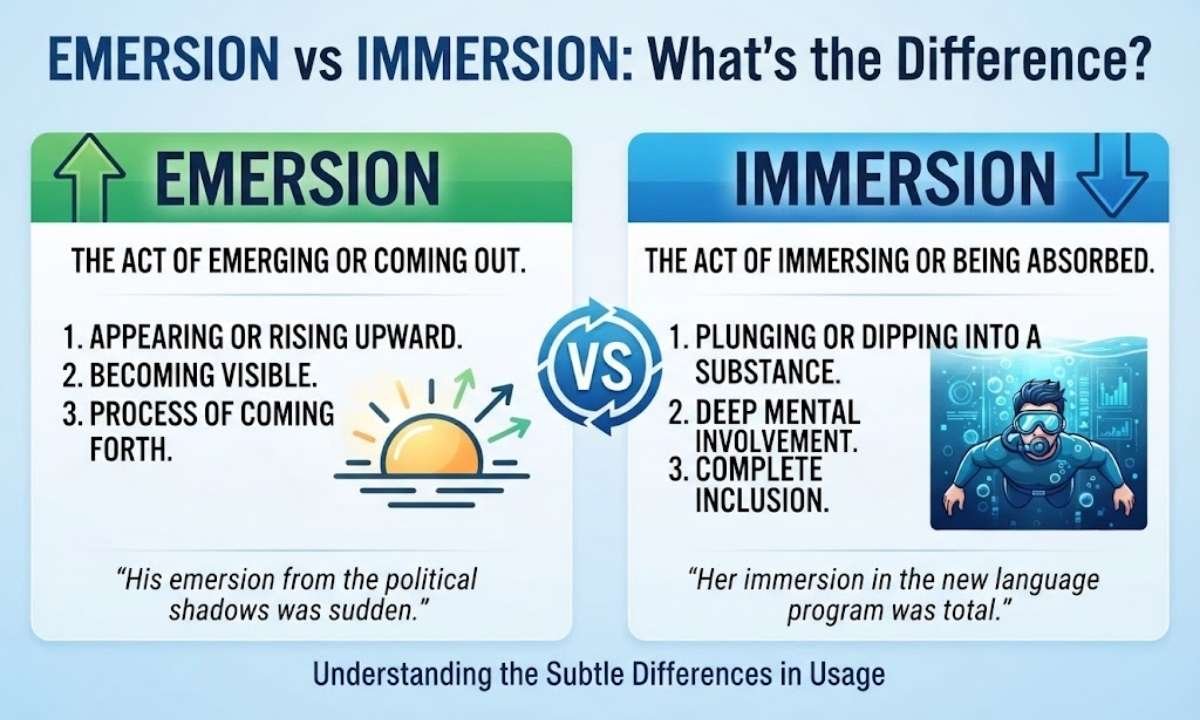
Emersion and immersion look almost identical, but they point in opposite directions. Immersion means going into or being deeply absorbed in something, while emersion means coming out or emerging back into view, most often after being covered or hidden.
Because the words differ by only two letters, they’re frequently confused or assumed to be a typo. This guide compares both words side by side, covers real usage examples, and explains exactly when each one is correct.
Emersion vs Immersion: The Quick Difference
What Does Emersion Mean?
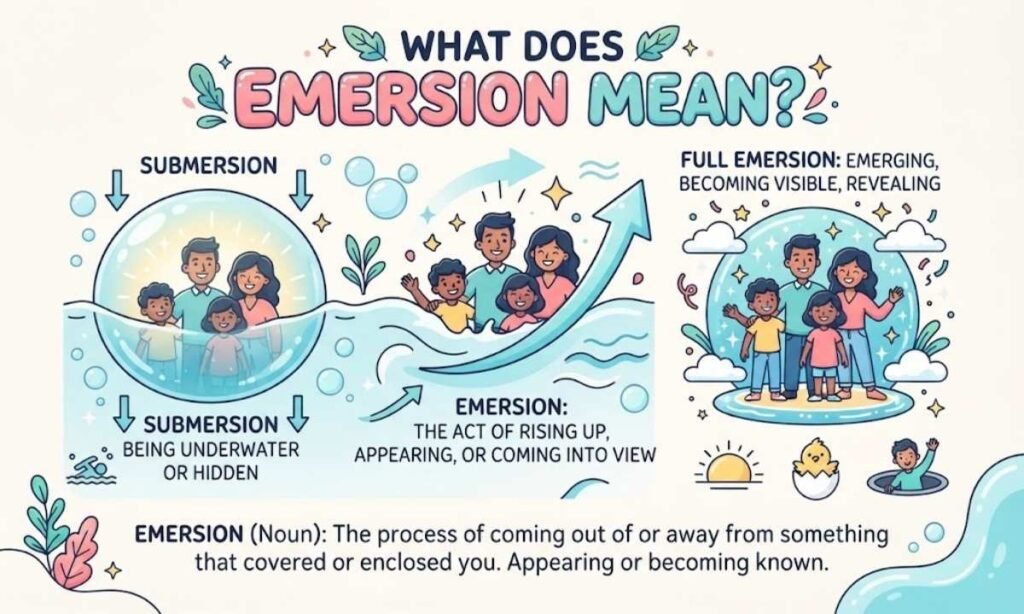
Emersion means the act of emerging or coming out, especially from beneath water or from behind something that was blocking it.
What Does Immersion Mean?
Immersion means entering, being submerged in, or becoming deeply involved in an activity, subject, or environment.
Emersion Means Coming Out, Immersion Means Going In
The simplest way to separate them is direction: immersion goes inward, emersion moves outward and back into view.
Emersion vs Immersion Compared Side by Side
| Feature | Emersion | Immersion |
| Direction | Coming out / emerging | Going in / submerging |
| Common contexts | Astronomy, physical emergence | Water, language, culture, technology |
| Everyday frequency | Rare, mostly technical | Very common in daily language |
| Example | The moon’s emersion from eclipse | Immersion in a new language |
Meaning and Direction
Immersion describes movement or focus going inward, while emersion describes something reappearing or coming back out.
Common Contexts
Immersion appears constantly in language learning, culture, and technology, while emersion is largely limited to astronomy and physical description.
Frequency and Everyday Usage
Immersion is used far more often in everyday writing and speech than emersion, which stays mostly in technical contexts.
Example of Each Word
“She experienced total immersion in Spanish culture” versus “Astronomers timed the star’s emersion from behind the moon.”
What Does Emersion Mean?
Emersion Definition in Plain English
Emersion simply means the act of emerging, rising up, or becoming visible again after being hidden or submerged.
Emersion in Water and Physical Contexts
Physically, emersion can describe an object or person coming up out of water, the opposite of sinking or submerging.
Emersion in Astronomy
In astronomy, emersion specifically refers to the reappearance of a celestial body after an eclipse, occultation, or transit.
Emersion as the Opposite of Immersion
Whenever immersion describes going in, emersion describes the reverse process of coming back out.
What Does Immersion Mean?
Immersion Definition in Plain English
Immersion means being fully submerged in a substance or being deeply engaged and absorbed in an activity or environment.
Physical Immersion in Water
In its most literal sense, immersion describes an object or person being completely covered by water or liquid.
Language Immersion and Education
Language immersion refers to learning a language by being surrounded by it constantly, rather than through occasional lessons.
Cultural and Experiential Immersion
Cultural immersion means engaging so deeply with a place or community that it feels like genuinely living within it.
Immersion in Technology and Gaming
In technology, immersion describes how convincingly a game, film, or virtual environment pulls someone into the experience.
Emersion vs Immersion in a Sentence
Examples Using “Emersion”
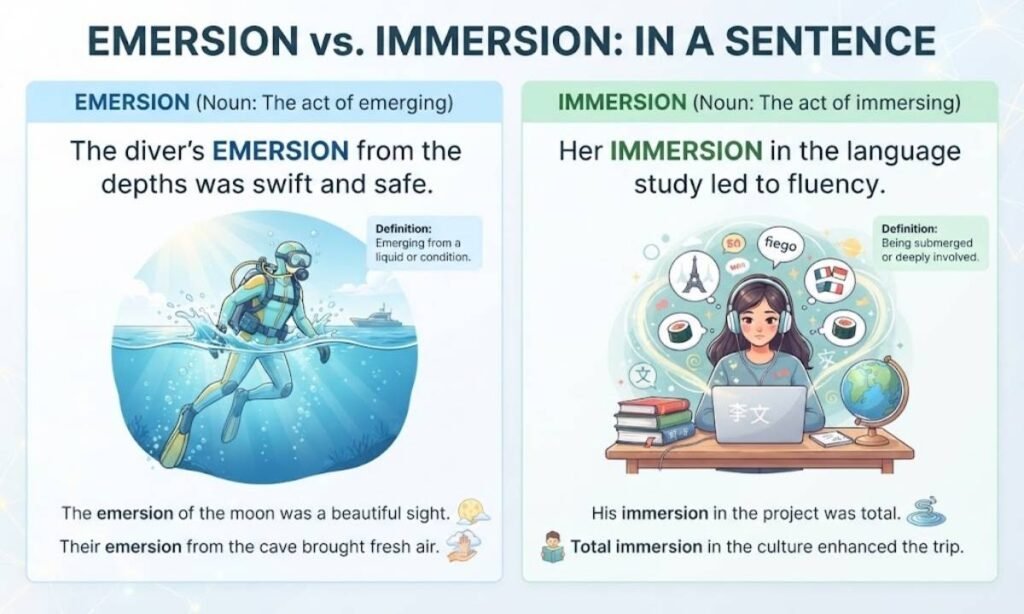
The diver’s emersion from the lake drew applause from the crowd watching nearby.
Examples Using “Immersion”
Full immersion in the project helped the team finish weeks ahead of schedule.
Emersion and Immersion in Everyday Writing
Most everyday writing leans heavily on immersion, since emersion rarely fits outside technical or scientific descriptions.
Formal and Technical Examples
A scientific report might read: “The satellite’s emersion occurred precisely twelve minutes after totality began.”
When Should You Use Emersion?
Use Emersion for Emerging From Water
Choose emersion when describing something physically rising up and out of water or another liquid.
Use Emersion in Astronomy
Emersion is the standard, correct term for describing a celestial body reappearing after an eclipse or transit.
Use Emersion for Something Becoming Visible Again
More broadly, emersion fits any situation where something hidden becomes visible again.
When Should You Use Immersion?
Use Immersion for Submerging Something
Use immersion when describing an object or person being fully covered or submerged in liquid.
Use Immersion for Deep Involvement
Immersion also works whenever someone becomes deeply absorbed or engaged in an activity or subject.
Use Immersion for Language Learning
When describing constant language exposure as a learning method, immersion is the correct and expected term.
Use Immersion for Technology and Experiences
For virtual reality, gaming, and film experiences, immersion describes how convincing and absorbing the experience feels.
Is Emersion a Misspelling of Immersion?
Is “Emersion” a Real Word?
Yes, emersion is a legitimate English word listed in standard dictionaries, not a misspelling of immersion.
Why Does Emersion Look Like a Spelling Mistake?
Because the two words differ by only one letter and share a Latin root, emersion is frequently mistaken for a typo.
Emersion vs Immersion: Which Word Should You Choose?
Choose based on direction: immersion for going in or deep involvement, emersion for coming out or reappearing.
Emersion vs Immersion Pronunciation
How to Pronounce Emersion
Emersion is pronounced ih-MUR-zhun, with stress on the second syllable.
How to Pronounce Immersion
Immersion is pronounced ih-MUR-zhun as well, sounding nearly identical to emersion when spoken.
Why the Two Words Sound So Similar
Both words share the same Latin root “mergere,” meaning to dip or plunge, which explains their nearly identical sound.
Emersion vs Emergence: Are They the Same?
Emersion vs Emergence Meaning
Emergence is broader, describing something coming into existence or becoming known, while emersion is more literal and physical.
When to Use “Emergence” Instead
Use emergence for abstract situations, like new ideas, trends, or issues coming into existence.
Emersion, Emergence, and Immersion Compared
Immersion goes in, emersion physically comes out, and emergence describes something abstract coming into being.
Emersion vs Immersion in American English
Is Emersion Used in American English?
Yes, emersion appears in American English dictionaries, though it remains far less common than immersion in daily use.
Is Immersion More Common in Everyday American English?
Yes, immersion is used constantly in American English, especially around education, technology, and culture.
Are the Spellings Different in British English?
No, both words are spelled the same way in British and American English, since the difference is meaning, not spelling.
Common Emersion and Immersion Mistakes
Using Emersion When You Mean Immersion
The most frequent mistake is typing emersion when the intended meaning was actually immersion.
Assuming Emersion Is a Typo
Many readers wrongly assume emersion is always a spelling error, even though it’s a valid, separate word.
Confusing Emersion With Emergence
Because they sound alike, emersion and emergence are sometimes swapped, even though their meanings differ.
Using Immersion for Something Emerging
Using immersion to describe something coming out or becoming visible again is a reversal of its actual meaning.
Easy Memory Trick for Emersion vs Immersion
Immersion = Into
Both “immersion” and “into” start with the letter I, making it easy to link immersion with going in.
Emersion = Emerging Out
“Emersion” and “emerge” share the same first letters, linking emersion directly to coming out.
Think “In” vs “Out” to Remember the Difference
Whenever you’re unsure, ask whether the word describes something going in or coming out, then pick accordingly.
Related Words You Should Know
Immerse and Immersive
“Immerse” is the verb form, while “immersive” describes an experience that fully absorbs someone’s attention.
Emerge and Emergence
“Emerge” is the verb form of emersion, while “emergence” describes something new coming into existence.
Submersion
Submersion describes being placed completely underwater, closely related to but slightly more literal than immersion.
Reemersion
Reemersion describes emerging again after a second period of being hidden or submerged.
History and Origin of Emersion and Immersion
Latin Roots of Immersion
Immersion comes from the Latin “immergere,” meaning to dip or plunge into something.
Latin Roots of Emersion
Emersion comes from the Latin “emergere,” meaning to rise up or come forth out of something.
How the Words Evolved in English
Both words entered English through scientific and Latin-influenced writing, later expanding into everyday and technical usage.
Emersion and Immersion in Science and Technology
Immersion in Physics and Engineering
In physics and engineering, immersion describes fully submerging materials or components in liquid for testing or cooling.
Emersion in Scientific Observations
In scientific observation, emersion marks the precise moment an object becomes visible again after being obscured.
Immersive Technology Today
Modern immersive technology, including virtual reality, relies on the same core meaning of being fully absorbed in an environment.
Synonyms for Emersion and Immersion
Words Similar to Immersion
Close synonyms for immersion include submersion, absorption, engagement, and involvement.
Words Similar to Emersion
Close synonyms for emersion include emergence, reappearance, and resurfacing.
| Word | Closest To | Typical Use |
| Submersion | Immersion | Being fully underwater |
| Absorption | Immersion | Deep mental engagement |
| Reappearance | Emersion | Becoming visible again |
| Resurfacing | Emersion | Coming back up or into view |
How Dictionaries Define Emersion and Immersion?
Standard Dictionary Definitions
Major dictionaries define immersion as submersion or deep involvement, and emersion as the act of emerging or coming into view.
Why Dictionaries Still List Emersion
Emersion remains listed because it serves a specific, still-used purpose in astronomy and formal physical description.
What This Confirms About Correct Usage
Dictionary support confirms emersion is a legitimate, separate word rather than an error or variant spelling.
Quick Reference Cheat Sheet for Emersion vs Immersion
• Immersion = going in, being submerged, or deeply involved
• Emersion = coming out, reappearing, or becoming visible again
• Immersion is common in everyday language; emersion is mostly technical
• Both share the Latin root “mergere,” meaning to dip or plunge
• When unsure, ask: is this going in, or coming out?
Frequently Asked Questions
Is emersion the opposite of immersion?
Yes, emersion describes coming out while immersion describes going in.
Is emersion a correct English word?
Yes, it’s a valid dictionary word, not a misspelling.
Which is correct, emersion or immersion?
Both are correct; the right choice depends on the intended direction or meaning.
What is the difference between emersion and emergence?
Emersion is physical and literal, while emergence is broader and often abstract.
What does immersion mean in simple words?
It means being fully submerged in something or deeply focused on an activity.
What does emersion mean in astronomy?
It refers to a celestial body reappearing after an eclipse, transit, or occultation.
Can emersion and immersion be used interchangeably?
No, they describe opposite directions and shouldn’t be swapped.
How do you remember emersion vs immersion?
Link immersion with “into” and emersion with “emerge” to recall the direction each word describes.
Conclusion
Use immersion when something goes into or becomes deeply involved in something. Use emersion when something emerges or comes out, especially in technical or astronomical contexts.