
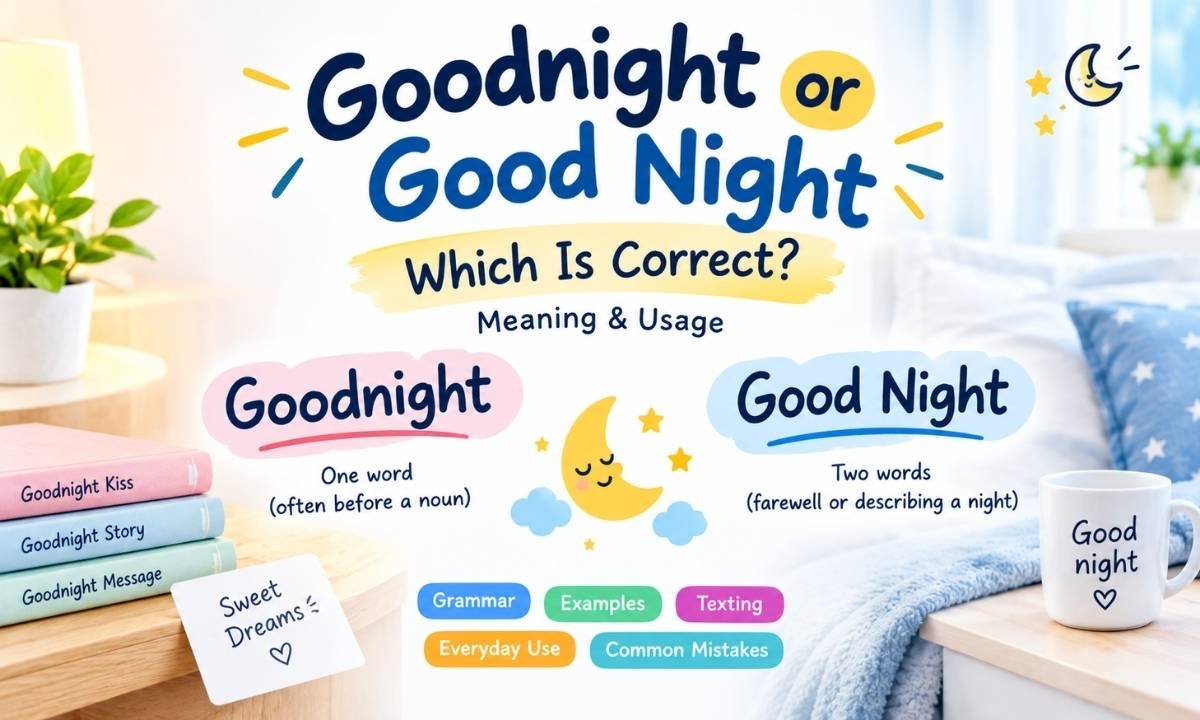
Typing out a simple farewell should not feel confusing, yet “goodnight” and “good night” trip up more writers than almost any other everyday phrase. Both spellings look normal, both sound identical out loud, and both show up constantly in texts, books, and emails, which is exactly why so many people pause before hitting send.
The short answer is that both forms are correct, but they are not always interchangeable. Good night works as the traditional farewell before bed, while goodnight often functions as a single word before a noun. This guide breaks down the real difference with clear examples, so you never have to guess again.
Goodnight or Good Night: Which One Is Correct
Both spellings are accepted in modern English, so neither one is simply wrong. Good night is the older, open compound form, similar in structure to good morning and good afternoon. It works as an interjection when you are saying farewell at the end of the evening.
Goodnight, written as one word, developed later and is now common as a modifier before a noun or as a standalone casual greeting in texting. The safest rule for formal writing is to use the two word version, while the closed form fits naturally into relaxed, everyday messages.
What Does Good Night Mean?
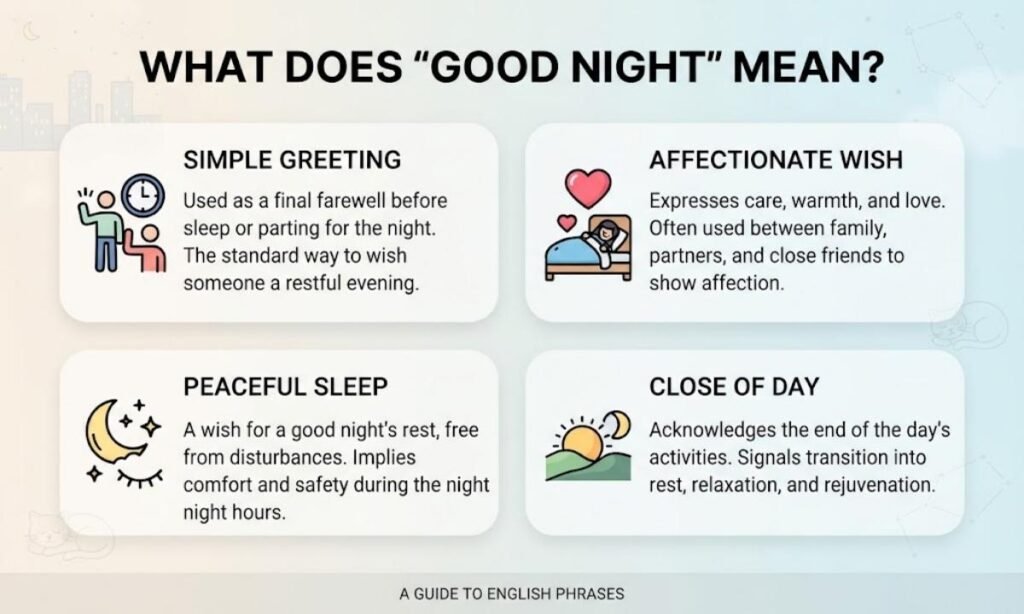
Good night is most often used as a farewell, the same way people say goodbye at the end of a visit or a phone call. It signals that the conversation or the day is wrapping up and that the person is heading off to sleep.
It can also describe the night itself as a noun phrase, referring to a pleasant or eventful evening rather than a farewell at all.
- Good night, see you tomorrow
- We had a good night at the concert
- I said good night and turned off the lights
What Does Goodnight Mean?
Goodnight, spelled as a single word, usually appears right before a noun, turning it into a descriptive term rather than a farewell on its own. It also shows up frequently as an informal way to say bye in texts and social messages.
- She gave him a goodnight kiss
- He read a goodnight story to his daughter
- I sent a quick goodnight message before bed
Goodnight vs Good Night: The Key Difference
The clearest way to separate the two comes down to what role the phrase plays in a sentence.
| Form | Typical Role | Example |
| Good night | Farewell or description of a night | Good night, sleep well |
| Goodnight | Modifier before a noun, or casual text farewell | Goodnight kiss |
When the phrase stands alone as a goodbye, good night is the traditional and generally preferred choice. When it directly modifies a word that follows it, goodnight as one word reads more naturally.
When Should You Use Good Night?
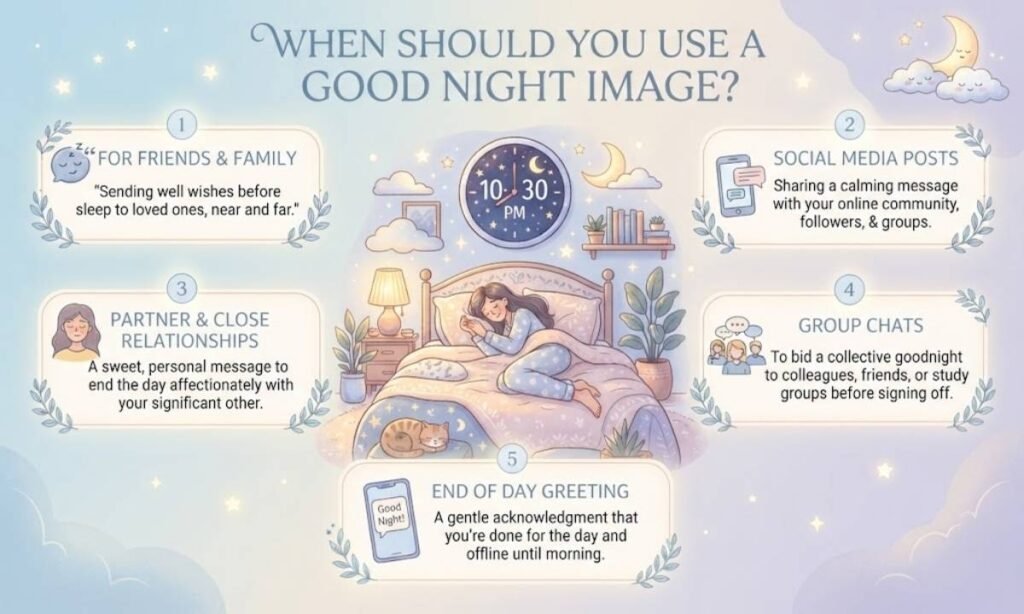
Reach for the two word spelling in situations where you are formally saying farewell or referring to the night as a noun.
- Ending a phone call with a family member
- Saying goodbye to guests as they leave an evening event
- Wishing someone well before they go to sleep
- Describing how an evening went, such as “a good night out”
When Should You Use Goodnight?
The single word form fits naturally in casual writing and whenever the phrase is followed directly by a noun.
- Texting a quick goodnight to a friend
- Writing “goodnight kiss,” “goodnight story,” or “goodnight hug”
- Ending a late night chat with something short and informal
- Captioning a photo taken right before bed
Goodnight or Good Night in Text Messages
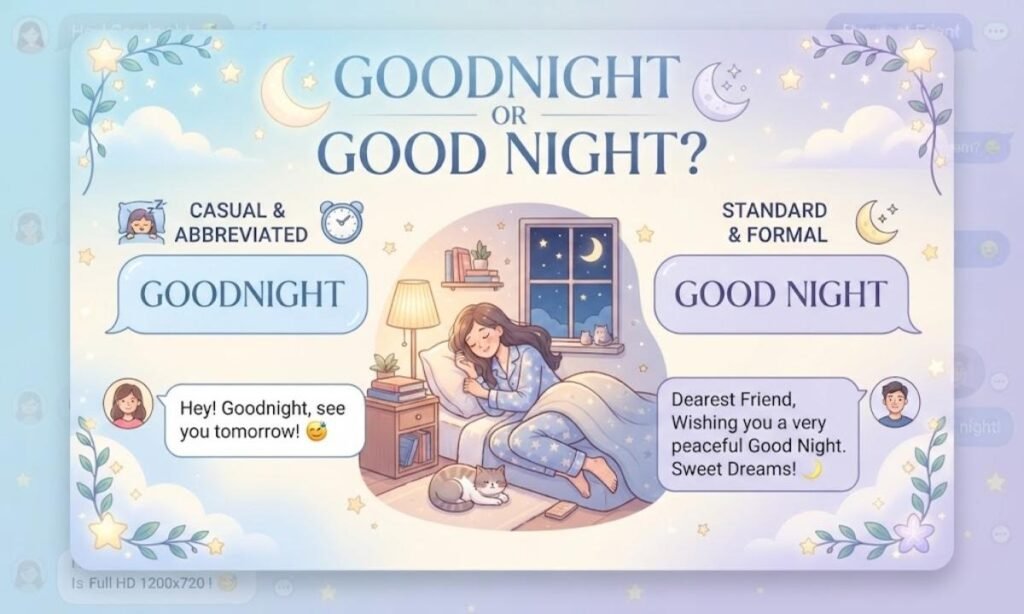
Texting sits in a gray area because the setting is informal by nature. Many people default to the single word goodnight simply because it feels quicker to type and matches the relaxed tone of a text thread.
That said, good night with a space is never wrong in a message, and it often looks slightly more polished. Neither version will confuse the reader, so personal style and habit usually decide which one gets used more in daily conversations.
Good Night’s Sleep or Goodnight Sleep
This is one of the most searched variations of the phrase, and it has a clear answer. The correct expression is “a good night’s sleep,” written as two words with an apostrophe before the s, since it describes sleep belonging to the night.
“Goodnight sleep” without the apostrophe is considered incorrect in standard English, so this is one case where only one version holds up in formal writing.
Goodnight or Good Night: Common Mistakes
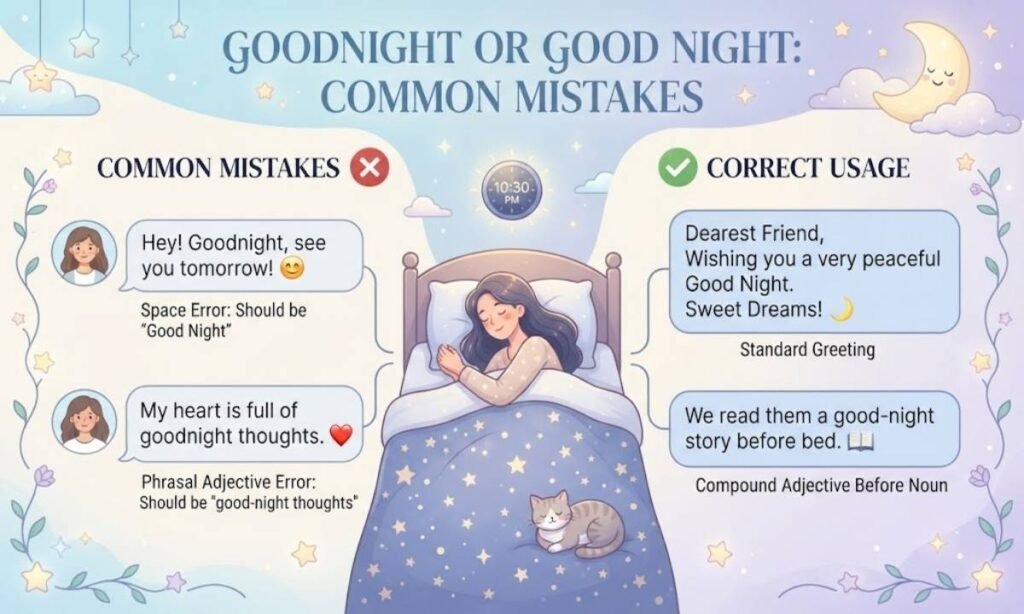
A few patterns account for most of the confusion people run into with this phrase.
- Writing goodnight when describing an enjoyable evening instead of good night
- Adding a space before a noun, such as “good night kiss” instead of goodnight kiss
- Assuming one spelling is always wrong rather than context dependent
- Mixing up good night with good evening, which serves as a greeting rather than a farewell
Good Evening vs Good Night: What Is the Difference
Good evening works as a greeting used when arriving somewhere or starting a conversation after the sun goes down. Good night, on the other hand, is almost always used to end a conversation or say farewell before sleep.
Saying good night to someone as you arrive at their home would sound out of place, since it signals an ending rather than a beginning.
Good Night in Literature and Classic English Writing
Long before texting existed, good night appeared as the standard closing line in plays, letters, and novels. Classic literature consistently favored the two word spelling, treating it as a formal expression of farewell rather than a casual sign off.
This historical pattern is part of why style guides and dictionaries still list good night as the traditional form, even though goodnight has become widely accepted in modern, informal writing.
How Autocorrect Affects Good Night and Goodnight Spelling
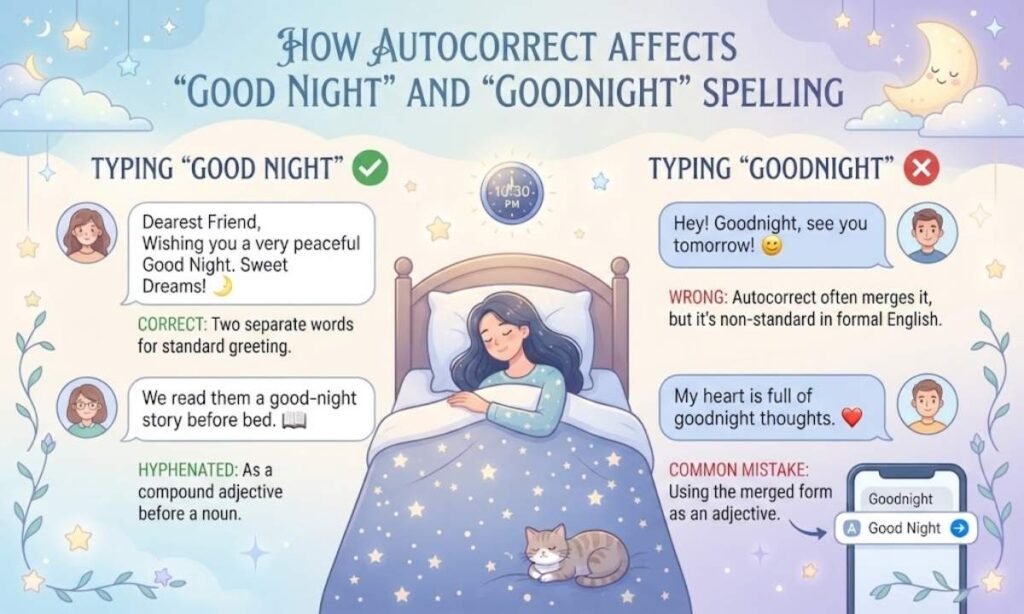
Phone keyboards do not always agree on which spelling to suggest, and autocorrect settings can quietly change one version into the other while typing quickly. This is part of why both forms appear so often across texts and social media, regardless of which one a person originally intended to type.
Turning off aggressive autocorrect or checking a message before sending helps keep the intended spelling consistent, especially in professional messages where formatting matters more.
Good Night in Formal Emails and Business Writing
In professional communication, the two word spelling is the safer and more widely accepted option. Business emails, official letters, and formal documents almost always favor good night over the closed compound form.
Ending a late evening email with “good night” reads as polished and standard, while “goodnight” can come across as slightly too casual for a workplace setting.
Cultural Differences in Saying Good Night Around the World
English speakers in different regions largely agree on when to use good night, but the surrounding habits vary. In many cultures, saying good night is accompanied by a specific gesture or phrase, such as wishing someone sweet dreams or a peaceful rest, reflecting how central this farewell is across everyday communication worldwide.
Despite these small cultural touches, the core spelling rules stay consistent across American, British, and other English speaking regions.
Common Search Confusion: Good Nite, Gud Night, and Other Misspellings
Casual texting has produced several shorthand versions that are not considered correct spellings, even though they appear frequently online. Forms like “good nite,” “gud night,” and “goodnite” are informal shortcuts rather than accepted alternatives.
These variations are fine between close friends in quick texts, but they should be avoided in any writing meant to look polished or professional.
Other Ways to Say Good Night
If the phrase starts to feel repetitive, several natural alternatives carry the same meaning.
- Sleep well
- Sweet dreams
- Sleep tight
- Have a good night
- Talk tomorrow
- Night
Quick Comparison: Goodnight vs Good Night
| Question | Answer |
| Which is used as a farewell | Good night, or goodnight informally |
| Which describes the night itself | Good night |
| Which comes before a noun like kiss | Goodnight |
| Which pairs with sleep and an apostrophe | Good night’s sleep |
| Is goodnight a real word | Yes |
| Is good night correct | Yes |
| Are they pronounced differently | No |
Frequently Asked Questions
Is it goodnight or good night?
Both are correct. Good night is the traditional farewell, while goodnight often works as a modifier before a noun.
Is goodnight one word?
Yes, goodnight can be written as one word, especially before a noun or in casual texting.
Is good night two words?
Yes, good night as two words is the traditional spelling used as a farewell or to describe a night.
Can I say goodnight in a text?
Yes, goodnight is completely acceptable and common in casual text messages.
Is goodnight kiss one word?
Yes, goodnight kiss is written as one word since goodnight acts as a modifier here.
Is good night’s sleep correct?
Yes, “a good night’s sleep” with an apostrophe is the correct standard expression.
What is the difference between good evening and good night?
Good evening is a greeting used when arriving, while good night is a farewell used when leaving or going to sleep.
Conclusion
Both goodnight and good night are grammatically valid, and the right choice simply depends on how the phrase is being used.
Save the two word spelling for formal farewells and descriptions of a night, and reach for the closed compound when it sits directly before a noun or in a quick, casual text. With that rule in mind, spelling this everyday phrase correctly becomes second nature.