
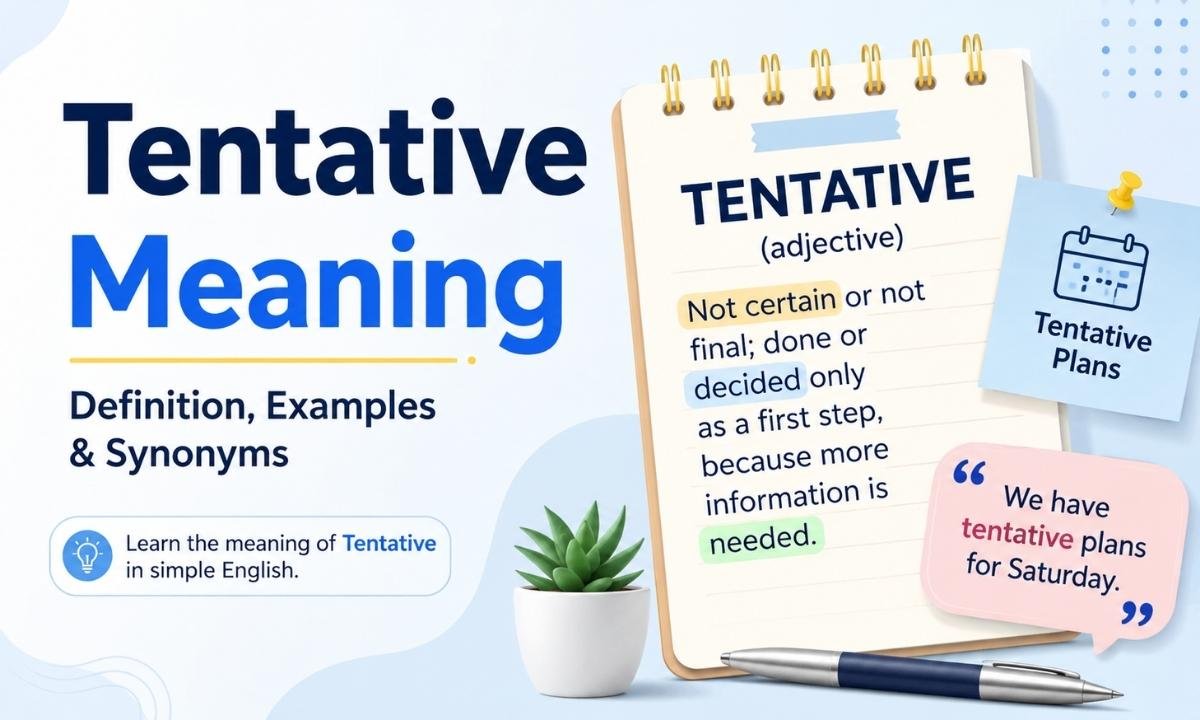
Tentative is a word people hear often at work, in school, and in daily conversations, yet many still wonder what it truly means. In simple terms, tentative describes something that is not final, not certain, or still open to change.
This guide breaks down the tentative meaning in plain English, shows how the word is used in real sentences, and explains related terms like tentatively and tentativeness so you never feel unsure about it again.
What Does Tentative Mean?
Tentative is an adjective that describes a plan, decision, agreement, or action that is not yet fixed, confirmed, or final. It is often used as a first step that may still be changed once more information becomes available.
The word can also describe a person’s manner. When someone acts tentative, they behave in a hesitant, cautious, or unsure way, often because they lack confidence or are testing the situation before committing fully.
Tentative Meaning in Simple English
In everyday language, tentative simply means unsure or provisional. If a plan is tentative, treat it as a draft rather than a done deal, since it can still shift based on new details or feedback.
Tentative Pronunciation and Part of Speech
Tentative is pronounced ten-tuh-tiv and functions as an adjective. Its related forms include the adverb tentatively and the noun tentativeness, both of which describe degrees of uncertainty or caution.
Tentative Meaning in a Sentence
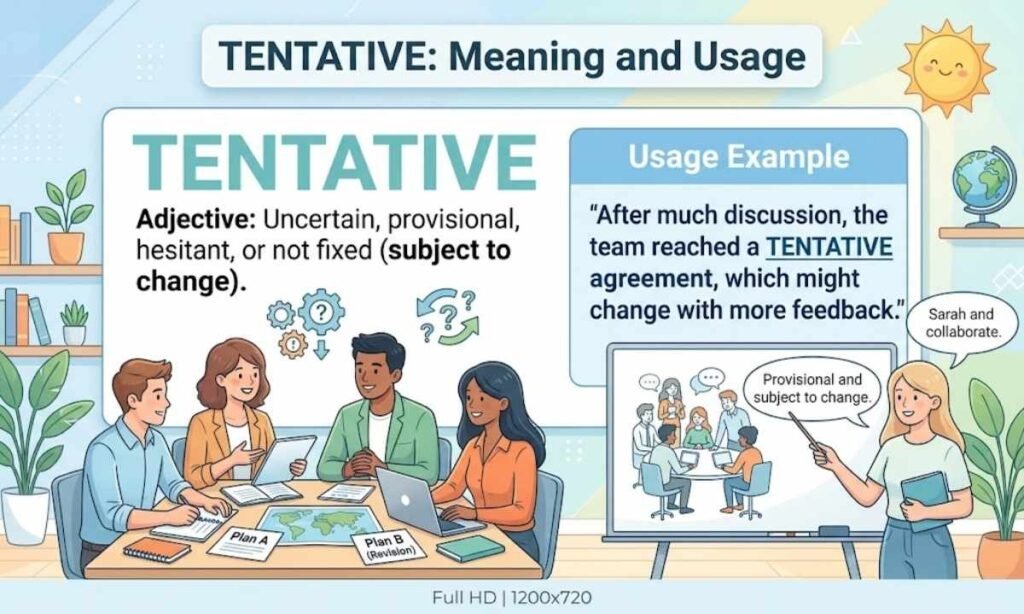
Seeing the word in context makes the meaning much clearer. Below are common ways tentative appears in real writing and speech.
Everyday Examples of Tentative
- We have tentative plans for Saturday evening.
- She gave a tentative smile before answering.
- His tentative steps showed he was still healing.
- They reached a tentative decision about the venue.
Tentative in School and Work
Students and employees often use tentative when a schedule, grade, or project timeline is not locked in. A tentative deadline, for instance, signals that the date may still move depending on approvals or workload.
Tentative in Conversations and Messages
In casual chats, people say things like “let’s keep it tentative” to mean the plan is flexible. This usage is common in texts and emails when both sides want to leave room for changes.
What Does Tentative Mean in Plans and Agreements?
This is one of the most searched uses of the word, especially in business, travel, and legal contexts.
Tentative Plans Meaning
Tentative plans are arrangements that have been discussed but not fully confirmed. They act as a placeholder until both parties agree on final details such as time, location, or availability.
Tentative Date Meaning
A tentative date is a proposed date that is likely but not guaranteed. It is commonly used for events, meetings, or bookings that depend on confirmation from another party.
Tentative Agreement Meaning
A tentative agreement means both sides have reached a preliminary understanding, but the terms still need formal approval, signatures, or further negotiation before becoming binding.
Tentative Job Offer Meaning
A tentative job offer is an offer of employment that depends on conditions being met, such as a background check, reference verification, or drug screening, before it becomes official.
What Does Tentative Mean When Describing a Person?
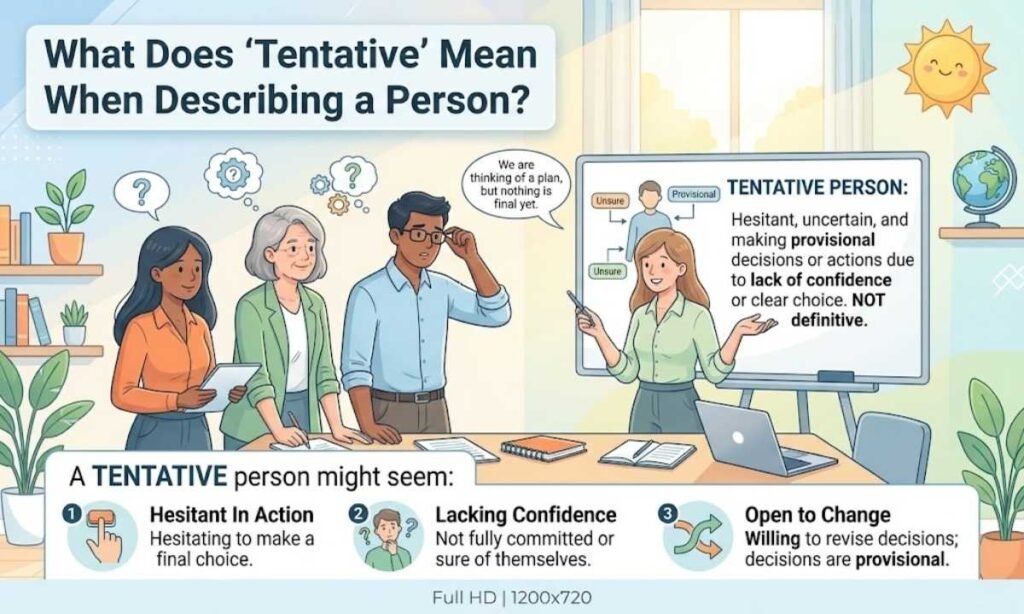
Beyond plans, tentative also describes human behavior, especially in unfamiliar or uncertain situations.
Tentative Behavior and Body Language
A tentative person often shows hesitant gestures, avoids direct eye contact, or speaks softly. This behavior reflects inner doubt, nervousness, or a cautious approach to a new experience.
Tentative Answer vs. Confident Answer
A tentative answer is offered with visible uncertainty, often using phrases like “I think” or “maybe.” A confident answer, by contrast, is stated directly without hedging or hesitation.
Origin and History of the Word Tentative
Tentative comes from the Medieval Latin word tentativus, related to the Latin verb tentare, meaning to test or try. This root explains why the word still carries a sense of trial, experiment, or attempt today, whether describing a plan or a person’s cautious action.
How to Pronounce and Spell Tentative Correctly?
Many learners misspell tentative as “tentetive” or “tentitive.” The correct spelling always follows t-e-n-t-a-t-i-v-e, and the stress falls on the first syllable: TEN-tuh-tiv. Practicing the word aloud in sample sentences helps lock in both spelling and pronunciation.
Tentative Synonyms and Antonyms
Knowing similar and opposite words helps you use tentative more naturally in writing and conversation.
| Category | Words |
| Synonyms | provisional, conditional, uncertain, hesitant, preliminary, indefinite |
| Antonyms | definite, confirmed, final, certain, decisive, fixed |
Common Synonyms for Tentative
Words such as provisional, conditional, and preliminary share the same core idea of something not yet final. Each carries a slightly different shade of meaning depending on context, whether it relates to timing, agreement, or attitude.
Tentative vs. Definite
Tentative implies uncertainty and openness to change, while definite means something is fixed, decided, and unlikely to shift. A tentative meeting time may move, but a definite meeting time will not.
Tentative vs. Temporary
Temporary refers to something limited in duration, while tentative refers to something not yet confirmed. A temporary job has a set end date; a tentative job offer simply awaits final approval.
Tentative in Business and Legal Documents
In contracts and corporate communication, tentative often appears alongside words like pending, subject to approval, or draft. Businesses use it to protect themselves, showing that a term or figure is not yet binding until every condition is satisfied and documented in writing.
Tentative vs. Tentatively vs. Tentativeness
These three related forms serve different grammatical roles but share the same core meaning of uncertainty.
How to Use Tentatively in a Sentence
Tentatively is the adverb form, used to describe how an action is performed. For example: “The meeting is tentatively scheduled for Monday,” meaning the schedule is likely but still unconfirmed.
What Does Tentativeness Mean?
Tentativeness is the noun form, referring to the quality or state of being hesitant, cautious, or uncertain. It often describes a person’s overall demeanor rather than a single action.
Common Mistakes When Using Tentative
- Using tentative when something is already fully confirmed
- Confusing tentative with temporary, which refers to duration, not certainty
- Forgetting that tentative can describe both plans and personal behavior
- Overusing the word in formal writing instead of varying it with synonyms like preliminary or provisional
Quick Reference: Tentative at a Glance
| Phrase | Simple Meaning |
| Tentative plans | Plans that may still change |
| Tentative date | A proposed date, not yet final |
| Tentative agreement | An understanding pending confirmation |
| Tentative answer | An uncertain or hesitant response |
| Tentative smile | A cautious, unsure smile |
Common Questions About Tentative
Does Tentative Mean Yes or No?
Tentative means neither a firm yes nor no. It signals a leaning toward agreement while leaving room for change before anything is locked in.
Does Tentative Mean Confirmed?
No, tentative is the opposite of confirmed. It describes something still pending final approval, so treat it as likely rather than guaranteed.
Frequently Asked Questions
What does tentative mean in simple words?
Tentative means not final or certain, often used for plans, dates, or answers that may still change.
Is a tentative date guaranteed?
No, a tentative date is proposed but not confirmed and can still be adjusted later.
What is the opposite of tentative?
The opposite of tentative is definite, meaning something fixed, confirmed, and unlikely to change.
Can tentative describe a person’s behavior?
Yes, a tentative person acts hesitant, cautious, or unsure, especially in new or uncertain situations.
What is a tentative agreement?
A tentative agreement is a preliminary understanding between parties that still needs formal confirmation or approval.
How do you use tentatively in a sentence?
Use tentatively to describe how something is done cautiously, such as “She tentatively agreed to the new schedule.”
Does tentative mean temporary?
No, tentative means uncertain or unconfirmed, while temporary refers to something limited in duration.
Conclusion
Understanding the tentative meaning helps you communicate more clearly at work, in school, and in daily conversations. Whether describing a plan, a date, an agreement, or a person’s cautious behavior, the word always points to something uncertain and open to change.
Once you recognize how tentative differs from definite and temporary, using it correctly in sentences becomes second nature, making your English sound more precise and confident.